Traffic can be strong, the site can look polished, prices can be competitive, and sales can still stall.
That disconnect frustrates many businesses because the usual explanation feels too simple. If people are visiting, clicking, and even reaching product or service pages, then low conversion should mean something is broken. Yet many times, nothing is technically wrong.
What stops the sale is often not a visible flaw. It is a missing layer in the buying decision.
Most teams focus on the parts they can easily measure: design, page speed, offers, checkout flow, discount strategy. Those matter. Still, they do not explain every abandoned cart, every silent exit, or every high-intent visitor who leaves without acting. The deeper causes tend to live in the buyer’s mind during the final stretch of decision-making.
Table of Contents
Why website traffic does not automatically become online revenue
A website can attract attention without creating enough certainty to earn action. That distinction matters more than many businesses expect.
A visitor may be interested, qualified, and even ready to buy soon. Yet in the last few moments, they may feel a small amount of doubt, friction, or confusion. That small hesitation is enough to delay the decision. Online, delay often becomes abandonment.
The core issue is this: people rarely buy because information exists. They buy when they feel confident enough to move forward.
Visible website issues vs hidden buying barriers
The common conversion checklist usually targets visible issues. Those fixes can improve performance, but they often miss the real reason a person pauses.
| What businesses usually optimize | What the customer is actually feeling | Result |
|---|---|---|
| Better design | “This looks nice, but can I trust it right now?” | Browsing without buying |
| Faster pages | “I still have one question before I commit.” | Exit before checkout |
| Lower pricing | “Why is it cheaper? Am I missing something?” | Value concern |
| More discounts | “Maybe I should wait for a better deal.” | Delayed purchase |
| Smoother UX | “I can use the site, but I’m not sure this is the right choice.” | Hesitation remains |
| More email follow-up | “I needed help when I was deciding, not later.” | Lost momentum |
This gap becomes even more serious when the purchase carries more weight. A high-ticket offer, a service with moving parts, a premium experience, or a product that needs explanation all ask for a higher level of trust.
When the risk feels higher, the buyer wants more than a clean interface. They want reassurance.
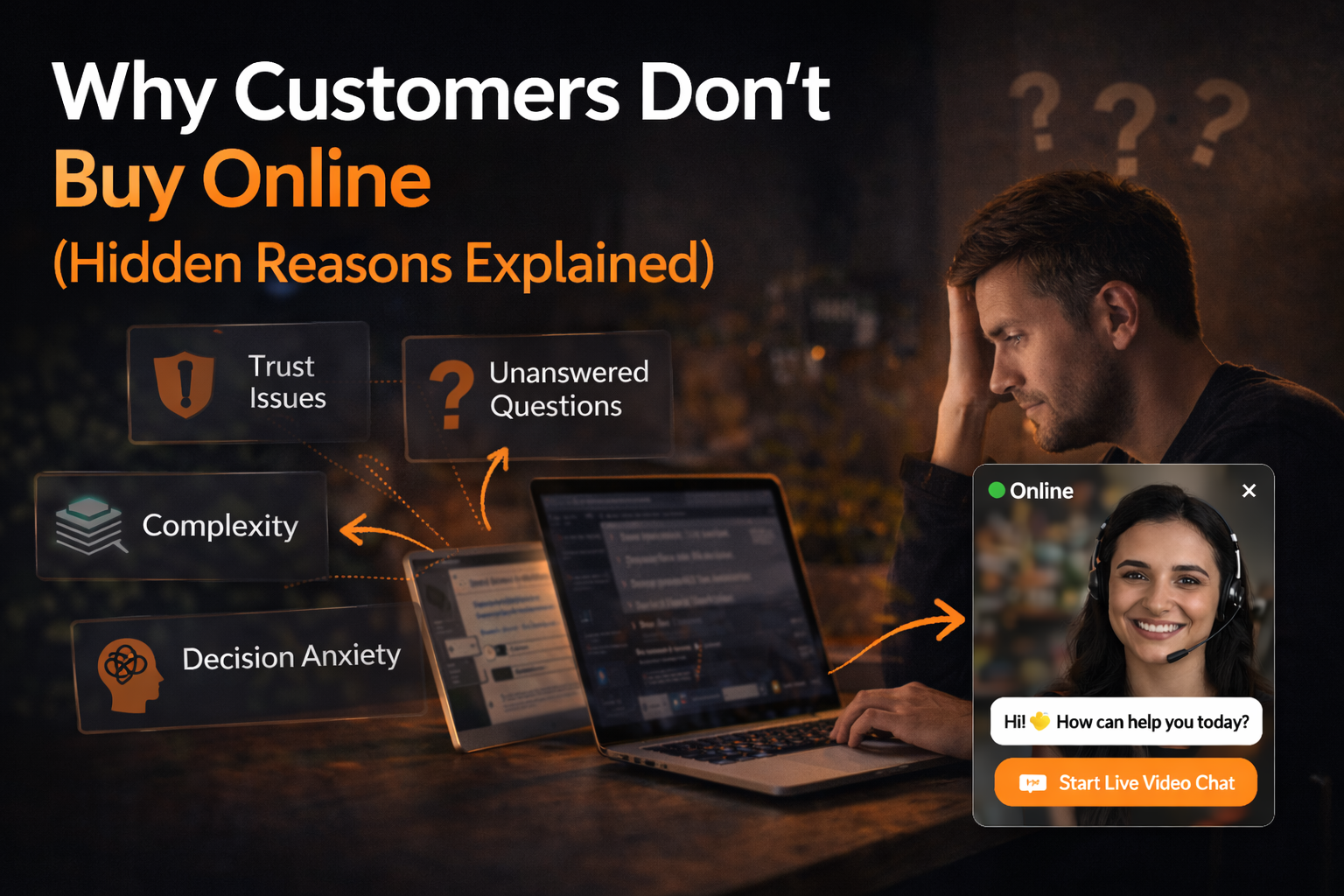
Lack of trust at the final buying moment
Trust is not a fixed condition that appears once a visitor lands on a site. It rises and falls throughout the buying process. Many businesses build general trust fairly well through branding, reviews, and professional design. The hidden problem happens later.
At the moment of commitment, a customer may suddenly ask themselves quiet but powerful questions: Will this work for me? What happens if I choose wrong? Can I reach someone if there is a problem? Is this company actually present, or just polished?
That last-minute trust gap can appear even on strong websites. It is not always about fraud concerns or poor reputation. Often it is about emotional certainty. People want to feel that there is a real business, with real people, standing behind the offer.
This is why conversion can remain low even when traffic quality is good. Interest gets people to the page. Trust closes the distance between interest and action.
Unanswered questions reduce online conversions faster than most teams expect
Some visitors do not leave because they dislike the offer. They leave because one unresolved question blocks the purchase.
That question may seem minor from the business side. From the customer side, it may be decisive.
A buyer might wonder whether one package is better than another, whether delivery timing fits their needs, whether the service includes setup, whether a return process is easy, or whether a premium option is truly worth the extra cost. If the answer is not obvious, they often avoid committing.
Common pre-purchase questions that stop sales include:
- Choosing the right option
- Clarifying what is included
- Confirming timing or delivery
- Checking fit, compatibility, or scope
- Asking what happens after purchase
The striking part is that these visitors are not casual browsers. Many are close to buying. They are comparing, validating, and trying to reduce risk before they act.
If that clarity does not arrive in time, they leave to think about it. Or they open a competitor’s site.
Fear of making the wrong decision keeps high-intent buyers stuck
Online buying compresses decision-making into a private, silent experience. There is no salesperson reading hesitation, no receptionist noticing uncertainty, and no advisor stepping in with a calm answer. The customer is left alone with the burden of choice.
That burden becomes heavier in a few situations:
- High-ticket purchases: the financial risk feels significant
- Complex products: the buyer is not fully sure what they need
- Services that require explanation: the offer is hard to judge from a page alone
- Premium experiences: expectations are higher, so mistakes feel costlier
In each case, the customer is not only evaluating the product. They are evaluating the risk of regret.
That is why conversion barriers are often psychological before they are technical. A person may like the brand, accept the price, and still freeze because the cost of a wrong choice feels too high.
Commitment hesitation often appears right before checkout
Many businesses misread checkout abandonment as a payment issue or a pricing problem. Sometimes it is. Often, it is something more subtle.
Checkout is the point where browsing turns into commitment. Up to that moment, the customer stays in a low-risk mode. Once payment or contact submission begins, the decision becomes real. That shift can trigger second thoughts.
A visitor may start checkout and then pause because they suddenly want reassurance about support, cancellation terms, product fit, next steps, or delivery expectations. If no human response is available in that moment, hesitation grows.
This is why a technically smooth checkout does not always convert well. Ease of use is not the same as confidence.
Why discounts, UX fixes, and chatbots fail to solve the real problem
Many businesses respond to low conversion with the usual toolkit: lower prices, improve design, refine the funnel, add automation, send abandoned-cart emails.
Those changes can help. They just do not solve every type of hesitation.
Traditional fixes often miss the decision gap for a simple reason:
- Discounts: they can increase urgency, but they may also reduce perceived value
- UX improvements: they make the path cleaner, but they do not answer emotional uncertainty
- Chatbots: they handle simple requests well, but nuanced questions often need human judgment
- Email follow-up: it reaches people after the decisive moment has already passed
The timing is the issue. Buyers often need reassurance while they are still on the page, comparing, hesitating, or hovering over the next step. Once they leave, intent cools quickly.
A business can optimize the funnel and still leave the most human part of the sale unattended.
The biggest online buying gap is the absence of real-time human interaction
This is the missing piece many conversion strategies ignore.
When a buyer reaches a moment of uncertainty, they do not always need more content, more copy, or another pop-up. They often need a person. Someone who can listen, answer, reassure, and help them decide without forcing the sale.
That real-time human interaction changes the buying experience in a way that static pages cannot. It turns a silent decision into a supported one.
This is especially valuable when the visitor is already high-intent. They are not asking to be marketed to. They are asking, directly or indirectly, to feel safe moving forward.
How Live Reception supports sales at the exact moment trust is needed
Live Reception meets the customer where hesitation happens. Instead of letting uncertainty sit unanswered, it gives visitors direct access to a real human conversation during the decision moment.
That matters because reassurance is most effective when it is immediate. A clear answer delivered at the right time can remove friction that no amount of design polish can fix.
Live Reception can help in ways static website elements cannot:
- Instant clarification: questions get answered before the visitor leaves
- Human reassurance: trust rises when the buyer knows someone is present
- Decision support: visitors get help choosing the right option
- Reduced hesitation: commitment feels safer when uncertainty is addressed
- Higher conversion intent: warm traffic gets support before interest fades
This is not just about customer service. It functions as a conversion mechanism.
When a visitor is comparing two offers, unsure which package fits, or hesitating before checkout, a real conversation can close the gap between interest and action.
Real examples of hidden friction during online buying
These situations happen every day, often without being seen in analytics.
A visitor browses several product pages and keeps returning to one category. They are interested but unsure which version suits their needs. The site has plenty of details, yet the buyer still wants someone to say, “Based on what you need, this is the right choice.”
Another visitor compares similar services across multiple websites. Pricing is close. Features look comparable. What tips the decision is not a lower fee. It is the feeling that one company is more responsive, more present, and easier to trust.
Another reaches checkout, pauses, and wonders what support looks like after payment. No answer is available in real time, so they abandon the process.
Another reads a premium offer but cannot fully grasp how the service works. The offer is strong, but the explanation does not remove enough uncertainty. The visitor leaves, not because the service lacks value, but because the value is not clear enough to justify commitment.
These are not technical failures.
They are decision failures caused by missing interaction.
Why human reassurance matters more for premium and complex offers
The more expensive or nuanced the offer, the more confidence the customer needs.
A low-cost impulse purchase can survive a small amount of doubt. A premium service cannot. When a purchase involves reputation, business outcomes, personal preference, or a large financial decision, buyers need more than features and benefits. They need evidence that the business will support them before and after the sale.
That is why high-intent conversion work often has less to do with squeezing friction out of the page and more to do with adding confidence into the moment.
A human conversation does exactly that. It helps the customer feel informed, seen, and supported.
It also protects perceived value. Cutting price to force action may win some sales, but it can also weaken brand position. Reassurance keeps value intact while making action feel safer.
How Live Reception connects to lead generation, sales, and customer support
When traffic is coming in but purchases stay low, the issue does not sit in one department. It touches acquisition, sales, and support at the same time.
Lead Generation suffers when paid or organic traffic lands on a site that cannot help high-intent visitors convert. Good traffic without enough buying confidence becomes wasted budget.
Sales as a Service becomes stronger when real-time conversations act as a closing layer. Not every customer needs a full sales call, but many need a short human exchange before they are ready to commit.
Customer Support starts before the sale. Pre-purchase questions often shape revenue more than post-purchase ticket volume. If a buyer cannot get help while deciding, support has already failed at the most profitable stage.
The connection looks like this:
| Business function | What usually happens without human interaction | What changes with real-time support |
|---|---|---|
| Lead Generation | Traffic arrives but a large share leaves undecided | More qualified visitors convert while intent is high |
| Sales as a Service | Interest exists, but no one helps move the decision forward | Human conversations support closing in the moment |
| Customer Support | Support begins after purchase, too late to affect many lost sales | Pre-purchase guidance directly improves revenue |
This is why conversion strategy should not be treated as a design problem alone. It is also a conversation problem.
What businesses should watch for when conversions stay low
When a site looks strong but sales remain soft, the most useful question is not “What is broken?”
It is “What is missing from the decision moment?”
Signs of a missing interaction layer often include:
- Strong traffic with weak checkout completion
- Repeated visits before purchase
- Abandonment on pricing or package pages
- High engagement but low inquiry quality
- Good product interest with slow sales cycles
These patterns suggest that visitors are not rejecting the offer outright. They are pausing because they do not have enough confidence to move now.
That is a very different problem from poor traffic or weak design, and it calls for a different solution.
Customers do not always need more information. They need timely reassurance, clear answers, and a real person when the decision feels risky.
Customers don’t need more information. They need the right interaction at the right moment.
That is what turns traffic into actual revenue.
Why Customers Don’t Buy Online?
Many businesses are puzzled when website visitors don’t convert, even though everything appears optimized—traffic is steady, the site looks great, and pricing is competitive.
The truth is, customers rarely leave because something is broken; they leave because something essential is missing.
Hidden psychological barriers like lack of trust, unanswered questions, and hesitation at the final moment often prevent users from buying online, even when their intent is high. Understanding these invisible obstacles is the first step to turning more visitors into loyal customers.
What Actually Makes Customers Buy Online?
What actually makes customers buy online goes far beyond competitive pricing or a visually appealing website. The decisive factor is the customer’s sense of certainty and support during their buying journey.
When shoppers feel understood, valued, and guided, especially in real time, they are empowered to move forward with confidence. Live human interaction plays a pivotal role here, offering instant reassurance, clarifying doubts, and addressing nuanced concerns that automated systems or static content simply can’t resolve.
Customers are motivated to buy when they trust the brand, clearly understand the value of the product or service, and feel their unique needs are acknowledged. This is especially true for high-value purchases, complex offerings, or situations where the stakes feel high.
Personalized engagement—whether through live chat, video consultations, or proactive outreach—bridges the gap between interest and action. It transforms uncertainty into trust and hesitation into commitment.
In the end, what truly makes customers buy online is the presence of authentic, timely, and human-centered interactions that remove friction and build confidence. Businesses that prioritize these experiences don’t just increase conversions—they create loyal advocates who return and refer others, turning every interaction into an opportunity for growth.