Many dealership teams face the same frustrating pattern: the phones ring, forms come in, chat conversations start, and traffic reports look healthy, yet the sales floor still feels starved for real buyers.
The issue is rarely a lack of interest. It is usually a qualification problem. Too many inbound leads sit in a gray area between casual browsing and real purchase intent, and most dealership processes do very little to sort one from the other early enough to matter. That gap hurts speed, wastes sales time, and lowers conversion rates across the entire funnel.
Table of Contents
Automotive Lead Conversion: Why Most Dealerships Lose High-Intent Buyers
High-intent buyers do not always announce themselves in a clean, obvious way. They may open a VDP at lunch, compare finance options after work, and submit a quick availability form while standing on another lot. Their intent is strong, but their patience is limited.
That is where many dealerships lose them. Traditional lead handling assumes every inquiry can wait for a call back, an email cadence, or a chatbot script. Real buyers often want an answer now. They want to confirm a vehicle is actually available, ask about trade-in value, review monthly payment ranges, and decide whether a visit is worth their time. If they cannot get that in the moment, they move on.
A lead form captures contact data, but it does not capture readiness. A chatbot can route a question, but it rarely builds enough trust to move a buyer toward action. In a high-intent environment, speed matters, but clarity matters just as much. When a shopper gets real-time guidance from a real person, the dealership learns more in three minutes than it might learn from three days of follow-up.
That is why automotive lead conversion improves when qualification happens earlier, while attention is still high and questions are still fresh.
Automotive Lead Conversion and Lead Quality Challenges
Lead volume can be misleading. A dealership may generate hundreds of inquiries each month and still struggle with poor sales efficiency. The problem is not always top-of-funnel traffic. It is often the mix of traffic.
Many inbound leads are incomplete, low-commitment, or poorly matched to available inventory. Some are price shoppers with no timeline. Some are duplicate submissions across multiple stores. Some are research-only visitors who are months away from a decision. When those leads land in the same queue as active buyers, the entire team slows down.
This creates several costly patterns:
- Wasted outbound calls
- Slow response to serious buyers
- Bloated CRM pipelines
- Lower appointment set rates
- Sales fatigue
The challenge grows when digital teams are judged by raw lead counts instead of lead quality. A store can look busy on paper while salespeople chase weak inquiries, BDC teams spend hours on dead-end conversations, and managers lack a clean view of who is actually ready to buy.
A better approach starts with pre-qualification. Instead of asking every buyer to fill out the same form and wait for the same process, dealerships can introduce a live video option that sorts intent earlier. A trained representative can ask a few smart questions, verify actual interest, and direct the shopper toward the next best step. That shift changes the value of every incoming lead.
| Metric | Traditional Form-First Process | Live Video Pre-Qualification Process |
|---|---|---|
| Lead quality | Mixed and often unclear | Higher clarity at first contact |
| Response time | Minutes to hours | Instant or near-instant |
| Appointment rate | Lower due to weak intent | Higher due to active engagement |
| Sales team efficiency | More time spent filtering | More time spent selling |
| Conversion rate | Dragged down by poor-fit leads | Improved by better prioritization |
Car Dealership Conversion Rate: Where the Funnel Breaks
Most dealership funnels do not fail in one dramatic moment. They break in small, repeated places.
A shopper submits a lead but gets a generic reply. A rep calls while the shopper is at work, then never connects. An online question about a specific trim gets answered with a broad invitation to visit the store. A finance-focused buyer wants payment guidance but receives a template email about inventory. Little mismatches like these lower trust and stall momentum.
The funnel is especially vulnerable in the middle. At the top, traffic still looks healthy. At the bottom, sold units are easy to count. In between, intent gets lost. This is where dealership conversion rate often weakens:
- Initial inquiry: response lacks relevance or speed
- Vehicle validation: shopper cannot confirm availability, features, or condition
- Budget discussion: no real-time payment or finance conversation
- Visit commitment: no strong reason to book today
- Appointment follow-through: weak engagement leads to no-show behavior
When dealerships rely only on static forms and delayed outreach, they create friction at every stage. Buyers are left to connect the dots themselves. Some will. Many will not.
Real-time human interaction closes those gaps faster. When a shopper can click to speak with someone on video, the dealership can validate inventory, answer objections, build trust, and move the conversation toward a concrete next step while the buyer is still engaged.
Automotive Website Conversion and Missed Opportunities
A dealership website often attracts stronger intent than any other owned channel. Visitors on VDPs, finance pages, trade-in tools, and payment calculators are not casually scrolling. They are evaluating.
Yet most sites still treat these visitors as if they were all the same. The primary path is usually a form, a chatbot, or a phone number. That leaves a lot of revenue sitting in silence.
Consider the buyer who has already viewed three SUVs, checked monthly payment estimates, and spent six minutes on one VDP. That shopper may be very close to booking a visit. If the only next step is a generic “Contact Us” form, the moment can disappear. The same is true for used car buyers who need quick reassurance on mileage, condition, reconditioning, or warranty options.
Live video support changes automotive website conversion because it introduces a guided path right when intent peaks. Instead of leaving the site to wait for a reply, the shopper can talk to a real person who can see the context of the visit, answer specific questions, and qualify the lead without delay.
This does not replace strong website fundamentals. It complements them. High-performing stores often combine:
- SEO that brings in qualified local traffic
- lead generation campaigns that target active shoppers
- live reception that ensures every inquiry reaches a person
- live video engagement for pre-qualification and booking
That combination turns the website from a digital brochure into an active sales channel.
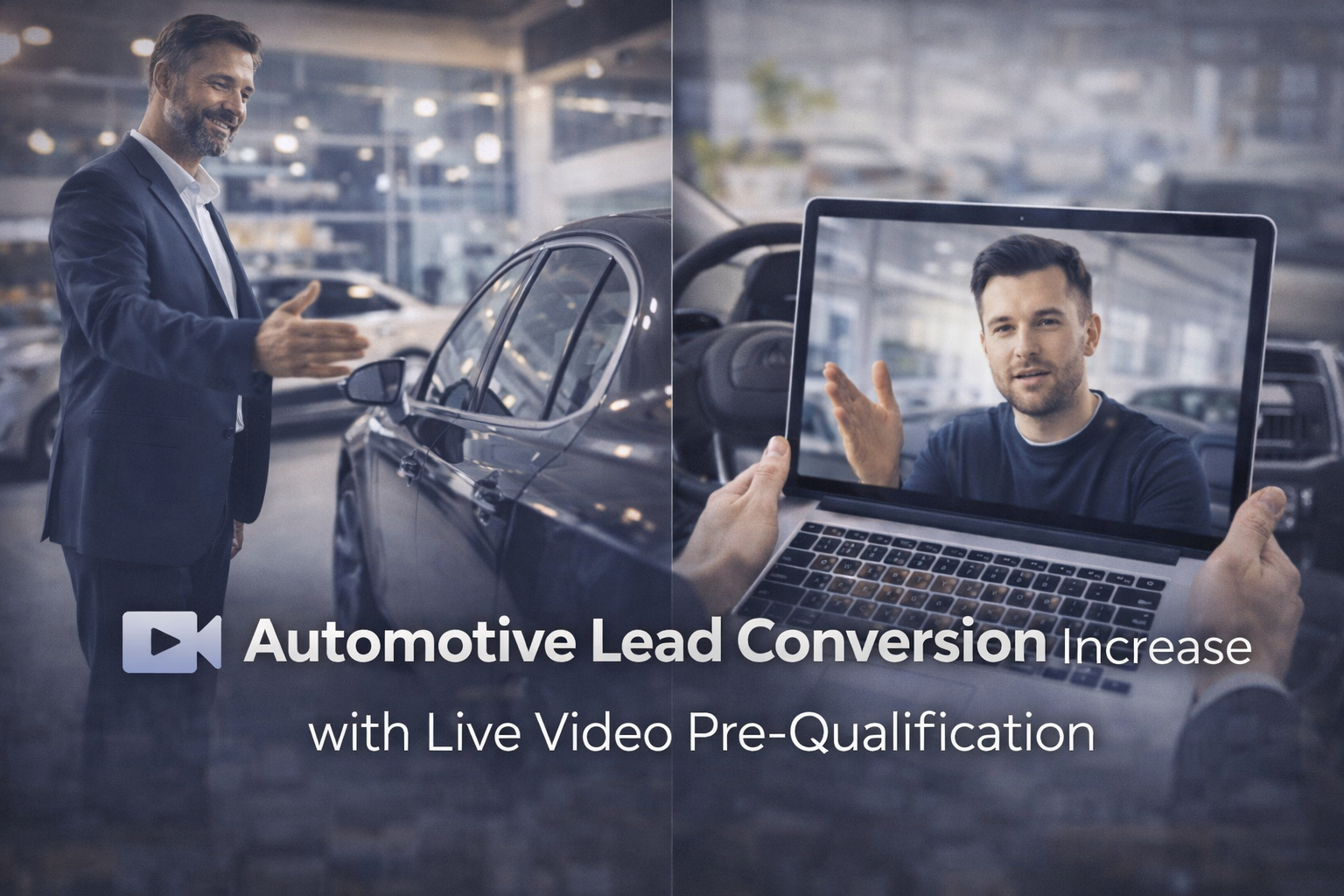
Automotive Lead Conversion with Live Video Pre-Qualification
Live video pre-qualification gives dealerships something forms and bots rarely provide: context with tone, urgency, and intent all visible at once.
A trained representative can ask direct, useful questions in a natural conversation. Is the shopper looking for a vehicle this week or next quarter? Do they have a trade? Are they focused on one VIN or still comparing models? Have they reviewed financing options? Do they want to buy, lease, or just confirm fit before visiting? These answers matter because they tell the sales team what to do next and how fast to do it.
The value is not just speed. It is precision. A real person can recognize hesitation, answer follow-up questions, and adapt based on the buyer’s priorities. That means fewer vague leads and more qualified opportunities entering the CRM.
A practical dealership scenario makes the impact clear. A shopper visits a used truck VDP on a Saturday afternoon. They have already looked at payment information and trade-in content. Instead of filling out a form, they click a live video prompt. Within seconds, they connect with a representative who confirms the truck is available, walks around the vehicle on camera, answers questions about towing package details, and asks whether the shopper has a trade-in and a target monthly payment. The buyer says they want to come in that day if the numbers make sense. The representative schedules a visit, alerts the sales team, and logs key qualification notes before the shopper arrives.
That is a very different lead than “Interested in this vehicle, please contact me.”
Live video pre-qualification works well because it moves the dealership from passive lead capture to active buyer progression. It can also support after-hours coverage when paired with live reception or outsourced sales support, which helps stores protect demand outside standard showroom hours.
Test Drive Bookings and Automotive Lead Conversion
Test drive bookings often sit at the center of automotive lead conversion because they signal real movement from online interest to physical retail activity.
The challenge is that many bookings are soft commitments. A buyer may click to reserve a slot without having key questions answered. They may not know if the vehicle is truly available, whether their trade is viable, or whether the monthly payment range fits. That uncertainty leads to no-shows.
Live video changes that dynamic by turning a booking into a more informed commitment. When a buyer speaks with a real person before the appointment is set, the dealership can confirm fit and remove doubt. That makes the visit feel purposeful instead of tentative.
A strong live video interaction before a test drive can include:
- Vehicle confirmation: exact stock, trim, color, and availability
- Need assessment: daily use, family size, commute, towing, budget
- Trade discussion: current vehicle status and payoff context
- Finance direction: rough payment expectations and purchase path
- Appointment framing: date, time, rep name, and what happens on arrival
That level of clarity improves show rates because the buyer knows why they are coming in and what they expect to accomplish. It also gives the in-store team better preparation. The salesperson can greet the shopper with context, vehicle readiness, and a more relevant conversation.
No-shows drop when ambiguity drops.
Automotive Lead Conversion Strategy for High-Intent Traffic
High-intent traffic deserves a different operating model than low-intent website traffic. If someone is reviewing pricing, availability, trade-in tools, financing details, or specific inventory pages, the dealership should not wait passively for a form completion and a later callback.
A better strategy is to identify those moments and route them toward real-time engagement. That can mean a live video prompt on VDPs, finance pages, certified inventory pages, and pages where shoppers typically pause before reaching out. It can also mean a tiered response model where the most valuable digital behaviors trigger faster human contact.
This approach helps sales teams prioritize serious buyers earlier. Instead of sorting the entire lead pool manually, managers receive better-qualified opportunities with notes that reflect actual buyer intent. The result is sharper tasking, cleaner handoffs, and stronger use of showroom time.
A dealership building this strategy should focus on a few practical steps:
- Define high-intent actions on the website.
- Offer live video at those points, not everywhere.
- Train representatives to qualify, not just greet.
- Push qualified notes directly into the CRM.
- Track appointment set rate, show rate, and sold rate by source.
This is also where SEO and lead generation fit naturally into the picture. Strong SEO brings in local shoppers already searching for relevant makes, models, and purchase terms. Paid lead generation expands reach to active buyers in market. Live reception makes sure inquiries are not missed. Live video pre-qualification turns more of that traffic into actionable sales conversations.
Dealerships that connect these pieces gain an edge in markets where speed and relevance shape outcomes. They are not just collecting more leads. They are identifying better ones earlier, responding with more confidence, and converting more high-intent traffic while competitors are still sending autoresponders.
That is a real advantage when buyers are ready now, inventory is competitive, and every missed inquiry can become someone else’s sale.