Contact two companies with the same urgent issue.
One replies in 12 minutes on Monday, then takes two days on Wednesday, and says nothing about what happens next. The other says, clearly, that first responses arrive within 30 minutes, priority issues are escalated immediately, and open cases receive updates every four hours until resolution.
Most customers will trust the second company, even if both teams are equally capable.
That difference is the value of a strong service level agreement. In customer support, professionalism is not only about speed. It is about predictability, accountability, and a service experience that feels consistent every time.
Table of Contents
What a service level agreement means in customer support
A service level agreement is a documented commitment that defines how support will be delivered and measured. In practical terms, it tells customers what they can expect and tells the business what it must consistently provide.
A mature SLA customer support model covers far more than a simple promise to “reply within X minutes.” It can include first response targets, resolution targets, escalation rules, service availability, communication intervals, channel coverage, and exceptions for complex cases. A strong customer support SLA also clarifies who owns each step, how priority is assigned, and what happens when targets are missed.
This is why a service level agreement matters to both sides. Customers get clarity. Support leaders get an operating framework. Executives get visibility into service performance and risk.
A simple way to picture it looks like this:
Customer Expectations
        ↓
Service Level Agreement
        ↓
Team Processes
        ↓
Performance Monitoring
        ↓
Customer Satisfaction
Why service level agreements matter for customer support
When support teams work without clear commitments, customers fill the gap with their own assumptions. That creates frustration fast. Even a good team can look disorganized if response patterns are inconsistent or communication goes quiet during investigation.
A well-built service level agreement sets realistic expectations before frustration begins. It also gives managers a structure for staffing, queue management, escalation, and quality control. That is where SLAs start to shape support operations, not just customer messaging.
Strong SLAs usually improve several areas at once:
- Predictability
- Accountability
- Consistency across channels
- Better workload prioritization
- More reliable customer trust
There is also an internal benefit that support leaders sometimes overlook. SLA performance exposes where operations are strong and where they break down. If first response is healthy but resolution time slips, the issue may be training, handoff quality, or limited subject matter coverage. If a contact center SLA is regularly missed during peak hours, workforce management may need adjustment.
That is why SLA reporting should sit beside other customer service KPIs, not apart from them. First contact resolution, customer satisfaction score, customer effort score, average handle time, and quality assurance results all add context to SLA performance. A team can hit response targets and still create poor experiences if interactions are rushed or incomplete.
Common customer support SLA types and service level agreement examples
Most customer support SLAs use a mix of time-based and process-based commitments. Time-based measures are easier to track, so many organizations start there. Mature teams add structure around priority, communication, and case progression.
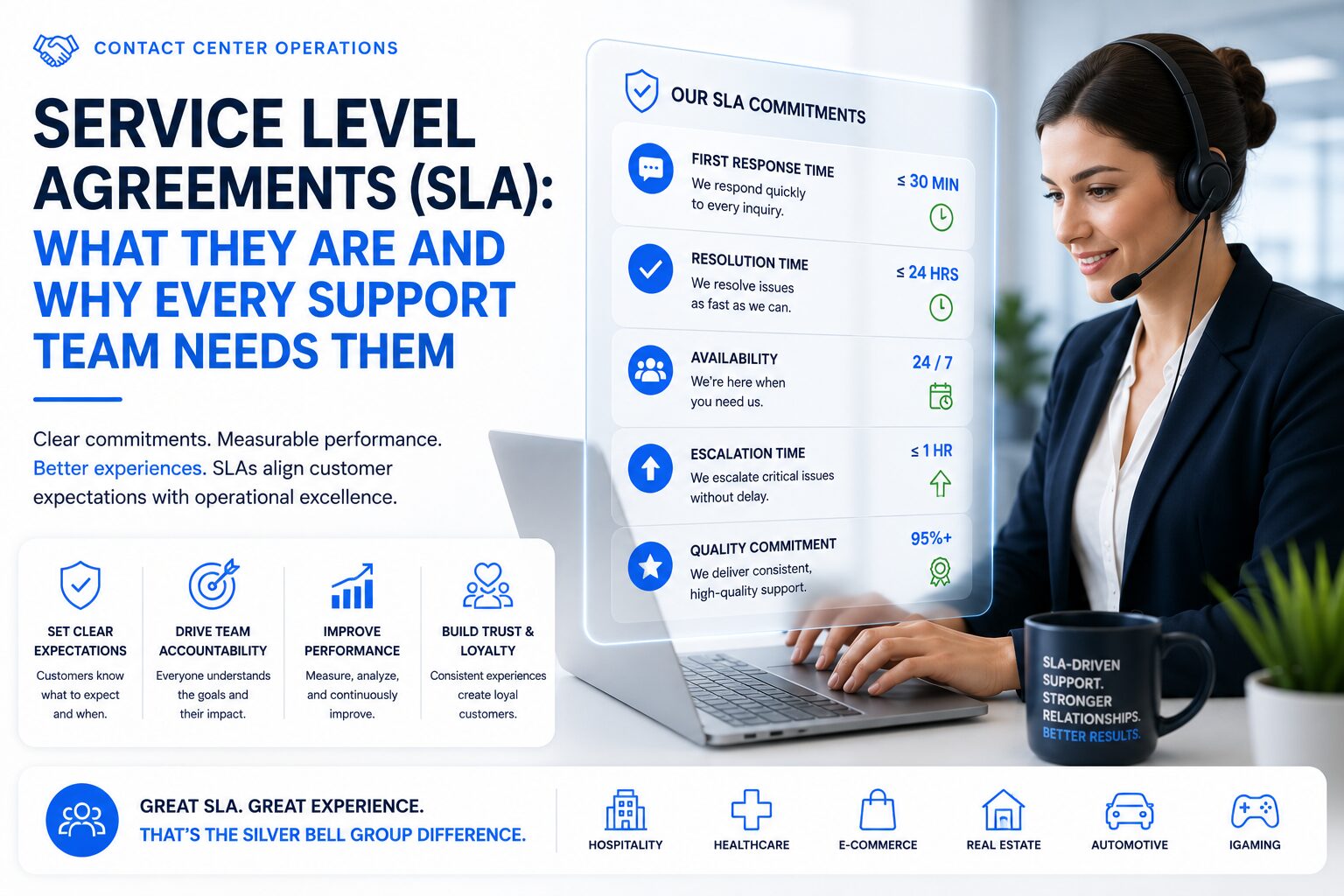
A customer support SLA often includes commitments like these:
- First response time: How quickly the customer receives an initial human or qualified automated acknowledgment
- Resolution time: How long the team has to fully solve the issue
- Escalation time: How quickly the issue moves to a specialist or supervisor when needed
- Update frequency: How often the customer is informed if the issue remains open
- Availability: Hours of operation, channel coverage, and uptime commitments for support systems
Service level agreement examples can look very different depending on the business model. A software company may promise a one-hour first response for high-priority tickets and four business hours for standard requests. An ecommerce brand may set separate targets for chat, email, and phone. A B2B support team may include named escalation contacts and business impact criteria in its SLA.
The difference between a weak SLA and a mature one is often easy to spot.
| Weak SLA | Mature SLA |
|---|---|
| Only response time | Multiple service commitments |
| No prioritization | Priority-based targets |
| Manual tracking | Real-time monitoring |
| Reactive communication | Proactive customer updates |
| Focus on speed | Balance of speed and quality |
That last row matters a lot. Speed alone is not service quality. A five-minute reply that does not move the issue forward is less valuable than a 20-minute response that confirms ownership, sets expectations, and starts meaningful action.
SLA response time vs full service level agreement
SLA response time is one metric inside the broader agreement. It is not the agreement itself.
This is one of the most common misunderstandings in support leadership. Teams often say they “have an SLA” when what they really have is a target for first response. That is useful, but incomplete. A full service level agreement defines the standards for the overall support experience, including how issues are prioritized, progressed, escalated, monitored, and communicated.
Consider a simple example. A team promises a 15-minute response on chat. That sounds strong. Yet if difficult cases sit untouched after the first reply, customers still experience delay. The service level agreement should address both the opening response and what happens next.
A good rule is simple: response time measures acknowledgment, while the SLA governs service delivery.
That distinction helps leaders avoid shallow reporting. If dashboards only celebrate fast first replies, they can hide weak resolution performance, poor handoffs, and unnecessary repeat contacts.
How high-performing contact centers manage SLA performance
High-performing teams do not treat SLAs as a poster on the wall. They build daily operations around them. That is why the best contact center SLA programs are closely tied to staffing models, workflow design, QA reviews, and real-time performance monitoring.
Technology helps, but people and process still decide results. Routing logic, CRM visibility, automation, and dashboards can reduce delay. Well-trained agents, clear playbooks, and disciplined team leads are what turn targets into actual customer outcomes.
Mature support operations usually focus on a few core practices:
- Workforce planning: Match staffing to demand patterns by channel, day, and season
- Real-time monitoring: Use dashboards to spot backlogs before they become SLA failures
- Escalation workflows: Define exactly when and how complex issues move to specialists
- Quality assurance: Check whether fast responses are also accurate, empathetic, and useful
- Performance review: Read SLA data alongside customer support metrics like FCR, CSAT, CES, and AHT
This is also where call center performance becomes more predictable. When service levels are visible by priority, queue, language, and channel, leaders can make better decisions about staffing, coaching, and process redesign. That makes SLAs a management tool, not just a reporting tool.
Teams that want more precision often build different targets by severity level. Priority one issues may need immediate action and hourly updates. Lower-priority requests may allow longer windows without harming the customer relationship. That balance protects service quality without overcommitting the team.
Common service level agreement mistakes in support operations
Many SLA failures start long before a ticket arrives. They begin with poor design.
Some organizations set aggressive targets because they sound impressive in a sales process. Others copy another company’s SLA without checking whether their staffing, tooling, or issue complexity can support it. Both paths create frustration for customers and pressure for agents.
The most common mistakes look like this:
- Unrealistic targets
- No distinction between simple and complex cases
- One SLA across every channel and customer type
- Limited customer updates during long investigations
- Tracking speed without tracking quality
Another frequent problem is poor prioritization. A billing outage and a password reset should not compete under the same timer. Priority-based SLAs give teams a rational way to direct effort where risk is highest.
Communication failures also damage SLA performance, even when technical targets are met. A customer may tolerate a longer resolution window if updates are clear and timely. Silence makes delays feel worse. Good SLAs protect against that by defining update frequency, ownership, and escalation touchpoints.
How outsourced customer support improves SLA performance
For many companies, SLA consistency gets harder as volume grows, channels multiply, or support hours extend across regions. This is where outsourced teams can make a measurable difference.
A strong Customer Support Outsourcing partner brings repeatable processes, staffing depth, channel coverage, and operational discipline that support in-house teams sometimes struggle to maintain alone. That matters when a business needs evening coverage, multilingual support, seasonal flexibility, or 24/7 service.
Outsourced models often improve customer support SLA performance in a few practical ways:
- Coverage: broader hours, weekend support, and follow-the-sun operations
- Scalability: easier ramp-up during launches, promotions, or peak seasons
- Standardization: documented workflows, QA routines, and reporting cadence
- Training depth: structured onboarding and refresher coaching tied to target outcomes
- Language support: multilingual teams that reduce delay for global customers
There is also value in front-end responsiveness. Live Reception Services can help reduce response delays by connecting site visitors and inbound contacts to a real representative immediately. That shortens wait times, improves handoff quality, and supports a more reliable first impression.
Outsourcing is not a shortcut around SLA design. The business still needs clear priorities, reporting standards, and customer expectations. Yet the right operating partner can make it much easier to meet those commitments consistently.
How to measure service level agreement performance
Measuring SLA performance starts with precision. Teams need a clear definition for when the clock starts, when it pauses, what counts as a response, what counts as resolution, and which cases are excluded. Without that clarity, dashboards create confusion instead of accountability.
The best measurement approach combines SLA compliance with broader customer support metrics. A team may hit its SLA response time but still show weak first contact resolution or falling CSAT. That is why customer service KPIs should be read together, not in isolation.
Useful SLA measurement questions include these:
- Are targets being met by channel and priority?
- Where are breaches concentrated by time of day or case type?
- Do escalated cases behave differently from standard tickets?
- Is quality stable when speed improves?
- Are customers kept informed during longer investigations?
If a support leader wants a stronger reporting foundation, related topics worth reviewing include Customer Support Metrics That Actually Matter, Workforce Management, Contact Center Quality Assurance, Average Handle Time (AHT), First Response Resolution (FCR), Customer Satisfaction Score (CSAT), and Customer Effort Score (CES).
FAQ about service level agreement and SLA customer support
What is a service level agreement?
A service level agreement is a documented commitment that defines the standards a support team will meet. In customer support, that usually includes response times, resolution targets, escalation rules, communication expectations, and service availability.
What should a customer support SLA include?
A customer support SLA should include at least first response time, resolution time, priority levels, escalation paths, update frequency, hours of coverage, and how performance is measured. More mature SLAs also define quality expectations and exceptions for complex issues.
What is the difference between SLA and response time?
Response time is one metric. The SLA is the broader framework. It covers the full support commitment, not just how quickly a case gets its first reply.
How do you measure SLA performance?
Measure SLA performance with clear clock rules, real-time tracking, and reporting by channel, priority, and case type. Then compare SLA compliance with customer support metrics like FCR, CSAT, CES, QA scores, and AHT to get a fuller picture.
Why are SLAs important?
SLAs matter because they create predictability for customers and accountability for support teams. They also help leaders plan staffing, spot bottlenecks, improve call center performance, and build trust through consistent delivery.
How can outsourcing improve SLA compliance?
Outsourcing can improve SLA compliance by adding coverage, staffing flexibility, multilingual support, QA structure, and performance monitoring. With the right processes in place, outsourced support teams can help businesses meet service commitments more consistently across channels and time zones.