
Call abandonment rate looks simple on the surface: a customer calls, waits, and hangs up before reaching an agent.
Yet this metric becomes misleading very quickly when it is treated as a universal scorecard for contact center quality.
A good call abandonment rate is generally one that remains consistently low without requiring unsustainable staffing levels. However, there is no universal abandonment-rate benchmark that applies to every contact center. The appropriate target depends on call volume, industry, customer expectations, operating hours, and how the organization defines an abandoned call.
Abandonment rate should therefore be evaluated alongside service level, average response time, first contact resolution, and customer satisfaction rather than as an isolated KPI.
Editorial note: This article is intended for contact center leaders and uses stated Silver Bell Group operational case study data as first-party evidence. The results cited below come from separate client operations and are not universal benchmarks.
After that baseline, a few points matter most:
- Call abandonment rate measures how often callers disconnect before reaching an agent.
- A lower abandonment rate usually signals better accessibility, but the number needs context.
- Short accidental calls may need to be excluded from the calculation.
- High abandonment can reflect long waits, weak staffing alignment, demand spikes, or routing issues.
- Abandonment rate and service level should be reviewed together.
- Silver Bell Group managed operations have recorded abandonment rates as low as 1% to 1.43% in specific support environments.
What call abandonment rate means in a contact center
Call abandonment rate is the percentage of inbound callers who enter the queue and disconnect before an agent answers.
That definition seems straightforward, but methodology matters. Some teams count every disconnect as abandoned. Others exclude very short calls, such as callers who hang up within three or five seconds because they misdialed, lost signal, or dropped by accident. Two contact centers may report the same abandoned call rate while using different rules.
It also helps to separate two terms that are often blended together.
An abandoned call is a caller who entered the queue and disconnected before speaking with an agent. A missed call is a broader operational label that may include abandoned calls, unanswered calls, after-hours calls, or other interaction types depending on the telephony platform and reporting logic. They are related, but they are not automatically interchangeable.
How to calculate call abandonment rate correctly
The standard formula is simple:
Call Abandonment Rate = (Abandoned Calls / Total Eligible Inbound Calls) × 100
Example: if 1,000 eligible calls enter the queue and 30 callers disconnect before reaching an agent, the abandonment rate is 3%.
The word “eligible” is where many reporting disputes begin. If one team excludes calls under five seconds and another does not, their numbers are not directly comparable. That is why any call abandonment rate benchmark only makes sense when the calculation method is also clear.
If your operation is refining its measurement model, it is worth documenting three rules in plain language:
- Queue entry definition: when a call is considered officially in queue
- Short-call treatment: whether accidental or ultra-short calls are excluded
- Transfer handling: whether transferred or rerouted calls can count as abandoned
What is a good call abandonment rate?
This is where many articles oversimplify the issue.
A good call abandonment rate is not a single magic percentage. It is a rate that stays low enough to protect customer access while still fitting the economics and operating realities of the business. A premium concierge line, an insurance claims queue, a healthcare support desk, and a seasonal ecommerce contact center should not all be judged by one identical target.
The right target depends on several operating variables: industry, urgency of the customer need, call arrival pattern, hours of coverage, queue design, language requirements, staffing model, and the type of support being delivered. A center handling high-stakes or time-sensitive issues may need a tighter abandonment target than one handling lower-urgency general inquiries.
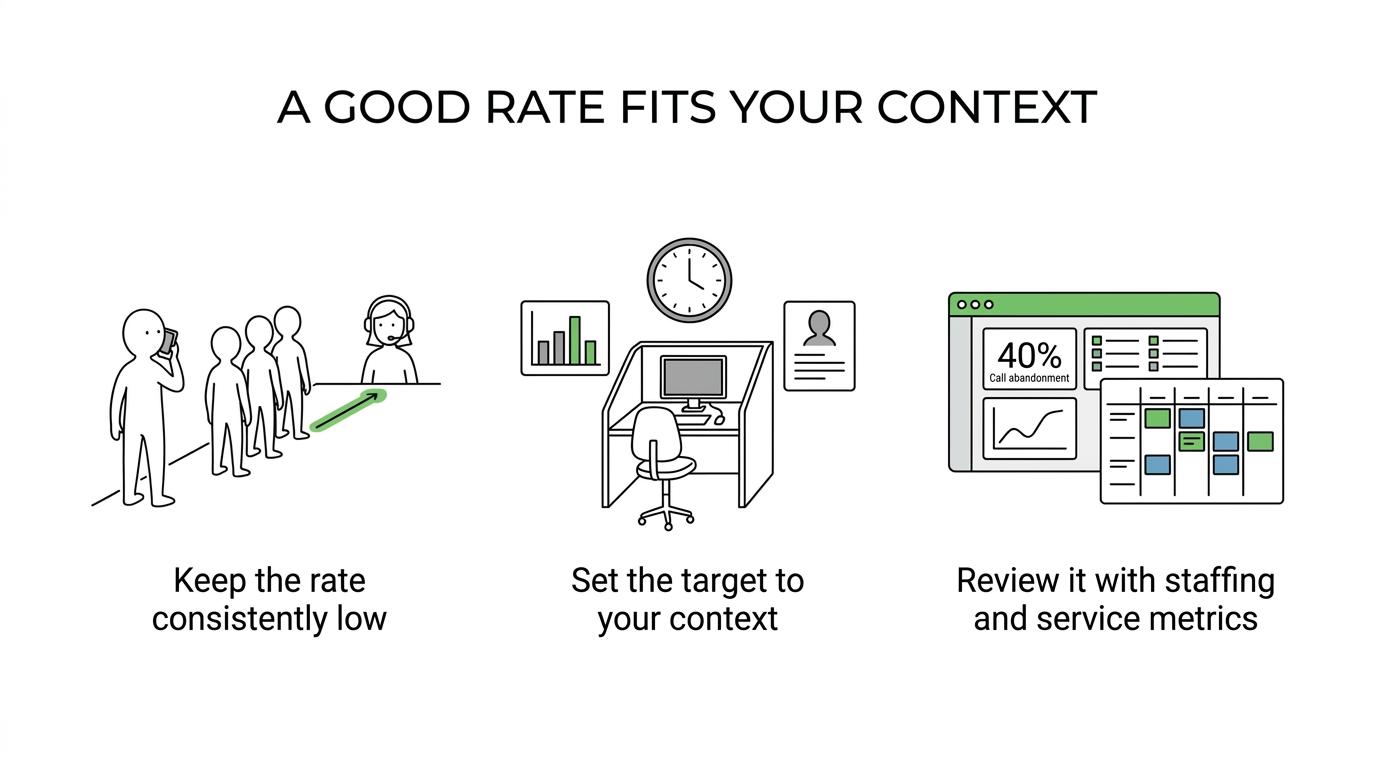
This is why “good call abandonment rate” should be discussed together with What Is a Good Call Center Service Level?, response time, and broader Customer Support Metrics. A 2% rate achieved through heavy overstaffing and weak productivity may not reflect a healthier operation than a 4% rate paired with strong resolution, strong CSAT, and sustainable labor use.
Real-world call abandonment rate data from Silver Bell Group
First-party operating data is much more useful than generic internet averages when it is presented in context.
In one insurance customer support operation managed by Silver Bell Group, abandonment reached as low as 1.43%. On its own, that sounds impressive, but the supporting metrics explain why it matters operationally: service level reached up to 94.48%, more than 98% of calls were answered, average response time was about 14 seconds, and the environment handled more than 500 calls per day.
In a separate premium customer support operation, Silver Bell Group recorded a 1% abandonment rate alongside a 96% service level.
These results come from separate Silver Bell Group client operations and represent specific operational outcomes, not industry benchmarks.
Real-World Contact Center Performance
In one insurance customer support operation managed by Silver Bell Group, call abandonment fell as low as 1.43%, while Service Level reached up to 94.48%, more than 98% of calls were answered, and average response time was approximately 14 seconds.In a separate premium customer support operation, Silver Bell Group recorded a 1% abandonment rate alongside a 96% Service Level.
Source: Silver Bell Group operational case study data. Results represent separate client operations and should not be interpreted as universal benchmarks.
Why customers abandon calls in a contact center
Customers usually abandon for understandable reasons, and most of them tie back to queue design and workforce planning rather than caller impatience alone.
- Long wait times: the most direct driver of abandonment, especially when customers hear long estimated waits or repeated hold messaging
- Unexpected call volume: demand spikes can flood the queue faster than staffing plans can absorb
- Poor workforce forecasting: if forecast assumptions miss peak intervals, abandonment rises even with capable agents
- Incorrect scheduling: the right headcount at the wrong hours still produces long waits
- Long Average Handle Time: higher Average Handle Time (AHT) reduces available capacity and lengthens queues
- Inefficient call routing: callers may wait unnecessarily because skills, language, or intent routing is off
- Limited operating hours: customers who call close to closing time may hang up when service windows are too narrow
- Seasonal peaks and technical issues: promotions, weather events, outages, and system friction can sharply raise abandonments
- Customer expectations: callers who expect immediate access abandon faster than those prepared for moderate waits
The main lesson is practical: high abandonment is usually a symptom, not the root problem.
Call abandonment rate vs service level and related call center metrics
Abandonment rate is one view of accessibility. It should sit beside service level and other call center metrics, not replace them.
| Metric | Measures |
|---|---|
| Abandonment Rate | Customers who leave before reaching an agent |
| Service Level | Calls answered within a defined time threshold |
| Average Speed of Answer | Average time before an agent answers |
| Missed Call Rate | Unhandled inbound interactions |
| FCR | Issues resolved during the first interaction |
A contact center can improve one of these metrics while damaging another. Cutting queue time may lower abandonment, but if agents rush calls and First Contact Resolution (FCR) drops, customer effort may still rise. That is why service level call center targets, answer speed, and abandonment should be reviewed together rather than in separate dashboards.
Why a low call abandonment rate does not always mean strong customer support
Accessibility is only one part of customer experience.
A center can post a low call center abandonment rate and still underperform in the areas customers remember most: poor resolution, repeat contacts, inconsistent agent quality, low CSAT, or long conversations caused by broken internal processes. It can also overspend heavily to keep abandonment artificially low.
That tradeoff matters. If a team pushes staffing levels far beyond what demand requires just to reach a vanity target, the result may look good in reporting while weakening margin and lowering occupancy. Strong operations balance customer access with quality, efficiency, and consistency.
How to reduce call abandonment rate with an operational framework
Reducing abandonment calls for a structured review of demand, staffing, and queue behavior rather than a quick fix.
- Analyze abandonment by hour and day.
- Identify demand peaks and abnormal spikes.
- Compare call volume with available staffing.
- Improve forecasting assumptions.
- Optimize schedules, breaks, and shift coverage.
- Review AHT and process friction.
- Improve routing logic and queue design.
- Monitor service level and average speed of answer at the same time.
- Introduce callbacks or alternative channels where they fit the customer base.
- Review results continuously and adjust before the next peak cycle.
Teams that do this well rarely focus on one KPI in isolation. They pair abandonment analysis with workforce management, routing logic, and process improvement.
How missed calls and abandonment rate are connected
Abandonment and missed calls often rise from the same access problem: demand is not being matched well enough with capacity.
That is why separate KPI fixes often fail. In one Silver Bell Group managed operation highlighted in How to Reduce Missed Calls in a Call Center, gross missed calls fell from about 40% to 10%, while net missed calls dropped from about 20% to 5%. The lesson is not that missed calls and abandonment are identical. The lesson is that accessibility problems usually require operational redesign, not isolated reporting changes.
What metrics to track alongside call abandonment rate
Any serious review of contact center KPIs should place abandonment next to service level, average speed of answer, AHT, FCR, missed call rate, CSAT, total call volume, and agent occupancy.
Those metrics answer different questions. Service level shows whether calls are being answered within target. Average speed of answer shows wait time behavior. AHT reflects how quickly capacity turns over. FCR and CSAT show whether access actually turns into useful customer outcomes. Occupancy reveals whether the staffing model is healthy or stretched.
If you optimize only the abandoned call rate, you can easily create a polished dashboard and a weaker operation.
When high call abandonment becomes an outsourcing problem
Some abandonment problems are process issues. Others signal a structural capacity gap.
If high abandonment is tied to chronic hiring delays, unpredictable volume, seasonal surges, multilingual demand, extended hours, new market entry, or weak workforce management capability, outside operational support may be the more realistic solution. This is often the point where leaders begin evaluating When Should You Outsource Customer Support? and broader Customer Support Outsourcing Services.
The question is not whether outsourcing automatically lowers abandonment. The real question is whether the current model can deliver stable accessibility without excessive cost, constant fire drills, or service instability.
FAQ about call abandonment rate
What is call abandonment rate?
It is the percentage of callers who enter the queue and hang up before speaking with an agent.
What is a good call abandonment rate?
A good call abandonment rate is one that stays consistently low while matching customer expectations and sustainable staffing levels. There is no universal benchmark that fits every contact center.
How do you calculate call abandonment rate?
Use this formula: abandoned calls divided by total eligible inbound calls, multiplied by 100.
What causes a high call abandonment rate?
Common causes include long wait times, demand spikes, weak forecasting, poor schedules, high AHT, routing issues, limited hours, and technical problems.
Is a low abandonment rate always good?
No. A low rate can coexist with poor FCR, low CSAT, inefficient staffing, or inflated labor cost.
What is the difference between abandonment rate and missed-call rate?
Abandonment rate tracks callers who disconnect before reaching an agent after entering the queue. Missed-call rate is broader and depends on how the platform defines unhandled interactions.
What is the difference between abandonment rate and service level?
Abandonment rate measures how many customers leave before answer. Service level measures how many calls are answered within a defined time target.
How can you reduce call abandonment rate?
Review abandonment by interval, improve forecasting, fix schedules, reduce AHT where process friction exists, improve routing, and monitor service level in parallel.
Does Average Handle Time affect abandonment rate?
Yes. When AHT rises, agents stay occupied longer, available capacity drops, and queue waits often increase.
Can outsourcing reduce call abandonment?
It can, especially when the root problem is scale, recruiting speed, language coverage, seasonal capacity, or limited workforce management maturity.