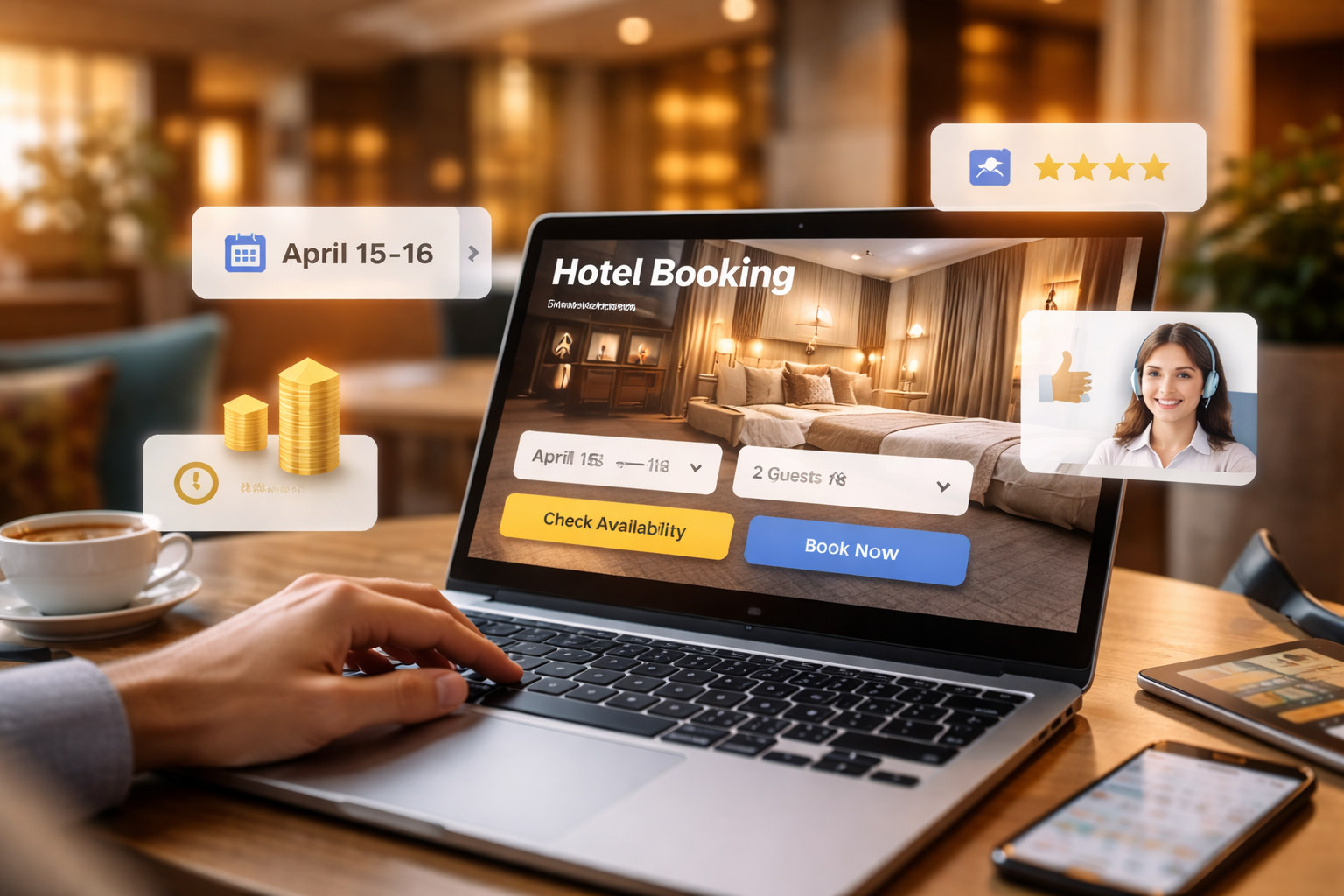
A hotel website can look polished, load quickly, rank well on brand search, and still quietly lose bookings at the moment that matters most due to a lack of customer engagement. The pattern is familiar: visitors reach room selection, compare rates, read the fine print, then vanish right before checkout.
What disappears with them is not just revenue. It is a conversation that never happened.
Table of Contents
The most expensive drop off in hotel website conversion rate happens late
Early funnel leaks are easy to spot. Late funnel leaks are harder, because the session looks healthy until it suddenly ends. From a hotel website conversion rate and conversion optimization perspective, this is the most expensive moment to lose a guest.
By the time someone is reading cancellation terms or checking parking details, they have already invested attention and intent. They are no longer browsing. They are confirming.
At this stage, a small uncertainty carries outsized weight on hotel website conversion rate. Hospitality decisions are personal and situational. Guests are not only buying a room. They are buying sleep quality, arrival ease, safety, flexibility, and reassurance that someone will help if plans change.
One unanswered question can shift the decision. “If my flight lands after midnight, will I still get in?”
When there is no fast, clear answer, leaving the site becomes the simplest next step, and hotel website conversion rate drops not because of price or availability, but because confidence breaks at the final moment.
Why analytics alone undercounts the damage
Most hotel teams track conversion rate, revenue, and cost per acquisition. Those numbers matter, but they rarely explain why a committed visitor chose not to book. Session recordings, chat transcripts, and support logs often reveal a different story than pricing or availability data.
The “reason” is often a missing bridge between policy and reassurance. FAQ pages can list rules, yet guests still want to ask, “Does this apply to my situation?” Email feels too slow. Phone calls feel like work. So the guest opens another tab, checks an OTA listing, and finds comfort in the perception of easier changes or better support.
The website may be doing its job as a storefront, while failing at the job hotels have always excelled at: being present.
The questions that cause high intent visitors to pause
The surprising part is that many late stage questions are not complex. They are specific. They are contextual. They are human.
You see them clustering around the moments when a guest is about to commit payment details but is still picturing the stay. Common themes tend to repeat across upscale properties, city hotels, and multi property groups.
The questions usually sound like this:
- Late arrivals and access after hours
- Parking, drop off, and loading logistics
- Noise, room layout, and sleep concerns
- Date flexibility and minor changes
- Cancellation terms in plain language
None of these require a redesign. They require responsiveness.
“Missed conversations” are a measurable commercial metric
A missed conversation is not just an unanswered message. It is the absence of an easy way to ask at the exact moment doubt appears. If the only options are “search the site” or “send an email,” many guests choose a third option: leave.
The cost shows up in several places:
- Lower direct booking share, which increases OTA dependency
- Higher paid media waste, because the click was earned but the booking was not
- More pressure on support teams, because guests who do reach out tend to do so later and with more frustration
- A weaker brand experience, because the site feels transactional instead of welcoming
A hotel website that cannot respond in real time behaves like an empty front desk. People do not wait long in an empty lobby.
A simple model to estimate the revenue at risk
You do not need perfect data to start sizing the opportunity. A practical approach is to model what happens when a portion of late stage abandoners would have booked if their question had been answered quickly.
Below is an example framework that many teams can adapt. The numbers are placeholders to show the math, not a promise of results.
| Funnel component (monthly) | Example value | Notes |
|---|---|---|
| Booking intent sessions (reach room selection) | 80,000 | High intent traffic, not total site visits |
| Current conversion rate (intent to booking) | 2.4% | Bookings attributed to those sessions |
| Current bookings | 1,920 | 80,000 × 2.4% |
| Average booking value | $480 | Room revenue only, conservative for many city hotels |
| Current revenue from these sessions | $921,600 | 1,920 × $480 |
| Late stage abandoners with a “question moment” | 18% | Estimated via recordings, scroll depth, repeat policy views |
| Share of those who would convert with fast reassurance | 12% | A cautious assumption, testable through experiments |
| Incremental bookings | 1,728 | 80,000 × 18% × 12% |
| Incremental revenue at risk (monthly) | $829,440 | 1,728 × $480 |
Even if your real lift is a fraction of that model, the financial signal is clear: late stage reassurance can be worth more than another round of landing page tweaks.
One sentence from a calm human can be cheaper than another thousand clicks.
What changed in one upscale European hotel group
In one anonymized case, a mid to large upscale group operating across multiple European cities had strong traffic quality driven by paid search, brand search, and repeat visitors. On paper, the website looked healthy.
Yet the commercial team kept seeing late stage abandonment, concentrated around room selection, pricing, and policy review. Guests were not confused about the rate itself. They were uncertain about the small details that shape real travel: access, timing, logistics, and flexibility.
When the team reviewed session recordings alongside support logs, the pattern sharpened. Guests who hesitated did not need persuasion. They needed reassurance.
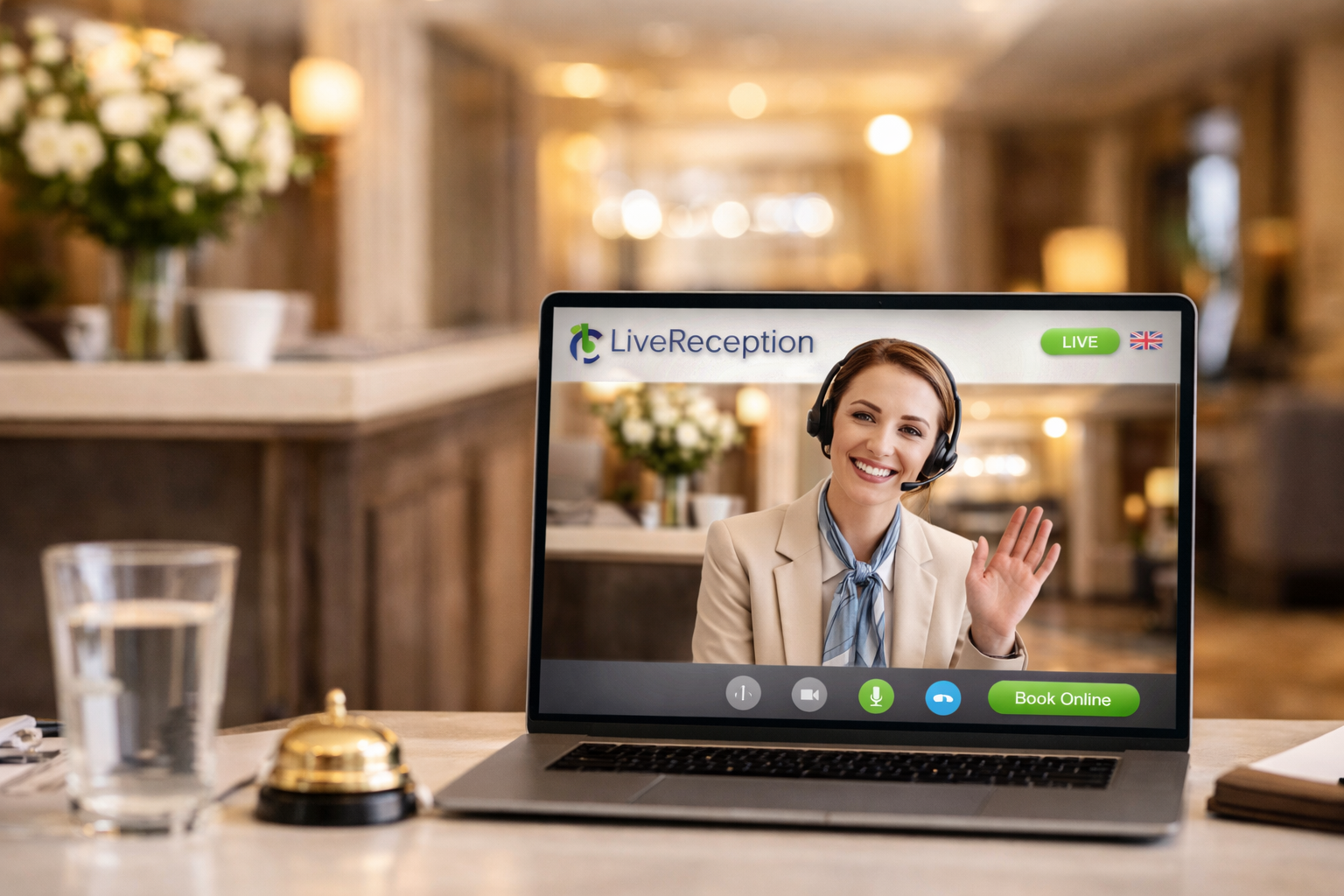
So the team introduced real time human availability directly on key booking pages. The goal was presence, not pressure. Conversations were practical, short, and specific, and they respected the tone of hospitality, enhancing customer engagement.
Within weeks, behavior shifted in ways that matched the hypothesis:
- Sessions extended deeper into checkout
- Drop off between selection and payment decreased
- Guests who interacted converted at a higher rate
- Booking related support emails declined
One of the most telling signals was simple: fewer guests opened multiple tabs. They stayed, asked, and decided.
Why human presence outperforms “more content”
Many hotels respond to friction by adding more copy. Another paragraph about cancellation, another block of legal language, another FAQ accordion. That can help clarity, but it can also increase cognitive load right when the guest wants relief.
Real time human support works because it does three things at once:
- Timing: It shows up at the moment of doubt, not hours later.
- Interpretation: It translates policy into plain language for a specific scenario.
- Emotional safety: It signals that help exists after the booking, not only before it.
Automation can assist with routing or basic prompts, but hospitality questions are often nuanced. “Is the street noisy?” is not a data field. “Will you hold my room if my train is delayed?” is a promise. Guests can sense when a system is trying to sound human without actually being accountable.
Designing real time support without harming the booking flow
Real time support fails when it feels like a pop up trap. It succeeds when it behaves like a front desk: available, calm, and optional.
A few patterns tend to keep the experience aligned with direct booking goals:
- Placement: Show availability on room detail, rate rules, and checkout pages where doubt spikes.
- Tone: Short, clear, service oriented language that matches the property’s voice.
- Visibility: Make it obvious when a real person is available and when they are not.
- Boundaries: Use hours, response targets, and handoff paths so the promise is credible.
- Feedback loop: Tag conversation themes and feed them back into policy wording and page design.
Notice what is missing from that list: aggressive discounting. Guests asking about parking or late arrival are often already sold on the property. They simply want the confidence to proceed.
What to track once conversations are visible
When a hotel adds real time interaction, the most useful metrics are not vanity numbers like total chats. What matters is whether reassurance is happening at the point of decision.
Teams often start with a small set of signals:
- Chat initiation rate on high intent pages (room selection, rate details, checkout)
- Conversion rate of sessions with interaction versus without
- Drop off rate between selection and payment steps
- Repeat policy views in a single session (a proxy for uncertainty)
- Share of contacts that could not be served in real time (missed coverage)
- Theme frequency (late arrival, parking, noise, flexibility) to guide copy and operations
These metrics turn “support” into a commercial system. They also create a healthier relationship between marketing, revenue, and operations, because the questions guests ask are often operational truths the website has not expressed clearly.
Turning your website back into a front desk
Direct bookings grow when the website earns trust at the same speed that doubt appears. That does not require a full redesign. It requires acknowledging that hotel decisions are emotional, and uncertainty kills momentum.
If you want to estimate how many conversations you are currently missing, start by watching where guests pause, hesitate, or loop through policy content. Then test what happens when a real person is available right there, with a calm answer in seconds.
If you would like a structured way to assess late stage friction and map it to revenue impact, consider running a short measurement sprint across recordings, funnel analytics, and the themes that support teams see every week.