Traffic is not the same as opportunity.
Many B2B companies and high-value service businesses have already solved the visibility problem. Their SEO is working, paid campaigns are producing visits, and referral traffic is steady. Yet revenue does not rise at the same pace. The missing piece is often not more traffic. It is the moment when a serious buyer lands on the site, looks for clarity, and finds no one to talk to.
That gap between intent and interaction is where high intent traffic conversion is won or lost. A visitor may be ready to ask about pricing, compare options, or confirm whether a service fits their timeline. If the website responds with a form, a scripted bot, or silence, momentum disappears. A real sales conversation never begins.
Table of Contents
Convert high intent traffic into leads
what is high intent traffic
High intent traffic refers to visitors who are close to making a decision. They are not casually browsing. They are evaluating risk, timing, price, fit, and next steps. In many cases, they already know the problem they need solved and are actively searching for a provider.
These users show bottom-of-funnel behavior. They visit service pages, pricing pages, case studies, and contact pages. They compare vendors. They revisit the site after a first session. They want confidence, not education alone.
A few common signs appear again and again:
- Pricing page visits
- Return visits within a short period
- Time spent on service detail pages
- Contact page visits without form completion
- Searches that include “cost,” “quote,” “demo,” or “best”
why high intent users are the most valuable
High intent leads are valuable because their decision window is short. They are often choosing between a small set of providers right now. If they get a fast, credible response, they move forward. If they do not, they leave and speak with someone else.
That is why these users have a direct impact on revenue. A company can spend months building traffic, content, and brand awareness, yet the buying decision often comes down to a few minutes on the website. That moment carries more commercial weight than dozens of earlier impressions.
This also changes how website conversion optimization should be measured. A site does not need to persuade every visitor. It needs to identify and engage the ones already leaning toward action.
examples of high intent behavior
Behavioral signals are often clearer than companies expect. The problem is not a lack of evidence. The problem is failing to react while interest is active.
| Behavior | What it usually means | Best response |
|---|---|---|
| Multiple visits in 7 days | Active vendor evaluation | Offer immediate conversation |
| Pricing page followed by contact page | Budget and fit check | Answer cost or package questions live |
| Product or service comparison page views | Shortlisting options | Provide tailored differentiation |
| Long session on case studies | Looking for proof and trust | Connect to a human who can add context |
| Exit from form page | Interest with friction | Replace delay with direct interaction |
why high intent traffic does not convert
delayed responses kill conversion
A high intent user is rarely patient. When someone is trying to make a choice, speed communicates competence. Slow response times create doubt before a sales team even enters the picture.
Many sites still rely on “submit and wait” systems. A visitor fills out a form, receives an automated email, and hears from sales hours later or the next day. By then, attention has shifted. Users leave before engagement starts, and the original purchase energy is gone.
forms create friction instead of momentum
Forms have a place, but they are often overused. Asking for too many fields too early turns a live buying moment into admin. It asks the visitor to pause, think, type, and trust without receiving anything back in return.
There is also no instant feedback. A serious buyer may have one or two questions blocking action. If those questions remain unanswered, the form becomes a dead end instead of a bridge.
The most common friction points look like this:
- Too many fields: Long forms feel like work before value is clear
- No response expectation: Visitors do not know whether they will wait 10 minutes or 2 days
- No dialogue: Complex buying questions do not fit neatly into a textbox
- No reassurance: There is no human signal that the business is attentive and credible
chatbots fail in decision moments
Chatbots can help with basic routing, but they often break down at the exact point where a sale could happen. Decision-stage users usually ask specific, layered questions. They want answers tied to their situation, not generic prompts.
Scripted responses make this worse. A buyer asks about onboarding time, service scope, or custom pricing and receives a menu tree. That feels mechanical and indifferent. Lack of context becomes expensive when someone is ready to buy.
high intent lead conversion challenges
users have unanswered questions
Complex decisions require clarity. In B2B and high-value services, buyers are not just asking “What do you do?” They are asking whether the service fits their team, budget, timeline, compliance needs, or existing systems.
A landing page cannot answer every situational question. Even a strong page leaves room for uncertainty. When uncertainty remains unresolved, the user delays action. That delay often means the lead disappears.
lack of trust at the final stage
Trust issues tend to appear late, not early. A visitor may believe the company is credible and still hesitate because there is no human reassurance at the final stage.
That final stage matters because buyers want signs of responsiveness. They want to know that if they become a client, communication will be clear and timely. If no one is available during a decision moment, the business may look less reliable than a competitor with the same offer.
missed timing opportunities
Most websites are built to inform, not to engage in real time. That is a major blind spot. Timing is often the difference between interest and conversion.
A visitor can be deeply qualified, highly motivated, and commercially ready, yet never become a lead because the site offered no real-time customer engagement. That is not a traffic problem. It is a response problem.
real time engagement for high intent traffic
capturing users in the moment of decision
The strongest conversion layer is immediate access to a real person when intent peaks. Timing is critical because decision-stage interest is perishable. A site visit is not just a visit. It is a live opportunity to answer, reassure, and qualify.
Real-time engagement does not mean interrupting every visitor. It means recognizing high intent behavior and offering a clear path to conversation when the user is most likely to need it.
turning website visits into conversations
When a website creates immediate interaction, it stops acting like a brochure and starts acting like a business development channel. That shift is powerful for companies that want to convert website visitors to leads without increasing traffic.
A live receptionist, sales coordinator, or trained conversation team can greet, triage, and route inbound interest as it happens. Instead of capturing a name and hoping for a callback, the business begins qualification in the same session.
reducing hesitation through human interaction
Human interaction reduces hesitation because people can adapt in real time. They can clarify service fit, explain next steps, answer objections, and create confidence faster than a static page or automated script.
This is where high value lead generation becomes more effective. The traffic source still matters, but the conversion lift often comes from what happens after the click, not before it.
live conversations vs traditional lead capture
forms vs conversations
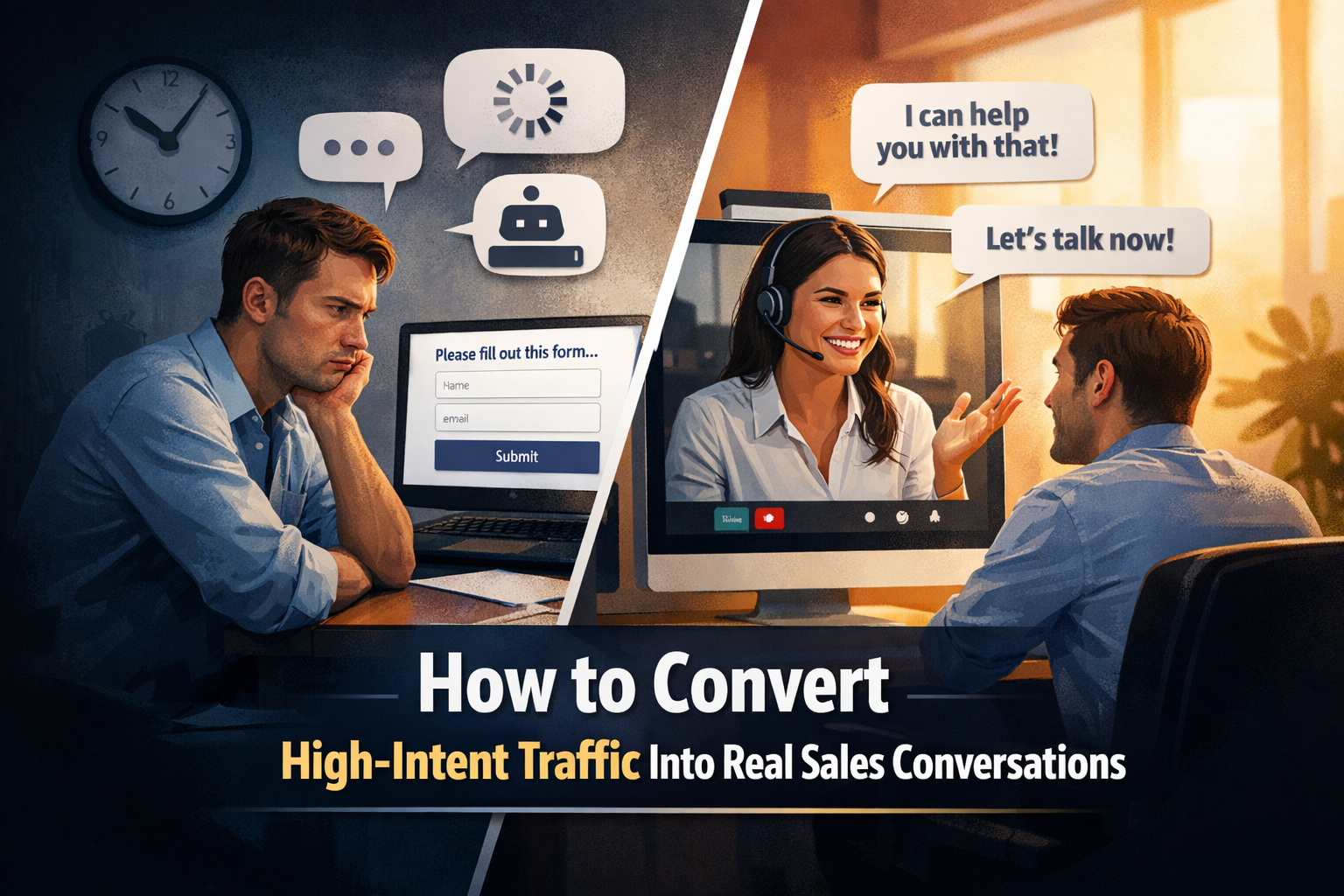
Forms are passive. Conversations are active.
A form asks the visitor to commit before the business has earned that commitment. A live conversation meets the user halfway. It lowers effort and raises clarity. That can increase website conversion rate quickly, especially on high-intent pages.
chatbot vs human interaction
Automation is useful when questions are repetitive and low stakes. Human interaction is stronger when nuance matters. Serious buyers do not always know the exact language to use. They need adaptable responses, not keyword matching.
A human can detect urgency, budget sensitivity, buying stage, and unspoken concerns. That is the core of real time lead qualification.
real time vs delayed communication
Speed is a conversion factor, not just a service detail. Real-time communication keeps buying momentum alive. Delayed communication asks the buyer to care later.
| Approach | Visitor experience | Likely outcome |
|---|---|---|
| Long contact form | Effort first, value later | Drop-off or delay |
| Chatbot flow | Quick but rigid | Partial capture, weak trust |
| Email follow-up after submission | Slow and uncertain | Lost urgency |
| Live human response | Immediate and adaptive | Higher conversation rate |
how to convert high intent traffic with human interaction
real time qualification of leads
Not every visitor is sales-ready, and that is exactly why live interaction is valuable. It helps identify serious buyers quickly. Instead of sending every inquiry into the same queue, real-time qualification can separate pricing requests, urgent project needs, and general research.
This makes the sales team more effective while improving the buyer experience. Strong lead conversion strategy is not only about volume. It is about matching speed and attention to commercial value.
personalized support during decision-making
Tailored communication changes the tone of the interaction. A buyer comparing vendors wants to feel that their situation is being heard, not pushed through a process.
Personalized support can include:
- Clarifying fit: Confirming whether the service matches the buyer’s use case
- Answering objections: Addressing cost, timeline, or delivery concerns immediately
- Routing correctly: Sending qualified prospects to the right sales contact without delay
- Setting next steps: Turning interest into a scheduled call, quote request, or consultation
guiding users toward conversion
The best websites remove friction instead of adding more of it. That means placing live interaction on pricing pages, service pages, comparison pages, and high-exit contact pages. It also means training the people behind that interaction to move conversations forward, not just answer questions.
When human support is available at the right points, the path to conversion becomes clearer. Users do not need to guess what happens next. They can ask, confirm, and proceed.
high intent traffic conversion strategy
aligning marketing and sales
Marketing and sales should share one goal: turning intent into conversation. Marketing brings in demand. Sales closes demand. The space between those teams should be small, visible, and measurable.
This is where many businesses lose high intent leads. Marketing reports traffic growth. Sales reports pipeline gaps. The real issue sits in the handoff. A conversation-first system closes that gap by treating qualified engagement as a joint metric.
focusing on conversation-first approach
A conversation-first approach shifts the site from passive capture to active response. It does not remove forms completely. It puts them in the right place and reserves high-visibility, high-intent pages for faster interaction.
A practical system often includes these moves:
- Review pages with the highest buyer intent
- Add live response options where hesitation appears
- Train human responders on qualification and scheduling
- Use forms as backup, not the primary path
measuring conversion beyond clicks
Clicks, sessions, and bounce rate matter, but they do not tell the full story. Conversations should become a KPI. If a page drives strong traffic but weak engagement, the issue may not be messaging alone. It may be the absence of a real-time response layer.
Useful indicators include conversation start rate, qualified conversation rate, booked consultations, and time-to-response. Those metrics connect website behavior to pipeline value far better than traffic numbers alone.
It also helps to support this system with internal content that addresses common drop-off points. Pages about high intent website traffic, conversion drop off, chatbot vs human support, checkout abandonment, and industry case studies can guide both users and internal teams toward better decisions.
combining seo lead generation and live reception
seo brings high intent traffic
SEO attracts organic demand from people already searching for answers, vendors, and pricing. When the content strategy targets bottom-of-funnel queries, it brings in visitors who are closer to action than most ad clicks.
That makes SEO one part of a larger high intent traffic conversion system. Ranking well matters. Responding well matters just as much.
lead generation captures interest
Lead generation creates the initial bridge. Landing pages, offers, case studies, and targeted messaging help capture attention and move users toward contact.
Still, capture alone is not enough for high-value lead generation. If the user reaches out and receives delay, friction, or robotic interaction, the lead weakens before sales can act.
live reception converts traffic into revenue
Live reception provides the missing layer between visibility and revenue. It turns demand generation into human response. It catches visitors at the moment of decision, answers the questions that block action, and routes qualified opportunities quickly.
When SEO, lead generation, and live reception work as one system, the website stops leaking intent. Traffic still matters, but the business no longer depends on more clicks to grow. It improves conversion without increasing traffic by meeting serious buyers when they are ready.
If the site is already attracting the right audience, the next step is simple: audit where decision-stage users stall, add real-time conversations where intent is strongest, and invite those visitors into a demo or consultation while their interest is still active.