
Choosing between in-house and outsourced customer support is rarely a simple staffing decision. In-house customer support gives companies direct control over people, processes and customer knowledge, while outsourced customer support transfers part or all of the operational responsibility to a specialized provider. Neither model is universally better. In-house support often works well when volumes are manageable and deep internal product knowledge is essential, while outsourcing becomes more relevant when businesses need to scale quickly, extend operating hours, support multiple languages or improve operational performance. Many enterprise organizations use a hybrid customer support model that combines internal expertise with outsourced operational capacity.
The better question is not whether outsourcing is “better.” It is which parts of support create strategic value by staying close to the business, and which parts have become operationally difficult to manage internally.
Table of Contents
Key takeaways
These points should shape any serious in-house vs outsourced customer support decision.
- Direct control, deeper internal proximity
- Internal support requires recruitment, training, QA, WFM, reporting, and management infrastructure
- Outsourcing can add operational expertise, not just extra agents
- Multilingual customer support and extended hours increase internal complexity fast
- Cost should be measured as total operating cost, not salary alone
- Hybrid customer support can keep sensitive work internal while adding flexible external capacity
- The right model depends on scale, service expectations, internal capability, and growth plans
What is in-house customer support?
In-house customer support means the company directly employs and manages the people who handle customer interactions. That includes phone, email, chat, social, and escalation teams.
This matters because many companies compare internal salaries against an outsourcing fee and treat that as an apples-to-apples comparison. It is not. An in-house customer support operation also includes the systems and management needed to keep service levels stable.
A company that keeps support in-house usually owns the full operating model:
- Recruitment: hiring and retention
- Training: onboarding, product knowledge, refreshers
- Operations: scheduling, workforce management, QA, reporting
- Technology and knowledge management
- Escalation design and performance management
When support volumes are stable and product complexity is high, this structure can work very well.
What is outsourced customer support?
Outsourced customer support means a third-party provider handles part or all of the support function. That can look very different from one company to another.
Some businesses outsource a dedicated team. Others use support only for certain channels, languages, time zones, or seasonal peaks. In more mature arrangements, the provider takes responsibility for staffing, workforce management, QA, reporting, and day-to-day operational control.
That distinction is important: outsourcing agents is not always the same as outsourcing customer support operations.
In-house vs outsourced customer support: key differences
The main differences sit in control, speed, and operating complexity.
| Factor | In-House | Outsourced |
|---|---|---|
| Control | Direct organizational control | Managed through agreed processes and SLAs |
| Recruitment | Managed internally | Provider can manage recruitment |
| Training | Internal responsibility | Shared or provider-supported |
| Workforce Management | Internal | Can be managed by provider |
| Scalability | Limited by internal hiring capacity | Usually faster to expand |
| Multilingual Support | Requires language-by-language hiring | Access to multilingual recruitment infrastructure |
| Operating Hours | Requires internal shift coverage | Easier to extend through provider capacity |
| QA | Built internally | Can be part of outsourced operation |
| Reporting | Internal systems and processes | Defined through reporting cadence and SLAs |
| Knowledge | Close to product and internal teams | Requires structured knowledge transfer |
| Cost Structure | Payroll plus management, tools, infrastructure | Contracted service cost |
| Flexibility | Depends on internal resources | Often stronger for volume swings |
Advantages of in-house customer support
In-house customer support gives leadership direct visibility into daily customer conversations. That closeness can be valuable when support is tightly tied to product decisions, compliance requirements, or sensitive workflows.
It also strengthens feedback loops. Agents can raise recurring issues to product, sales, operations, or leadership with less friction. If a company is still shaping its offer, that immediacy can matter more than pure operating efficiency.
In-house support tends to fit best when the environment is predictable. If interaction volumes are manageable, hours are stable, and customer conversations require deep internal context, building everything internally may be the right choice.
Challenges of in-house customer support
The challenge is not the agents. It is the operating burden that comes with growth.
As contact volumes increase, recruitment becomes ongoing rather than occasional. Supervisors, QA specialists, workforce planners, trainers, and reporting owners become necessary. Peaks create a difficult tradeoff: understaff and service suffers, overstaff and capacity sits idle.
Multilingual expansion is another common pressure point. Launching into five markets may mean building five hiring pipelines, five training tracks, and five scheduling plans. Evening, weekend, or 24/7 support adds another layer of complexity.
At a certain point, customer support starts competing with core business priorities for management attention.
Advantages of outsourced customer support
Outsourced customer support can solve capacity and complexity problems much faster than most internal teams can. A mature provider already has recruitment channels, workforce management capability, QA processes, and operational leadership in place.
That becomes especially useful when companies need to scale support without building every management layer from scratch. It is one reason customer support outsourcing benefits often show up in speed, coverage, and consistency rather than in headline cost alone.
Multilingual customer support is a clear example. In one global ecommerce operation, support was delivered through an environment of 400+ employees covering 20+ languages. That does not simply show scale. It shows the infrastructure required to recruit, train, schedule, and manage multilingual support at enterprise level.
Extended hours are another practical advantage. If customers need broader coverage across markets and time zones, an outsourced support team can often stand that up faster than an internal function can.
What are the risks of outsourcing customer support?
Outsourcing is not automatically good, and many outsourcing customer service pros and cons lists gloss over the real risks.
Poor knowledge transfer can weaken quality. Weak governance can reduce visibility. Unclear escalation ownership can frustrate both customers and internal teams. If a provider is chosen mainly on price, brand tone, reporting quality, and performance management often suffer.
The key point is this: many outsourcing failures are not caused simply because support was outsourced. They usually come from a weak operating model between client and provider.
A strong outsourced customer support setup needs clear ownership, shared metrics, disciplined QA, and regular reporting.
What good outsourced customer support looks like
Good outsourced customer support should be measurable. That means visibility into service level, abandonment rate, speed of answer, answered call rate, queue performance, agent performance, staffing, and customer satisfaction.
A useful example comes from an anonymized insurance technology operation founded in Serbia. In that environment, the outsourced operation handled 500+ calls per day while maintaining strong performance.
| KPI | Result |
|---|---|
| Service Level | Up to 94.48% |
| Abandonment Rate | As low as 1.43% |
| Answered Calls | 98%+ |
| Response Time | About 14 seconds |
| Daily Capacity | 500+ calls |
The value here is not just that calls were answered. The outsourced operation produced measurable service delivery against clear operational standards.
If your team is also tracking metrics like service level and abandonment, related benchmarks in What Is a Good Call Center Service Level? and What Is a Good Call Abandonment Rate? can help frame performance.
What happens when internal support can no longer keep up?
Sometimes a support issue is not a bad week. It is a structural demand-capacity mismatch.
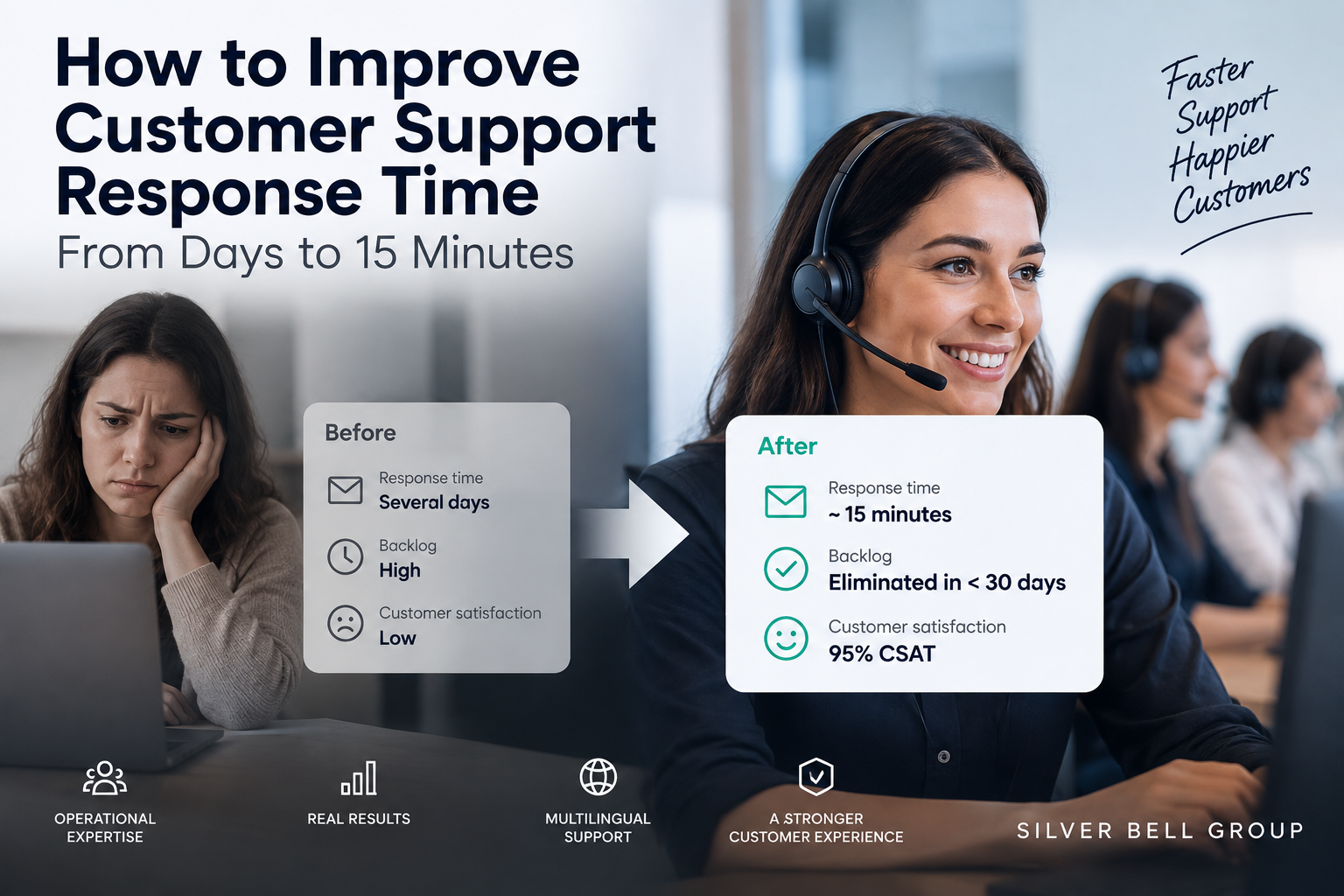
In one ecommerce recovery case, response times dropped from several days to about 15 minutes, the backlog was cleared in under 30 days, and CSAT reached 95%. That kind of turnaround matters when delayed responses have become normal rather than occasional.
This is where customer support outsourcing becomes relevant as an operating decision, not a short-term patch. A related piece, How to Improve Customer Support Response Time: From Days to 15 Minutes, is useful if response delays are already affecting customer experience.
The hidden cost of in-house customer support
Agent salary does not equal total customer service outsourcing cost or internal support cost.
A proper comparison should look at total cost of ownership across the full support function:
- People costs: salary, benefits, overtime, absenteeism, turnover
- Operating costs: recruitment, onboarding, training, QA, WFM, supervision
- Infrastructure costs: technology, office space, equipment, reporting tools
- Underutilized capacity during low-demand periods
This is why some internal teams appear cheaper on paper while consuming far more managerial time and operational spend than expected.
When should customer support stay in-house?
There are real cases where in-house customer support is the better model.
If volume is small and predictable, keeping support internal can be simpler than adding an external partner. The same applies when founders or product teams still need direct contact with customers, or when conversations are highly specialized and tightly connected to internal systems.
It can also make sense when the company already has strong operational infrastructure in place. In that case, outsourcing may add coordination work rather than remove it.
When should you consider outsourcing customer support?
Certain signals tend to show up before a business decides to outsource customer service.
- Volume: demand is growing faster than hiring
- Performance: response times, service level, or abandonment keep slipping
- Coverage: new hours, time zones, or languages are now required
- Management load: leaders spend too much time solving staffing issues
- Backlogs keep returning
- Seasonal peaks create unstable service
If several of these signals are already visible, When Should You Outsource Customer Support? 8 Signs It’s Time is the natural next read.
What is a hybrid customer support model?
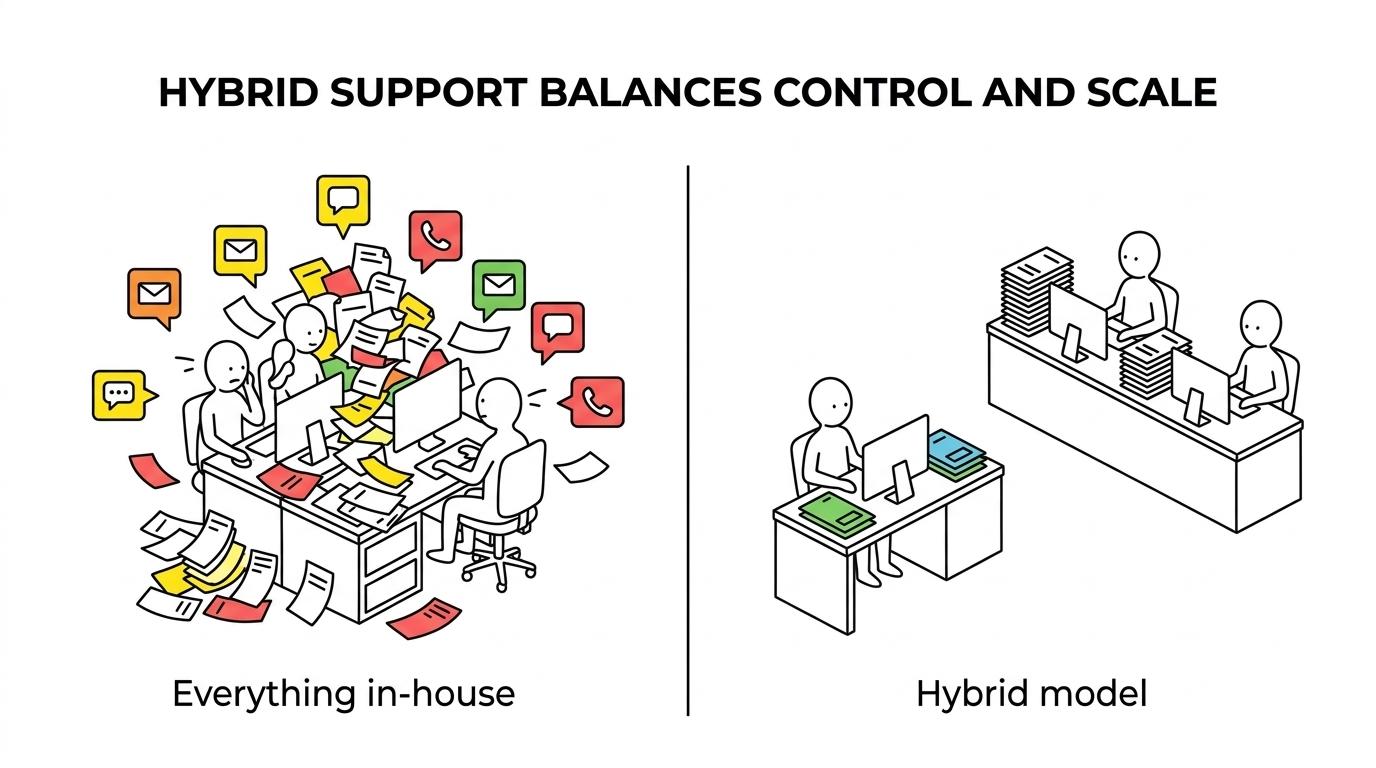
A hybrid customer support model combines internal ownership with outsourced execution. It is often the most practical answer for enterprise teams that want both control and scale.
A common structure looks like this:
- In-house: strategic accounts, complex escalations, policy ownership, sensitive cases
- Outsourced: Tier 1 support, overflow, after-hours coverage, multilingual queues, seasonal capacity
This model works well when some interactions create strategic value by staying internal, while others benefit from external operational capacity.
How to decide between in-house, outsourced, and hybrid support
The right model depends less on ideology and more on operating reality.
Keep support primarily in-house when volume is predictable, operational complexity is low, and internal capability is strong. Consider outsourced customer support when scale, language needs, hours, recruitment pressure, or service instability have become operational constraints. Consider hybrid support when you want to retain strategic knowledge while using external infrastructure for scale.
A practical decision framework starts with a few direct questions:
- Volume: How many interactions do we handle now?
- Growth: What happens if demand rises by 50%?
- Languages: How many markets must we support?
- Hours: What coverage do customers expect?
- Performance: Are response times, SL, and abandonment where they should be?
- Capability: Do we have enough QA, WFM, and management depth?
- Cost: What is our true total operating cost?
- Strategy: Which interactions genuinely need to remain internal?
Silver Bell Group’s experience spans tightly measured insurance operations and multilingual ecommerce environments involving 400+ employees across 20+ languages. That kind of range supports a simple point: different businesses need different customer support operating models.
Customer support outsourcing as an operating model decision
A useful customer support partner should do more than provide headcount. The role should be to help build an operation that can perform, scale, and remain measurable as the business changes.
That is why the most productive question is not “Should we replace our internal agents with cheaper external agents?” It is “What support model gives customers the service they need while giving the business the control, scalability, and visibility it requires?”
FAQ
Is it better to outsource customer support or keep it in-house?
Neither is always better. The right choice depends on volume, complexity, languages, operating hours, internal capability, and strategic needs.
Is outsourced customer support cheaper than in-house support?
It can be, but the comparison should be total operating cost versus contracted service cost, not salary versus fee.
What are the disadvantages of outsourcing customer service?
Common risks include weak knowledge transfer, poor escalation ownership, reduced visibility, inconsistent quality, and choosing a provider mainly on price.
Can you outsource only part of customer support?
Yes. Many companies use a hybrid customer support model for specific channels, languages, time periods, or support tiers.
When should a company outsource customer support?
When internal hiring, management capacity, multilingual requirements, operating hours, or performance issues make it difficult to deliver the expected customer experience.
What customer support functions can be outsourced?
Phone support, email, chat, Tier 1 support, overflow handling, after-hours service, multilingual support, and market-specific queues are common examples.