Luxury ecommerce has matured to the point where the next gains rarely come from another template refresh or a faster checkout. For high value purchases or live shopping for Luxury Brands how we call it, the limiting factor is often human, not technical: confidence.
A client browsing a fine jewelry collection at midnight, a collector considering a limited leather piece, or a gift buyer trying to get the size and personalization right all face the same quiet question before they pay: “Am I sure?”
Table of Contents
The moment where luxury ecommerce pauses
Luxury buyers hesitate for reasons that rarely show up in analytics dashboards. The product is expensive, yes, but the risk is broader than price. They are buying identity, taste, and long-term satisfaction, all without the cues that a boutique naturally provides.
Even loyal clients pause when the purchase carries social visibility (a watch worn daily) or long-term commitment (a handbag meant to age beautifully). The anxiety is not only “Will I like it?” but also “Will I regret choosing wrong?”
That hesitation is often rational. Premium products have nuanced differences that matter: a subtle change in strap length, a gemstone tone that reads differently in varied lighting, or a specific fit intention that depends on how the item will be worn.
And while luxury customers are comfortable online, they still expect care.
Why static pages and automation hit a ceiling
Most luxury websites are already excellent at presentation. They offer art-directed imagery, refined copy, editorial content, and robust performance. Yet static pages remain one-way communication.
Even rich PDPs cannot answer follow-up questions in the sequence they arise. A customer might need to compare two sizes, then ask about wear, then confirm delivery timing for a specific address, then ask how to care for the material in their climate. The moment becomes interactive, and the page stays still.
Automation helps, but it is not the same thing as reassurance. Chatbots and scripted help flows do well with logistics, not judgment. For high ticket decisions, buyers often want a trained person to validate the choice and reduce the fear of a costly mismatch.
The gaps tend to cluster around a few themes, especially when the cart value is high:
- Fit and proportion
- Material behavior over time
- Authenticity signals and provenance
- Styling context and use-case nuance
- Gift guidance and personalization confidence
When the customer cannot resolve those questions quickly, the purchase delays, cart abandonment rises, and the brand’s carefully built aura can feel oddly distant.
Live shopping for luxury brands as a digital concierge layer
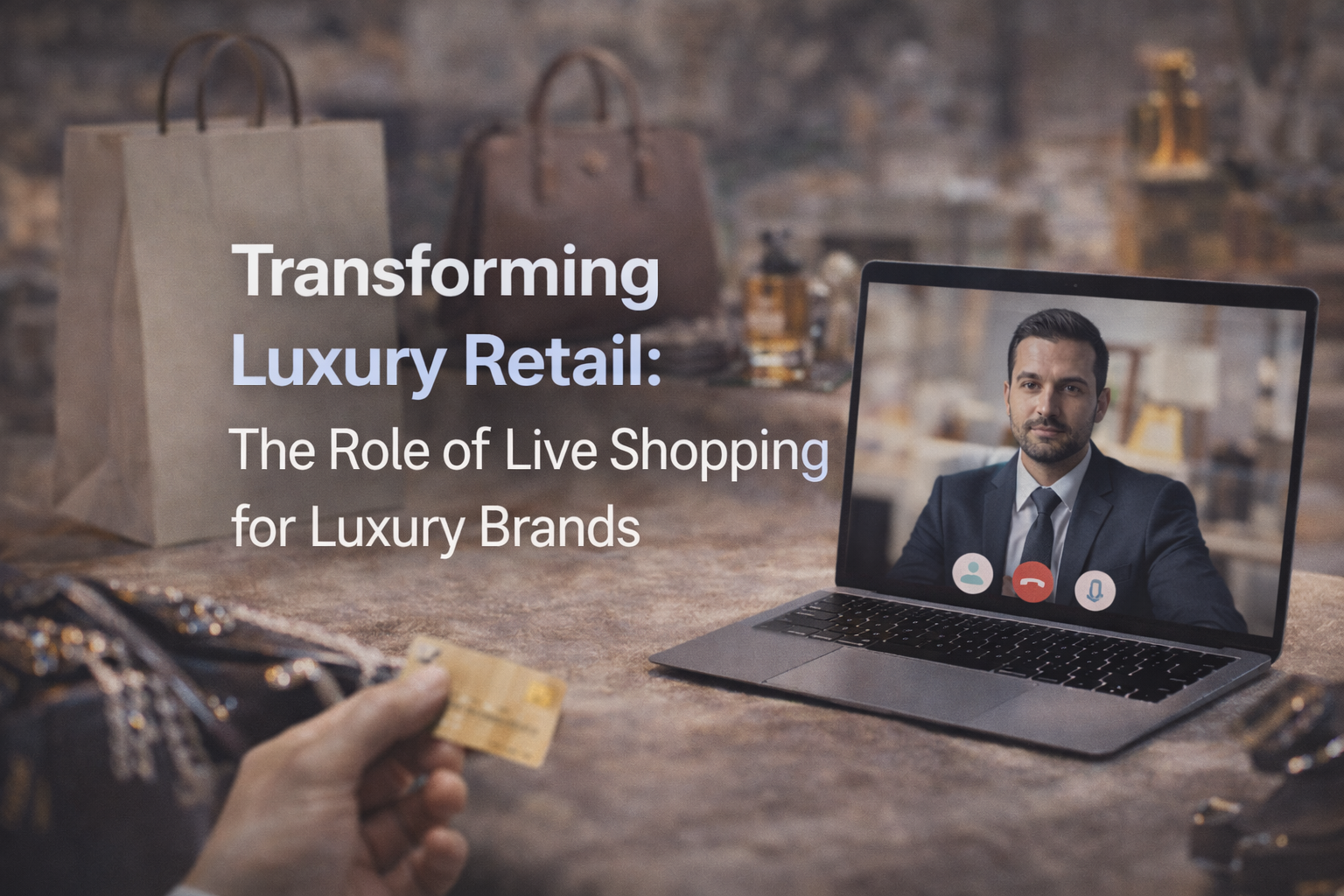
Live shopping, in a luxury context, is best treated as a real-time consultation layer embedded directly into the brand site. It is not a broadcast. It is not influencer entertainment. It is a private, brand-controlled interaction where a client speaks with a trained representative over live video at the moment of decision.
This format matters because it restores what ecommerce removed: presence. The client can ask, “Can you show me the clasp up close?” or “How does this sit on the wrist?” and receive an immediate, tailored response. The representative can mirror boutique behaviors: clarify preferences, confirm intent, and guide without pressure.
A strong implementation feels like an appointment that can happen instantly. The entry points can be subtle and elegant: on PDPs for high consideration categories, within the cart for threshold values, or on editorial pages where clients move from inspiration to selection.
The objective is not volume. It is precision.
What changes in buyer psychology when a human appears
Luxury purchase anxiety is often a mix of uncertainty and accountability. A client wants to be certain, and they also want to feel seen. Live video creates a “shared moment” where the decision becomes supported rather than solitary.
A trained representative can do what no static interface can: read the question behind the question. “Is this too bold?” may actually mean “Will this fit my wardrobe and my role?” “Is this delicate?” might mean “Will I feel nervous using it daily?” These concerns are emotional, but they show up as practical questions.
Live consultation also provides a gentle form of authentication. Not proof in a technical sense, but credible signals: confident product handling, accurate terminology, and brand-appropriate language. That is the digital equivalent of stepping into a boutique and sensing professionalism.
A well-run program reinforces trust through behaviors that are simple but hard to automate:
- Guided comparison: showing differences between two close options in real time
- Context building: describing how the product wears, ages, and is commonly styled
- Risk reduction: confirming policies, timing, and post-purchase care with clarity
- Taste support: helping the client choose without making them feel sold to
Commercial outcomes that matter
Live consultation should be judged on outcomes that luxury leaders care about: conversion on high-intent sessions, average order value, and returns reduction. The mechanism is straightforward. When uncertainty drops, confidence rises. When confidence rises, clients commit to higher-value selections and are less likely to send items back.
Returns in luxury are especially costly. They are not just shipping and restocking. They can involve reconditioning, packaging replacement, fraud exposure, and lost time on scarce inventory. Many returns are “decision returns,” not “quality returns.” The item was fine; the choice was wrong.
Live shopping addresses this by moving key clarifications earlier, before the label prints and the inventory cycle gets disrupted. It also creates opportunities to guide toward the right complement: care products, accessories, or a second item that completes the intended look, done in a way that feels consultative rather than transactional.
The comparison below captures how the same customer intent can play out under two different experience models.
| Moment in the journey | Static ecommerce experience | Live concierge layer on-site |
|---|---|---|
| Evaluating two similar products | Tab switching, guesswork on differences | Side-by-side demo, guided comparison |
| Fit and proportion questions | Size chart and generic guidance | Tailored guidance based on intended wear |
| Material and craftsmanship | Copy and photos | Close-up viewing, explanation, care advice |
| Delivery timing confidence | Policy page, chat queue | Immediate confirmation and options |
| Post-purchase satisfaction | Higher mismatch risk | Lower mismatch risk through pre-buy validation |
Protecting experience consistency online
Luxury brands protect consistency obsessively in boutiques: tone, pacing, etiquette, and visual standards. Online, consistency is often reduced to UI components and brand guidelines. Yet for high value selling, consistency is behavioral.
Live shopping can either strengthen or damage brand positioning depending on how it is governed. A luxury consultation must feel calm, knowledgeable, and precise. It must never feel like a script, a hard sell, or a race to close.
That demands alignment across teams that do not always work together: ecommerce, CX, retail operations, merchandising, and brand. The representative needs the same product knowledge and service expectations as in-store staff, adapted to the digital environment.
One sentence can define the ambition: the client should feel they received boutique-level care without leaving the website.
Designing the operating model (people, process, tech)
A luxury live shopping program is not only a feature. It is an operating model with staffing, training, scheduling, and quality control. The strongest programs treat the representative as a digital extension of the brand, not a generic support agent.
Start by being clear about which categories justify live consultation. Watches, fine jewelry, leather goods, and made-to-order pieces tend to benefit immediately. Beauty can work when regimen building is central and when service standards remain premium.
After defining scope, the next decision is service design: instant connect versus booked appointments. Many brands find value in both. Instant connect captures high-intent moments. Appointments support personalization, clienteling, and complex configurations.
Key build decisions usually include:
- Staffing model: in-house experts, store-based associates, or a hybrid team
- Coverage plan: priority markets and time windows that match purchase behavior
- Knowledge system: a single source of truth for product, policy, and availability
- Experience standards: language, pacing, camera setup, and brand-appropriate etiquette
- Escalation paths: how to handle VIP requests, repairs, complaints, or edge cases
Technology should stay discreet. The best implementations embed video cleanly in the site, preserve visual identity, and minimize friction. A client should not feel pushed off-platform or forced into unfamiliar steps.
Privacy and security matter as well. Clients need clear consent, transparent data handling, and a sense of discretion. For luxury, discretion is part of the product.
Measurement that respects luxury realities
Measurement should not mimic mass conversion playbooks. Luxury performance is often about high-intent sessions, multi-visit journeys, and lifetime value. Live shopping should be evaluated with a mix of commercial metrics and experience signals.
A simple framework is to track impact across three layers: session outcomes, order quality, and relationship health. Session outcomes include conversion uplift and reduced abandonment on assisted sessions. Order quality includes AOV, attachment rate, and fewer decision-driven returns. Relationship health includes satisfaction, repeat purchase behavior, and appointment rebooking.
If you need a practical starting point, use a short list of KPIs, then expand once operations stabilize:
- Assisted conversion rate on eligible PDPs and carts
- Assisted AOV and attachment rate
- Returns rate and return reasons for assisted orders
- Time to connect and appointment show rate
- CSAT paired with qualitative call reviews
Quality assurance is essential. A luxury consultation is a brand moment, and brand moments require coaching. Call reviews, shadowing, and ongoing product education should be routine, not occasional.
Where live shopping fits in long-term digital infrastructure
Treating live shopping as infrastructure changes the planning conversation. It becomes part of the core experience stack, like search, checkout, and customer service, only focused on high-consideration decisions.
It also creates a bridge between ecommerce and clienteling without forcing clients into an app, a social platform, or a store visit. Over time, this can support personalized outreach, VIP servicing, and more confident remote selling, all while keeping the brand’s environment intact.
The strategic opportunity is not to replicate boutique foot traffic online. It is to provide a modern form of boutique care at the exact moment when a luxury client needs reassurance, taste support, and clarity.
When that care is delivered with consistency, discretion, and expertise, live shopping stops being “a feature on the site” and becomes a durable advantage in premium ecommerce.