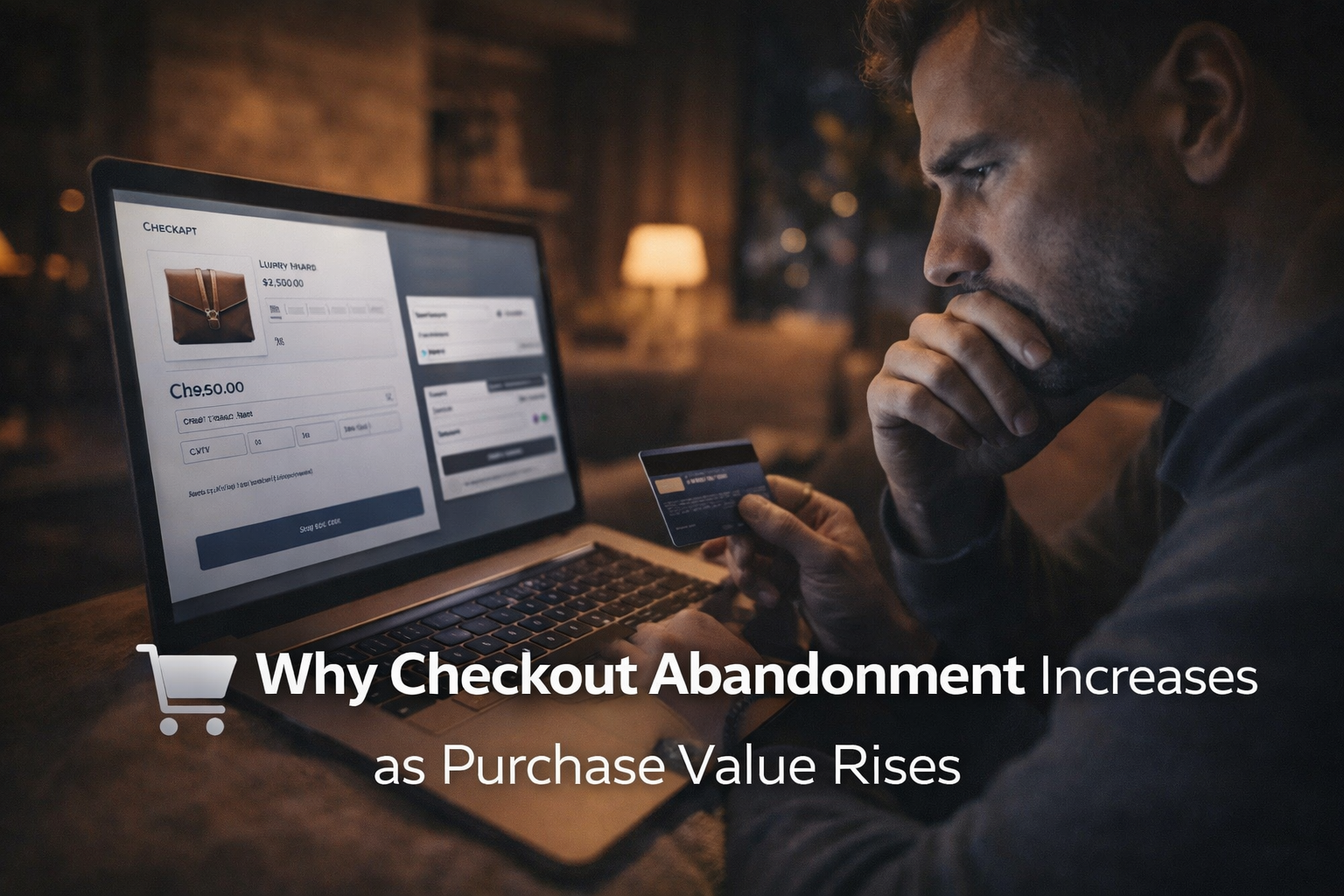
When a customer walks away from checkout, the reason is not always poor intent. In high-value sales, abandonment often rises because the decision feels heavier, riskier, and more personal. A $20 impulse purchase can survive a little friction. A $2,000, $20,000, or $200,000 purchase usually cannot.
That shift matters across luxury retail, automotive, travel, and real estate. Brands may invest heavily in SEO, paid media, and lead generation, only to lose serious buyers at the final step because the moment of commitment feels too exposed and too unsupported.
Table of Contents
Checkout abandonment high value purchases
Checkout abandonment high value purchases follow a different pattern than low-cost online buying. As price rises, the checkout abandonment rate often rises with it, showcasing increased abandonment rates, even when traffic quality is strong. The issue is not just usability. It is decision psychology.
A visitor who reaches checkout on a high-ticket item is often very interested, yet still uncertain. That person is no longer asking, “Do I like this?” The real question becomes, “Am I completely sure?” That is a much harder threshold to cross.
High-intent users and low-intent users behave differently at this point. Low-intent traffic may browse, compare, or add items to cart casually. High-intent users are closer to action, but they are also more sensitive to unresolved doubts. When the purchase value is high, small doubts become major blockers.
| Purchase context | Typical buyer mindset at checkout | Abandonment pressure |
|---|---|---|
| Low-cost retail | Impulse, convenience, low perceived risk | Lower |
| Mid-range purchase | Comparison, budget check, timing questions | Moderate |
| High-value purchase | Risk review, trust validation, need for certainty | High |
| Luxury or complex sale | Emotional weight, stakeholder input, deeper reassurance needed | Very high |
This is why checkout abandonment for high value products should not be treated as a simple cart problem. It is often a confidence problem.
Why high ticket checkout abandonment happens
The higher the price, the more psychological pressure enters the purchase. Buyers imagine regret before they imagine ownership. They begin to test every assumption: product quality, return options, seller credibility, payment safety, delivery, long-term value, and whether waiting might be smarter.
Spending more money also activates a fear of making the wrong decision in public and in private. A poor low-cost purchase is annoying. A poor high-ticket purchase feels embarrassing, financially painful, and harder to reverse. That emotional load slows action.
Many buyers also need validation before they commit. They may want to ask a clarifying question, confirm a policy, speak to a person, or simply feel that someone is available if anything goes wrong. If that reassurance is missing, delayed decision-making becomes the safe choice.
A few forces tend to stack together:
- Perceived risk: The buyer feels the consequences of error more sharply
- Decision visibility: Expensive purchases may need approval from a partner, manager, or family member
- Timing pressure: The buyer worries about acting too fast and missing better options
- Trust gap: The brand may look polished, yet still feel distant at the moment of payment
This is where many businesses misread behavior. Checkout abandonment in high ticket ecommerce conversion is often not a signal of weak demand. It can be a sign that the buyer is serious enough to hesitate.
Ecommerce checkout abandonment causes in high value sales
Several ecommerce checkout abandonment causes, such as shopping cart abandonment, become stronger as order value climbs. Trust signals matter more. Clarity matters more. The ability to get real answers matters far more.
A buyer considering a luxury item, vehicle reservation, premium travel package, or property inquiry is not moving through checkout like a shopper buying office supplies. The process is often layered with emotion, research, and hidden questions. If the checkout process feels mechanical, the buyer may pause, leave, and return later, or never return at all.
Common friction points include the following:
- Weak reviews or generic testimonials
- No visible guarantees
- Slow page loads
- Confusing financing or payment terms
- Extra fees appearing late
- Limited contact options
No real-time answers is one of the biggest issues. A buyer may wonder about delivery timing, returns, fit, product origin, financing, customization, taxes, insurance, availability, or legal terms. If no one is there to answer in the moment, momentum fades.
Poor user experience also hurts more in high-value sales, leading to higher abandonment rates. A long checkout flow, unclear steps, or missing pricing detail in the checkout process creates suspicion and contributes to shopping cart abandonment and checkout abandonment. Buyers start asking whether the product itself will be just as frustrating as the site experience.
High value purchase decision making behavior
High value purchase decision making behavior is rarely linear. Buyers move across devices, revisit pages, compare alternatives, read reviews, check brand credibility, and return at different emotional states. The path to purchase is longer because the buyer is building certainty, not just intent.
That longer consideration cycle means checkout is not the first real decision point. It is the final test. By the time someone arrives there, the business has already earned attention, yet issues like checkout abandonment often occur. The missing piece is often reassurance.
Research-heavy behavior is especially common in sectors where price and consequences are both high. Real estate, automotive, high-end travel, and premium retail attract buyers who want proof, context, and human confirmation before action.
Human reassurance matters because expensive purchases are not only rational. They are identity decisions. People imagine how the purchase will affect status, comfort, convenience, reputation, or lifestyle. That type of decision often benefits from real time customer engagement, not just static content.
A useful way to think about it is this:
- Search: The buyer gathers options
- Evaluate: The buyer narrows based on fit, price, and trust
- Validate: The buyer seeks reassurance from content, people, and signals
- Commit: The buyer takes action only after risk feels manageable
If validation is weak, the rest of the funnel underperforms, no matter how strong the traffic volume looks.
How to reduce checkout abandonment for high ticket products
To reduce checkout abandonment, businesses need to remove friction at the exact point where commitment becomes emotionally difficult. That starts with simplification. Fewer fields, clearer steps, stronger summaries, and visible next actions all help.
Transparency is just as important. Buyers should not be surprised by fees, financing terms, delivery windows, shipping costs, or restrictions near the end of the process. Clear pricing builds confidence. Hidden complexity destroys it.
Trust elements should be easy to find without forcing the buyer to leave checkout. Reviews, guarantees, return policies, security indicators, and concise explanations of what happens next can improve checkout conversion rate because they reduce the mental cost of saying yes.
Real-time support deserves special attention. For high-ticket products, support should not appear as a last-resort contact page buried in the footer. It should be present where hesitation appears.
Live video support for ecommerce conversion
Live video support for ecommerce conversion can reduce hesitation because it adds a human layer at the moment static pages stop being enough. The buyer sees that real help is available, right now, from a person who can respond with nuance.
That changes the emotional texture of checkout. A well-designed live video option can make the experience feel accountable and credible without disrupting the buyer’s path. It does not need to replace chat, phone, or automated workflows. It works best as an additional conversion layer for complex or high-value decisions.
Human presence builds trust quickly because it answers two silent questions at once: “Is this business real?” and “Will someone help me if something goes wrong?” For many buyers, that reassurance is what closes the gap between interest and payment.
It is also useful when the question is too detailed for FAQ content and too urgent for email. A product specialist, advisor, or live reception team member can explain options, clarify pricing, confirm availability, or guide next steps in minutes instead of hours.
A deeper comparison between automated and human-led conversion support can be found in Human vs Chatbot conversion.
Real time customer support for high intent buyers
Real time customer support for high intent buyers works because it catches hesitation before it turns into shopping cart abandonment. That timing matters. If a buyer leaves to “think about it,” the sales process becomes harder, slower, and more expensive to recover.
High-intent users are already near decision. They do not need broad education. They need the last unanswered detail resolved with confidence. Human support for ecommerce is especially effective here because it can read context, respond to emotion, and adapt to complexity in a way scripted automation often cannot.
This support layer can also qualify serious buyers. Not every visitor needs live interaction. The right model prioritizes users who show strong purchase signals, high cart values, repeated product views, or interest in understanding shipping costs or financing intent.
That produces several commercial benefits:
- Faster action: Questions get resolved before momentum fades
- Higher confidence: Buyers feel supported rather than processed
- Better qualification: Sales teams spend time on serious opportunities
- Lower drop-off: Fewer buyers abandon at the point of payment or inquiry
For sectors with longer sales cycles, this can also create cleaner handoffs into sales or concierge teams rather than letting valuable demand disappear into anonymous form submissions.
Conversion optimization for high value ecommerce
Conversion optimization for high value ecommerce should be viewed as a full system, not a page-level tweak. SEO may bring traffic. Paid campaigns may create reach. Lead generation may capture interest. Yet traffic alone is not enough when expensive decisions demand reassurance at the point of commitment.
That is why ecommerce conversion optimization for high-ticket products often requires multiple layers working together. Content builds credibility. Landing pages shape intent. Checkout design reduces friction. Human interaction closes confidence gaps.
Many businesses focus heavily on acquisition because it is easier to measure at the top of the funnel, yet neglecting the checkout process can result in increased abandonment rates. The harder truth is that more traffic sent into an under-supported checkout simply increases waste. If the buying experience cannot support high-intent users in real time, checkout abandonment increases and acquisition efficiency drops.
A practical strategy usually includes:
- Strong SEO around transactional and comparison keywords
- Paid traffic aimed at high-intent audiences
- Clear landing pages that answer core objections
- Real time customer engagement near checkout or inquiry points
- Follow-up systems for visitors who do not convert immediately
This is also where industry-specific proof matters. High-value buyers respond well to relevant evidence. Case studies from sectors like real estate and automotive can help reduce doubt because they show how similar decision paths were supported successfully.
Combining seo lead generation and live reception
Combining seo lead generation and live reception creates a more resilient path to conversion. SEO brings intent by placing the brand in front of buyers already searching for answers. Lead generation captures that demand through forms, calls, gated content, or booking flows. Live interaction helps convert the portion of that demand that stalls at the decision moment, addressing issues of checkout abandonment.
This is not an argument against existing systems. It is an argument for adding the missing layer. Many brands already have chat, email automation, CRM workflows, sales teams, and service teams. The gap appears when a high-intent buyer needs immediate human reassurance before committing online.
Live Reception fits well here because it can sit alongside current infrastructure rather than replacing it. That makes it useful for businesses that want to increase online sales conversion without rebuilding their funnel from scratch. More detail on that model can be found on the Live Reception landing page.
When businesses look closely at checkout abandonment rates in high value purchases, the pattern becomes clear. Rising purchase value increases emotional risk. Emotional risk raises the need for trust, answers, and human contact. If those are absent, the checkout abandonment rate rises even when demand is strong.
Improving the conversion strategy means treating the final step with the same seriousness given to acquisition. For high-ticket sales, the decision moment deserves real support. A short demo or consultation can help identify where human interaction may reduce friction and improve checkout conversion rate.