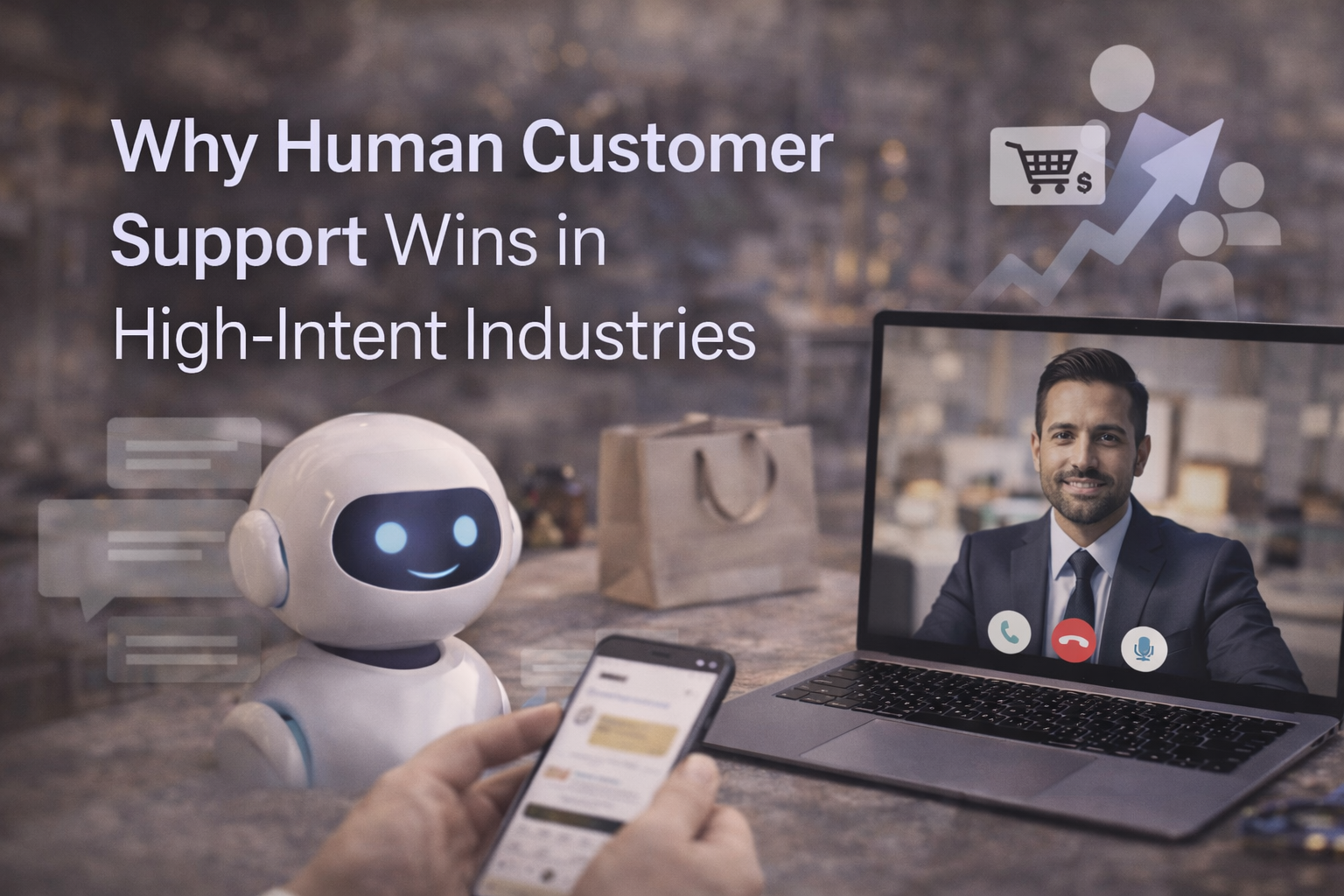
High-intent industries do not win on information alone. They win on confidence. When a guest is about to book a nonrefundable suite, when a patient is debating whether to schedule, or when a buyer is close to committing six figures on a home or car, the decision is rarely just “Can I?” It is “Should I trust you?”
Automation has a strong place in modern customer support. It can reduce friction, keep queues short, and answer the repeatable questions that otherwise drain teams. The problem starts when automation is asked to do a different job: carrying trust through a critical moment. That is where speed, nuance, and emotional intelligence stop being nice-to-haves and start shaping revenue.
Table of Contents
Low-intent and high-intent traffic are different species
Not every visitor deserves the same experience, and that is a good thing. Many interactions are low-intent: a quick check of store hours, a request for a return policy, a password reset, a shipping update. These moments reward speed and consistency.
High-intent interactions are different. The customer is closer to a decision, the stakes are higher, and the “question behind the question” matters more than the literal text in the chat box. A fast answer can still fail if it does not create certainty.
A useful way to think about this is not “human vs. bot,” but “task completion vs. decision support.” Both matter. Confusing them is where experience breaks.
| Dimension | Low-intent moment | High-intent moment |
|---|---|---|
| Customer goal | Get a quick fact | Reduce risk and commit |
| What “good” feels like | Fast, accurate, minimal | Reassuring, tailored, decisive |
| Typical questions | Hours, policy, status | Exceptions, edge cases, timing, trade-offs |
| Primary risk | Friction | Doubt |
| Best first response | Automation | Human guidance (with tools) |
| What delays cost | Annoyance | Abandonment, churn, negative word of mouth |
A chatbot can be excellent at low-intent work because it is predictable. High-intent work is where predictability can become a liability.
“Fast reply” is not the same as “confidence”
Organizations often measure support performance with response times, containment rates, and ticket deflection. Those are valid metrics, yet they miss what high-intent customers are buying in the moment: a sense that someone competent is present, accountable, and able to handle exceptions.
Confidence comes from signals. Humans read those signals quickly, sometimes subconsciously:
- Does this person understand what I mean, not only what I typed?
- Are they empowered to solve the issue, or just repeating policy?
- If something goes wrong later, will I be taken care of?
Automation can reply in one second and still fail all three. The mismatch shows up most when the customer has already done research and is now pressure-testing the brand. A scripted response can feel like a wall, even when it is technically correct.
In high-intent categories, that wall does not just slow a decision. It changes the emotional direction of the decision, from “I’m ready” to “I’m not sure.”
The trust gap created by scripted support
Automation tends to flatten language into safe, pre-approved structures. Safety is useful in compliance-heavy environments, yet it often produces a recognizable “support voice.” Customers interpret that voice as distance.
The trust gap is not about whether the bot is “smart.” It is about whether the customer feels seen, and whether the interaction adapts to the situation in front of it.
Critical moments often include one or more of these characteristics:
- The customer is asking an edge-case question that mixes multiple policies.
- The customer is anxious about timing, penalties, or eligibility.
- The customer needs reassurance that a real person can intervene if needed.
- The customer is making a high-value decision and is scanning for risk.
After a paragraph of back-and-forth with scripted replies, many customers stop asking and start leaving. The loss rarely shows up as an angry complaint. It shows up as quiet drop-off.
Signals that a conversation has shifted into high-intent mode are usually easy to detect if you look beyond keywords.
- Price anchoring: “Before I confirm, can you explain the total and what’s included?”
- Risk language: “What happens if…” “Is it refundable…” “Will I lose…”
- Time pressure: “I need this today.” “My appointment is tomorrow.”
- Authority checks: “Can you guarantee…” “Who can approve…”
- Comparison behavior: “Another provider said…” “Your competitor offers…”
These are not just questions. They are late-stage friction points. Treating them like FAQ items is where automation starts to break down.
When timing becomes a revenue variable
In high-intent industries, the best moment to help is often the narrow window right before commitment. That window is short, and it has a distinctive shape: motivation is high, doubt is active, and the customer is willing to engage.
This is why “we responded quickly” is not enough. What matters is whether the response moved the decision forward.
A slow human reply can cost a booking. A fast automated reply that fails to resolve doubt can cost the entire lifetime value. The second loss is harder to notice because it masquerades as normal conversion variance.
There is also a compounding effect. When late-stage conversations fail, marketing has to work harder to replace those near-wins. Acquisition costs rise, lead quality gets blamed, and teams spend months tuning funnels when the true issue is decision support at the edge.
The emotional dimension of conversion
Even enterprise buyers are human. A patient who is worried, a traveler who is uncertain, a VIP player who feels ignored, a buyer who fears making a mistake: these are emotional states that shape outcomes.
Emotional intelligence is not “small talk.” It is a professional skill: naming the concern, confirming constraints, presenting options, and giving the customer a clean next step. In many cases, it also means knowing when to be brief.
Automation can mimic empathy phrases. It struggles with the deeper work:
- Prioritizing the customer’s real concern when the message is ambiguous.
- Recognizing when the customer is asking permission to proceed.
- Adjusting tone based on seriousness and context.
- Making a judgment call when policies collide with reality.
In high-intent contexts, the most valuable sentence is often a confident one: “Yes, we can do that, and here is how.” A human can say it with ownership. A script often cannot.
Industry snapshots: where bots underperform in critical moments
The pattern is consistent across sectors, even though the surface-level questions differ.
Hospitality is a classic “almost ready” environment. Guests frequently hesitate at the point of booking because of cancellation terms, date changes, or room differences that are not well represented online. A bot can quote policy. A human can interpret the intent, offer the right room, explain what flexibility exists, and reduce fear around making the wrong choice. That reassurance is conversion work.
Healthcare has a trust threshold before scheduling. Patients may ask about insurance, preparation, privacy, symptoms, or what to expect. Many of those questions are not purely administrative. They are safety checks. A human presence can keep the conversation calm, verify the right path, and prevent the patient from abandoning care or delaying unnecessarily. Even when clinical advice is not appropriate, respectful guidance matters.
Luxury retail hinges on high-ticket hesitation. Customers might be seconds from checkout yet still need validation: authenticity, warranty, sizing nuances, availability, gifting timelines, or whether the item fits the moment they are buying for. Luxury is partly product, partly assurance. Scripted support can feel mismatched to the brand promise.
Real estate is a qualification and seriousness test. Buyers ask about contingencies, disclosures, financing readiness, viewing logistics, neighborhood constraints, and timing. A bot can schedule a tour. A human can assess readiness, route to the right agent, and handle the delicate questions that decide whether the buyer shows up or disappears.
Automotive is consultative by nature. Shoppers want clarity on financing structures, trade-in details, trim differences, availability, and what can be done today. The sale is shaped by friction removal and credible answers. When automation cannot address specifics, it can create the impression that the dealership is hard to reach, even when staff are available.
iGaming has an even sharper version of the same issue: VIP retention and churn prevention. High-value players often reach out when something feels off: withdrawals, limits, account verification, responsible gaming controls, or a perceived lack of recognition. In those moments, speed matters, yet tone and discretion matter just as much. A scripted response can escalate frustration and accelerate churn.
Across all of these examples, the common thread is that the customer is asking, “Is it safe to proceed with you?” That is a trust question more than a support question.
Human customer support and human presence increases qualification, not only conversion
A human-led interaction does more than close. It filters. That can sound counterintuitive to growth teams, yet it is one of the healthiest outcomes for high-intent pipelines.
When a trained person engages at the right moment, they can:
- Clarify requirements and reduce downstream cancellations.
- Confirm fit and route to the correct product, service, or specialist.
- Set expectations that prevent refunds, disputes, and chargebacks.
- Identify urgency and prioritize truly valuable conversations.
In other words, human support is not only a cost center. In high-intent environments, it functions as a revenue quality layer.
This is also why purely automated “containment” can be misleading. Containment rates can rise while satisfaction and conversion silently weaken, because the customers who needed nuance simply leave instead of escalating.
A digital front desk that activates only when intent is high
The strategic alternative is not to rip out automation. It is to treat automation as the lobby, and humans as the concierge.
Many organizations are moving toward a human-first digital layer: a digital front desk that handles low-intent requests automatically, then escalates smoothly when intent signals appear. Done well, it preserves efficiency while protecting the moments where trust drives revenue.
This model becomes even stronger when it includes richer presence, like live video or co-browsing, for the interactions where seeing a real person reduces doubt quickly. Video is not required for every industry or every customer, yet in high-stakes moments it can compress time-to-trust dramatically.
A practical activation model usually follows a few principles.
- Define what “high intent” means in your business using behavioral and language signals.
- Route high-intent conversations to trained staff with clear empowerment paths.
- Keep context intact so customers do not repeat themselves when escalated.
- Offer an optional “human now” path for customers who do not want to negotiate with a bot.
- Measure outcomes that reflect trust, like conversion lift, saved cancellations, reduced disputes, and retained VIP value.
The goal is not more human interaction. It is better-timed human interaction.
What decision makers should measure when trust is the product
If your category depends on confidence, your support metrics should reflect that reality. Response time still matters, yet it should sit alongside measures tied to late-stage outcomes.
Look closely at what happens after a “resolved” automated conversation. Did the customer book, schedule, deposit, visit, or purchase? Did they return with the same issue? Did they cancel within a short window? Did they escalate publicly?
When you connect support mode to commercial outcomes, the pattern tends to be clear: automation excels at repeatable tasks, while human presence protects the revenue moments where nuance, accountability, and emotion shape the decision.
The strongest customer experience strategies accept this division of labor and design for it. They let machines do what machines do best, and they put real people on the field when the game is actually being decided.
How Human Customer Support Impacts Hotel Website Conversion
In hospitality, hesitation happens seconds before booking. When guests cannot clarify cancellation policies, late arrivals, parking rules, or room details, they leave. That final moment is where human customer support makes the difference.
If you want to explore how missed conversations directly affect booking performance, read our in-depth analysis on hotel website conversion rate and missed guest conversations, where we break down how high-intent traffic slips away without real-time human interaction.