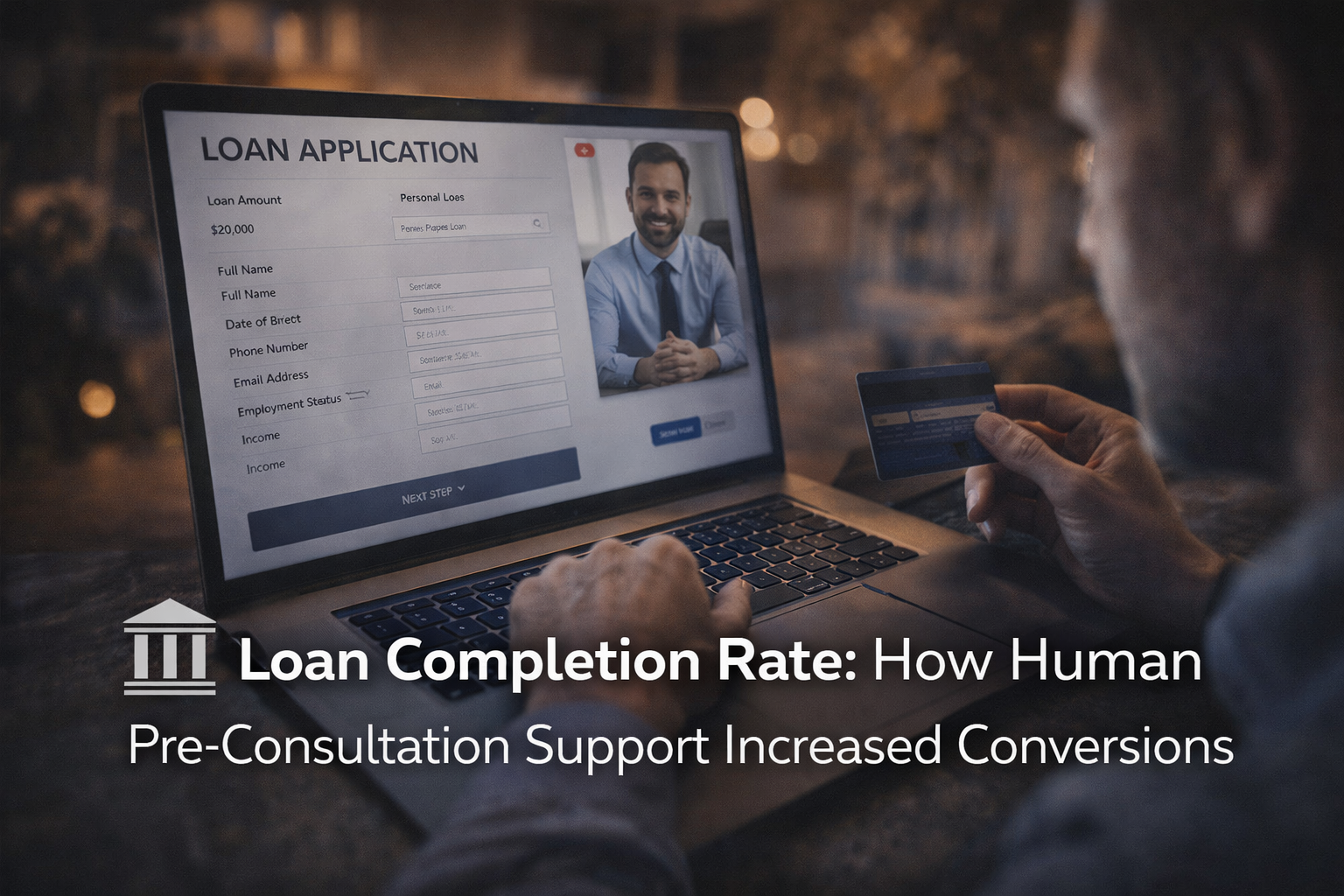
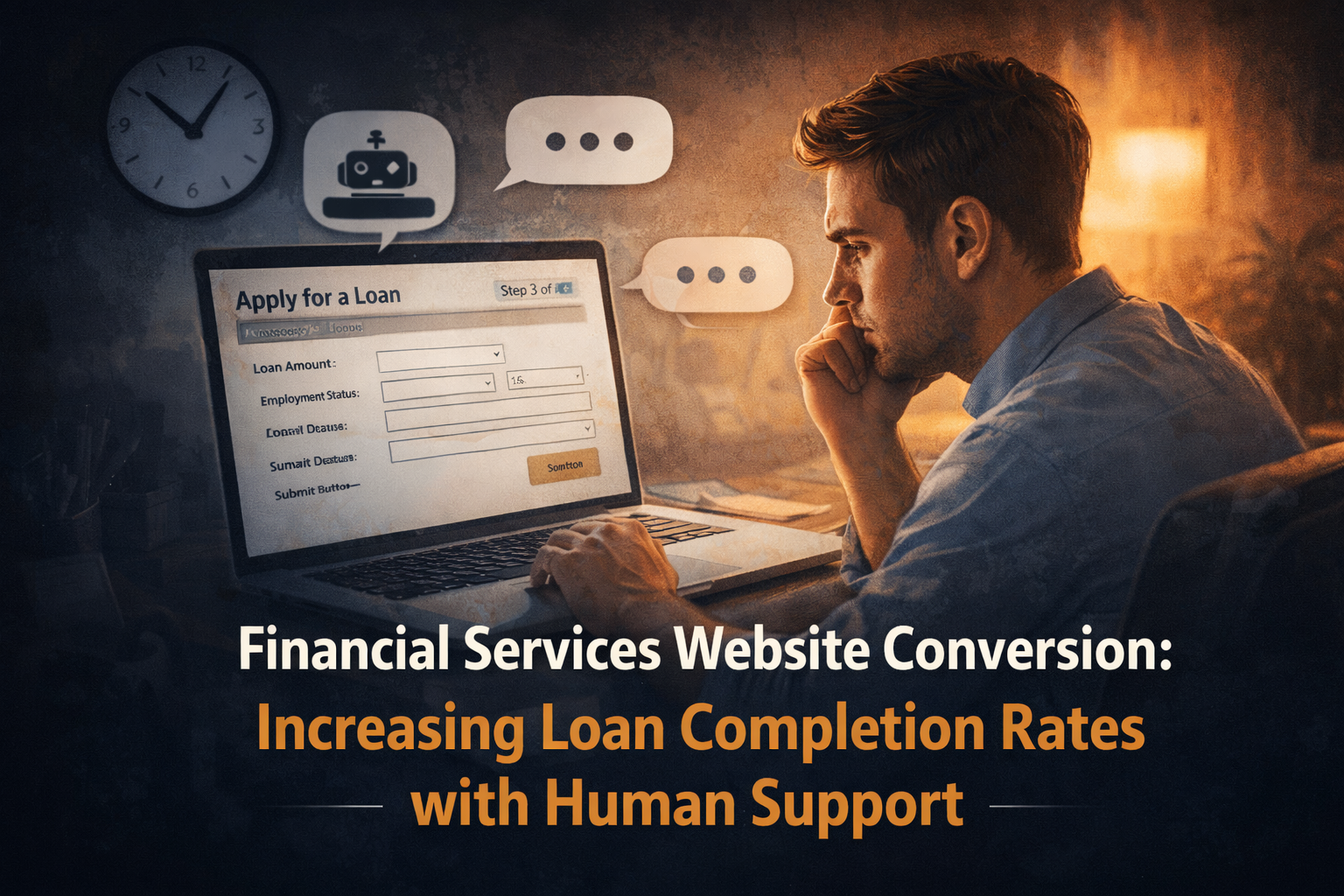
A financial services website can attract thousands of visitors who are ready to act, compare offers, and begin an application. Yet many of those same users leave before submitting a loan request. The traffic is there. Intent is there. Revenue potential is there. What breaks down is the final step between interest and commitment.
That gap matters because loan applications are not casual purchases. They involve personal data, financial risk, and decisions that can affect someone’s next several years. When a user feels uncertain, rushed, or unsupported, abandonment rises fast. For banks, fintech companies, and lenders, the answer is often not more traffic. It is better conversion support at the point where confidence starts to wobble.
Table of Contents
financial services website conversion challenges
Financial services website conversion is the percentage of visitors who complete a meaningful action on a site. That action might be booking a consultation, requesting a quote, starting an application, or submitting a completed loan form. In lending, the most valuable conversion often sits at the end of the funnel: a fully completed application.
This is what makes conversion in financial services different from many other sectors. A user may arrive with strong intent and still hesitate because the action requires more than a click. It requires trust, clarity, and certainty. A retail shopper can abandon a cart and come back later with little consequence. A borrower weighing a personal loan, mortgage, or business finance product is carrying a larger emotional and financial load.
Loan application funnels also ask a lot from users. They request identity details, income information, employment history, and consent to checks. Even when the product itself is attractive, the path to completion can feel long or exposed. That friction has a direct effect on the financial services conversion rate.
This is why many firms see a mismatch between traffic volume and actual loan performance. Their site may be succeeding at acquisition while underperforming at financial website lead conversion. Traffic numbers look healthy, but the business still struggles to improve financial website conversion where it matters most: completed applications.
why financial services website conversion drops in loan applications
Loan applications tend to lose users at the exact stage where reassurance is most needed. Complexity is part of the issue. Multi-step forms, eligibility questions, document requests, and unclear terminology can make users pause. Every extra field adds effort. Every unexplained requirement adds doubt.
Clarity is another major factor. Many sites explain the product well at the marketing level but fall short inside the application flow. A user may understand the rate range or repayment term, yet still ask practical questions: What counts as acceptable income evidence? Will checking eligibility affect credit? Can a joint applicant be added later? If those answers are not easy to find, users often stop rather than guess.
Trust concerns are never far away in financial journeys. A person who is willing to read about a loan product may still hesitate when asked to upload documents or share sensitive personal data. The issue is not always fear of fraud. Sometimes it is uncertainty about who is reviewing the application, what happens next, and whether the process is worth finishing.
The final problem is the absence of real-time guidance. A user can be minutes away from applying, then meet a point of confusion with no obvious route to help. If support is hidden behind a contact form or delayed email reply, momentum disappears. In that moment, silence costs conversions.
After firms review session recordings, support logs, and funnel analytics, the same patterns tend to appear:
- Long forms
- Vague eligibility language
- Concerns about credit impact
- Questions about required documents
- No immediate access to a real person
loan completion rates and financial services website conversion
The loan application completion rate measures how many users who start an application actually finish it. It is one of the clearest indicators of funnel health because it shows whether intent is being converted into revenue opportunity.
A site may generate strong click-through rates from search, paid campaigns, or partner channels, yet still underperform if users abandon midway through the process. That means the top of the funnel is working while the bottom is leaking value. In practical terms, the relationship is simple: stronger loan completion rates usually mean stronger financial services website conversion.
The business impact is significant. When more qualified applicants complete the process, underwriting teams spend less time on partial records, sales teams receive better leads, and decision cycles shorten. That affects efficiency as much as growth. A higher loan application completion rate is not just a marketing win. It improves operating economics across the funnel.
| Metric | Weak funnel | Supported funnel |
|---|---|---|
| Application starts | High | High |
| Completion rate | Low | Higher |
| Lead quality | Mixed | Stronger |
| Manual follow-up needed | Heavy | Lower |
| Time to decision | Slower | Faster |
A rise in completion also improves forecasting. When lenders can trust that high-intent visitors are moving forward at a predictable rate, they can plan staffing, ad spend, and approval workflows with more confidence. That is why teams focused on digital banking conversion increasingly track completion rate alongside traffic and lead volume.
human pre consultation support in financial services website conversion
Human pre consultation support gives users access to a real person before or during the loan application process. It can take the form of live reception, inbound call handling, callback routing, or website-triggered conversations when a user shows signs of hesitation. The key point is timing: support arrives before abandonment becomes final.
This support fits between initial interest and formal application submission. SEO may attract the visitor. Lead generation tools may capture basic interest. Human interaction steps in when the user needs reassurance, explanation, or a quick answer that moves them forward. This is the conversion layer many financial sites are missing.
Why does it work so well? Because financial decisions are rarely made on information alone. They are made when information is paired with confidence. A short conversation with a trained human can resolve uncertainty faster than a FAQ page, chatbot script, or follow-up email sent hours later.
how human interaction improves financial services website conversion
A real person changes the emotional temperature of the application process. Instead of facing a static form, the user feels supported. That matters because trust is built through responsiveness as much as design. Clean pages and secure forms are essential, but human presence tells the applicant that help is available right now.
Human interaction also reduces hesitation at the most fragile stage of intent. A user who pauses to ask, “Will this affect my credit score?” is still engaged. A user who closes the tab may be gone for good. Real time customer support financial services teams can save those moments by answering quickly and confidently.
There is also a practical benefit. Loan applications often involve questions that are too nuanced for automated prompts. Income types, self-employment details, co-applicant scenarios, and documentation requirements can vary. Human support keeps the process moving without forcing users to decode policy language on their own.
This is where live support creates measurable gains:
- Trust building: users feel there is accountability behind the website
- Clarification: confusing terms and steps are explained in plain language
- Momentum: hesitation is addressed before the user exits
- Decision support: applicants gain enough confidence to continue now, not later
When firms want to reduce loan application abandonment, these gains translate into numbers. More starts become completions. More leads become qualified opportunities. More visitors move from curiosity to action.
case study financial services website conversion improvement
A mid-sized lender was generating consistent organic and paid traffic to personal and small business loan pages. The site performed well at attracting visitors with clear commercial intent. Application starts looked promising, yet completion lagged well behind expectations. Analytics showed drop-off clustering around document upload, eligibility uncertainty, and final submission review.
The business initially focused on page design, form tweaks, and reminder emails. Those changes helped at the margins, but not enough to shift the financial services conversion rate in a meaningful way. User feedback pointed to a deeper issue: applicants wanted to speak with someone before they committed sensitive details or clicked submit.
The next phase introduced human pre consultation support. Visitors on high-intent pages were offered immediate access to a real person through live reception and fast callback options. Support staff were trained to answer common application questions, clarify next steps, and route more complex cases to the right internal team. Messaging was placed near friction points, not buried in the footer.
Within one quarter, the funnel looked different. Completion rose because users received help at the exact moment confusion appeared. Lead quality improved because applicants entered the form with better context. Sales and operations teams also saw fewer incomplete records and faster follow-up cycles.
| Outcome | Before human support | After human support |
|---|---|---|
| Loan application completion rate | 22% | 34% |
| Abandonment after form start | 58% | 39% |
| Qualified lead share | 41% | 56% |
| Average time to decision | 5.1 days | 3.8 days |
The strongest result was not just more conversions. It was better conversions. That distinction matters. When a lender can increase loan completion rate while improving applicant quality, the commercial return is stronger across marketing, underwriting, and customer care.
real time support in financial services conversion
High-intent users do not stay high-intent forever. Intent is perishable. In lending, a user may compare several providers in one sitting, ask a few internal questions, and choose the business that feels most responsive. Real time customer support financial services teams can capture that moment before uncertainty becomes delay.
This is especially valuable on mobile, where forms feel longer and interruptions are common. A user beginning an application on a phone may face extra friction when switching apps for document access or checking bank details. A timely human interaction can keep the user engaged and reduce drop-off during those breaks.
When support is available at the right moment, three improvements usually follow:
- Faster clarification
- Lower abandonment
- Stronger completion intent
- Better financial services customer experience
That last point deserves attention. A better financial services customer experience is not only about friendliness or brand tone. It is about reducing effort in a process where stakes feel high. Good support lowers friction without lowering standards.
combining seo lead generation and live reception in financial services
The strongest conversion systems do not treat traffic, leads, and conversations as separate functions. They work together. SEO brings in users who are actively searching for loan solutions, rates, approval criteria, and financing options. Those visitors often have stronger commercial intent than general awareness traffic, which makes them especially valuable.
Lead generation captures that interest before it disappears. That may include form starts, quote requests, eligibility checks, or callback requests. Yet capture alone is not enough. If a user enters the funnel and then stalls, the opportunity is only partially secured. This is where live interaction completes the system.
A practical model looks like this:
- SEO: attracts high-intent users searching for financial products
- Lead generation: captures early interest and identifies intent signals
- Live reception: converts hesitation into completed action through human support
This layered approach helps improve financial website conversion without depending only on higher traffic volumes. It also supports stronger digital banking conversion by treating human interaction as part of the digital experience, not a separate offline function.
Teams building this system often pair funnel analysis with content and support strategy. Educational articles can address early-stage questions, while real-time help handles decision-stage doubts. Related resources might include pages or blogs on Loan Application Drop-Off, Loan Completion Rate, Checkout Abandonment, Human vs Chatbot, and High Intent Traffic. Together, those assets strengthen both acquisition and conversion.
For banks, fintech brands, and lenders that already attract interested visitors, the next growth move may be simpler than another traffic campaign. It may be adding the human layer that turns uncertainty into action. If your site generates application starts but struggles to convert them, a live pre consultation model can reveal how many borrowers are ready to proceed once someone answers the right question at the right time. A focused demo or consultation can show where those moments happen and how to turn them into measurable gains in revenue.