Many teams treat a rising checkout abandonment rate as a design failure. They tighten spacing, reduce form fields, test button colors, add another payment icon, and hope the numbers move.
Sometimes they do, but not by much.
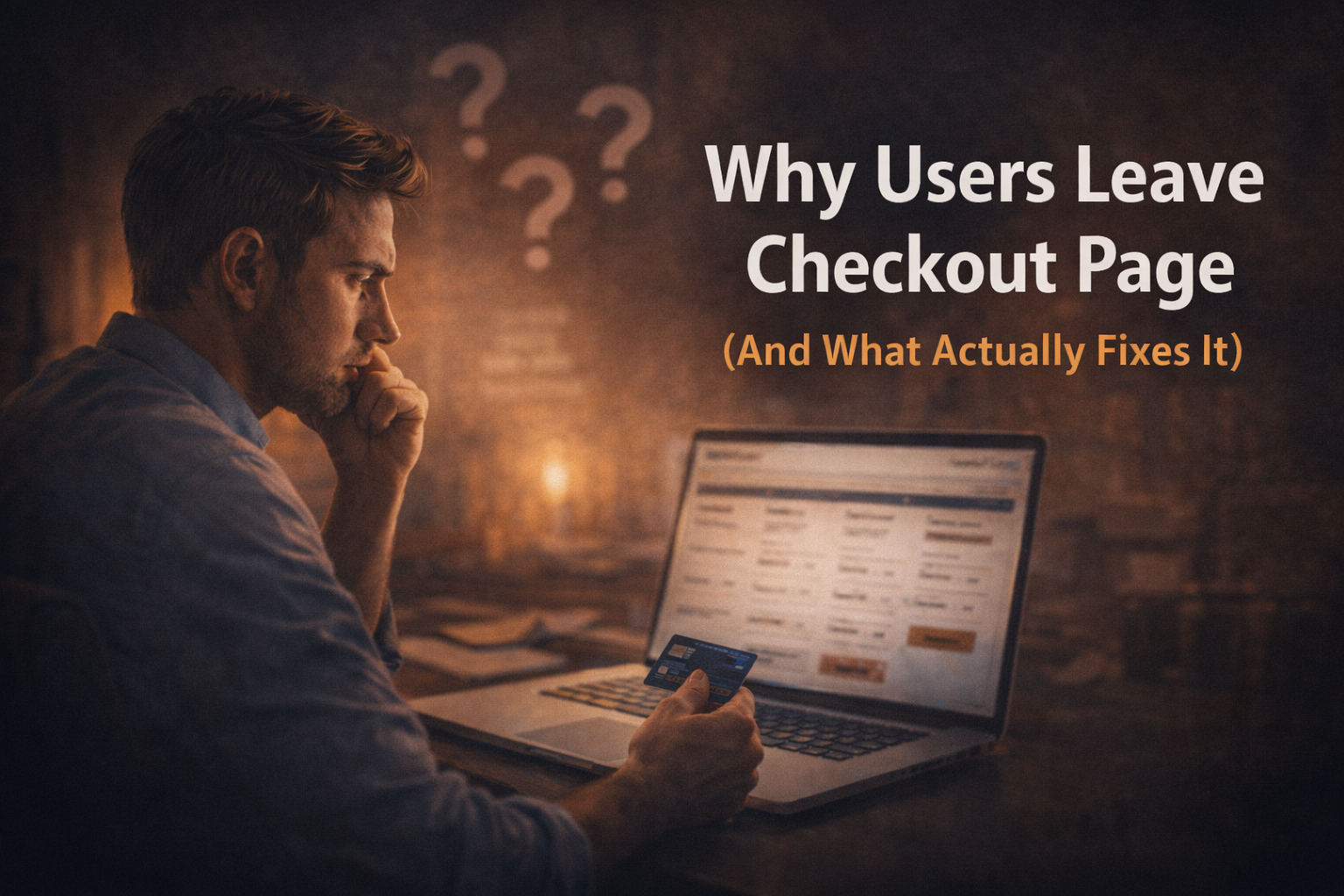
That is because many users do not leave at checkout because the page is broken. They leave because the decision is still unresolved. The cart may be full, the product may be right, and the buying intent may be real, yet a final question or quiet doubt stops the purchase. At that point, the issue is not usability alone. It is hesitation.
Checkout abandonment is not a checkout problem. It is a decision-making problem.
Table of Contents
Why checkout abandonment is often misdiagnosed
It is easy to blame the page itself. Checkout is measurable, high stakes, and close to revenue. When users disappear there, the checkout page becomes the obvious suspect.
That view is incomplete.
By the time someone reaches checkout, they have already moved through product pages, pricing, comparisons, and internal debate. They are not casual browsers anymore. They are high-intent buyers standing at the final step. If they leave now, it often means they still lack the confidence to commit.
A cleaner layout can reduce friction. Faster load times matter. Fewer form fields can help. Yet these are supporting factors, not the main cause in many cases. A buyer can complete a long form when they feel certain. They can abandon a beautifully designed checkout when they do not.
The pattern becomes even clearer in ecommerce categories where the purchase carries more weight:
- furniture
- premium electronics
- custom products
- medical or wellness devices
- luxury goods
- business equipment
In these cases, hesitation is rarely about where to click next. It is about whether buying now feels safe and sensible.
What users are really thinking at the final step
Checkout is where abstract interest turns into a real financial decision. The customer is no longer imagining the product. They are about to spend money, commit to delivery, and trust the seller.
That shift changes everything.
A person who looked confident a minute earlier may now ask silent questions: Is this the right version? What if shipping takes longer than expected? Can I return it easily? Why is the total higher than I thought? Is this brand actually reliable? If something goes wrong, will anyone help me?
These questions are not technical issues. They are decision blockers.
The problem is that most checkout experiences are built as if buyers need only mechanics, not reassurance. They offer fields, buttons, policy links, and maybe a chatbot. What they often do not offer is a way to resolve uncertainty in the moment it appears.
Here is what tends to sit underneath checkout abandonment:
- Product doubt: Is this item really the right fit, size, model, or package?
- Price doubt: Is the total fair, and am I missing hidden costs?
- Delivery doubt: When will it arrive, and can I count on that timeline?
- Trust doubt: If there is a problem, will this company respond?
- Outcome doubt: Will this purchase actually solve the problem I have?
A buyer does not need many doubts to leave. One is enough.
Why users leave checkout page and why standard checkout fixes often fail to solve the real issue
Most optimization playbooks focus on surface friction. That makes sense because those changes are visible, testable, and relatively easy to ship. The trouble is that they do not always answer the buyer’s question.
A shorter checkout does not explain whether white-glove delivery includes setup. A discount popup does not reassure a customer who is unsure about warranty coverage. An abandoned cart email arrives after the hesitation has already won.
The timing is a major problem. Decision friction is strongest when the customer is actively trying to decide. If help comes later, the emotional momentum is gone.
The common fixes are not useless. They are just often aimed at the wrong layer of the problem.
| Common tactic | What it can improve | What it usually cannot resolve |
|---|---|---|
| Simplified forms | Speed and reduced effort | Product, trust, or delivery doubts |
| Better visual design | Clarity and perceived polish | Final purchase confidence |
| Exit-intent discounts | Price sensitivity | Questions unrelated to price |
| Abandoned cart emails | Recovery after leaving | Real-time hesitation at decision point |
| Chatbots with scripted flows | Basic FAQs | Nuanced, context-heavy concerns |
This is why many brands keep optimizing checkout and still feel stuck. The page may become smoother while abandonment remains stubbornly high.
Why hesitation grows at checkout, especially for high-ticket ecommerce
The closer a customer gets to paying, the more real the tradeoff becomes. During browsing, the upside dominates. At checkout, the risks come forward.
That is normal buyer psychology.
A $25 impulse purchase can survive small uncertainties. A $1,200 chair, a personalized ring, or a commercial espresso machine usually cannot. The customer may need a quick answer before they feel ready to proceed. Not tomorrow. Not after an email sequence. Right then.
Take a few familiar ecommerce moments. A shopper is buying a sectional sofa and wants to know whether the delivery team will carry it upstairs. Another is purchasing a high-end air purifier and needs confirmation that it covers the square footage in their home. Another is about to place a large skincare order but worries about return eligibility after opening one item.
These are not edge cases. They are the exact kinds of questions that show up when purchase intent is strongest.
And when no one answers them, the customer pauses. Then they leave.
Why static information and chatbots are not enough
Many ecommerce teams assume the answer is already on the site somewhere. There is a shipping page, a returns page, a product FAQ, and a chatbot in the corner. From an operational point of view, that seems reasonable.
From a buyer’s point of view, it often feels like work.
At checkout, users are not looking for more pages to read. They want resolution. They want a direct answer to their exact concern, with enough confidence behind it that they can move forward.
Static content helps with standard objections, but it cannot adapt to nuance. A chatbot can answer simple, repeatable questions, but it usually struggles when context matters. If the customer’s real concern is subtle, emotional, or product-specific, scripted responses tend to feel thin.
One sentence matters here: people trust people when the decision feels risky.
That does not mean every cart needs a phone call. It means there should be a clear path to immediate human help when the buyer needs it.
Real-time human communication changes the checkout equation
When a customer can reach a real person at the point of hesitation, the nature of checkout changes. The page is no longer a dead end. It becomes a decision support layer.
This matters because human interaction can do what static interfaces cannot. A real person can hear the actual concern, clarify the right detail, adapt the answer, and reassure the customer that someone will be there after the purchase too.
That is why real-time communication is not just a support feature. It is a conversion mechanism.
The shift is simple:
- from form completion to decision support
- from delayed follow-up to immediate reassurance
- from generic content to tailored answers
For many brands, this is the missing layer between interest and purchase.
A service like Live Reception fits naturally into that gap. It gives high-intent shoppers access to real people at the exact moment they are deciding whether to complete the order. Instead of asking the buyer to leave, wait, or search, it brings human interaction into the moment that matters most.
Used well, this does not feel intrusive. It feels reassuring.
What real human help can resolve that checkout optimization cannot
A real person can answer the question behind the question.
When a shopper asks, “Can I return this if it doesn’t fit?” they may really be asking, “Is it safe to buy from you?” When they ask, “Why is shipping this high?” they may really be asking, “Am I about to regret this purchase?” Pages and scripts tend to answer literally. People can answer intelligently.
That creates several advantages at once:
- Clarification: product fit, delivery details, warranties, returns
- Confidence: reassurance that the company is reachable and accountable
- Momentum: fewer delays between doubt and decision
- Trust: human presence at the point of payment
This is especially valuable for categories where the product has complexity, customization, or a meaningful price tag. In those settings, the buyer is not asking for hand-holding. They are asking for confidence.
How this looks in practical ecommerce scenarios
Consider a customer buying a $2,500 dining table online. The photos look good. The finish options are clear. The shopper adds the item to cart and reaches checkout. Then a concern appears: will the wood tone match what they expect under warm indoor light? A generic FAQ cannot really settle that. A chatbot may offer a returns link. A real person can explain the finish, mention common customer feedback, and confirm the return policy in plain language. That can be enough to move the order through.
Or take a buyer purchasing a fitness machine for a home gym. They are ready to pay, then stop because they are not sure whether delivery includes room-of-choice placement. They do not want curbside drop-off for a 300-pound item. If nobody answers that in real time, the sale stalls. If someone answers clearly within seconds, the buyer can proceed with confidence.
These are conversion moments, not service moments.
That distinction matters. The goal is not simply being helpful. The goal is removing the exact uncertainty preventing purchase.
How to add a human layer without making checkout feel heavy
Some teams hear “human interaction” and picture a slow, high-touch sales process. That is not what this requires. The best version is light, timely, and available only when needed.
The objective is not to interrupt every buyer. It is to support the buyers who are close to purchasing but not fully ready.
A practical setup often includes:
- clear access to a real person from checkout
- fast response during key shopping hours
- agents trained on product, shipping, returns, and common objections
- handoff paths that keep the customer near the purchase, not away from it
The operational model matters too. If the interaction feels buried, slow, or disconnected from the brand, it will not help much. If it feels immediate and informed, it can turn hesitation into action.
That is where a service layer like Live Reception becomes useful. It gives ecommerce brands a way to meet final-stage doubt with real human response, without rebuilding the entire buying experience around a call center model.
What to measure if you shift from page optimization to decision support
If the root problem is hesitation, then success metrics should reflect that. Page speed and form completion still matter, but they are not enough on their own.
Watch what happens when human help is available at checkout. Do assisted sessions convert at a higher rate? Are average order values stronger? Do high-ticket products benefit more than low-cost items? Are fewer shoppers leaving after seeing shipping costs or return details?
The key signals usually include both conversion and confidence.
- Assisted checkout conversion rate
- Response time to human inquiries
- Revenue from assisted sessions
- Abandonment rate for high-ticket carts
- Post-purchase cancellation or return patterns
Those numbers tell a more useful story than cosmetic page tests alone. They reveal whether buyers are getting the reassurance they need when the decision is still alive.
The main shift is simple but powerful: stop asking only how to make checkout easier, and start asking how to make the decision easier.
That question opens a better path. It moves attention away from tiny interface fixes and toward the real barrier, which is unresolved doubt at the point of commitment. When ecommerce brands answer that doubt in real time, checkout stops being a silent filter and starts becoming a supported decision.