Hotels spend heavily to attract attention online. They invest in search visibility, paid campaigns, OTA listings, social content, and polished websites. Yet even with healthy traffic, many properties still see the same frustrating pattern: visitors arrive, review rooms, compare rates, hesitate at checkout, and leave without making a direct booking.
That gap is where revenue slips away.
For hotel owners, managers, and hospitality marketers, the issue is rarely a lack of interest. Many of those visitors are already close to booking. They are checking room types, reading policies, reviewing amenities, and weighing options against competing properties. They are not casual browsers. They are deciding.
Table of Contents
Why website traffic does not automatically increase hotel bookings
A hotel website can do many things well and still fail at the final step. Beautiful design, sharp imagery, fast load times, and a modern booking engine all matter. They help a property look credible and easy to book.
Still, usability is not the same as confidence.
Guests often pause because they need one more piece of information before they commit. Maybe they are unsure whether a family room fits their needs. Maybe they want clarity on parking, breakfast, cancellation terms, airport transfers, or late check-in. Maybe the pricing looks close to a competitor, and they want a reason to choose your property instead.
When no one answers those questions in the moment, the visitor keeps comparing, leaves to check another site, or returns to an OTA where the path feels more familiar.
The result is a familiar mix of pressure points:
- OTA dependence
- High commission costs
- Low direct booking conversion
- Abandoned booking sessions
- Lost revenue at the decision stage
Why high-intent hotel website visitors still leave without booking
Hotels often assume that if a guest wants to book, they will figure it out. In practice, even motivated guests can stall when uncertainty enters the process.
This is especially true for higher-value or more complex stays. A traveler booking a one-night business trip may need a quick answer on invoice details or early breakfast. A family may need certainty about bedding configurations and child policies. An international guest may want reassurance about payment methods, taxes, or local transportation. A couple comparing room categories may need help deciding whether the upgrade is worth it.
These are not weak leads. They are strong booking opportunities that have not received timely support.
Several forms of hesitation tend to appear right before the booking is completed:
- Room questions: bed types, views, accessibility, occupancy limits
- Policy concerns: cancellation rules, deposits, pet policies, check-in times
- Rate uncertainty: taxes, inclusions, promotional terms, best available offer
- Trust signals: who to contact, whether the booking is really direct, what happens if plans change
- Booking friction: too many steps, unclear wording, lack of reassurance during checkout
A visitor who reaches this stage has already shown intent. The challenge is not attraction. It is conversion.
Why common hotel conversion tactics often fall short
Many hotels respond to low direct booking rates with the usual fixes. They redesign the site. They add urgency messages. They offer a discount code. They send email reminders after abandonment. These steps can help, but they do not solve the core problem when the guest needs a real conversation before making a decision.
Better design improves clarity, but it does not answer a specific question at 9:40 p.m. Discounts may lift conversion, but they cut into margin and train guests to wait for incentives. Email follow-up has value, though it often arrives after the visitor has already booked elsewhere. Chatbots can cover basic requests, yet nuanced booking questions rarely fit into scripted flows.
What gets missed is simple: many bookings are lost because nobody is available when the guest is ready to ask.
That is where Live Reception changes the model.
How Live Reception increases direct hotel bookings
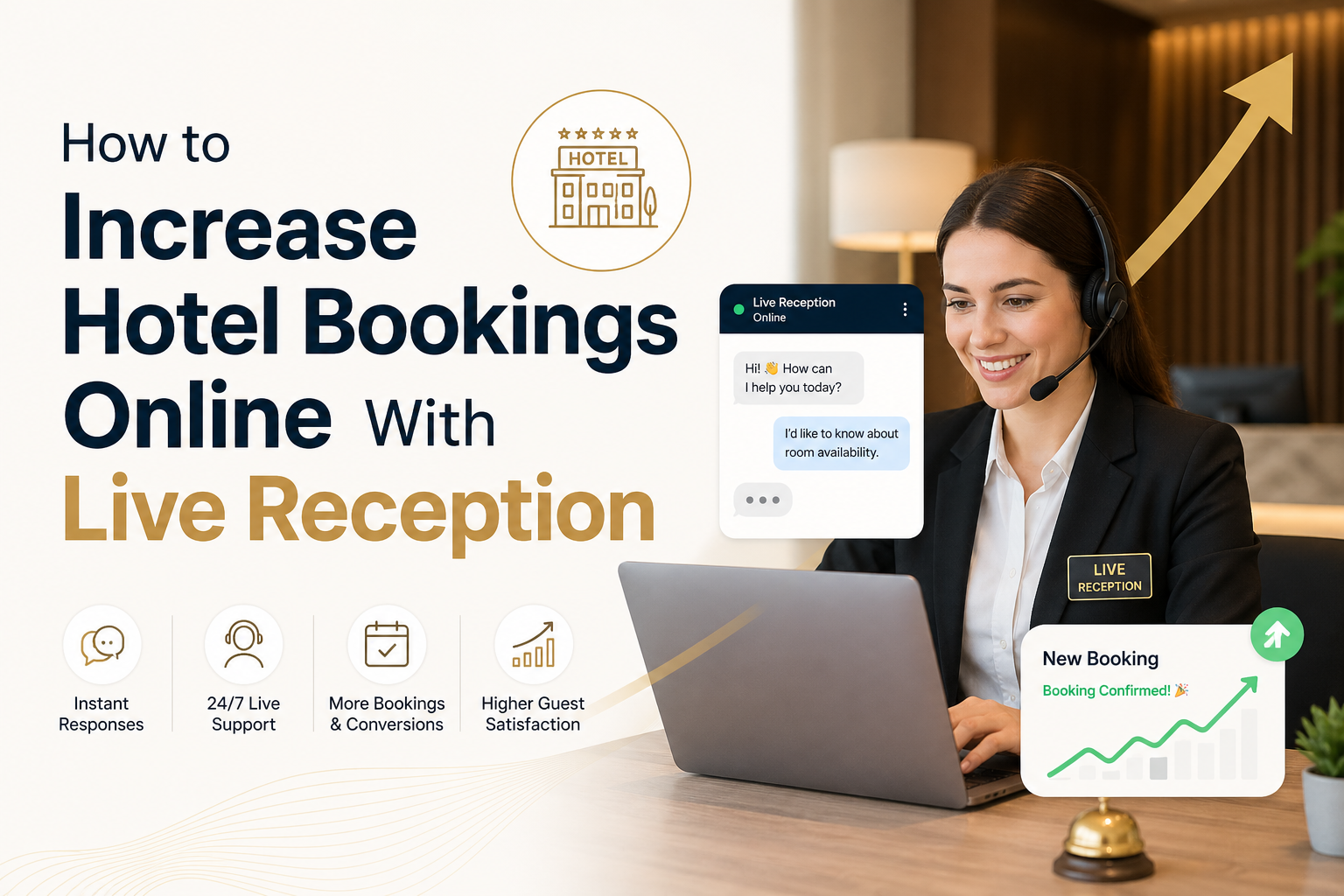
Live Reception adds a real-time human interaction layer to the hotel website. It is not just another support tool. It is a conversion layer placed exactly where hesitation happens.
When a visitor is browsing rooms, comparing rates, or lingering on the booking page, Live Reception gives them immediate access to a real person who can answer questions, clarify details, and guide them toward a confident decision.
This matters because hospitality is built on reassurance. Guests are not only buying a room. They are buying confidence in the stay, the experience, and the booking itself.
A real receptionist or booking specialist can do what static pages and bots cannot:
- Clarify details: explain room differences, rate inclusions, and availability in plain language
- Recommend options: suggest the right room or package based on guest needs
- Reduce doubt: answer policy questions and remove uncertainty before checkout
- Support direct booking: keep the guest on the hotel website rather than sending them back to OTAs
This is the shift many properties need. The website should not function only as a brochure plus booking engine. It should also act like a live front desk for online visitors.
What Live Reception looks like during the hotel booking process
In practice, the flow is simple.
A guest lands on the hotel website after seeing an ad, organic search result, metasearch listing, or social post. They review room options and start comparing choices. Then a question comes up. Instead of leaving the site to search elsewhere or postponing the decision, they connect with Live Reception.
A real person responds right away, addresses the concern, and helps the guest move forward. That may mean clarifying whether a deluxe room includes a balcony, confirming if breakfast is included in a direct rate, explaining cancellation flexibility, or helping the guest choose between two dates.
The key point is speed paired with human judgment.
| Booking stage | Typical visitor behavior | Risk without support | Live Reception impact |
|---|---|---|---|
| Room browsing | Compares categories and amenities | Leaves to check competitor sites | Gets guided toward the best-fit room |
| Rate review | Questions pricing or inclusions | Assumes OTA is safer or clearer | Receives immediate rate clarification |
| Policy check | Looks for cancellation or check-in details | Delays booking due to uncertainty | Gains reassurance and books direct |
| Checkout hesitation | Pauses before payment | Abandons booking entirely | Gets live help and completes reservation |
Used well, Live Reception supports the guest without adding pressure. It creates the feeling that someone is present, informed, and ready to help.
Hotel booking scenarios where Live Reception makes a measurable difference
Some of the best use cases appear in moments hotel teams already recognize, but often cannot influence in real time.
A guest choosing between room types may not understand the practical difference between categories. Website copy may list square footage and amenities, yet that does not always answer the real question: which room is best for this specific stay? Live Reception can translate features into a useful recommendation.
A guest comparing with competitors may be deciding between similar prices in the same market. One small clarification can tilt the decision. If the hotel can explain what is included, what the location offers, or why booking direct gives better flexibility, the property is no longer competing only on price.
A last-minute traveler is another strong example. These visitors move quickly, and hesitation can send them elsewhere within minutes. Immediate human help keeps the momentum alive.
International guests often benefit even more. Time zones, language nuance, payment questions, local taxes, and unfamiliar policies can all create friction. A live person can reduce that friction far better than automated prompts.
Common situations where Live Reception helps close bookings include:
- choosing between standard and premium room categories
- asking about family occupancy or extra beds
- verifying airport transfer or parking options
- confirming late arrival procedures
- checking direct booking benefits
- clarifying local taxes and payment terms
Live Reception is more than support because it sits inside conversion
Many hospitality teams think of live assistance as a service function. That view is too narrow.
When used on the website, Live Reception contributes across three commercial areas: traffic conversion, booking sales, and guest support. It sits between marketing spend and revenue outcome.
Lead generation brings visitors in. Sales activity helps close the booking. Customer support keeps the experience smooth before and after the reservation. Live Reception connects all three.
A hotel may already be paying to attract high-intent traffic through SEO, paid search, metasearch, social campaigns, or brand awareness efforts. If those visitors leave without booking, acquisition costs rise and OTA reliance stays high. By helping convert more of that traffic directly, Live Reception improves the return on existing marketing investment.
It also supports a sales mindset without feeling overly promotional. The interaction is consultative. The guest asks, the hotel responds, and confidence grows.
Why human interaction beats automation at the decision stage
Automation has a place in hospitality. It can route inquiries, answer simple FAQs, and handle repetitive tasks efficiently. Yet the final booking decision often depends on context, tone, and judgment.
A chatbot may identify keywords. A skilled human can recognize hesitation.
That difference matters when the guest is torn between room types, worried about policy restrictions, or trying to compare value across several hotels. The best response is rarely a canned answer. It is a helpful, informed exchange that feels personal and credible.
This is why traditional automation often falls short at the most valuable moment in the funnel. It helps process intent, but it does not always convert intent.
Live Reception gives hotel websites something many of them currently lack: presence.
What hotel teams should track when using Live Reception to increase direct bookings
If the goal is stronger direct booking performance, Live Reception should be measured as a conversion tool, not just a support channel.
A few metrics are especially useful. Conversion rate from engaged visitors is the most obvious starting point. Teams should also track how many booking-related conversations occur on room and checkout pages, what percentage of those interactions lead to completed reservations, and whether OTA share declines over time as direct conversion improves.
Operational quality matters too. Fast response times, accurate answers, and booking knowledge all influence results. Live Reception works best when the team handling it understands inventory logic, room positioning, guest objections, and the property’s direct booking advantages.
Useful performance indicators include:
- Conversation-to-booking rate: how often live interactions lead to completed reservations
- Direct booking lift: change in website conversion after Live Reception is introduced
- Page-level engagement: which room, rate, or checkout pages trigger the most assistance requests
- Response speed: how quickly potential guests receive help during key decision moments
These metrics help hotel teams treat Live Reception as a revenue channel rather than a courtesy feature.
The moment of decision is where online hotel bookings are won
Hotels do not usually lose bookings because demand is missing. They lose them when interested guests reach the point of decision and still feel uncertain.
That is why more traffic alone does not solve the problem, and why lower rates are not always the answer. If a potential guest is already on the website, comparing room options and checking details, the opportunity is real. What they often need is not another banner, another automation, or another follow-up email tomorrow.
They need a person today.
Live Reception brings human interaction back into the online booking path at exactly the moment it matters most. For hotels aiming to reduce OTA dependence, protect margin, and convert more direct demand, that can be the difference between a visitor who leaves and a guest who books.
So, how to increase hotel bookings online?
By integrating Live Reception into the hotel’s online strategy, properties can enhance direct bookings and reduce OTA reliance by providing immediate, personalized support that transforms high-intent website visitors into confident guests.