When revenue softens, many leadership teams reach for the same answer: spend more on marketing.
It feels rational. More ad budget should mean more clicks, more form fills, more calls, and more pipeline. Yet that logic breaks down when the real bottleneck sits after the lead arrives. A company can invest heavily in Google Ads, LinkedIn Ads, SEO, content marketing, and paid social, then still miss revenue targets because nobody answers the phone, web inquiries wait in a queue, or follow-up emails go out the next day.
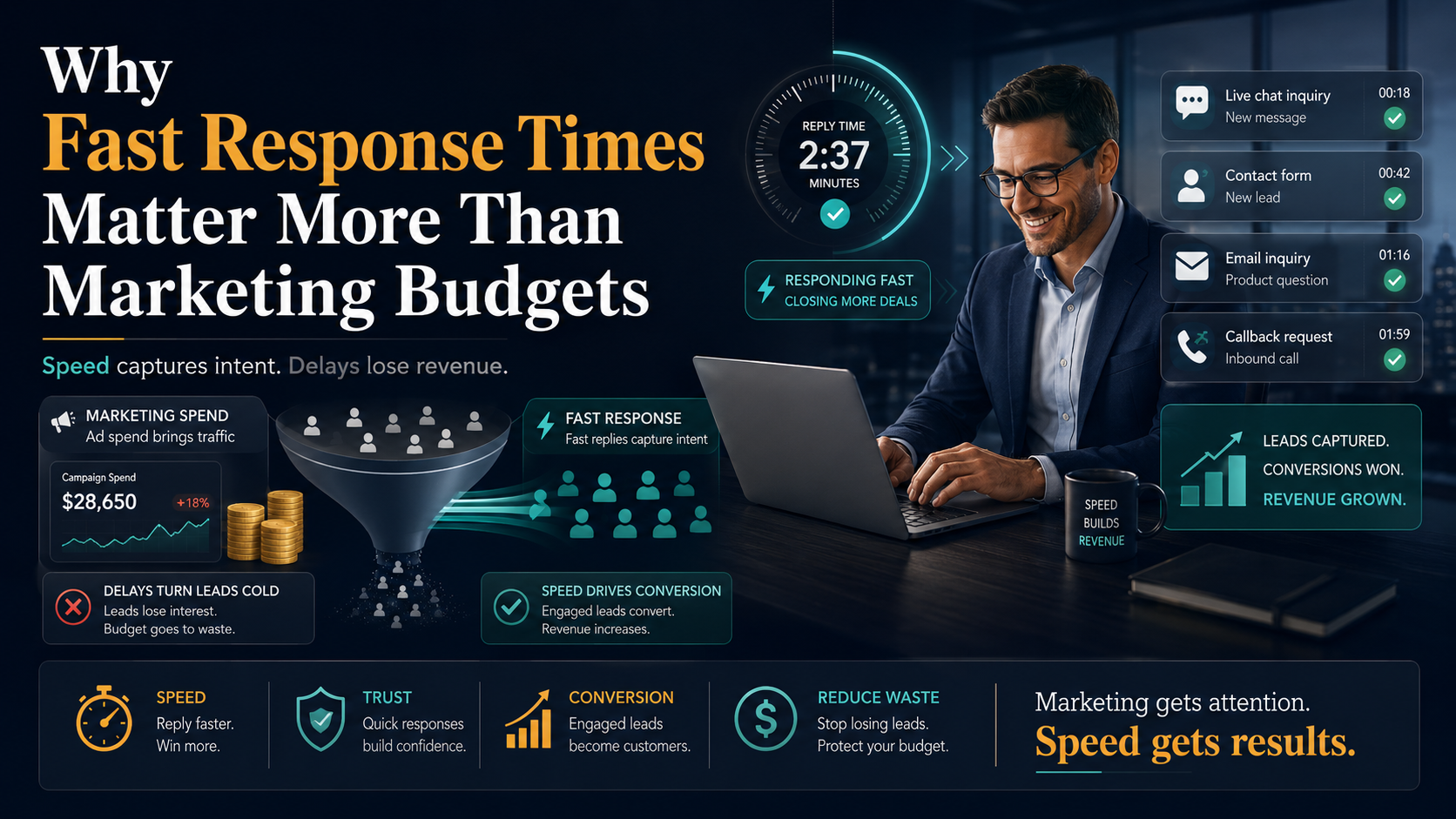
That is why fast response times deserve far more executive attention than they usually get. In many cases, the problem is not lead volume. It is lead response time. Modern buyers compare vendors quickly, contact several options at once, and often make their shortlist based on who responds first with relevance and confidence.
A faster customer response time does more than improve service perception. It can increase conversions, lift sales conversion rate, reduce customer acquisition cost, and turn existing marketing spend into a stronger revenue growth strategy.
Table of Contents
Why response speed often beats larger marketing spend
More traffic is only valuable if the business can engage that traffic while intent is high. That is the part many organizations underestimate. A prospect who fills out a form at 10:03 a.m. is signaling active interest right now, not sometime tomorrow afternoon when a sales rep has free time.
That moment matters because buying momentum is perishable. Attention shifts quickly. A competitor replies first. The buyer moves into another meeting. The original need feels less urgent. The company that generated the lead still paid for it, but the chance to convert it is already weaker.
This is why response speed often produces a better return than a larger media budget. It improves the yield on demand that already exists.
The hidden revenue cost of slow lead response time
Slow response does not show up neatly on a marketing dashboard, which is one reason it gets missed. Cost per click, cost per lead, and website traffic are easy to measure. Lost intent is harder to see. If calls roll to voicemail and form fills sit untouched for six hours, those missed conversations rarely appear in a clean report labeled “revenue lost due to delay.”
They still have a financial impact. A business may believe it needs more leads when it actually needs better capture, routing, and immediate outreach. That mistake creates a cycle of overspending: marketing brings in demand, operations respond slowly, sales conversion rate stays soft, then leadership increases budget again to compensate.
The leakage tends to happen in familiar places.
- Unanswered inbound calls
- Contact forms waiting until the next business day
- Website chat monitored inconsistently
- Demo requests routed to a crowded inbox
- After-hours inquiries with no live response
A private medical practice, a law firm, a B2B software company, and a home services business can all face the same issue. Different industries, same pattern: interest arrives, response lags, revenue slips away.
Research often cited from Harvard Business Review found that companies responding to leads within an hour were nearly seven times more likely to qualify them than those responding even an hour later, and far more likely than companies that waited a full day. Many sales studies also show sharp declines in contact and qualification rates after the first five minutes. The exact numbers vary by industry, though the direction is consistent. Speed wins.
How customer response time impacts sales conversion rates
A strong sales conversion rate is rarely just about persuasion. It is also about timing. When a prospect reaches out, the first interaction shapes confidence, urgency, and willingness to continue the conversation. Fast outreach signals attentiveness. Slow outreach signals friction.
That effect compounds across the funnel. Quick responses increase the odds of actual contact. Better contact rates create more discovery conversations. More conversations produce more qualified opportunities. More qualified opportunities create more closed revenue. By the time leadership reviews quarterly numbers, the impact of customer response time is already embedded in every stage.
The pattern is easy to see when comparing operating models.
| Business factor | Fast response organization | Slow response organization | Revenue effect |
|---|---|---|---|
| Inbound call handling | Answered live or returned in minutes | Sent to voicemail or returned hours later | Faster team captures more buying intent |
| Contact form follow-up | Automated routing and rapid outreach | Manual review and delayed assignment | Slow team loses momentum before first contact |
| Website visitor engagement | Real-time chat or callback option | Passive form only | Fast team creates more conversations |
| Lead qualification | Immediate screening and scheduling | Backlog-driven qualification | Fast team moves fit leads into pipeline sooner |
| Sales conversion rate | Higher due to speed and continuity | Lower due to attrition and drop-off | More revenue from the same traffic |
| Customer acquisition cost | Lower because existing leads convert better | Higher because more spend is needed to compensate | Better efficiency across channels |
Does faster response really matter if the lead is high quality?
Yes, because high quality does not mean permanently available.
A good lead can still choose another vendor if that vendor responds first, answers questions clearly, and makes the next step easy. Lead quality and response speed are not competing ideas. They multiply each other. The best leads are often the most valuable to respond to quickly because they are also attractive to competitors.
Why the first meaningful interaction shapes buying decisions
Buyers are not just evaluating price or features. They are evaluating risk. A prompt, useful first response lowers uncertainty. It shows the business is reachable, organized, and capable of follow-through.
That first impression can outweigh marketing polish. A company with average branding and excellent response habits will often outperform a company with polished campaigns and weak accessibility.
Why more traffic does not always mean more revenue
If a website already generates inquiries, adding more traffic can simply create a larger pile of neglected opportunities.
That is the marketing budget trap. Leadership sees pipeline pressure, assumes awareness is the issue, and approves more spend. Yet if the organization cannot respond quickly and consistently, more traffic does not solve the real constraint. It magnifies it.
A business spending $20,000 a month on demand generation with a weak response system may get less value than a business spending $12,000 with excellent speed-to-lead processes.
Common failure points usually sit between marketing and sales, not inside the ad platform.
- Routing delay: inquiries go to a shared inbox with no owner
- Coverage gap: calls come in outside business hours and nobody answers
- Qualification lag: reps wait too long to screen new interest
- Scheduling friction: prospects cannot book the next step immediately
- Follow-up inconsistency: leads receive one touch, then silence
Take a B2B services firm generating 300 inbound leads a month. If just 15 percent of those prospects disengage because response is slow, that is 45 lost opportunities before the sales team really begins selling. Increasing ad spend may replace those losses at a high cost. Fixing response speed may recover them at a much lower cost.
The relationship between customer acquisition cost and response speed
Customer acquisition cost is often discussed as a marketing metric, though response speed has a direct effect on it. If a company pays to generate leads but converts only a small share because follow-up is delayed, acquisition cost climbs. The business is paying for demand it fails to capture.
That means response speed is not only a customer experience issue. It is a financial efficiency issue. Better lead response time helps the organization get more customers from the same traffic, the same ad budget, and the same brand awareness. When conversion improves, acquisition cost usually improves with it.
This is one of the highest-leverage operational gains available to growth-minded teams. No new campaign is required. No rebrand is required. No major media test is required. The company simply gets faster and more consistent at engaging interest that already exists.
A simple example makes the math clear. Imagine a company spends $30,000 per month on marketing and acquires 30 customers, resulting in a customer acquisition cost of $1,000. If faster response times help increase conversions enough to produce 40 customers from the same spend, acquisition cost falls to $750. That is a major performance gain without adding a dollar to the budget.
Fast response times as a competitive advantage
In many categories, products look similar, pricing is close, and service claims sound the same. Response speed becomes the difference a buyer can feel immediately.
The first-mover advantage is powerful because buyers tend to contact multiple providers within a short window. The first company to answer live, ask smart questions, and guide the next step often defines the standard against which the others are judged. Everyone else is playing catch-up from that point forward.
This is especially true when the inquiry is time-sensitive. A property management company handling urgent maintenance, a commercial vendor responding to an RFP request, or a clinic fielding appointment demand cannot assume the buyer will wait patiently. Accessibility becomes part of the offer itself.
Fast response also supports brand positioning. It tells the market that the business is serious, reliable, and easy to work with. That perception is hard to create with marketing alone.
How live reception services help businesses respond instantly
Many companies know speed matters but struggle to staff for it. Internal teams have meetings, lunch breaks, fluctuating call volume, and limited after-hours coverage. Even disciplined organizations miss inquiries when their systems depend on a handful of busy employees.
That is where live reception services can make a practical difference. They give businesses a way to answer calls immediately, engage website visitors in real time, and reduce the gap between interest and action. Instead of sending prospects to voicemail or a delayed callback queue, the business creates an immediate human touchpoint.
That speed matters at the exact moment when a buyer is deciding whether to continue.
Live reception can support several revenue-critical functions.
- Immediate answer: inbound callers reach a person instead of voicemail
- Real-time qualification: inquiries are screened before they cool off
- Faster scheduling: qualified prospects move to meetings sooner
- Coverage consistency: after-hours and peak-time inquiries still receive attention
- Missed opportunity reduction: fewer leads disappear between marketing and sales
For businesses that compete on responsiveness, live reception services are not just an administrative convenience. They are a conversion tool.
Can automation solve this without live support?
Automation helps, though it rarely solves the full problem by itself.
Auto-replies can acknowledge a form submission. Routing tools can assign leads. Scheduling links can remove friction. Those are useful steps. Still, many buyers want immediate human engagement, especially when the purchase is high-value, urgent, or complex. The strongest model usually combines automation with live coverage.
Building a revenue growth strategy around speed and accessibility
A real revenue growth strategy should treat speed as an operating discipline, not a slogan. That means measuring response time, setting service levels, and making ownership explicit. If nobody owns the first five minutes, nobody owns the revenue inside those five minutes either.
This is where sales operations become essential. High-performing teams do not only generate leads. They create systems that ensure leads receive immediate, consistent, high-quality follow-up. That includes inbound call handling, lead routing, qualification workflows, scheduling, and multi-touch outreach.
When internal capacity is stretched, sales outsourcing services can help maintain response quality at scale. A business may have solid demand generation but lack enough trained people to contact leads quickly, qualify them properly, and keep follow-up disciplined. Outsourced sales support can close that gap without forcing the company to build every function internally.
A practical framework usually includes four moves.
- Measure current lead response time: track first-call answer rate, form response time, and after-hours coverage gaps.
- Set speed targets: define what “fast” means by channel, whether that is immediate call answer, under five minutes for hot inbound leads, or same-hour contact for form submissions.
- Fix routing and staffing: assign ownership, remove inbox bottlenecks, and add live reception or outsourced support where internal teams cannot keep up.
- Track conversion impact: compare speed improvements against contact rates, qualified opportunities, sales conversion rate, and customer acquisition cost.
This approach changes the conversation at the leadership level. Instead of asking, “How do we buy more leads?” teams start asking, “How do we win more of the leads we already paid for?”
That is a more profitable question.
What high-growth companies understand about response time
High-growth companies tend to view responsiveness as revenue infrastructure. They know that speed is not a nice extra layered on top of a growth plan. It is part of the growth plan. Marketing creates attention. Sales creates momentum. Operations protects both.
They also know that consistency matters as much as raw speed. A company that replies in three minutes on Monday and twelve hours on Tuesday is still unpredictable. Buyers notice that. The goal is dependable accessibility across channels, time periods, and team members.
This is why leading organizations audit response performance with the same seriousness they apply to advertising performance. They review missed calls. They measure first-touch times. They test form workflows. They look at how long it takes to move a prospect from initial inquiry to real conversation. Then they tighten the system.
Many businesses do not have a lead generation problem. They have a response time problem. Before raising the marketing budget, it is worth asking a tougher question: how much revenue is already slipping away because the business is too slow to meet the moment?
The fastest responder often wins, even when another company spent more to generate the same opportunity.