A fast reply can calm a customer for a moment. A real solution keeps that customer coming back.
That distinction matters more than many teams admit. Companies often celebrate response time because it is easy to monitor, easy to report, and easy to improve with automation. Yet customers rarely remember that a message arrived in 30 seconds if the issue still took three calls, two transfers, and a follow-up email to fix.
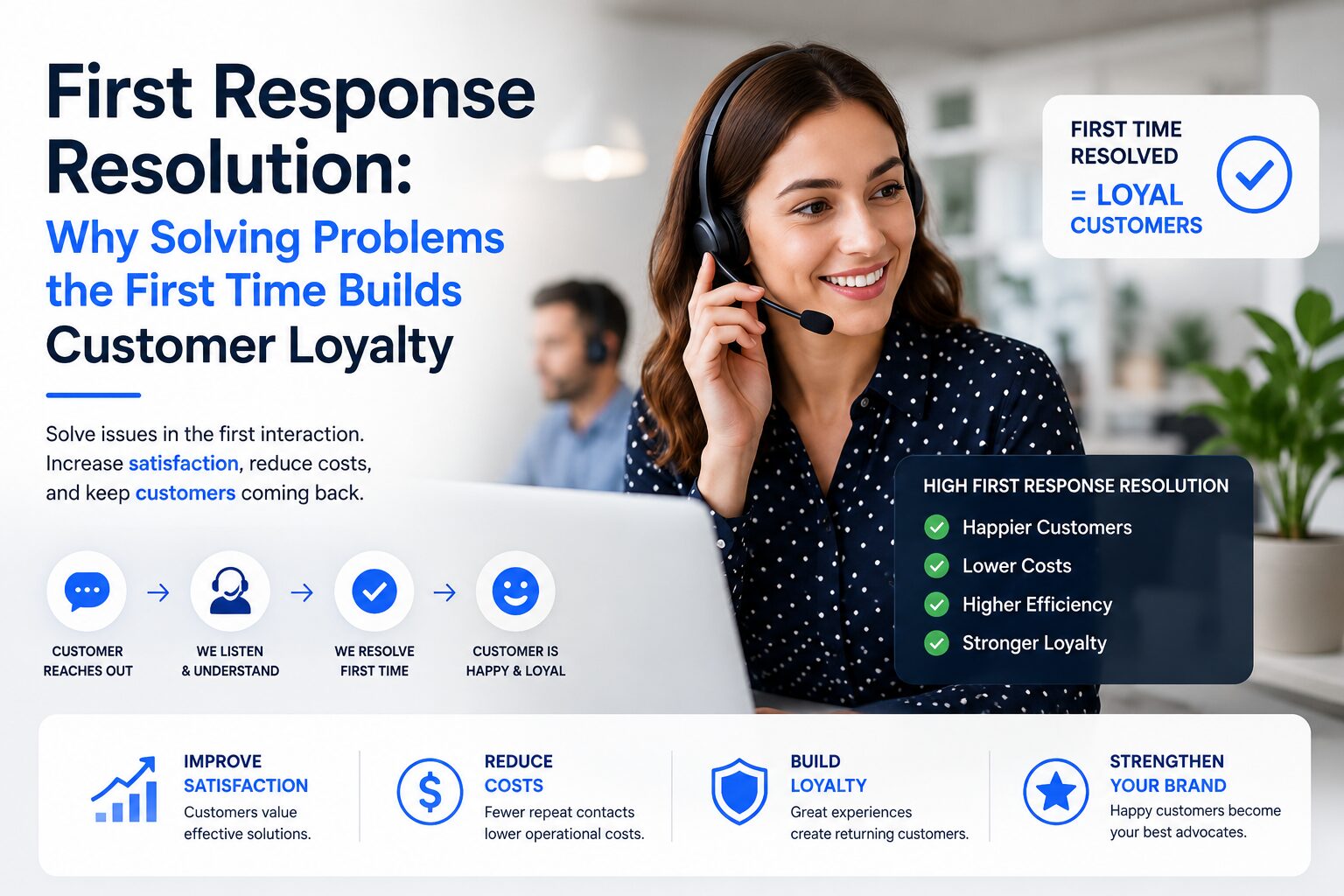
First response resolution, often called first contact resolution, changes the conversation. It asks a better question: did the customer leave the first interaction with the issue solved? When the answer is yes, customer satisfaction rises, repeat contacts fall, and support becomes a profit protector instead of a cost center.
Table of Contents
What first response resolution means in customer support
First response resolution is the percentage of customer issues resolved during the first interaction, without requiring the customer to call back, send another email, or get transferred through a chain of departments. The “first interaction” can happen by phone, chat, email, SMS, or at the front desk, depending on the business model.
This metric is often grouped with first contact resolution, and in practice many teams use the terms interchangeably. The core idea stays the same: the customer receives a complete answer or outcome the first time they reach out.
A simple formula helps make it measurable:
- First response resolution rate: resolved on the first interaction ÷ total support cases × 100
- High level benchmark: many strong teams aim for 70% to 80% or better, depending on case complexity
- Shorter queues
- Fewer callbacks
That target should be interpreted carefully. A SaaS platform handling technical integrations will not look identical to a hotel reservation desk or an ecommerce returns team. Still, the pattern holds across industries. Better first contact resolution usually means better customer service metrics overall.
Why first response resolution matters more than response speed
Speed gets attention. Resolution builds loyalty.
A customer who reaches a live person quickly still feels disappointed if they need to repeat the same issue three times. By contrast, a customer who spends a few extra minutes in a thoughtful first conversation often leaves with much more confidence in the company.
This is why first response resolution should sit beside, not behind, metrics like first reply time or average speed of answer. Response speed measures access. Resolution measures effectiveness. One tells you whether support picked up the phone. The other tells you whether support actually helped.
The emotional impact is hard to ignore. Every repeat contact adds friction. Each transfer suggests disorganization. Every “someone will get back to you” creates doubt. Customers may not say, “your first contact resolution rate is low,” but they absolutely feel the effects of it in the form of effort, delay, and uncertainty.
For leadership teams, that means a fast but unresolved interaction is not a success. It is unfinished work.
The business impact of solving customer issues the first time
High first response resolution improves customer satisfaction, customer retention, and operating efficiency at the same time. That combination is rare, which is exactly why it deserves executive attention.
When an issue is solved in one interaction, the organization avoids the hidden cost of repeat volume. One ticket does not turn into three. One call does not create a chain of internal handoffs. Agents spend more time solving new issues instead of reworking old ones. Managers see less backlog, less staffing pressure, and better productivity.
The customer side is just as important. A smooth first interaction creates trust. Trust shapes renewal decisions, online reviews, referrals, and the willingness to buy again after something goes wrong.
| Support environment | High first response resolution | Low first response resolution |
|---|---|---|
| Customer experience | Clear answers, low effort, stronger trust | Repetition, transfers, frustration |
| Operations | Lower repeat volume, better agent capacity | More callbacks, higher workload |
| Cost profile | Reduced handling cost per case | Rising cost per issue |
| Brand impact | Better reviews and loyalty | Churn risk and negative word of mouth |
| Leadership view | Support seen as strategic | Support seen as reactive overhead |
A few common business outcomes tend to follow strong first contact resolution:
- Lower cost per case: fewer repeat interactions and less rework
- Higher customer satisfaction: customers feel heard and helped
- Stronger retention: resolved issues are less likely to become cancellation triggers
- Better online ratings
- Higher agent confidence
In hospitality, a guest calling about a late check-in wants confirmation, not a transfer from reception to reservations to night staff. In ecommerce, a buyer asking about a damaged order wants a replacement or refund path immediately. In SaaS, a billing concern resolved on the first call can prevent churn. In healthcare, quick and accurate support around scheduling, insurance basics, or intake steps reduces anxiety. In a BPO setting, strong resolution rates become a visible proof point of service quality.
Common reasons teams struggle with first contact resolution
Most companies do not miss first response resolution because their agents do not care. They miss it because the support system around the agent is fragmented.
One common problem is knowledge gaps. Agents are expected to answer product, billing, policy, and workflow questions, yet the information they need is scattered across inboxes, spreadsheets, and tribal knowledge. Even strong communicators fail when the facts are hard to access.
Another issue is limited authority. If frontline staff need manager approval for routine refunds, booking adjustments, account updates, or service credits, the customer is almost guaranteed to need a second touch. A team cannot resolve issues on the first contact if it lacks permission to act.
Technology also gets blamed too quickly and praised too easily. A modern platform helps, but it does not replace clarity, judgment, or ownership. When support tools are disconnected, customers get bounced between systems and departments. When processes are vague, agents play it safe and escalate cases that could have been closed immediately.
The warning signs usually look familiar:
- Frequent transfers: customers move between teams before receiving a clear answer
- Repeated explanations: the same issue is retold in every interaction
- Narrow agent scope: staff can answer questions but cannot complete actions
- Long resolution queues
- Inconsistent case notes
How better training improves first contact resolution
Training has the biggest impact when it goes beyond scripts.
Agents need product knowledge, communication skill, and decision-making confidence. They must know what the business offers, what common issues look like, where to find the right information, and when they are authorized to solve the issue without escalation.
That is why high-performing teams train for scenarios, not just procedures. A hospitality team may rehearse overbooking calls, room-change requests, and group booking questions. An ecommerce team may practice damaged shipment claims and order modification requests. A SaaS support desk may run through failed logins, billing confusion, and feature access questions. Repetition builds judgment.
Empowerment matters just as much. If the training says “own the customer experience” but the process says “ask three supervisors before doing anything,” first contact resolution will stay low.
A practical training program usually includes:
- Product and policy mastery
- Scenario coaching: real cases by channel, not abstract scripts
- System fluency: fast use of CRM, knowledge base, and order or booking tools
- Decision rights: clear limits for refunds, credits, changes, and exceptions
This is also where customer support outsourcing can create a real advantage. A dedicated outsourced team with clear process ownership, steady QA, and role-specific coaching often delivers more consistency than a generalist in-house team that is stretched across competing priorities. When outsourcing is structured well, it supports stronger customer support KPIs instead of simply adding coverage.
How multilingual customer support increases first response resolution
Customers explain complicated problems more clearly in their strongest language. That alone raises the likelihood of solving the issue on the first interaction.
Misunderstandings are expensive. A customer may choose the wrong words, miss a key detail, or misread a policy if support is offered only in a secondary language. The agent may answer the wrong question while believing the issue is resolved. That creates false closure, followed by another contact.
Multilingual customer support reduces that friction. It improves accuracy, shortens handle time in many cases, and builds trust quickly, especially in hospitality, healthcare, travel, and global ecommerce. Customers feel respected when they do not have to fight through a language barrier during a stressful moment.
For businesses serving diverse markets, multilingual coverage is not only a service upgrade. It is a resolution strategy.
How live reception services help resolve customer requests faster
Many support experiences break down before the issue even reaches the right person. Long hold times, voicemail loops, and generic call routing create delay before any real problem-solving begins.
Live reception services can improve this first step by giving customers an immediate, professional point of contact. When that reception layer is trained to qualify the request, verify key details, and connect the caller with a knowledgeable representative, resolution becomes far more likely during the first interaction.
A well-run live reception model works especially well for hospitality groups, healthcare practices, service businesses, and multi-location organizations where phone traffic includes both simple requests and time-sensitive questions. Instead of forcing callers through unnecessary delays, a live team can route intelligently and capture context that helps the next person solve the issue without repetition.
Businesses evaluating this model can review live reception services as part of a broader customer experience strategy.
Measuring first response resolution as a customer support KPI
First response resolution deserves a place beside response time, average handle time, CSAT, and abandonment rate. It is one of the clearest customer service metrics because it reflects both customer effort and operational quality.
Still, measurement needs discipline. Teams should define what counts as “resolved,” which channels are included, and how reopened cases are treated. A vague definition can inflate results and hide process problems.
A useful KPI set often includes:
- First response resolution rate: the main measure of one-touch success
- Customer satisfaction score: confirms whether “resolved” also felt resolved
- Repeat contact rate: shows how often issues come back
- Escalation rate: highlights gaps in authority or training
A good first response resolution rate depends on complexity and channel mix, though many organizations view 70% to 80% as a strong operating range. Simpler environments may aim higher. Highly technical support teams may land lower while still performing well. What matters most is trend, consistency, and the reason behind unresolved contacts.
For CEOs, operations managers, and customer experience leaders, this metric has a useful clarity. It shows whether support is removing friction or recycling it. When the rate rises, cost pressure often falls with it. When it drops, customer satisfaction usually follows.
That is why first response resolution is more than a support statistic. It is a signal of how well the business keeps its promises the moment a customer needs help most.