Most companies still treat multilingual customer support as a language problem. If a customer writes in Spanish, hire a Spanish speaker. If a prospect calls from Germany, route the call to someone who speaks German. That logic feels efficient, but it leaves revenue on the table.
Language matters, of course. Yet international customers are not simply listening for correct words. They are reading tone, pace, timing, confidence, etiquette, and intent. They are deciding whether a business feels familiar, trustworthy, and easy to buy from.
That is why multilingual customer support has moved far beyond translation. The strongest international brands use global customer support to create trust, reduce friction, lift conversion rates, and keep customers longer. They do it by pairing language ability with local cultural insight.
Table of Contents
How multilingual customer support builds a stronger competitive edge
A business that speaks to every market in the same way often looks organized internally and disconnected externally. Customers notice that gap fast.
A well-run multilingual customer support function does more than answer questions in different languages. It emphasizes personalization by reflecting local business etiquette, buyer behavior, and customer expectations. That changes how people respond during support interactions, sales calls, complaint handling, and onboarding conversations.
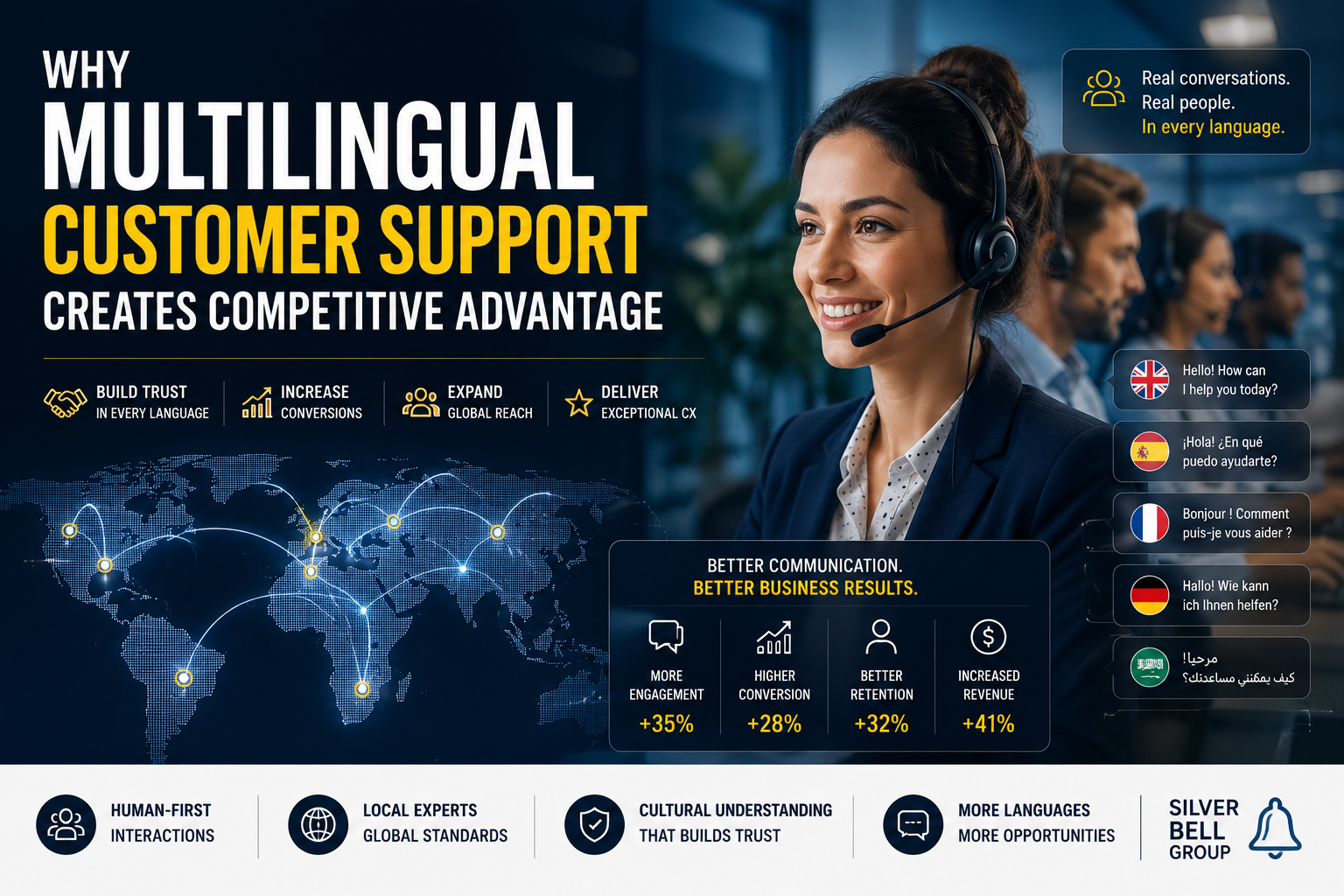
The payoff shows up in the numbers, enhancing customer loyalty. Better trust leads to better response rates. Better conversations lead to higher conversion. Better customer experience leads to stronger retention. This is where multilingual customer support becomes a commercial advantage, not just a service feature.
How multilingual customer service influences customer trust
Trust starts before a problem is solved. It begins the moment a customer hears the tone of a greeting, reads the structure of an email, or sees how quickly a business responds.
A Danish prospect may appreciate direct language and respect for personal time. A call placed after working hours can feel intrusive and careless. In parts of Southern Europe, a warmer and more relationship-led interaction may create confidence faster. In Germany, detailed answers and precision often matter more than a highly casual style.
The same message, translated word for word, can land very differently across those markets.
When businesses miss these differences, multilingual customer support can feel generic. When they get them right, customers feel recognized. That emotional shift has real business value.
Some trust signals vary sharply by market:
- Response timing: Fast replies matter almost everywhere, but what counts as “fast” differs by channel and region
- Level of formality: Some customers expect polished, formal language while others prefer a natural, conversational tone
- Amount of detail: A concise answer may feel efficient in one market and incomplete in another
- Personal boundaries: Contacting prospects at the wrong hour can damage credibility before a sales conversation even starts
A travel company serving Nordic and Mediterranean customers can see this clearly. Nordic travelers may prefer efficient self-service, clear cancellation rules, and minimal follow-up. Mediterranean customers may respond better to a more personal exchange, stronger reassurance, and an agent who sounds genuinely engaged. Both groups value service. They just define good service differently.
Why global customer support requires more than language skills
Language fluency without cultural fit is not enough for international customer support. A support agent can speak perfect French and still sound off to a French customer if the phrasing feels too blunt, too scripted, or too casual for the situation.
Global customer support teams need market awareness in several areas: channel preference, social norms, buying behavior, culture, local expectations around professionalism, and the importance of multilingual customer support. Without that, support quality becomes inconsistent even when grammar is flawless.
This is one reason customer support outsourcing can succeed or fail. Outsourcing by itself is not the issue. The issue is whether the outsourced team has local market grasp, not just a list of supported languages. A low-cost team that translates accurately but misses local cues can weaken both customer experience and sales performance.
The gap becomes easier to see when comparing language-only support with culturally aware support.
| Area | Language-only support | Culturally aware multilingual support |
|---|---|---|
| Greeting style | Correct translation | Tone matched to local business etiquette |
| Response timing | Standard service level for all markets | Service levels adapted to local expectations and channels |
| Complaint handling | Scripted apology | Apology framed in a way that feels sincere in that market |
| Product explanation | Generic wording | Detail level adjusted to local decision style |
| Sales follow-up | Same cadence everywhere | Contact schedule shaped by local norms and buying signals |
| Trust building | Focus on being understood | Focus on making the customer feel recognized |
| Customer retention | Reactive support | Relationship building through market-sensitive communication |
A SaaS company expanding into Germany offers a good example of how effective customer support can impact growth. Its English-language support team was translated into German, yet conversion from trial to paid remained weak. The issue was not vocabulary. The issue was that prospects wanted more precise implementation details, clearer contract language, and firmer answers during onboarding. After the company shifted to agents who could communicate in a more detail-oriented way, trial conversions improved.
The hidden difference between translation and cultural insight
Translation tells customers what you mean. Cultural insight tells customers you get them.
That difference changes the outcome of everyday interactions. In e-commerce, a translated checkout support message with personalization may answer the question. A culturally aware answer can also reduce doubt about delivery reliability, returns, payment methods, and brand credibility. In hospitality, a translated confirmation email may be accurate. A culturally aware email can reassure the guest in the style and culture they expect, with the details they care about most.
This matters because buying decisions are emotional as well as rational. People buy faster when communication feels natural. They complain less when the tone feels respectful. They stay longer when the service feels familiar.
A retailer entering the Japanese market, for example, may find that direct sales language that performs well in the United States feels too aggressive. A hotel group serving German guests may notice that short, vague responses create more follow-up questions, while detailed answers lower contact volume. These are not language issues. They are customer communication issues.
The practical differences often show up in a few key areas:
- Clear expectations
- Localized reassurance
- Appropriate formality
- Channel fit
- Buying confidence
How international customer support impacts conversion rates
Customer support and sales are often treated as separate functions. In international markets, that split is less useful. Many support conversations are really pre-sales conversations, even when customers do not label them that way.
A prospect asks whether shipping is reliable in their country. A buyer wants to know if invoices match local norms. A hotel guest asks about check-in timing, airport transfer, or cancellation flexibility. A software lead asks whether onboarding can happen in their preferred language. Each of these moments can either move a sale forward or stall it.
This is where multilingual customer support and sales support changes performance. Sales teams that understand local communication habits qualify leads more accurately, build trust faster, and shorten the time between first contact and purchase. Businesses looking to connect customer service with growth often use sales outsourcing services to build this kind of multilingual sales capability across markets.
A B2B software provider selling into Northern Europe saw this in practice. Its central team handled inbound leads in English, then sent translated follow-up emails. Lead quality looked healthy, but demo attendance lagged. After shifting to local-language outreach with market-appropriate scheduling and more direct communication, demo attendance improved and sales cycles became shorter.
The same pattern appears in e-commerce:
- abandoned cart recovery
- product comparison questions
- payment reassurance
- post-purchase upsell opportunities
- returns conversations that influence repeat purchases
When customers feel rushed, misunderstood, or handled with a script copied from another market, they hesitate. When customer communication fits their expectations, they move with more confidence.
Why customer experience depends on local expectations
Customer experience is often discussed as if it were universal. It is not.
What feels efficient in one country can feel cold in another. What feels friendly in one market can feel unprofessional in the next. Even preferred support channels differ. Some customers want live chat. Others trust phone support more. Some are comfortable with asynchronous email threads. Others expect immediate human contact.
Hospitality companies deal with this every day. A guest from one market may view proactive phone contact as attentive service. Another may see it as unnecessary pressure. Travel businesses face the same issue with itinerary changes, refund requests, and pre-arrival communication.
The strongest international teams map customer expectations market by market, then shape service around them.
A few areas deserve close attention:
- Channel preference: Chat, phone, email, and messaging apps do not carry the same trust level in every region
- Decision pace: Some buyers move quickly after a short exchange, while others want more proof and more detail
- Trust markers: Local phone numbers, payment methods, website wording, and office hour habits all affect confidence
- Complaint style: Direct complaints in one market may appear softer or more indirect in another, which changes how support should respond
Customer retention and customer loyalty often rise when these details are handled well because fewer interactions feel awkward, repetitive, or misread.
How multilingual customer support helps businesses enter new markets
Market entry plans usually focus on pricing, distribution, regulation, demand, and multilingual customer support. Customer support should sit beside those priorities, not behind them.
A business can invest in localized ads and a translated website, then still lose momentum when support feels foreign. That is common in e-commerce, SaaS, travel, and hospitality. Marketing opens the door. Support determines whether trust holds once real customers start asking questions.
When companies enter a new region, multilingual customer support provides an early signal about product-market fit. Support conversations reveal what local buyers worry about, what language they use to describe value, and which objections appear again and again. This information improves sales scripts, onboarding flows, help content, and even product design.
A practical market-entry setup often includes:
- Local call handling: Customers reach a human voice that sounds familiar and credible
- Market-specific scripts: Teams use language and examples that fit local buying behavior
- Lead qualification: Support and sales share insight on which prospects are ready, hesitant, or poorly matched
- Feedback loops: Customer questions are tracked by market so patterns shape future decisions
This is also where customer support outsourcing can make sense, provided the partner offers real market fluency rather than generic coverage. For a business expanding into Scandinavia, support agents need to know more than the language. They need to know business rhythm, communication style, and what actions may weaken trust immediately. The after-hours call example in Denmark is a strong reminder. Small mistakes can send a large signal.
How live reception services deliver multilingual customer support at scale
Scale is where many international businesses struggle. They can offer thoughtful multilingual customer support in one or two markets, then lose quality when inbound demand grows across regions and time zones.
Live reception services help solve that gap by placing culturally aware human interaction and personalization at the front of the customer experience. For international website visitors, partners, and prospects, multilingual customer support during that first interaction can determine whether they stay engaged or leave.
A multilingual live reception model works best when it combines real-time responsiveness with local communication fit. That means the person answering does not just route calls or repeat a script. They know how to greet, reassure, qualify, and direct the conversation in a way that feels natural for the caller. Businesses looking to strengthen that front-line experience can use live reception services as part of a broader global customer support strategy.
A travel brand, for example, may receive inquiries from guests in several languages during peak booking periods. A live reception team that can respond in the guest’s language, while also matching the expected tone and urgency of that market, reduces abandoned inquiries and creates a stronger first impression. For many customers, speaking to a person who “gets it” is the difference between browsing and booking.
What high-performing global brands know about customer communication
The most effective international brands do not assume that consistency means saying the same thing in every market. They know consistency is about delivering the same standard of confidence through locally appropriate communication.
They invest in customer communication systems that capture market nuance. Support teams share patterns with marketing. Sales teams feed objections back into onboarding and retention work. Customer experience leaders look beyond translation accuracy and ask a harder question: did this interaction feel right to the customer?
That shift produces better outcomes across departments. Support resolves issues with less friction. Sales has more productive conversations. Operations teams see clearer demand patterns. Leadership gets cleaner signals about which markets are ready for more investment.
This approach also protects brand reputation. A company that looks polished in one country but tone-deaf in another is not building a global brand. It is building scattered local impressions. Strong multilingual customer support keeps those impressions stronger, warmer, and more commercially useful.
Common questions about international customer support
Is multilingual customer support mainly a cost center?
No. It affects revenue in direct ways.
Support quality shapes conversion rates, repeat purchase behavior, customer loyalty, and retention. It also influences how quickly prospects trust a business in a new market. When multilingual customer service is handled well, it supports both customer satisfaction and sales growth.
What is the difference between multilingual customer service and multilingual sales support?
Customer service usually focuses on helping existing customers or assisting with product questions. Multilingual sales support is more closely tied to lead qualification, objection handling, and moving prospects toward a purchase.
In practice, the two often overlap. A chat about delivery timelines can become a sales conversation. A support call about setup can become an upsell moment. That is why many international businesses treat customer support and revenue operations as connected functions.
Can AI translation replace human global customer support?
AI translation is useful for speed and coverage, but it cannot fully replace multilingual customer support that is culturally aware and offers human interaction.
It may translate words correctly while missing tone, implied meaning, urgency, or social expectations. For low-risk content, AI can help. For trust-heavy interactions, complaint handling, lead qualification, and live conversations, people still matter a great deal.
When does customer support outsourcing make sense for international businesses?
It makes sense when a business needs broader language coverage, longer service hours, or faster market entry without building every team in-house.
The key question is not whether support is outsourced. The key question is whether the partner can deliver local market grasp, strong customer communication, and commercial awareness. If the answer is yes, outsourcing can support growth very effectively.
Which industries gain the most from culturally aware international customer support?
Several do, especially:
- e-commerce
- hospitality
- travel
- SaaS
- B2B services with cross-border sales
Any business that sells across markets, handles inbound leads, or depends on trust during service interactions can gain from this approach.
The companies that grow fastest across borders are rarely the ones that only translate. They are the ones that make customers feel recognized, respected, and ready to say yes.