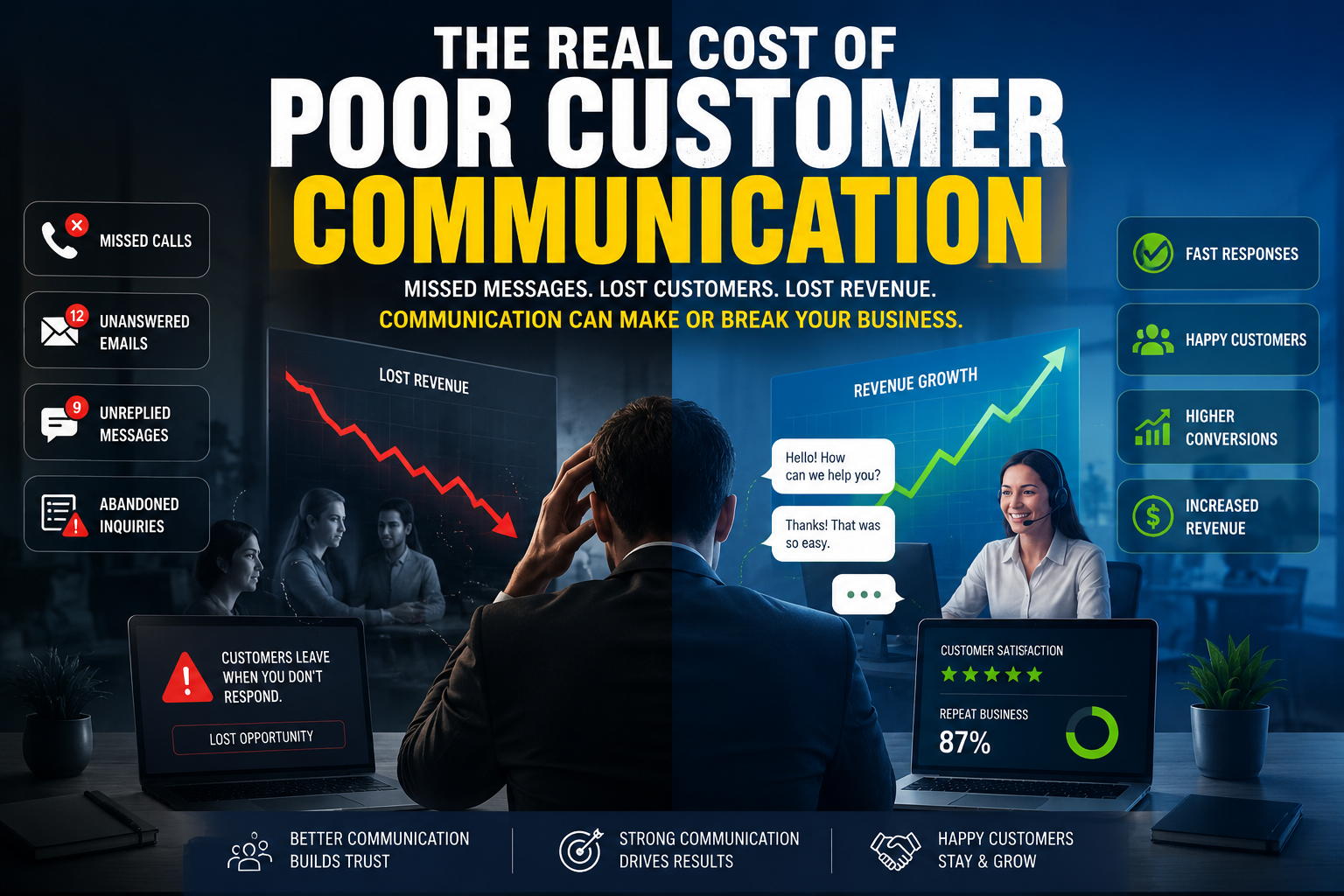
Most businesses do not lose customers only because of price, product gaps, or aggressive competitors. They lose them in quieter ways: a missed call, a delayed reply, a confusing handoff, an unanswered email, a prospect who never hears back after asking for a quote.
That is why poor customer communication is expensive in ways that often stay hidden on a P&L.
A company can invest heavily in lead generation, sales enablement, customer experience management, and retention programs, then quietly undermine all of it with weak communication at the exact moments when buyers and customers need clarity, speed, and confidence. The cost is not limited to customer service frustration. It shows up in lower conversion rates, shorter customer lifetime value, declining customer satisfaction, and a brand reputation that starts to slip long before leadership sees the full pattern.
Table of Contents
Why Poor Customer Communication Costs More Than Most Businesses Realize
Communication is part of the product.
Customers judge a business not only by what it sells, but by how it responds, how easy it is to reach, how clear the information is, and whether the experience feels consistent across teams. A great offer can still lose to a competitor if the competitor simply answers faster, follows up better, and removes uncertainty from the buying process.
This is especially true now. Salesforce has reported that 88% of customers say the experience a company provides matters as much as its products or services. That changes the role of communication. It is no longer a support function sitting off to the side. It is a revenue driver that influences acquisition, retention, referrals, and margin.
The businesses that treat communication as operational infrastructure tend to grow with less friction.
After a paragraph like that, the hidden costs become easier to name:
- Lost leads: inquiries go cold before sales gets back to them
- Lower conversion rates: prospects hesitate when information is unclear or delayed
- Higher churn: customers leave when routine questions feel difficult to resolve
- Negative reviews: one poor interaction becomes public evidence of business communication problems
- Reduced lifetime value: fewer renewals, fewer upsells, weaker loyalty
The Hidden Revenue Impact of Poor Customer Communication
Poor communication rarely looks dramatic at first. It often appears as small, isolated incidents. A voicemail left at 4:45 p.m. that no one returns until the next day. A web form response that arrives 18 hours later. A customer who has to repeat the same issue to three different people. A proposal that goes out without a clear next step.
Each event seems minor on its own. Together, they create drag across the entire revenue engine.
HubSpot has found that 90% of customers rate an immediate response as important when they have a customer service question, and 60% define “immediate” as 10 minutes or less. That expectation is not limited to support. It shapes lead response, sales follow-up, billing questions, scheduling, onboarding, and renewals. If a business takes hours or days to respond while a competitor responds in minutes, the competitor has already framed the relationship as easier and more reliable.
Does response time really affect conversion rates?
Yes, and often more than teams expect.
A prospect who reaches out is signaling intent. That moment has energy. When communication is fast and clear, momentum stays intact. When it is slow or vague, intent fades. Sales teams then blame lead quality, marketing questions channel performance, and leadership wonders why pipeline is not closing at the expected rate.
A common pattern appears in service businesses. A legal office, home services company, med spa, or B2B consulting firm may spend thousands on ads and referrals, yet miss calls during lunch, after hours, or while staff is occupied. Those missed conversations are not just missed interactions. They are missed buying moments.
The table below shows how communication quality changes business outcomes.
| Customer touchpoint | Strong communication outcome | Poor communication outcome | Likely business effect |
|---|---|---|---|
| First inbound call | Answered quickly, clear next step | Missed call or voicemail loop | Lost lead, lower conversion |
| Quote or proposal follow-up | Timely check-in, questions answered | Delayed outreach, no clarity | Stalled deal, price pressure |
| Onboarding | Expectations set, updates shared | Customer uncertainty, repeated questions | Slow activation, early churn |
| Support request | Fast resolution, ownership shown | Multiple handoffs, slow replies | Lower customer satisfaction |
| Renewal or upsell | Proactive outreach, value reinforced | Reactive contact, inconsistent touchpoints | Reduced retention and expansion |
| Issue or outage communication | Transparent status updates | Silence or vague messaging | Erosion of trust, negative reviews |
How Customer Communication Shapes Customer Experience Management
Customer experience management often gets discussed at a strategic level: mapping journeys, measuring NPS, refining touchpoints, improving service design. All of that matters. Yet the daily reality of customer experience is communication.
It is the appointment confirmation that reduces uncertainty. It is the billing explanation that prevents frustration. It is the proactive message that says, “We have not forgotten you.” It is the support rep who can see prior interactions and continue the conversation without forcing the customer to start over.
That is why communication should be treated as a system, not a series of isolated tasks. When marketing, sales, support, reception, and account management communicate in different ways, customers experience the company as fragmented. Strong customer communication strategy closes those gaps and makes the business feel competent, responsive, and easy to work with.
A strong customer experience is often less about spectacle and more about consistency.
Where Businesses Fail to Communicate With Customers
Many companies assume they have a communication problem only when customer complaints spike. In reality, the failure points show up much earlier and in more ordinary moments.
They usually happen at transitions: first contact, handoff, escalation, scheduling, onboarding, billing, renewal. These are the places where communication responsibilities get fuzzy, ownership breaks down, and messages arrive late or not at all.
Common failure points include:
- missed inbound calls
- slow email response
- inconsistent follow-up
- unclear pricing explanations
- support handoffs with no context
- no updates during delays
- generic automated replies
- sales and service teams working from different information
Well-known brands offer useful examples of the opposite approach. Domino’s turned order tracking into a communication product, not just a logistics tool. Customers do not only want pizza. They want visibility. Zappos built loyalty through accessible, human customer service communication that made people feel heard without friction. Amazon trained customers to expect constant status updates, which lowered anxiety throughout the buying cycle. Different industries, same lesson: clarity and responsiveness change behavior.
When businesses fail here, customers do not always complain. Many simply leave.
Why Customer Communication Influences Customer Retention
Customer retention is often framed as a product or pricing issue. Those factors matter, but communication is what protects retention day to day.
A customer may stay through a delayed shipment, a service hiccup, or even a billing problem if communication is transparent and timely. The same customer may leave after a minor issue if getting help feels slow, impersonal, or confusing. PwC has reported that 32% of customers will stop doing business with a brand they love after one bad experience. That statistic should get every operations leader’s attention.
Retention also depends on how well a business stays present after the sale. Silence can look like indifference. Inactive accounts, low feature adoption, delayed onboarding steps, and unresolved questions often signal communication gaps before they become churn events. Bain & Company’s widely cited research shows that increasing retention by 5% can raise profits by 25% to 95%. That makes communication quality a profit issue, not only a service metric.
A good customer communication strategy supports retention by making customers feel informed, recognized, and confident about what comes next.
The Link Between Customer Service Communication and Brand Trust
Brand trust is built in small increments.
A polished website may create interest. Advertising may create awareness. Sales messaging may create desire. Trust, though, usually solidifies in the operational moments: when someone answers, when expectations are set accurately, when a problem is acknowledged quickly, and when the customer does not have to fight for basic information.
This is where customer service communication becomes brand communication. A support exchange, an appointment confirmation, or a delayed shipment notice all send a message about competence and integrity. Businesses that communicate clearly during routine moments seem dependable. Businesses that communicate well during difficult moments seem trustworthy.
Transparency matters most when something goes wrong. An outage, delivery delay, staffing issue, or service error does not automatically destroy trust. Silence does. Vague language does. Contradictory answers do. Customers can handle bad news better than they can handle uncertainty.
How Live Reception Services Improve Customer Communication
One of the simplest ways to improve communication at a critical touchpoint is to make sure calls are answered when customers and prospects reach out. That sounds basic, yet it remains a major source of lost revenue for many businesses.
Live reception services close that gap by creating real-time responsiveness without forcing internal teams to be available every minute of the day. Instead of sending callers to voicemail or leaving them waiting for a callback, businesses can provide an immediate, professional interaction that captures intent while it is still strong.
This matters most in high-value or high-urgency settings. A missed call to a law office, clinic, contractor, property management company, or B2B service firm is often more than a missed message. It may be a missed sale, missed appointment, or missed client relationship. Live reception services can help businesses stay accessible, improve customer satisfaction, and reduce abandoned inquiries without expanding full-time front desk staffing.
The business case is straightforward:
- Faster first response: more opportunities converted before they cool off
- Higher accessibility: fewer missed calls during peak times, lunch breaks, and after hours
- More professional experience: callers reach a person instead of a dead end
- Better lead capture: conversations are routed, qualified, and documented consistently
- Stronger customer confidence: responsiveness signals reliability from the first interaction
Customer Support Outsourcing as a Scalable Communication Strategy
As companies grow, communication strain grows with them. More channels, more inquiries, more follow-up, more complexity. That is where customer support outsourcing can become a strategic choice rather than a cost-cutting exercise.
Used well, outsourced support expands responsiveness, standardizes service quality, and protects customer experience when demand rises. Used poorly, it creates even more fragmentation. The difference is in process design, training, knowledge transfer, and clear ownership of the customer conversation.
The same logic applies to sales communication. Growth often stalls when businesses generate more leads than their teams can follow up with consistently. Speed drops. Personalization declines. Pipeline coverage looks healthy on paper, but actual engagement weakens. Sales outsourcing services can help maintain response quality, follow-up discipline, and relationship continuity when internal teams are stretched.
A scalable communication strategy should protect four things as volume increases:
- response speed
- message consistency
- visibility across interactions
- clear next steps for the customer
If scale weakens those four elements, growth starts working against itself.
What High-Performing Companies Do Differently With Customer Communication Strategy
High-performing companies do not treat communication as a soft skill owned by one department. They treat it as an operating discipline.
They define service standards for response times. They document handoffs between teams. They use shared systems so customers do not need to repeat themselves. They audit communication breakdowns with the same seriousness they apply to sales performance or fulfillment quality. They look at missed calls, abandoned inquiries, repeat contacts, and slow follow-up as revenue signals.
They also design for customer expectations, not internal convenience. Customers expect omnichannel access, fast answers, proactive updates, and human help when it matters. The strongest organizations build around those expectations instead of asking customers to adapt to internal silos.
That shows up in practical ways. A prospect gets a prompt reply and a clear next step. A customer gets an update before needing to ask. A support issue moves across teams without losing context. A renewal conversation starts before uncertainty builds. Those actions sound simple because they are simple. The difficulty is consistency, and consistency is where strong operators win.
This is also where business communication problems become measurable. Leaders can track first-response time, missed-call rate, time to resolution, repeat-contact rate, review sentiment, conversion by source, and retention by touchpoint. Once communication is measured like a business driver, investment decisions become easier.
A strong product still matters. Competitive pricing still matters. Marketing still matters. Yet many companies already have enough demand, enough product value, and enough market opportunity to grow faster than they are growing now. What they lack is communication discipline at the moments that shape buying decisions and customer loyalty.
When communication improves, revenue leakage often shrinks before any major brand repositioning, product launch, or pricing change ever happens.