Travel planning is moving away from the old pattern of typing a few keywords into Google, opening ten tabs, and comparing hotel websites by hand. More travelers now ask full questions inside ChatGPT, Gemini, Perplexity, and Google AI Overviews, then expect one clear answer with a short list of options.
That shift changes far more than traffic sources. It changes who gets seen, who earns trust, and who owns the guest relationship.
For hotel owners, general managers, revenue leaders, and marketing teams, the message is simple: the next contest for direct hotel bookings will not be won by ranking for a blue link alone. It will be won by being visible inside AI search and by converting that attention with real human reassurance at the right moment.
Table of Contents
How AI Search Hotel Bookings Are Reshaping the Hospitality Industry
AI search hotel bookings are changing the first stage of the guest journey. Travelers are no longer searching with phrases like “best hotel in Austin with pool.” They are asking richer questions: “I need a quiet boutique hotel near downtown Austin for a three-night work trip, under $350 per night, with early check-in and good breakfast.” That is a very different input, and it produces a very different output.
Instead of a page full of links, AI tools summarize, compare, recommend, and filter before the guest ever reaches a hotel website. In that environment, hotels are not only competing on ranking. They are competing on structured information, review signals, rate clarity, policy transparency, brand authority, and how easily an AI system can interpret what makes the property a strong fit.
This is why traditional SEO still matters, but it is no longer enough on its own. Generative engine optimization, or GEO for hotels, is becoming part of the visibility stack. Hotels need content and data that answer real traveler questions in natural language, not just pages built around short keywords.
| Traditional search behavior | AI search behavior |
|---|---|
| User scans many links | User expects one synthesized answer |
| Hotel competes for click-through rate | Hotel competes to be included in the answer |
| SEO focuses on rankings and metadata | GEO focuses on clarity, authority, and answer readiness |
| Guest does the comparison work | AI does much of the comparison work |
| Website visit often happens early | Website visit may happen later, closer to booking |
A city hotel that once relied on branded search plus paid search may soon find that fewer guests start with Google in the old way. They may begin with an AI assistant, receive three hotel suggestions, and only click once they are nearly ready to book. That means the website visit carries more intent, more pressure, and less room for friction.
Why Direct Hotel Bookings Are Becoming Harder to Win
Direct hotel bookings are becoming harder to win because AI often favors brands with broad digital footprints, deep review inventories, strong content ecosystems, and high confidence signals. OTAs already perform well on all four.
Booking.com and Expedia have scale, inventory depth, standardized property data, massive review volume, and pages built for comparison. AI tools can parse those signals quickly. That makes OTA platforms highly visible when travelers ask for recommendations, especially when the prompt includes price range, neighborhood, amenities, cancellation terms, or traveler type.
A single hotel website, even a strong one, often has a narrower content set. It may have limited FAQ depth, thinner location pages, weak schema, unclear policies, and a booking engine that looks disconnected from the brand story. In a conversational search environment, those gaps matter more.
The result is a hard truth: many hotels risk being treated as suppliers inside the AI layer while OTAs remain the consumer-facing brands.
The Hidden Cost of OTA Dependency in the AI Era
OTA dependency has always carried a margin cost through commissions. In the AI era, the bigger cost is strategic. When OTAs dominate discovery, they do not just take a share of revenue. They take the guest relationship.
A hotel may spend heavily on photography, renovations, reputation management, paid media, and rate strategy, yet the booking still lands through a third party that controls the transaction flow, guest data, remarketing channel, and post-stay re-engagement. That weakens long-term profitability because each booking has to be repurchased again and again.
The issue becomes more serious when AI assistants repeatedly cite OTAs as the “best place” to compare or book. If that pattern hardens, direct channels may lose not only traffic share but brand memory.
- OTAs own the comparison layer: Travelers can review rates, policies, and room types in one place.
- OTAs own key customer data: Email capture, browsing history, and retargeting signals stay with the platform.
- OTAs own repeat influence: The next trip often starts with the same marketplace, not the hotel brand.
- Margin pressure
- Reduced first-party insight
- Weaker loyalty economics
A resort in a competitive leisure market can feel this quickly. Even with excellent service scores, a refreshed website, and strong paid search performance, the OTA may still become the default choice if the guest first meets the property through an AI-generated recommendation sourced from marketplace content.
Why Hotel Website Conversion Matters More Than Ever
If AI search sends fewer but higher-intent visitors, hotel website conversion matters more than ever. The website no longer serves only as a brochure. It becomes the closing environment.
That means the fundamentals need to be sharp. Rate visibility, room comparison, cancellation policy, parking details, breakfast inclusion, mobile speed, trust cues, and booking flow design all affect conversion. A guest who arrives from ChatGPT or Gemini may already know the shortlist. They are checking whether the direct path feels trustworthy, easy, and worth choosing over an OTA.
Hotels that lose these visitors are not losing casual browsers. They are losing near-bookers.
| OTA journey | Direct booking journey |
|---|---|
| AI suggests OTA listing | AI suggests hotel brand or hotel content |
| Guest compares many properties on one platform | Guest lands on a focused brand experience |
| OTA captures booking and customer data | Hotel captures booking and first-party data |
| Commission paid on each booking | Lower distribution cost |
| Remarketing stays with OTA | Future marketing stays with hotel |
A strong hotel website conversion strategy now has to answer three questions fast: Why this property? Why book direct? Why trust this site right now? If any answer is weak, the guest returns to the OTA tab.
Hospitality Customer Experience Starts Before a Guest Arrives
Hospitality customer experience no longer begins at check-in. It starts at the first question a traveler asks an AI assistant.
If the guest is anxious about parking, airport transfer, connecting rooms, pet rules, or whether a late arrival will be handled well, those questions shape booking confidence before the reservation exists. Hotels that treat pre-arrival communication as a sales stage, not just a service stage, are better placed to raise hotel booking conversion.
This is where many digital strategies fall short. Teams optimize ad spend and booking widgets, then overlook the fact that a guest may still hesitate for very human reasons.
Common pre-booking friction points include:
- late arrival concerns
- cancellation uncertainty
- room type confusion
- payment security questions
- local area reassurance
A family traveler might be ready to book but still want a quick answer on adjoining rooms and stroller access. A business traveler might need confidence that a 1:00 a.m. arrival will be handled smoothly. These are small questions on paper, yet they often decide whether the booking goes direct, goes to an OTA, or disappears.
The Missing Human Layer in Modern Hotel Booking Journeys
Automation has helped hotels control labor costs and standardize information, but a fully automated booking path often removes the last ingredient many guests need: reassurance.
Static FAQs help. Chatbots help in limited cases. Neither reliably replaces a capable human when the guest needs nuance, empathy, or confidence. That is especially true when travelers arrive from AI environments already loaded with options and trying to make a final choice.
Human interaction is not an operational extra. It is becoming a competitive advantage.
| Chatbot support | Human reassurance |
|---|---|
| Fast for simple, repeat questions | Strong for nuance and edge cases |
| Works well with fixed scripts | Adapts to traveler intent in real time |
| Limited emotional confidence | Builds trust and reduces hesitation |
| May hand off at the hardest moment | Can close the booking conversation |
| Useful for scale | Useful for conversion |
Think about a couple planning an anniversary stay. They have narrowed the list to two hotels through Perplexity. Both look good. The deciding factor may be a short conversation about room views, dining atmosphere, and whether the property can note a special occasion. That is not a search problem. It is a trust problem.
How Live Reception for Hotels Helps Convert AI Generated Traffic
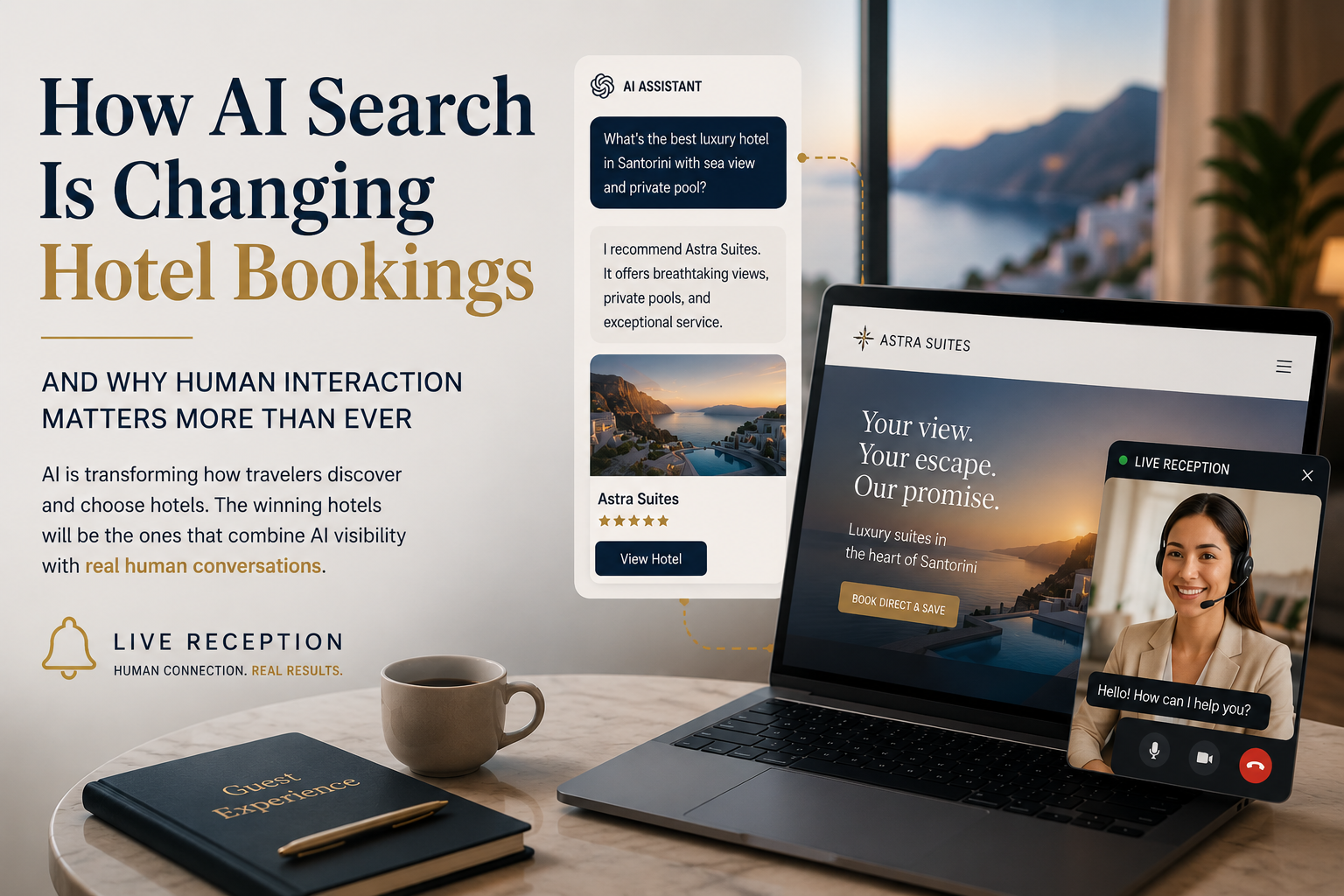
This is where live reception for hotels becomes strategically important. When AI discovery creates interest, a live human layer can turn that interest into direct revenue.
The model is simple: AI discovery leads to a website visit, the website prompts a question, a human answers quickly, and the booking moves forward with greater confidence. That bridge is often the missing link between hotel website conversion and hospitality customer experience.
A practical example of this approach can be seen in services built around live reception for hotels, where real-time guest interaction supports both conversion and service quality. In broader travel and hospitality settings, this kind of support also strengthens hospitality operations management by reducing missed calls, improving pre-arrival handling, and capturing valuable guest intent.
Hotels gain several advantages when live reception is part of the booking path:
- Higher conversion confidence: Guests can ask for clarification before they abandon the booking.
- Lower OTA dependency: More hesitant bookers can be rescued into direct channels.
- Better first-party data: Hotels capture contact details, questions, and intent signals.
- Stronger hotel guest engagement: The relationship starts before arrival.
A small independent hotel can benefit as much as a branded property here. In many cases, independents have more room to stand out through warmth, local knowledge, and responsiveness. Human contact lets them compete on trust, not only on media budget.
From Guest Questions to GEO for Hotels
One of the most interesting side effects of live guest conversations is the insight they generate. Every pre-booking question is a piece of market intelligence.
When guests repeatedly ask about parking, EV charging, allergy-friendly rooms, airport transfer, walkability, family setup, or safety in the surrounding area, those themes reveal natural language intent. This is exactly the kind of material that supports GEO for hotels.
Those conversations can be turned into:
- FAQ content
- room and amenity pages
- neighborhood guides
- booking engine prompts
- AI-ready knowledge base entries
This matters because AI systems favor sources that answer real questions clearly. A hotel that builds content from actual guest conversations is more likely to match the language travelers use in ChatGPT, Gemini, Perplexity, and Google AI Overviews.
A resort property, for example, may learn that guests keep asking whether the beach is walkable, whether chairs are included, and how family dining works after 9:00 p.m. If those questions are answered clearly across the site, in structured content, and in booking flow support, visibility and conversion can rise together.
Why a Digital Concierge Is Becoming Essential for Modern Customer Experience
A digital concierge seamlessly blends advanced technology with the warmth of human interaction, offering guests immediate support and expert guidance without the frustration of navigating complex websites or impersonal chatbots. Instead of leaving customers to fend for themselves, a digital concierge provides real-time answers, personalized recommendations, and the reassurance needed to make confident decisions—whether booking a hotel, comparing options, or exploring new services. This approach not only reduces friction and increases guest engagement but also elevates the overall hospitality customer experience, driving higher conversion rates and building lasting trust. This philosophy is at the heart of Live Reception, where authentic, human-led conversations transform digital traffic into direct bookings and meaningful business growth.
The Future of Direct Hotel Bookings Belongs to Human Assisted Experiences
The hospitality industry spent the last decade optimizing for search engines, metasearch, and booking engines. The next decade will be about optimizing for AI assistants without giving up customer ownership.
That means a new playbook. Hotels need content built for answer engines, technical signals that support AI visibility, websites designed to close high-intent visitors, and human interaction positioned where uncertainty is highest. The winners will not be the hotels that automate everything. They will be the hotels that know exactly where automation helps and where people create trust.
For investors and operators, this is also a profitability story. Lower OTA commissions, stronger first-party data, better hotel booking conversion, and richer hospitality customer experience all point toward a healthier direct channel.
The hotels that thrive will treat AI as the top-of-funnel guide and human contact as the closing advantage. Technology can attract the guest. People can win the booking.