Every company wants happier customers, yet many teams still treat customer satisfaction score as a survey tactic instead of an operating result.
That gap matters. A strong CSAT score is rarely created by clever wording at the end of a ticket or call. It is earned much earlier, through response speed, agent readiness, clear communication, and the ability to resolve issues without friction. Customers do not score the survey. They score the experience that came before it.
Table of Contents
What customer satisfaction score measures
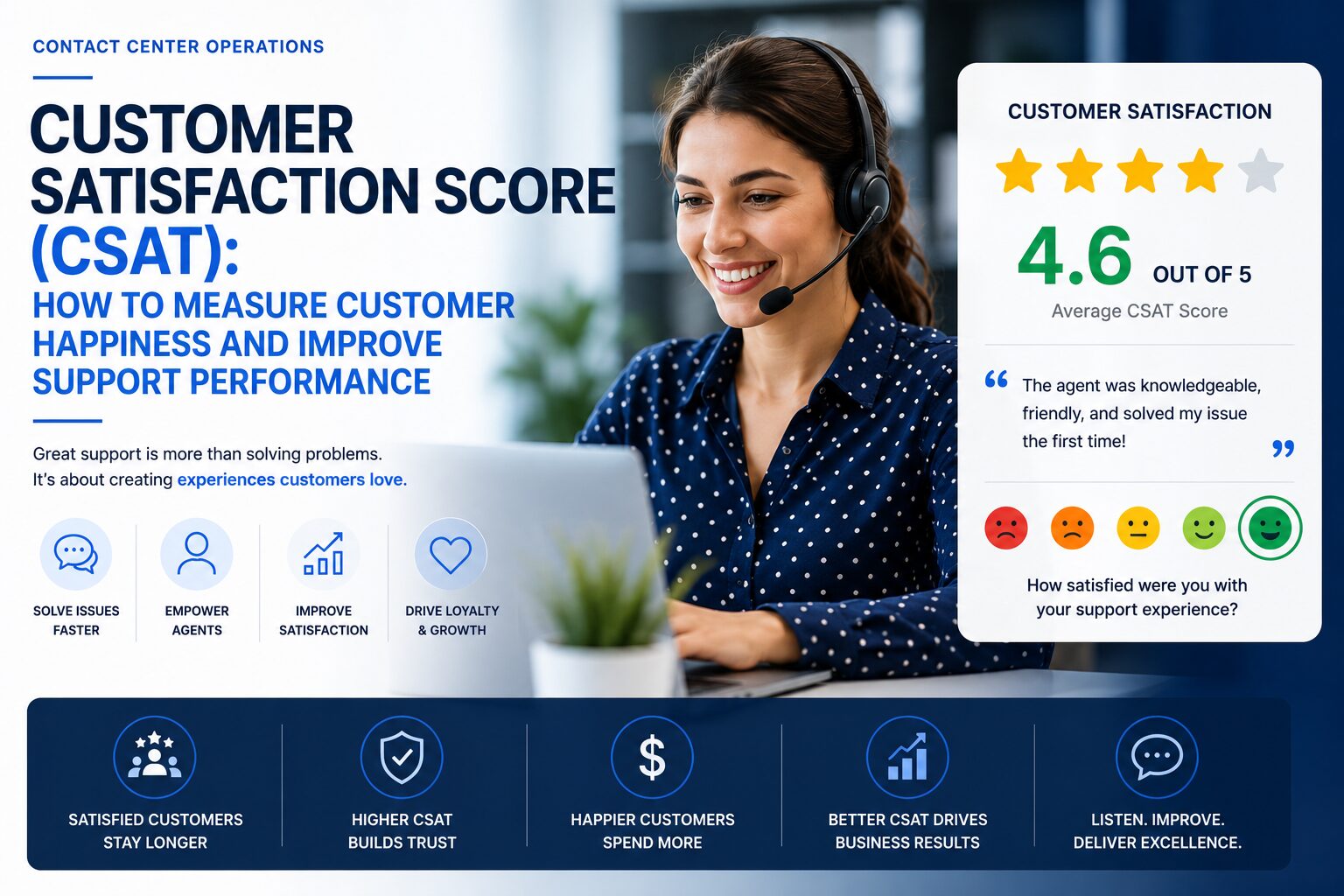
Customer Satisfaction Score, often shortened to CSAT, is a customer feedback KPI that measures how satisfied a customer feels after a specific interaction, product use, or service event. It is one of the most visible customer satisfaction metrics because it captures immediate sentiment in a simple format.
Most organizations ask a direct question like, “How satisfied were you with your support experience?” Customers respond on a scale, usually 1 to 5, 1 to 10, or with options ranging from “very dissatisfied” to “very satisfied.” The score is then turned into a percentage.
A common formula looks like this:
CSAT = (number of satisfied responses / total responses) × 100
In a 5-point survey, “satisfied” often means 4 or 5. If 82 out of 100 respondents select those two options, the CSAT score is 82%.
How CSAT is measured in customer support
The mechanics are simple, but the setup needs discipline. Survey timing, rating scale, response volume, and survey wording all affect the reliability of the result. If the method is inconsistent, the customer satisfaction score KPI becomes difficult to trust.
The best time to send a CSAT survey is usually right after the interaction, when the experience is still fresh. That could be after a phone call, live chat, email ticket, or a completed onboarding step in SaaS. Waiting too long increases recall bias and lowers response rates.
A practical approach usually includes a few basics:
- Timing: send the survey immediately after the interaction closes
- Scale: use a rating model that is easy to answer quickly
- Sample size: gather enough responses to spot real trends, not random swings
- Consistency: keep the question wording stable across reporting periods
- Context: connect scores to channel, queue, agent group, and issue type
Many teams also add an open text field after the score. That comment box often becomes the most useful part of the survey because it reveals why the customer rated the interaction the way they did.
What a good customer satisfaction score looks like
A good CSAT score depends on the industry, the channel, and the complexity of the request. A hospitality brand handling simple booking questions may post higher scores than a technical SaaS support team dealing with urgent integrations. Comparing scores without context can lead to the wrong decisions.
As a working benchmark, many support leaders view 75% to 85% as healthy, and 85%+ as strong. Still, the better question is not “What is a good CSAT score?” but “Is our score rising, stable, or falling relative to our service model and customer expectations?”
| Industry | Typical CSAT range | What shapes the range |
|---|---|---|
| Hospitality | 80% to 90%+ | Fast service, high emotional expectations |
| Ecommerce | 75% to 85% | Shipping issues, returns, order visibility |
| SaaS | 78% to 88% | Product complexity, onboarding quality, issue severity |
| Healthcare | 80% to 88% | Sensitivity, trust, clarity, compliance |
| BPO / outsourced support | 75% to 85% | Process quality, training, brand consistency |
These ranges are directional, not fixed rules. Survey design varies from company to company, which means external benchmarks are useful only when the methodology is similar.
Customer support operations that drive higher CSAT
Customer satisfaction is the outcome of everything that happens before the survey appears. If wait times are long, answers are vague, and customers need to contact support twice for the same problem, scores will reflect that reality.
A simple framework helps:
Training and processes
↓
Knowledge and technology
↓
Fast, effective resolution
↓
Higher customer satisfaction
↓
Customer loyalty and retention
The difference between low and high CSAT often looks like this:
| Low CSAT signals | High CSAT signals |
|---|---|
| Long wait times | Fast, predictable responses |
| Repeat contacts | First-contact resolution |
| Poor communication | Clear expectations |
| Inconsistent support | Standardized processes |
| Frustrated customers | Loyal customers |
When support leaders want to improve customer experience, they usually need to improve operations first.
Some of the biggest drivers include:
- First-contact resolution
- Response time
- Agent product knowledge
- Clear written and verbal communication
- Empathy and ownership
- Reliable follow-up
- Consistent service across channels
Multilingual support also has a direct effect. Customers are more comfortable, more patient, and more satisfied when they can explain their issue in their preferred language and receive a confident response without translation gaps.
Common CSAT measurement mistakes
A weak CSAT process can create false confidence or unnecessary alarm. The score may look healthy while customers are quietly struggling, or it may look volatile simply because the sample is too small.
One common mistake is focusing only on the average. A monthly CSAT score of 84% may look fine until the data is split by channel, language, team, or contact reason. In many cases, a few problem categories are dragging down the whole customer experience while the overall number hides the pattern.
A few issues show up often:
- Late surveys: customers forget details, and response rates fall
- Tiny samples: a handful of responses can distort the story
- Average-only reporting: one blended score hides problem areas
- Ignored comments: qualitative feedback gets left out of reviews
- Agent-only blame: process failures get mistaken for people failures
CSAT should be treated as a diagnostic starting point, not as a single verdict on customer support performance.
Why CSAT should be measured with other customer support KPIs
CSAT is powerful because it captures perception. It is incomplete because perception alone does not explain the cause.
This is why experienced leaders review CSAT alongside other customer support KPIs and customer service metrics. A team may have a respectable satisfaction score but poor efficiency. Another team may run a tight operation with low costs and still frustrate customers. Neither view is enough on its own.
Three related KPIs are especially useful:
- First Response Resolution (FCR): shows whether the issue was solved in the first interaction
- Average Handle Time (AHT): shows how long interactions take and how efficiently agents work
- Service Level Agreements (SLA): shows whether the team is meeting promised response and resolution targets
A high CSAT with very high AHT might suggest agents are kind and thorough but the process is too slow. A low CSAT with strong SLA performance might suggest the team is responding fast but not resolving the right problem. A falling CSAT with falling FCR often points to knowledge gaps, tool limitations, or broken workflows.
That is why many organizations build dashboards that connect CSAT with Customer Support Metrics That Actually Matter, including Average Handle Time (AHT), Service Level Agreements (SLA), and First Response Resolution (FCR). Future analysis often adds NPS, CES, workforce management, contact center quality assurance, and call abandonment rate to create a fuller view of contact center metrics.
How outsourced customer support can improve CSAT
Outsourcing does not improve customer satisfaction automatically. Good outsourcing improves CSAT because it adds structure, training discipline, reporting maturity, and service consistency.
For growing companies, this can be a major advantage. A specialized partner can bring QA programs, onboarding frameworks, coaching cadence, multilingual coverage, staffing flexibility, and tighter service standards than an internal team can build quickly on its own. That lifts both customer support performance and the customer experience.
This is also where Live Reception Services can matter. A live first touch reduces wait time, creates an immediate human connection, and raises the odds that a customer reaches the right path faster. When that front-end experience is tied to a well-run support function, CSAT tends to improve because the customer feels heard from the start.
Businesses evaluating Customer Support Outsourcing should look past pricing and ask how the partner manages measurable outcomes. Partners like Silver Bell Group position support around results that can be tracked, including CSAT, QA scores, response times, resolution quality, and process consistency.
Strong outsourced support usually includes a few shared traits:
- Structured onboarding
- Ongoing coaching
- Quality assurance reviews
- Multilingual agent coverage
- Standard operating procedures
- Clear KPI reporting
FAQ about customer satisfaction score
What is Customer Satisfaction Score?
CSAT is a percentage that shows how many customers reported being satisfied after an interaction or service experience.
How do you calculate CSAT?
Take the number of satisfied responses, divide by total responses, and multiply by 100. In a 5-point survey, satisfied often means 4 or 5.
What is considered a good CSAT score?
Many teams see 75% to 85% as solid and 85%+ as strong, though the right benchmark depends on industry, channel, and issue complexity.
Why is CSAT important?
It gives a direct view of how customers feel after support interactions. That makes it one of the most visible customer satisfaction metrics for service leaders, operations directors, and CEOs.
What affects customer satisfaction most?
Resolution quality, first-contact resolution, wait time, agent knowledge, empathy, language fit, and consistency across channels all have major impact.
How can outsourced customer support improve CSAT?
A capable partner can add better training, QA, coaching, multilingual service, live reception support, and stronger operational controls. Those improvements tend to raise satisfaction because they improve the experience before the survey is sent.
Using CSAT data to improve customer experience
The most effective teams do not stop at reporting the number. They use CSAT trends to locate friction in the operation, fix recurring problems, and build more reliable service. That could mean rewriting knowledge base content, improving triage rules, coaching a team on communication, or adjusting staffing to reduce response delays.
When customer satisfaction score is treated as the result of customer support performance, it becomes far more useful.
 It stops being a vanity metric and starts acting like an operating signal, one that connects customer perception to the decisions made every day in training, process design, staffing, quality assurance, and service delivery.