Most companies say they want more leads. What they often need is better recognition of the leads already in front of them.
Two people can arrive on the same website on the same day and look identical in a dashboard. Both count as visitors. Both may even come from the same campaign. Yet their buying behavior can be dramatically different. One reads a blog post and leaves. The other checks pricing, reviews case studies, visits service pages, returns twice that week, and starts comparing delivery options. One is browsing. The other is signaling intent.
That difference is where revenue efficiency lives.
When businesses can identify buying intent signals early, sales teams stop treating every inquiry the same. They prioritize the accounts most likely to move, respond with better timing, and improve close rates without increasing marketing spend. For sales directors, CROs, CEOs, and revenue operations leaders, this is not just a marketing concept. It is a practical operating advantage.
Table of Contents
What are buying intent signals
Buying intent signals are observable behaviors that suggest a prospect is moving closer to a purchasing decision. They can come from digital activity, direct conversations, inbound inquiries, CRM history, or engagement with sales materials. In simple terms, buyer intent is evidence that a person or company is not just interested in a topic, but actively evaluating whether to buy.
These signals often appear well before a contact form submission or proposal request. That matters because the customer buying journey rarely starts with a formal hand raise. Prospects reveal purchase intent through patterns. They compare solutions, revisit key pages, consume proof-based content, and ask more specific questions as risk decreases and confidence rises.
There are two broad categories of intent signals, and the strongest sales teams use both.
- Implicit signals
- Explicit signals
- Individual signals
- Account-level signals
Implicit signals are indirect. A prospect may not say, “We are ready to buy,” but their actions tell a similar story. Explicit signals are direct. A prospect asks for pricing, books a demo, requests implementation details, or mentions a decision timeline. Neither type should be viewed in isolation. A single action can be ambiguous. A pattern is much more reliable.
Explicit buying intent signals
Explicit buying intent signals are easy to recognize because the prospect communicates a clear commercial interest. This includes asking for a quote, requesting a proposal, booking a consultation, or asking if a service can be deployed by a certain date.
These are valuable because they shorten the distance between marketing activity and sales action. They also support stronger sales qualification since the prospect is already willing to reveal business context, urgency, and fit.
Implicit buying intent signals
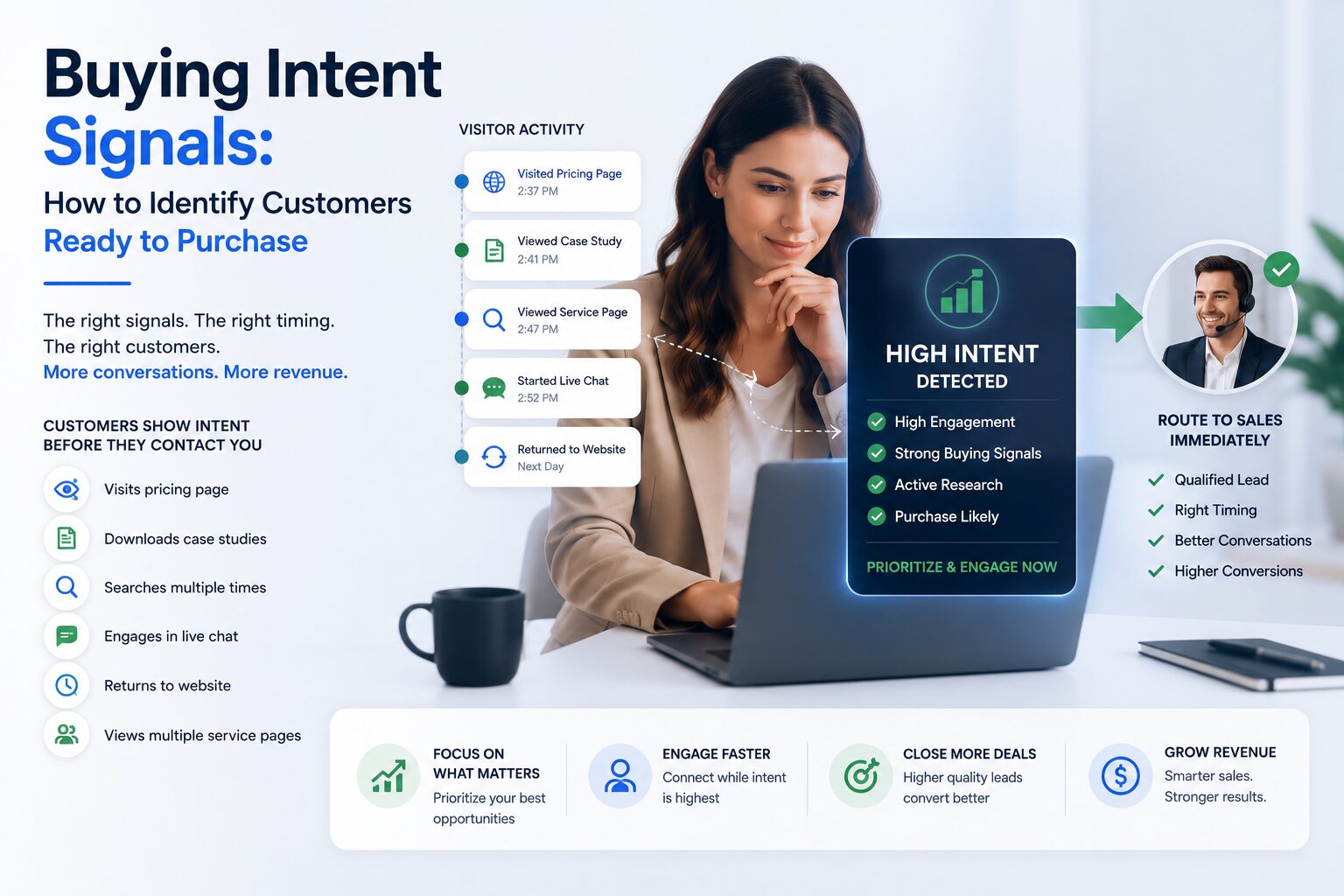
Implicit signals are quieter, but often show up earlier. A prospect may visit a pricing page three times in five days, return to a product comparison page, download a case study, or spend eight minutes reviewing service capabilities. None of these alone guarantees a sale. Together, they indicate movement from awareness toward evaluation.
This is where many high intent customers go unnoticed. Their intent is visible, just not obvious.
Why businesses miss high intent customers
Many companies still route leads using broad rules that flatten meaningful differences. Every form fill gets the same response. Every inbound call goes to the same queue. Every website visitor who converts on a top-of-funnel asset is treated similarly to someone actively comparing service options. That creates wasted effort and slow follow-up on the best opportunities.
The root problem is not a lack of inquiries. It is weak signal recognition.
A company may generate healthy traffic, solid campaign response, and steady inbound interest, yet still struggle with conversion because intent data sits in separate systems. Marketing sees web behavior. Sales sees CRM notes. Operations sees response delays. No one sees the full picture fast enough to act.
Common gaps show up in predictable ways.
- Equal lead treatment: every inquiry enters the same workflow, regardless of readiness
- Siloed data: website behavior, call history, and CRM records are not connected
- Slow response time: high intent prospects cool off while teams review queues
- Overreliance on forms: businesses wait for explicit contact instead of reading earlier buyer intent
- Weak qualification rules: scoring models reward volume activity rather than commercial behavior
The cost is larger than missed efficiency. It affects win rates. A competitor that recognizes purchase intent earlier can engage sooner, answer questions while interest is peaking, and shape the buying process before alternatives are fully compared.
The most important buying intent signals to watch
Not all signals deserve equal weight. A single blog visit rarely means much. A sequence of commercial actions usually does. The strongest intent models prioritize behaviors tied to evaluation, risk reduction, and decision readiness.
Pages and assets near the bottom of the funnel tend to carry the most value. Pricing, implementation details, service comparisons, FAQ pages, case studies, booking pages, and buyer-focused guides all indicate stronger movement than general thought leadership content. Returning sessions matter too, especially when they cluster within a short period.
The table below shows the difference between low intent browsing and high intent buying behavior.
| Signal area | Low intent visitor | High intent buyer |
|---|---|---|
| Content viewed | One blog post or general homepage | Pricing, case studies, service pages, FAQs |
| Visit frequency | Single session | Multiple visits within days |
| Session depth | Short, limited page path | Long sessions across commercial pages |
| Asset engagement | Top-of-funnel content only | Downloads proof assets or requests details |
| Form behavior | No form or newsletter sign-up | Demo, quote, callback, or consultation request |
| Questions asked | Broad interest questions | Specific questions about fit, timing, cost, implementation |
| Channel activity | Passive site visit | Email replies, calls, chat engagement, repeat conversations |
| Decision signals | No urgency visible | References timeline, budget, team review, or vendor comparison |
Explicit buying intent signals that support sales action
Explicit signals typically justify immediate outreach or priority routing. These include demo requests, quote requests, calls asking about availability, direct questions about implementation, or forms that mention a project timeline. In B2B services, a prospect who asks whether your team can support a specific volume or geography is already far closer to purchase than a prospect downloading a generic industry guide.
In SaaS, the classic pattern is clear: a company reviews plan tiers, visits integrations, checks security documentation, and books a product walkthrough. In healthcare, a practice group might ask about onboarding, compliance processes, and response coverage before committing to a vendor. In hospitality, a hotel operator might request service hours, overflow handling, and multilingual support details. Those are not casual questions. They reflect active evaluation.
Implicit buying intent signals that predict readiness
Implicit signals require more interpretation, but they often appear earlier and at larger scale. Repeated visits to pricing pages, traffic from competitor comparison searches, long sessions on service pages, increased engagement from multiple people at the same company, and repeat chat interactions are strong indicators of commercial interest.
Ecommerce businesses see similar patterns. A shopper may revisit a product category, compare shipping and returns, read reviews, abandon a cart, then return from a branded search. In B2B sales, an account may show intent when several stakeholders from the same domain consume case studies and solution content over a two-week period.
One signal can be noise. Clusters are what matter.
Digital behavior that predicts purchasing decisions
Digital behavior is often the first reliable view into buying behavior. The key is knowing which actions map to actual buying stages rather than general curiosity. Page views alone are not enough. Sequence, depth, repeat activity, and asset selection tell a better story.
A prospect who lands on a blog article from search may still be very early. A prospect who moves from a case study to pricing, then to a contact page, then returns two days later is showing structured evaluation. That path reveals intent because it mirrors how buyers reduce uncertainty: first relevance, then proof, then cost, then action.
Good revenue teams monitor patterns like these:
- return visits within a short timeframe
- multiple service page views in one session
- pricing page engagement
- case study downloads
- repeat chat or call interactions
- multiple contacts from the same company
- increased engagement after a proposal or sales email
Technology helps surface these signals, but software alone does not close deals. Analytics platforms can show traffic paths and return behavior. CRM systems can connect contacts, prior conversations, sales stage movement, and account ownership. Conversation intelligence tools can identify repeated objections or buying triggers. Website tracking can show which accounts are revisiting bottom-of-funnel pages.
Each system contributes a layer of context. The commercial edge comes from combining them.
Take SaaS. A product-led company might notice that trial users who invite teammates, view integration docs, and visit pricing twice are far more likely to convert to paid plans. In healthcare services, intent may show up when office managers return to coverage pages, read credentialing FAQs, and ask about call routing. In hospitality, a regional operator may compare service packages after a staffing shortage causes missed calls. In B2B services, multiple stakeholders revisiting case studies often indicates internal discussion is already underway.
This is why buyer intent should be viewed at both the person and account level. A single contact can appear quiet while the account as a whole is highly active.
How buying intent improves sales qualification
Sales qualification works best when it reflects real buying behavior, not just demographic fit or form completion. A lead can match the ideal customer profile and still be months away from a decision. Another may submit a short inquiry yet be ready to move now. Intent helps separate those scenarios.
When buying intent is included in sales qualification, teams can shift from static lead scoring to dynamic prioritization. That means assigning urgency based on what prospects are doing, not just who they are. High intent customers move to faster follow-up, stronger discovery, and more direct sales engagement. Lower intent contacts stay in nurturing until behavior changes.
The practical benefits are significant. Sales reps spend less time chasing weak opportunities. Managers get cleaner pipeline visibility. Marketing can judge campaign quality based on commercial engagement, not just lead counts. Revenue operations can build routing logic that reflects real purchase intent.
A useful qualification model often includes four layers:
- Fit: company size, industry, geography, use case
- Intent: pricing views, repeat visits, asset downloads, meeting requests
- Engagement: replies, calls answered, chat activity, stakeholder involvement
- Timing: stated urgency, contract dates, launch windows, operational need
A high-fit account with low intent may stay in nurture. A medium-fit account with high intent may deserve immediate outreach. That is the power of intent-based qualification. It gives teams permission to act with precision instead of habit.
How live reception services capture buying intent in real time
Some of the strongest buying signals appear during moments when a prospect wants an immediate answer. They call, open chat, ask about availability, or respond to a message while actively comparing vendors. If no one engages them quickly, momentum drops.
This is where live reception services can be commercially powerful, not just operationally useful.
A trained live reception function can identify buyer intent while the prospect is still in evaluation mode. Instead of letting a call go to voicemail or asking a prospect to wait for a callback, live reception can engage, ask qualifying questions, collect details, and route the opportunity based on urgency and fit. That turns an inbound contact point into a qualification layer.
The value is especially clear for businesses with fluctuating call volume, lean internal teams, or after-hours inquiries. A high intent prospect does not always arrive during ideal office hours. If the business is unavailable at that moment, intent may shift to a competitor within minutes.
Effective live reception can support actions like these:
- Immediate engagement: answer while interest is active
- Qualification capture: gather timeline, need, and service requirements
- Priority routing: direct high intent buyers to the right sales contact
- Sales intelligence: record context that sharpens follow-up
Companies evaluating this model can review live reception services as part of a broader intent-response strategy. The key idea is simple: digital signals identify interest, and real conversations confirm readiness.
Why sales outsourcing services help businesses act on buying intent faster
Recognizing buyer intent is only half the job. Teams still need the capacity to respond consistently, qualify accurately, and follow up with discipline. That is where sales outsourcing services can make a measurable difference.
Many companies generate enough inbound demand to justify stronger lead handling, but not enough to staff every role internally at full scale. Others have capable account executives but lack the bandwidth for fast first-touch outreach, structured follow-up, or account-level intent monitoring. In both cases, outsourced sales support can close the operational gap.
When aligned with intent data, outsourced sales teams can focus attention where conversion probability is highest. They can prioritize high intent customers, contact warm accounts quickly, validate buying conditions, and keep lower intent leads in the appropriate cadence until readiness rises. That is a better use of sales effort than treating every inquiry as equal.
This approach often benefits companies in transition. A SaaS firm entering a new market may need faster qualification coverage. A healthcare service provider may need tighter inbound response handling across locations. A B2B service company may want pipeline growth without building a large SDR function immediately.
Companies considering this route can assess sales outsourcing services through the lens of speed, qualification quality, and pipeline focus. Intent signals tell you where to look. Outsourced execution helps ensure those moments do not pass unanswered.
Building a sales strategy around buying intent signals
Intent-based selling works best when it becomes part of operating rhythm, not just dashboard reporting. The goal is to make buyer intent visible, actionable, and measurable across teams. That requires shared definitions, response rules, and accountability.
Start by defining which signals matter most in your business. For some companies, pricing views and demo requests carry the highest weight. For others, repeat calls, service page depth, or multiple stakeholders from one account may be stronger indicators. The model should reflect actual conversion patterns, not assumptions.
Then connect those signals to workflow. A high intent prospect should not sit in the same queue as a casual information request. Routing, response time targets, call handling, and sales qualification rules all need to reflect the commercial value of intent.
A practical operating model usually includes the following steps:
- Define intent thresholds: identify the behaviors that indicate low, medium, and high purchase intent
- Connect systems: link analytics, CRM, call data, and conversation history at the account level
- Build response plays: assign fast actions for high intent signals and nurture tracks for early-stage interest
- Review conversion patterns: compare signal combinations against meetings booked, opportunities created, and deals won
Measurement matters here. Track which signals appear most often before qualified meetings, proposals, and closed business. Review response times for high intent leads. Compare close rates between prioritized opportunities and standard lead handling. These metrics turn buying behavior into an operating asset rather than a marketing theory.
There is also a cultural shift involved. Teams need to move away from the idea that fairness means equal treatment. In revenue work, fairness means giving the right response to the right prospect at the right moment. That is how businesses protect rep time, improve customer experience, and win more often.
The companies that get this right do not simply generate inquiries. They recognize intent earlier, respond with more precision, and create momentum while competitors are still sorting their lead queue. That is a strong advantage in any market where speed, relevance, and timing decide who gets the deal.