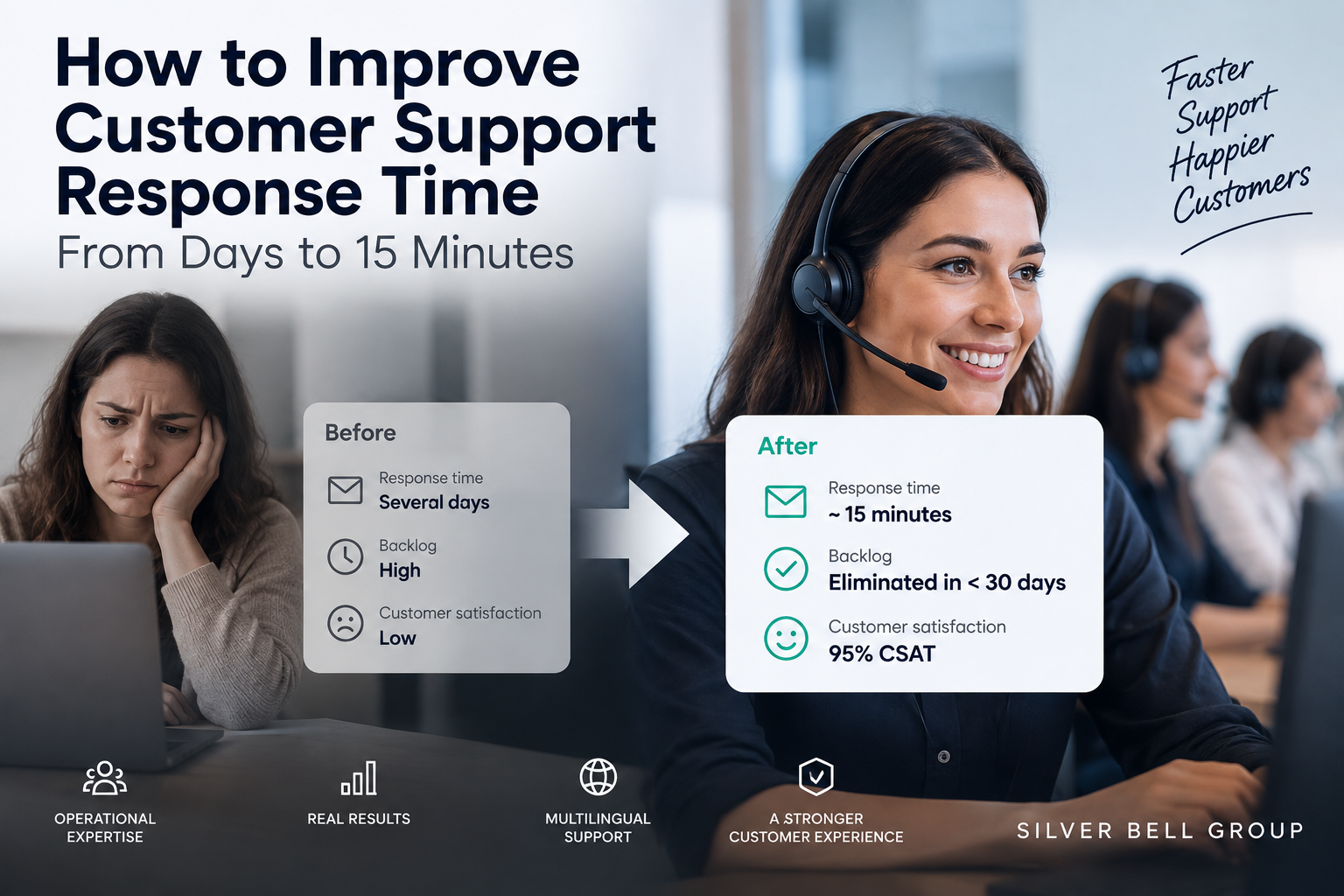
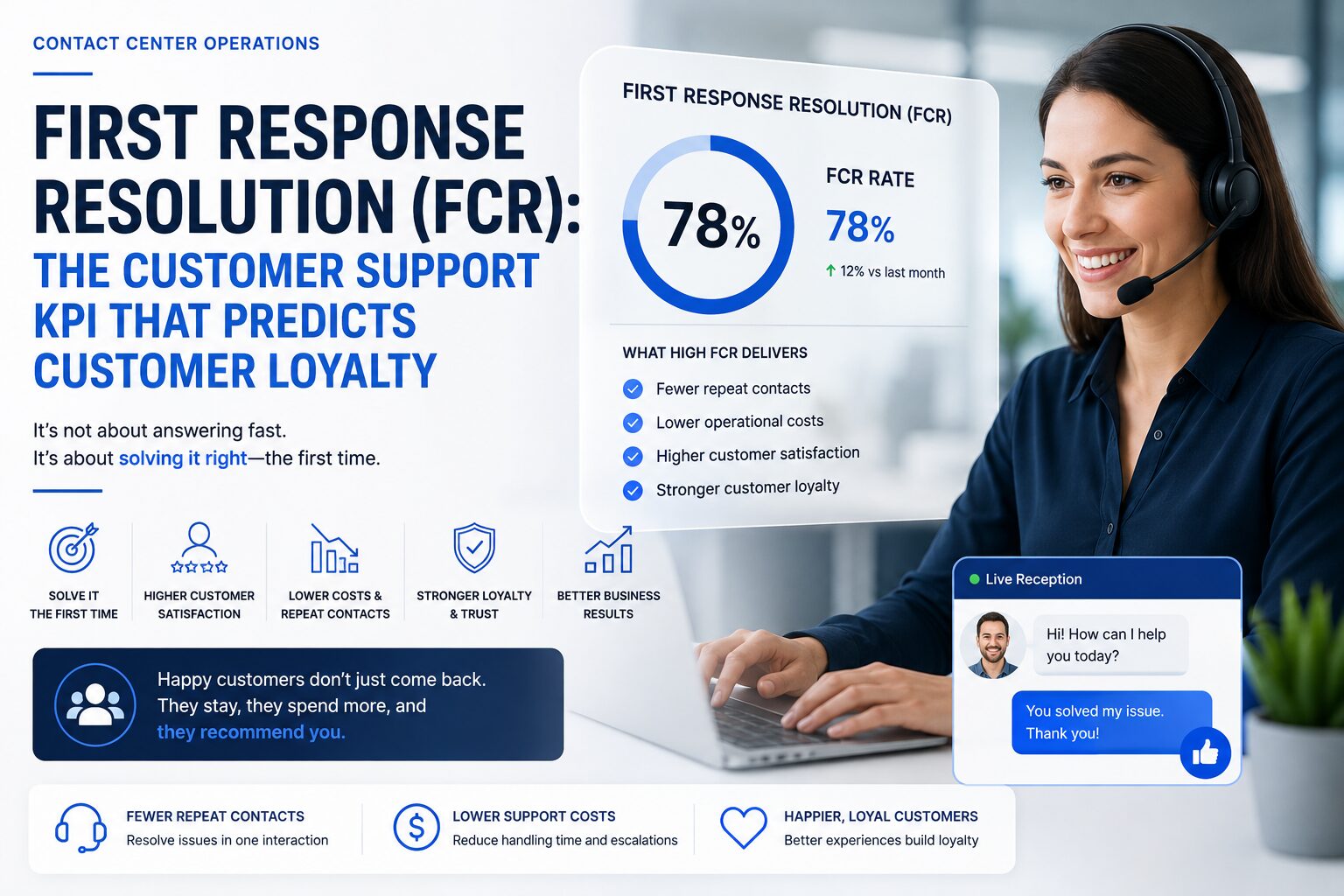
Many support teams celebrate speed because speed is easy to see. Dashboards light up when replies go out in seconds, service levels look healthy, and queues stay under control.
Customers, though, rarely remember the timestamp of the first reply. They remember whether the issue was solved.
That distinction is why first response resolution deserves far more attention in customer support operations. It is one of the strongest customer support KPIs because it measures the outcome that matters most: did the customer get a real answer, or did they get pushed into another interaction?
Table of Contents
What first response resolution means in customer support
First response resolution, often discussed alongside first contact resolution, measures how often a customer issue is fully resolved during the first interaction. The exact interaction can be a phone call, chat, email exchange, text conversation, or live reception handoff, depending on how the operation defines a contact.
In plain business terms, the metric answers a simple question: when a customer reached out, was that one touch enough?
That is very different from response time. A first response time metric tells you how quickly an agent acknowledged the request. First response resolution tells you whether the customer had to come back again, get transferred, wait for a follow-up, or escalate the issue.
Many organizations use first response resolution KPI and first contact resolution almost interchangeably. The difference usually comes down to channel rules. In voice support, “first contact resolution” is the common phrase because the interaction is typically a single call. In digital support, “first response resolution” is often more practical because the first agent response may carry the full solution, or it may not.
A common formula looks like this:
FCR = (Issues resolved on the first interaction / Total issues handled) x 100
That formula seems simple, but the value behind it is substantial. It connects operational performance, customer satisfaction, agent effectiveness, and cost control in one metric.
Why first response resolution matters more than response speed
Speed matters. Nobody wants to wait hours for a reply to a simple request. Still, speed without resolution often creates a worse experience than a slightly slower response that solves the problem in one step.
Picture two support teams. Team A answers every chat in under a minute, but the customer gets bounced to billing, then to technical support, then back to the original queue. Team B takes a little longer to answer, but the first representative has the tools, context, and authority to fix the issue immediately. Team B creates trust. Team A creates work.
This is where many customer support metrics can mislead leaders. A dashboard may show strong service levels, low initial wait times, and acceptable queue management while customer frustration keeps rising. The missing piece is resolution quality. If the first interaction does not close the issue, every fast reply can become part of a larger failure pattern.
Response speed is a promise. Resolution is proof.
That is why FCR is often a stronger indicator of customer experience than response time alone. It captures whether staffing, training, systems, routing, and knowledge management are actually working together.
How first response resolution affects customer satisfaction and retention
When customers get a complete answer the first time, they feel heard, respected, and confident that the company values their time. That feeling has a direct effect on customer satisfaction. It also influences Customer Satisfaction Score, Customer Effort Score, and Net Promoter Score, even when those metrics are not named on the daily dashboard.
Low-effort support tends to create strong emotional outcomes. Customers do not need to repeat their story. They do not need to reverify details with three different people. They do not need to wonder if the issue is still pending. A single clean resolution lowers friction, and lower friction usually leads to better CSAT.
Trust grows in small moments like these. When a company handles an issue correctly the first time, customers start to believe future interactions will be just as reliable. That confidence supports customer loyalty and customer retention, especially in industries where service quality can be a deciding factor.
The connection is easy to visualize:
Customer Question
        ↓
First Contact
        ↓
Issue Solved?
   ↓            ↓
 YES           NO
 ↓             ↓
Higher CSAT   Repeat Contact
 ↓             ↓
Customer      Higher Costs
Loyalty
FCR is not just an internal operations number. It reflects what the customer feels on the other side of the interaction.
The hidden cost of low first response resolution
Low FCR does more than hurt customer satisfaction. It also drives costs upward in ways that often stay buried inside larger contact center performance reports.
Every unresolved issue has a multiplier effect. One contact becomes two or three. One agent interaction becomes a chain of transfers, case notes, callbacks, escalations, and supervisor reviews. Queue volume rises even when customer demand has not changed. Productivity looks weaker even when the team is working hard.
The financial drag becomes clear when leaders look beyond average speed and volume.
| Low FCR | High FCR |
|---|---|
| Repeat contacts | One interaction solves the issue |
| More escalations | Fewer escalations |
| Higher support costs | Lower operational costs |
| Lower customer satisfaction | Higher customer satisfaction |
| Frustrated customers | Loyal customers |
Low first response resolution typically creates several cost pressures:
- Repeat demand: customers recontact the support team because the original issue is still open
- Escalation load: supervisors and specialists spend time on cases that should have been resolved earlier
- Staffing pressure: more contacts require more labor hours to manage the same customer base
- Revenue risk: dissatisfied customers are more likely to churn, downgrade, or delay renewal decisions
There is also a morale impact. Agents who constantly handle repeat contacts often feel stuck in a cycle of incomplete work. That can affect quality, engagement, and attrition. So FCR is not only a customer metric and not only a cost metric. It is also a workforce health metric.
FCR vs average handle time in contact center performance
Many operations leaders have been taught to keep conversations short. That instinct comes from years of focus on Average Handle Time, one of the best-known customer support metrics.
AHT is useful, but it can become harmful when it is treated as the main sign of efficiency.
If agents rush to end contacts, they may skip diagnosis, avoid ownership, or transfer too quickly. That can make handle time look better while first response resolution gets worse. The result is false efficiency: shorter individual contacts, more total contacts, and lower customer satisfaction.
A slightly longer call or chat is often the better business choice when it removes the need for a second or third interaction. That is why FCR and AHT should be reviewed together, not in isolation. A healthy operation balances both. It does not chase short conversations at the expense of real outcomes.
The same logic applies to Service Level Agreements. Strong SLA performance matters, but hitting an answer-time target does not guarantee the customer issue was solved. Resolution-based management is what turns service delivery into customer value.
How high-performing contact centers improve first response resolution
Higher FCR rarely comes from scripts alone. It comes from a stronger operating model that gives agents the information, confidence, and authority to solve problems completely.
The most effective teams invest in practical building blocks that remove friction inside the operation before customers ever feel it.
- Better training
- Clear escalation paths
- Strong knowledge bases
- CRM integration
- Smart routing
- Multilingual support
- Quality assurance
- Agent empowerment
Training is the obvious starting point, but not just product training. Agents need diagnostic training, policy judgment, and communication discipline. They need to know how to identify root causes, not just respond to symptoms.
Knowledge management matters just as much. If the right answer exists but is buried in outdated documents, FCR suffers. If customer history is trapped in separate systems, FCR suffers. If agents cannot see previous contacts, open tickets, billing status, or shipping data in one place, FCR suffers.
Technology should support resolution, not just speed. CRM workflows, guided knowledge, AI-assisted suggestions, smart routing, and case history can all improve first contact resolution when they are paired with capable people. Live reception services can also improve outcomes by connecting callers with a knowledgeable human representative who can act, not just take a message.
Operational design is another major factor:
- Empowered agents: give frontline teams the authority to issue common fixes, credits, updates, or approvals within defined guardrails
- Quality assurance: review whether the issue was actually solved, not only whether the script was followed
- Multilingual access: match customers with representatives who can resolve issues clearly in their preferred language
- Specialized routing: send contacts to the best-fit queue first so customers do not lose time in transfers
For organizations that need scale or specialized coverage, customer support outsourcing can be a strong path to better FCR. Dedicated outsourced teams often produce better results because they bring standardized onboarding, structured coaching, multilingual expertise, and disciplined workflow design. Silver Bell Group is one example of a partner focused on improving operational performance through the combination of people, processes, and technology, including customer support outsourcing and live reception services.
Measuring first response resolution correctly
FCR is powerful, but it can become unreliable when measurement rules are vague.
One common mistake is counting only agent-marked resolutions. Agents may close a case believing it is solved, while the customer still needs to follow up later. Another mistake is failing to define the time window. If a customer contacts support again three hours later, does that count against FCR? What about three days later? The rule needs to be consistent.
Teams also need channel-specific definitions. A phone call may be considered resolved when the issue is closed before the call ends. Email may require a longer window because the first reply could contain instructions the customer still needs time to test. Chat may sit somewhere in between.
A useful measurement framework usually includes:
- Clear resolution rules: define what counts as solved and what counts as repeat contact
- Channel logic: use realistic time windows for phone, email, chat, text, and reception-based contacts
- Customer validation: combine internal case status with CSAT, follow-up behavior, or post-contact surveys
- Segment reporting: track FCR by issue type, channel, team, language, and customer tier
Benchmarking can be tricky because every support model is different. A simple transactional support desk may target FCR above 80 percent. A complex technical support environment may consider a lower number healthy if cases require research or cross-functional action. The strongest benchmark is not a generic industry average by itself. It is a combination of peer context, issue complexity, and steady internal improvement.
When leaders interpret FCR, they should pair it with related customer support KPIs: CSAT, repeat contact rate, escalation rate, AHT, SLA performance, and quality assurance scores. FCR becomes far more useful when it is part of a system of customer support metrics that reflect both customer outcomes and operational efficiency.
FAQ about first response resolution
What is first response resolution?
First response resolution is the percentage of customer issues solved during the first interaction. It measures whether the customer needed any follow-up contact, escalation, or transfer to get the issue resolved.
What is a good FCR rate?
A good FCR rate depends on issue complexity, channel mix, and industry. Many teams view 70 to 80 percent as a strong target range, while highly specialized support environments may operate below that and still perform well. The better question is whether FCR is improving while CSAT, retention, and cost-to-serve also move in the right direction.
How do you calculate first response resolution?
Use this formula: issues resolved on the first interaction divided by total issues handled, then multiply by 100. The key is applying a consistent definition of “resolved” and a clear repeat-contact window.
Why is FCR important?
FCR matters because it captures the result customers care about most: getting the problem solved. Higher first response resolution usually leads to better customer satisfaction, lower operational costs, fewer escalations, and stronger customer retention.
How do you improve first response resolution?
Improve training, simplify workflows, connect systems, strengthen knowledge management, empower frontline agents, and review quality based on real outcomes. Many organizations also improve FCR through better routing, multilingual coverage, live reception services, or customer support outsourcing partners with structured operating models.
What is the difference between FCR and response time?
Response time measures how quickly support acknowledges a customer. FCR measures whether the issue was solved during that first interaction. Fast response time can support a good experience, but it does not guarantee resolution.
Support leaders who want better contact center performance should keep a simple standard in view: answering quickly is helpful, solving fully is what customers remember.