A customer contacts support.
They explain the issue once, get transferred, explain it again, wait on hold, then receive an email asking for details they already shared. The problem gets fixed in the end.
From an internal reporting view, that ticket may count as resolved. From the customer’s point of view, the experience was exhausting.
That gap is exactly why Customer Effort Score exists.
Customers rarely ask for memorable support. Most want something simpler: a fast, clear, low-friction path to an answer. When getting help feels easy, satisfaction rises, loyalty strengthens, and support teams spend less time dealing with repeat contacts. When getting help feels difficult, even a technically successful resolution can leave a bad impression.
Table of Contents
What Customer Effort Score Measures
Customer Effort Score, often shortened to CES, measures how easy or difficult it was for a customer to complete an interaction with a company. In support environments, that usually means getting an issue resolved, finding information, changing an account setting, or completing a service request.
The most common CES survey asks customers to rate a statement like, “The company made it easy for me to handle my issue.” The customer then selects a number on a scale, often from 1 to 5 or 1 to 7. Higher scores usually mean lower effort, though some companies use reverse scales where lower numbers mean less effort. That is why score design matters.
What makes customer effort score CES so useful is its focus. It does not ask whether the customer liked the brand. It does not ask whether the agent was polite. It asks a sharper question: how hard was this experience?
That makes CES different from broader customer experience metrics. A customer can feel satisfied with a friendly agent and still feel frustrated by the process. CES captures that friction directly.
How Customer Effort Score Calculation Works
Customer effort score calculation is simple on paper and easy to misuse in practice. The formula depends on the survey format, and the most important rule is consistency. If the scale changes, the benchmark changes too.
Here is how companies usually measure CES:
| Survey format | Example prompt | How it is scored | What a strong result means |
|---|---|---|---|
| 1 to 5 agreement scale | “The company made it easy to resolve my issue.” | Average of all responses | Higher average = lower effort |
| 1 to 7 agreement scale | “It was easy to get the help I needed.” | Average of all responses | Higher average = lower effort |
| Direct effort scale | “How much effort did you personally have to put forth?” | Average of all responses | Lower average = lower effort |
| Positive response rate | Same question as above | Percent of top-box or favorable responses | Higher percentage = lower effort |
Most teams follow a three-step process after collecting responses.
- Send the CES survey right after the interaction, while the experience is still fresh.
- Calculate the average score or favorable response rate for each channel, queue, team, or issue type.
- Compare trends over time, not just one isolated number.
Timing matters a lot. A CES survey sent immediately after chat, phone, email, or self-service gives cleaner data than a survey sent days later. It also helps to tie responses to operational details including transfer count, hold time, queue, language, and resolution status.
A good measurement setup does not stop at the overall average. It breaks customer effort score calculation into useful slices. A contact center might find that billing contacts score well while technical support scores poorly, or that chat feels easy while email creates repeated back-and-forth. Those insights turn CES from a vanity metric into an operational one.
Why Customer Effort Score Matters in Customer Support
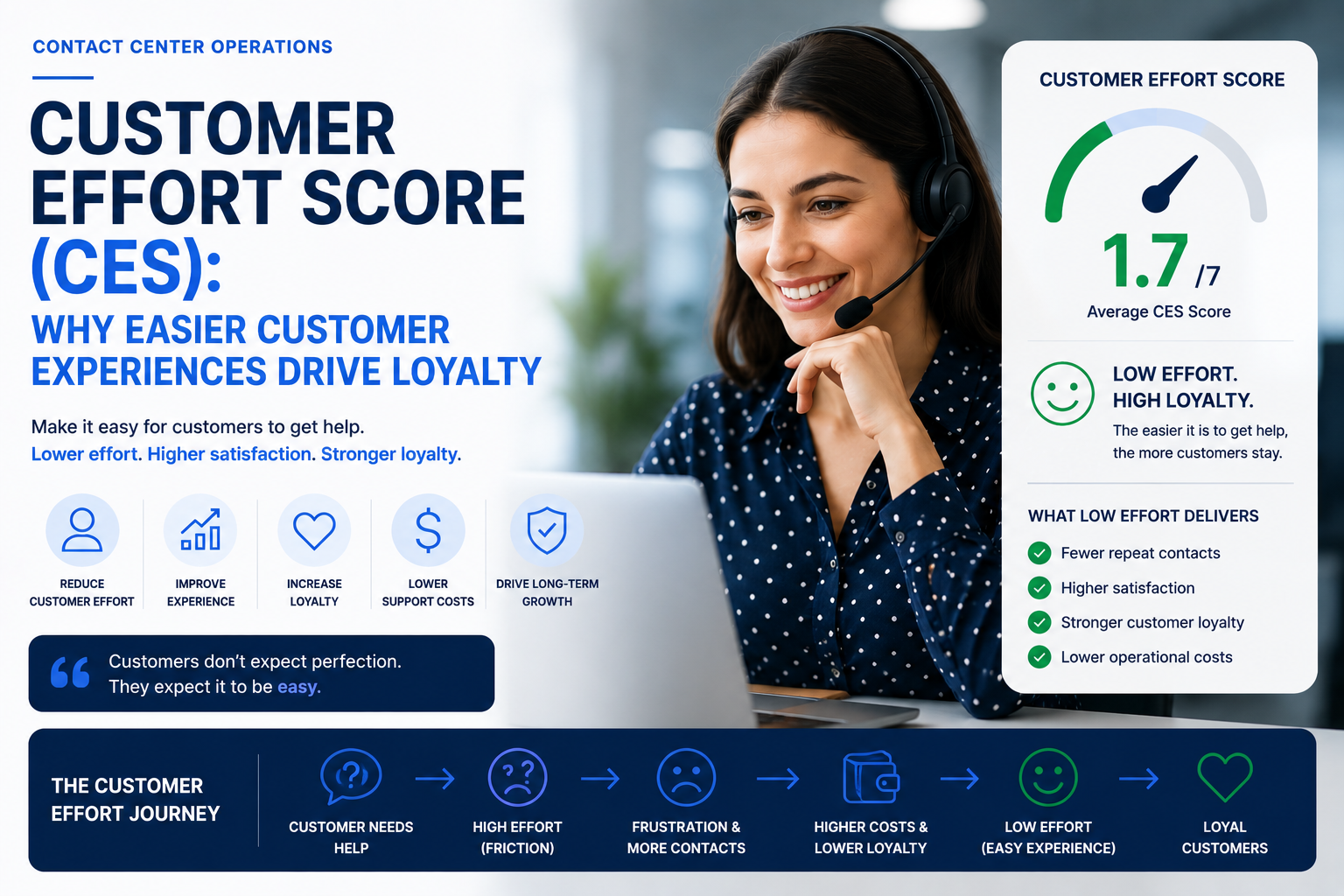
Effort has a direct effect on customer loyalty. Not because customers are keeping score on every minor inconvenience, but because repeated friction teaches them what future interactions will feel like. If help is slow, repetitive, and confusing, trust starts to erode.
Low-effort support also affects cost. When customers have to contact support multiple times, repeat steps, or move across disconnected channels, the company pays for that inefficiency. Higher handle times, more reopen rates, more escalations, and more abandonment often follow.
Ease is not a soft concept. It is an operational outcome.
A lower-effort customer service experience often leads to:
- fewer repeat contacts
- less channel switching
- lower abandonment
- stronger retention
- better agent productivity
This is why CES belongs next to the customer support metrics that actually matter. It gives context to speed, resolution, and satisfaction by showing whether the customer had to work too hard to get help.
Customer Effort Score vs CSAT and Other Customer Experience Metrics
CES and CSAT are related, but they are not interchangeable.
Customer Satisfaction Score, or CSAT, measures how satisfied a customer felt. CES measures how easy the experience felt. A customer may say, “The agent was kind, and I am satisfied,” while also thinking, “I should not have needed three contacts to fix this.”
That distinction becomes even clearer when CES sits beside other customer support KPIs.
| Metric | Main question it answers | Best use |
|---|---|---|
| CES | How hard was this experience? | Spot friction in service design |
| CSAT | How satisfied was the customer? | Track sentiment after interactions |
| FCR | Was the issue resolved in one contact? | Measure resolution efficiency |
| AHT | How long did the interaction take? | Monitor staffing and process efficiency |
| SLA | Did the team meet service commitments? | Track responsiveness and reliability |
If a team hits SLA but CES is poor, customers may be getting fast replies that do not actually make things easy. If CSAT is decent but CES is weak, good agents may be compensating for bad processes. If FCR is strong and CES improves at the same time, the operation is usually moving in the right direction.
That is why articles and dashboards about Customer Satisfaction Score (CSAT), First Response Resolution (FCR), Average Handle Time (AHT), and Service Level Agreements (SLA) are stronger when CES is part of the same picture.
What Creates High Customer Effort in Customer Service Experience
High effort usually comes from small operational failures stacking on top of each other. One delay might be tolerable. One transfer might be acceptable. One follow-up email might make sense. Put them together, and the customer experiences a process that feels unnecessarily hard.
Common friction points include:
- multiple transfers
- repeating information
- long waiting times
- disconnected channels
- confusing self-service paths
- poor agent knowledge
- forced follow-up contacts
- unclear escalation ownership
A customer does not care which department owns the problem. They care whether the company can solve it without making them do project management work.
This is where contact center performance becomes visible to the customer. Routing design, CRM structure, knowledge base quality, staffing models, escalation rules, and language coverage all shape perceived effort. CES turns those internal decisions into an external signal.
How First Response Resolution Reduces Customer Effort
First Response Resolution, often tracked as FCR, has a powerful relationship with CES. When an issue is resolved during the first interaction, the customer avoids the most frustrating parts of support: repeating the problem, waiting for updates, and wondering who owns the case.
A customer who gets a clear answer in one call or one chat usually describes the experience as easy, even if the issue itself was not simple. A customer who needs three contacts for the same issue rarely will.
This is why low FCR often shows up beside poor CES. The issue is not just that resolution took longer. The customer had to invest more effort to get to the same outcome.
How Contact Centers Can Improve Customer Effort Score
Improving CES rarely comes from a single initiative. It usually comes from removing friction step by step across the support operation.
Teams that improve customer effort score often focus on a few operational priorities first:
- Better routing: Send customers to the right queue and the right agent earlier.
- Agent training: Build stronger product knowledge, writing clarity, and ownership habits.
- CRM access: Give agents full interaction history so customers do not repeat themselves.
- Knowledge management: Keep internal and customer-facing content current, searchable, and easy to use.
- Omnichannel communication: Let customers move between phone, chat, email, and messaging without losing context.
- Agent autonomy: Reduce avoidable approvals for common fixes, credits, or exceptions.
- Multilingual support: Lower friction for customers who need help in their preferred language.
- Clear escalation processes: Make ownership obvious when the first agent cannot solve the issue alone.
These are not cosmetic improvements. They reshape the customer service experience at the point where frustration usually begins.
A strong CES program also studies the contact reasons behind low scores. If returns generate low effort but account recovery generates high effort, the next step is obvious. Fix the process that is creating the most friction. That may mean shorter authentication flows, better knowledge articles, cleaner handoff rules, or product changes outside the support team itself.
How Customer Support Outsourcing Can Reduce Customer Effort
Outsourcing does not improve CES by itself. A poorly designed support process stays difficult even if another team is handling it.
What can improve CES is an outsourcing model built around process discipline, training, integration, and active operational management. If an outsourced partner has access to the right systems, follows clear routing logic, uses accurate knowledge resources, and works within strong quality controls, customer effort can drop significantly.
That is where a partner like Silver Bell Group can fit into the picture. The value is not in outsourcing as a label. The value is in building support operations that are easier for customers to use and easier for agents to manage. That might include multilingual coverage, live reception support, better queue design, more stable service levels, or tighter escalation ownership.
For companies comparing in-house and outsourced support, CES is a useful decision metric. If the current model creates long waits, repeated handoffs, and inconsistent answers, the real question is not who owns the support team. The question is whether the operation can deliver a simpler experience.
Why Customer Effort Score Benchmark Data Can Mislead
A customer effort score benchmark can be helpful, but only when it is interpreted carefully. Different companies use different scales, different questions, different channels, and different customer segments. A 4.3 on a five-point agreement scale is not directly comparable to a 5.8 on a seven-point scale.
Benchmarks also shift by contact type. Password reset support should feel easier than a complex technical troubleshooting case. Comparing those without context can lead to bad decisions.
As a rough guide, many teams view these ranges as directional rather than absolute:
- On a 1 to 5 agreement scale, scores above 4.0 are often healthy.
- On a 1 to 7 agreement scale, scores above 5.5 are often healthy.
- On direct effort scales where lower is better, the target is a downward trend over time.
The more useful benchmark is your own baseline by channel, issue type, and customer segment. If phone support improves quarter after quarter while email stays flat, that tells a more actionable story than an industry average taken out of context.
Why Customer Effort Score Should Be Measured With CSAT, FCR, AHT, and SLA
CES becomes far more valuable when it sits inside a balanced scorecard of customer support metrics.
A single score can tell you that effort is high. It cannot tell you why. The supporting metrics help diagnose the cause.
- CSAT: Shows whether customers felt satisfied even when the process had friction.
- FCR: Reveals whether low effort is connected to one-contact resolution.
- AHT: Helps identify whether long conversations come from complexity, poor tooling, or unnecessary steps.
- SLA: Shows whether delayed responses are part of the problem.
This is also where contact center operations and customer experience stop looking like separate topics. They are the same topic viewed from different angles. Service levels, queue design, staffing, quality assurance, and knowledge systems all shape the amount of effort the customer must invest.
When teams review CES beside AHT, SLA, FCR, and CSAT, they can make better decisions. AHT can go down while CES gets worse if agents rush customers. SLA can look excellent while effort remains high because the customer still gets transferred twice. The mix matters.
Customer Effort Score FAQ
What is Customer Effort Score?
Customer Effort Score is a metric that measures how easy or difficult it was for a customer to complete an interaction with a company, most often during support.
How is Customer Effort Score calculated?
The most common method is to average survey responses to a question about ease, usually on a 1 to 5 or 1 to 7 scale. Some teams track the percentage of favorable responses instead.
What is a good Customer Effort Score?
It depends on the scale and question format. On a 1 to 5 agreement scale, many teams aim for 4.0 or higher. The stronger benchmark is your own trend over time by channel and issue type.
What is the difference between CES and CSAT?
CES measures effort. CSAT measures satisfaction. A customer can be satisfied with an agent but still feel that the process was too difficult.
Why is Customer Effort Score important?
It helps companies spot friction that affects customer loyalty, repeat contacts, abandonment, and support cost. It also connects operational choices to the real customer experience.
How can companies reduce customer effort?
They can improve routing, reduce transfers, give agents better system access, strengthen knowledge management, support multiple channels with shared context, and resolve more issues on the first contact.
Does lower customer effort increase loyalty?
In many cases, yes. When support feels easy, customers are more likely to stay, buy again, and return with confidence when they need help. Ease builds trust.
When support leaders want a clearer picture of customer loyalty and cost, CES is often the missing metric. It captures the friction that customers feel immediately and that operations teams can actually fix.