
Most discussions about call center service level begin and end with one number: 80/20. That shorthand is familiar, easy to repeat, and often treated like a default answer. The problem is that contact center operations are not built on defaults. They are built on call patterns, staffing realities, customer expectations, and cost tradeoffs.
A stronger answer starts with context.
A good call center service level is one that allows most customer interactions to be answered within a defined time threshold while keeping staffing sustainable and service quality strong. The widely referenced 80/20 service level, meaning 80% of calls answered within 20 seconds, can be a useful starting point. It is not a universal target. The right goal depends on call volume, industry, operating hours, staffing model, interaction complexity, and what customers actually expect when they reach out.
That distinction matters because many teams chase a benchmark that looks good in a dashboard but does not match their operation.
- Call center service level measures the percentage of interactions answered within a defined time threshold.
- 80/20: a common benchmark, not an automatic target for every business.
- Service level context: it should be reviewed alongside abandonment rate, response time, call volume, and customer satisfaction.
- Extremely aggressive targets can raise staffing costs fast without delivering a better customer experience.
- Real performance depends on forecasting, scheduling, processes, technology, and agent availability.
Table of Contents
What call center service level measures
Call center service level is a speed-to-answer metric. It tells an operations leader how often the team answers incoming contacts within a set time window. That window might be 20 seconds, 30 seconds, or another threshold defined by the business.
What it does not do is summarize the entire customer experience. A center can post a strong service level and still have poor resolution quality, high repeat contacts, or disappointing CSAT. That is why service level belongs inside a broader view of customer support metrics that actually matter.
It also helps to separate service level from a few related terms that are often mixed together. If your team also tracks a formal Service Level Agreements (SLA) framework, that usually covers broader contractual or operational commitments, not just answer speed.
| Metric | What it measures | Why it is different |
|---|---|---|
| Service level | Percent of contacts answered within a target time | Focuses on speed within a threshold |
| Average speed of answer | Average time callers wait before answer | An average can hide spikes and outliers |
| SLA | Agreed performance commitment | Often includes multiple KPIs, not only calls |
| Abandonment rate | Percent of callers who hang up before answer | Shows what customers do when wait times feel too long |
How call center service level is calculated
The standard service level formula is straightforward:
Service Level = (Calls answered within threshold ÷ total eligible calls) × 100
If 900 out of 1,000 eligible calls are answered within the defined threshold, the service level is 90%.
That looks simple, and at a high level it is. The nuance comes from the phrase eligible calls. One organization may exclude very short abandons. Another may include them. One team may calculate only voice interactions. Another may combine queues. This is why a call center service level calculation is only comparable when the methodology is clear.
A number without a definition can mislead a room full of smart operators.
What a good service level looks like in practice
A good service level is the one that matches business reality. In ecommerce, customers may expect fast answers during order issues or peak shopping periods. In insurance, urgency can rise around claims or billing questions. In hospitality, speed can directly affect bookings. In healthcare, the stakes may be much higher, but call types can also be more complex. In technical support, a slightly longer wait may be acceptable if the interaction solves the issue fully the first time.
This is why the answer to what is a good service level in a call center cannot be reduced to a universal benchmark.
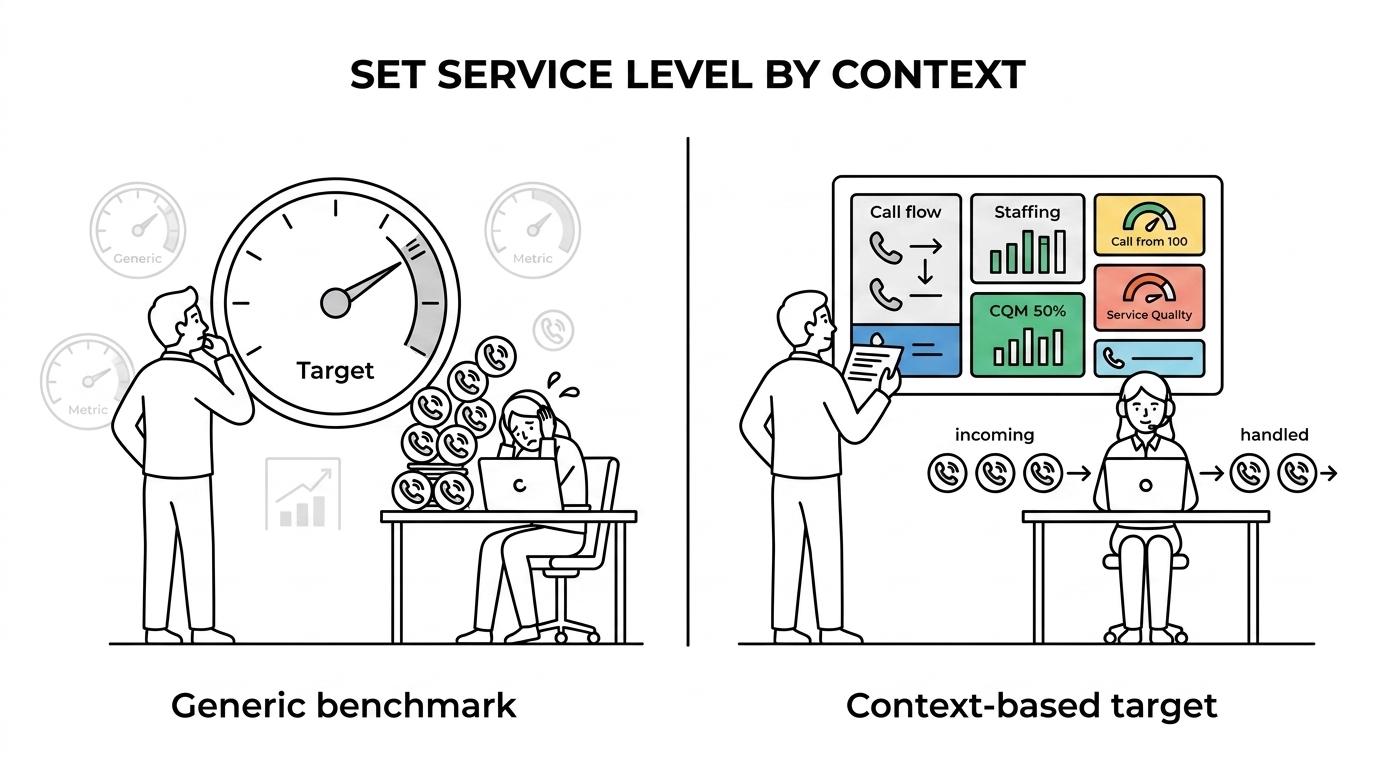
The 80/20 model remains useful because it gives teams a shared reference point. It is familiar and easy to communicate. Still, there is nothing magical about 80% or 20 seconds. A center handling simple transactional contacts may justify a tighter target. A center managing specialized or multilingual support may choose a different threshold because skill matching, issue complexity, and staffing constraints shape what “good” actually means.
A practical way to frame it is this:
- Good for customers: wait times feel reasonable for the issue type
- Good for operations: staffing is efficient and sustainable
- Good for the business: service quality supports retention, resolution, and cost control
Real-world contact center performance data
Numbers become more useful when they appear together instead of in isolation.
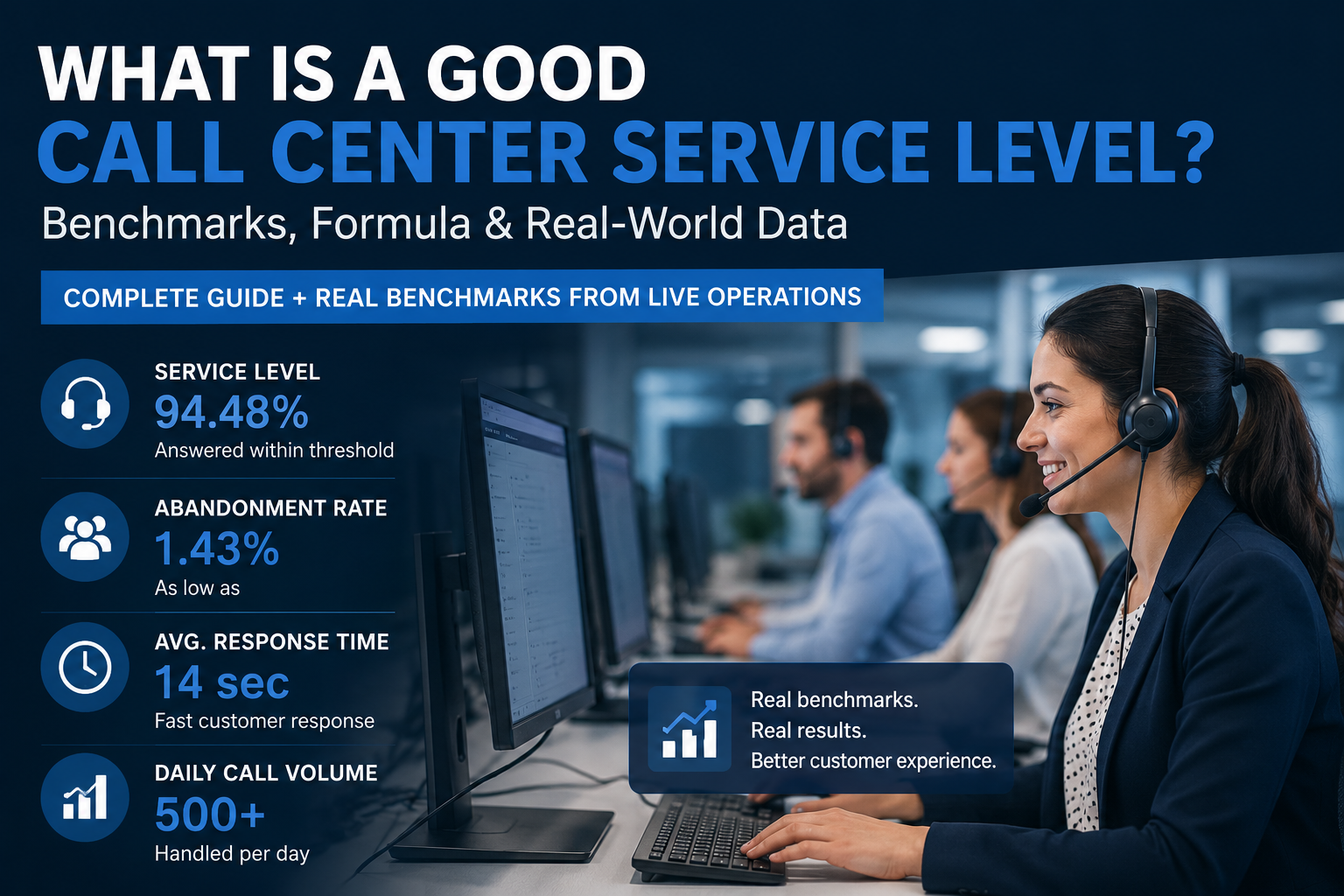
Real-World Contact Center Performance In an insurance customer support operation managed by Silver Bell Group, service level reached 94.48%, with 98%+ of calls answered, abandonment as low as 1.43%, average response times of approximately 14 seconds, and daily volumes exceeding 500 calls. Source: Silver Bell Group operational case study data.
This example is valuable because it resists the usual shortcut. The takeaway is not that 94.48% is the benchmark every center should copy. The takeaway is that service level makes more sense when paired with answer rate, abandonment, response time, and volume.
A high service level attached to low abandonment and strong answer coverage suggests a healthy operation. A high service level with rising abandons could point to a reporting quirk, queue design issue, or a customer path that causes callers to give up before they reach the measured stage.
That is the real lesson for contact center performance: context turns KPIs into decisions.
Why service level should never be measured alone
Service level works best as one signal inside a connected set of call center KPIs. Teams that treat it as the main score often miss the operational story behind the number.
The strongest reviews bring service level together with queue behavior, agent productivity, and customer outcomes. That includes Average Handle Time (AHT): Why Faster Isn’t Always Better, First Response Resolution (FCR), and Customer Satisfaction Score (CSAT).
- Service level + abandonment rate: high service level with high abandonment can point to a measurement gap or a broken caller experience.
- Service level + AHT: if handle time climbs, the same headcount covers less demand, even when volume stays flat.
- Service level + FCR: quick answers mean little if customers have to call back.
- Service level + CSAT: operational efficiency should produce a better customer experience, not only a faster pickup.
What affects call center service level
Service level shifts when demand and capacity move out of balance. That can happen because of obvious issues, like a sudden spike in call volume, or less visible ones, like poor schedule adherence or a routing setup that sends too many calls to too few skilled agents.
A low service level does not always mean the team needs more people. It may mean the center needs a better staffing model, sharper forecasting, cleaner workflows, or improved queue design.
Several operational factors shape contact center service level every day:
- Call volume and peak patterns
- Workforce forecasting: whether schedules reflect real demand by interval
- Staffing levels: enough capacity, but not idle overstaffing
- Average handle time
- Absenteeism and shrinkage: training, breaks, meetings, and unplanned absence reduce available capacity
- Call routing and queue structure
- Agent training and knowledge access: faster, more confident handling
- CRM and telephony integration
- Multilingual coverage
Multilingual operations deserve special attention. Supporting several languages or markets adds complexity far beyond raw volume. Even when total calls look manageable, the distribution of skills can create pockets of undercoverage that hurt service level in specific queues.
Why adding more agents is not always the answer
More agents can improve service level. They can also hide poor planning.
If schedules miss intraday peaks, new headcount may not fix the actual problem. If routing rules create bottlenecks, more generalists may not help a queue that needs specialized skills. If repeat contacts are inflating demand, the real issue may be resolution quality rather than staffing.
That is why many service-level recovery plans begin with diagnostics, not hiring. Forecasting accuracy, schedule fit, occupancy, escalation design, and agent utilization often produce bigger gains than a simple headcount increase.
How to improve service level in a call center
The best improvement plans are operational, not cosmetic. They start with demand and move toward control.
A useful framework looks like this:
- Measure incoming demand by interval, queue, and call type.
- Forecast volume using seasonality, campaigns, and known business events.
- Build a staffing model that includes shrinkage, occupancy, and skill requirements.
- Improve routing so customers reach the right agent faster.
- Give agents better knowledge tools, systems, and process clarity.
- Monitor service level with abandonment, AHT, FCR, and CSAT together.
- Adjust continuously as demand patterns change.
This approach turns service level from a static target into a managed outcome.
How customer support outsourcing can improve service level
For many companies, outsourcing becomes relevant when internal teams cannot scale coverage fast enough, cannot support enough languages, or need stronger workforce management discipline. In those cases, an experienced partner can bring structure that improves service level without forcing the business into permanent overstaffing.
The value usually comes from operational depth: flexible staffing, broader hiring reach, multilingual support, quality assurance, performance monitoring, and more mature forecasting and scheduling practices. Those are the foundations behind stable customer support SLAs and more resilient queue performance.
Companies reviewing Customer Support Outsourcing Services often focus on cost first. Service level is another major reason to evaluate the model, especially when demand swings sharply across seasons or campaigns.
For website-originated inquiries, Live Reception Services can also help close the gap between customer intent and human interaction. When visitors can reach a trained representative quickly, some support demand is handled earlier and more effectively.
Call center service level FAQ
What is a good service level for a call center?
A good service level is one that answers most calls within an appropriate time threshold while keeping staffing efficient and customer experience strong. It depends on industry, volume, call complexity, and customer expectations.
What does 80/20 mean in a call center?
It means answering 80% of calls within 20 seconds. It is a common benchmark, not a rule that fits every contact center.
How is call center service level calculated?
Use this service level formula: (Calls answered within threshold ÷ total eligible calls) × 100
Is 90% a good call center service level?
Often, yes. Still, 90% is only meaningful when paired with abandonment rate, response time, volume, and quality metrics. A strong number in isolation can be misleading.
What is the difference between service level and SLA?
Service level is a specific operational KPI about answer speed. An SLA is a broader agreement that may include multiple targets, response commitments, and service conditions.
What is the difference between service level and abandonment rate?
Service level tracks how many calls are answered within a target time. Abandonment rate tracks how many callers hang up before an agent answers.
How can a call center improve service level?
The biggest gains usually come from better forecasting, stronger scheduling, improved routing, cleaner processes, sharper knowledge management, and reviewing service level together with AHT, FCR, and CSAT.
Does outsourcing improve call center service levels?
It can. Outsourcing can improve service level when the partner brings stronger workforce planning, flexible staffing, multilingual coverage, and disciplined performance management.