

Table of Contents
A company should consider customer support outsourcing when rising demand, staffing needs, operating hours, language coverage, or market complexity become difficult to manage efficiently in-house. Common warning signs include slower response times, missed interactions, seasonal spikes, multilingual requirements, recruitment bottlenecks, and customer support costs that rise almost one-to-one with headcount. Outsourcing does not automatically improve service. It works when an external team can provide better structure, workforce flexibility, expertise, or coverage than the business can build internally at a sensible cost.
The better question is not whether outsourced customer support is inherently better than an internal team. It is whether support has become more complex to operate internally than it is strategically valuable to keep fully in-house.
A practical decision often starts with a few signals:
- solve an operational or scalability problem
- rising volume does not always mean hiring more agents
- seasonal peaks and longer hours increase internal complexity
- Hybrid models: keep sensitive or high-value interactions in-house
- Outsourced support team value: add flexibility without staffing permanently for peak demand
- Customer support costs: review management overhead, not just agent salaries
What outsourced customer support means
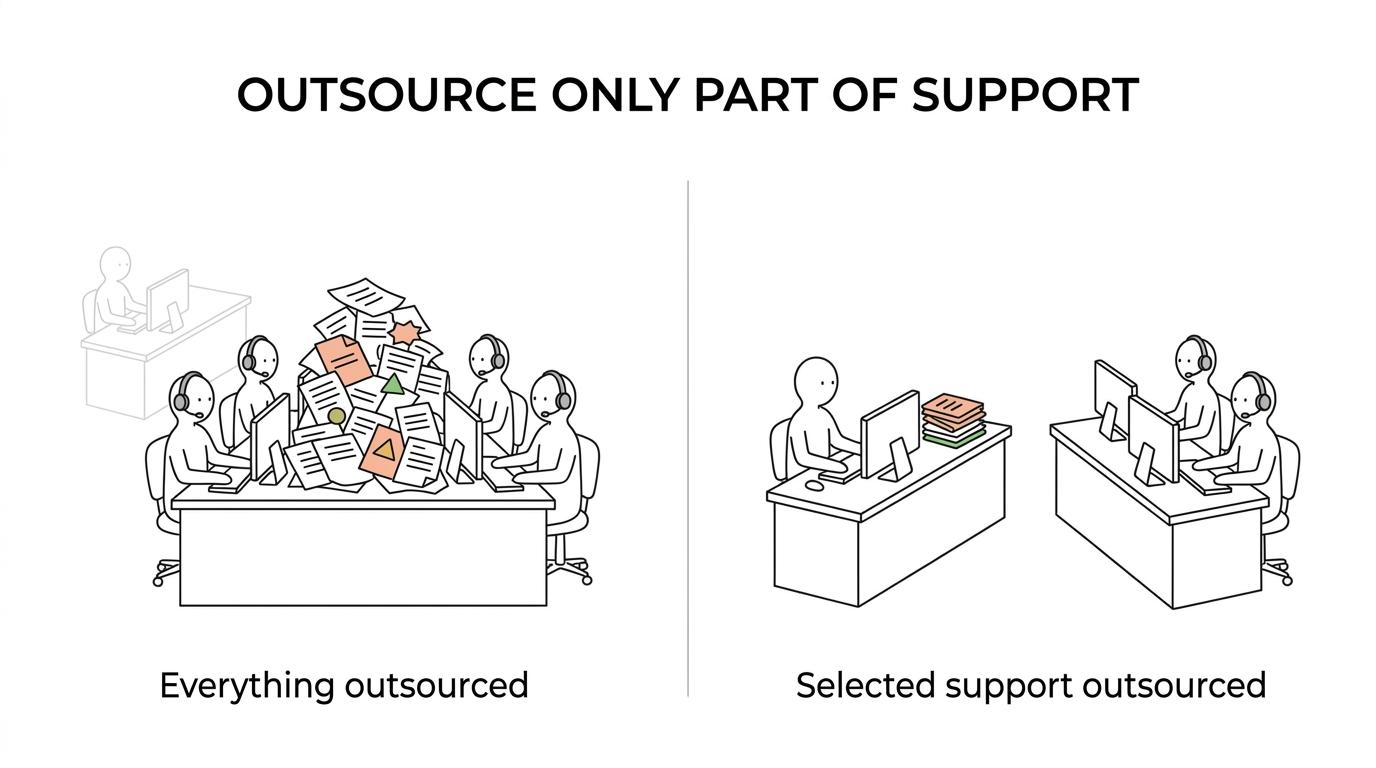
Customer service outsourcing can cover phone, email, live chat, ticketing, social messaging, after-hours support, and multilingual customer support. It does not have to mean handing over the entire customer relationship. Many companies outsource only a channel, a market, a language, a shift, or a support tier.
That flexibility matters. A business might keep escalations, VIP accounts, or technically complex cases in-house while using an outsourced support team for first-line inquiries, overflow calls, or weekend coverage. That is why the real in-house vs outsourced customer support decision is rarely all-or-nothing.
For teams comparing models, related benchmarks like What Is a Good Call Center Service Level? and Customer Support Metrics That Actually Matter help frame the operational side of the choice.
When should you outsource customer support?
The strongest case for outsourcing usually appears when service demand is outgrowing the operating model behind it.
Your customer support volume is growing faster than your team
More tickets and calls do not simply create more work for agents. They also create more hiring pressure, more team leads, more training needs, more scheduling complexity, and more quality management. When growth starts pulling managers away from product, revenue, or market expansion, customer support outsourcing becomes worth serious review.
Customers are waiting too long
Rising response times often show that capacity planning is lagging behind demand. If service levels are slipping, first replies are slowing, or queues are stretching across channels, the issue may be structural rather than temporary. A larger internal team can help, though only if recruitment and training can keep pace.
You are missing too many customer calls or inquiries
A high missed-call rate is rarely just an agent issue. It can point to poor forecasting, weak routing, uneven schedules, or not enough overflow capacity. If this is a growing pattern, the business may need an operating model built for workforce management rather than more reactive hiring. Resources like How to Reduce Missed Calls in a Call Center can help diagnose the gap.
Your customer demand is highly seasonal
Peak periods create a classic support problem. If you staff permanently for the busiest month, labor utilization suffers the rest of the year. If you staff for the average month, customer experience suffers at the peak. Outsourced customer support can give seasonal flexibility without locking the company into year-round fixed capacity.
You need multilingual customer support
Supporting several languages is often where internal scaling becomes much harder. Recruitment pools narrow, scheduling becomes more complex, and quality control has to work across markets. A provider with multilingual customer support already in place can reduce the time and management load needed to launch and maintain that coverage.
You need longer operating hours
Extended hours, overnight shifts, and weekend coverage can be expensive to build internally, especially when volumes are uneven. The same applies to international support when customers expect near real-time responses across time zones. In these cases, customer service outsourcing can be less about cost cutting and more about coverage design.
Customer support management is consuming too much internal capacity
This is one of the clearest signs.
If leaders are spending a disproportionate amount of time on hiring, attrition, coaching, QA, reporting, workforce planning, and daily service recovery, support may have become an operational business inside the business. That can be the moment when outsourcing starts to make commercial sense.
You are entering new markets faster than you can build local teams
Launching in a new geography often requires local language support, local schedules, and quick ramp-up. When expansion speed matters, outsourcing can remove months of recruitment and setup work while preserving service continuity.
When you should not outsource customer support
Some operations are simply not ready, and some should remain internal by design.
If support volume is low, the economics may not work. If interactions require deep product judgment or sensitive relationship handling, keeping them in-house may protect quality. If support is a core proprietary differentiator, control may be more valuable than flexibility. And if processes are undocumented, outsourcing will expose that weakness rather than solve it.
A useful rule is simple: outsourcing cannot fix a customer support model that the company itself does not clearly understand.
- Very low volume: not enough scale to justify transition effort
- Deep internal expertise: complex cases rely on product or regulatory judgment
- Core brand differentiator: support is central to competitive advantage
- Undocumented processes: unclear workflows create transfer risk
In-house vs outsourced vs hybrid customer support
Most executive teams end up comparing three models rather than two.
| Factor | In-house support | Outsourced support | Hybrid support |
|---|---|---|---|
| Control | Highest | Lower day-to-day control | Shared control |
| Scalability | Slower to expand | Faster ramp-up | Flexible by function |
| Cost structure | More fixed overhead | More variable capacity | Mixed |
| Multilingual coverage | Harder to build | Often easier to access | Add languages externally |
| Peak demand management | Costly if peaks are sharp | Stronger flex capacity | Good balance |
| Internal management requirements | Highest | Lower if partner is mature | Moderate |
| Specialized knowledge | Strongest for deep product cases | Depends on training model | Keep complex work inside |
| Speed of market expansion | Slower | Faster | Faster in selected markets |
Hybrid customer support often works well for companies that want internal ownership of complex or high-value interactions while outsourcing volume-heavy, repeatable, or time-sensitive work.
What good customer support outsourcing looks like
A strong outsourcing model is not a group of agents taking calls with limited context. It is a managed operation with agreed service levels, trained staff, reporting discipline, and clear ownership on both sides.
That is also why provider selection should go far beyond cost per seat. The real value sits in execution quality.
- Defined SLAs: response times, service level, abandonment, and resolution targets
- Clear KPIs: include Average Handle Time (AHT), First Contact Resolution (FCR), and Customer Satisfaction Score (CSAT)
- Dedicated management: team leaders, workforce planning, and escalation ownership
- Quality systems: QA reviews, coaching loops, and knowledge-base upkeep
- Technology fit: CRM integration, ticketing access, and transparent reporting
- Continuous optimization: regular reviews of volume trends, staffing, and root causes
For companies reviewing external options, Customer Support Outsourcing Services and Live Reception are examples of how support scope can be structured without outsourcing every interaction.
Real customer support outsourcing results from Silver Bell Group operations
Operational evidence matters more than generic claims. Silver Bell Group has reported results from different client support operations that show what disciplined execution can look like. These are separate examples from distinct environments and should not be read as a single benchmark.
| Operation | Reported result |
|---|---|
| Customer support operation | Gross missed calls reduced from about 40% to 10% |
| Customer support operation | Net missed calls reduced from about 20% to 5% |
| Insurance customer support operation | Service Level up to 94.48% |
| Insurance customer support operation | Abandonment Rate as low as 1.43% |
| Insurance customer support operation | Average response time about 14 seconds |
| Insurance customer support operation | More than 98% of calls answered |
| Premium customer support operation | Service Level of 96% |
| Premium customer support operation | Abandonment Rate of 1% |
These examples are useful because they reflect concrete operating outcomes: fewer missed interactions, faster answer times, and stronger queue performance. They do not prove that outsourcing is always the right path. They do show that an experienced partner can create measurable gains when the underlying support model is well defined.
How to decide whether to outsource customer support
A simple decision framework helps separate temporary pain from structural strain.
- Demand pressure: Is customer demand becoming harder to manage month after month?
- KPI decline: Are service levels, response times, or missed interactions getting worse?
- Scaling friction: Is internal hiring too slow or too expensive for current needs?
- Capability gap: Do you need languages, hours, or channels you do not currently have?
- Transfer readiness: Can the operation be documented, trained, and governed clearly?
If most answers are yes, it is time to evaluate outsourcing seriously.
How to choose a customer support outsourcing partner
Relevant operating experience should rank high. A provider should be able to show language coverage, recruitment depth, agent training methods, QA processes, reporting standards, security controls, and a management structure that can scale with demand. It should also be clear how escalation works, how knowledge is maintained, and how performance reviews are handled.
Price matters, though cost per agent is an incomplete measure. A cheaper provider with weak workforce planning or limited QA can produce lower service levels, higher repeat contacts, and more brand risk. For executive buyers, the more useful question is whether the partner can deliver stable service outcomes at scale.
FAQ about customer support outsourcing
When should a company outsource customer support?
When demand, complexity, or coverage requirements are outgrowing the internal model and service quality is slipping or becoming too expensive to maintain.
What are the benefits of outsourcing customer support?
Faster scaling, more flexible staffing, multilingual coverage, extended hours, and less internal management load.
What are the risks of outsourcing customer service?
Loss of control, inconsistent brand tone, weak product knowledge, and poor service if the provider lacks strong management or training.
Is outsourced customer support cheaper than in-house support?
Sometimes, though not always. The real comparison should include recruitment, supervision, QA, scheduling, and turnover costs.
Can a company outsource only part of its customer support?
Yes. Many businesses outsource only overflow, after-hours coverage, selected channels, specific languages, or first-line support.
Can customer support outsourcing handle multiple languages?
Yes, and multilingual customer support is one of the most common reasons companies outsource.
What customer support channels can be outsourced?
Phone, email, live chat, ticketing, messaging, after-hours reception, and some social support workflows.
How do you choose a customer support outsourcing company?
Review industry fit, language coverage, hiring capability, QA, reporting, technology integration, security, and proof of operational results.
What KPIs should an outsourced customer support team track?
Service level, response time, abandonment rate, missed contacts, AHT, FCR, CSAT, and channel-specific resolution measures.
Source note for Silver Bell Group operational data
The figures cited above are proprietary results reported from separate Silver Bell Group client operations. They represent distinct customer support environments and should not be combined into a general market benchmark. Reported metrics include missed-call reduction, service level, abandonment rate, response time, and answer rate as measured within those operations.
Author and reviewer information
Prepared by an editorial team for executive readers evaluating customer support outsourcing. Reviewed for operational accuracy against established customer support management practices and the reported Silver Bell Group case data.