
Growth can hide service problems for a while.
That was the situation for one fast-growing regional healthcare services provider that had expanded locations, added new offerings, and increased marketing activity within a short period. Inquiry volume rose faster than its internal support structure. The front desk, scheduling staff, and service coordinators were capable people, but they were being asked to manage too many inbound calls, too many follow-ups, and too many service questions at once.
What looked like a staffing strain was becoming a revenue and reputation issue. Missed calls were rising. Response time was slipping. Customer communication was inconsistent across shifts and locations. Every unanswered call carried a simple risk: a prospective customer might move on before the business had a chance to help.
Table of Contents
Why customer support outsourcing matters for growing businesses
Customer support outsourcing is often framed as a cost discussion. That misses the bigger opportunity.
For growth-stage companies and complex service organizations, outsourced customer support can act as an operating upgrade. It expands availability, improves call handling discipline, stabilizes response time, and creates a more consistent customer experience across channels. That matters when internal teams are already balancing service delivery, scheduling, sales support, and administrative work.
In this case, leadership did not want a basic overflow vendor. They needed a partner that could strengthen customer service operations without disrupting existing workflows. The objective was clear: reduce missed calls, improve inbound customer support, and protect service quality as demand kept rising.
“Most companies do not have a staffing problem first. They have a customer communication problem first.”
The hidden cost of missed calls in customer service operations
A missed call is rarely just a missed call.
For this client, many inbound inquiries came from people ready to book, confirm, reschedule, ask urgent questions, or decide between providers. When those calls went unanswered, the business lost more than a touchpoint. It lost context, momentum, and trust.
The leadership team had already seen the pattern in reporting and anecdotal feedback. Customers mentioned long wait times. Internal teams were staying late to return calls. Peak periods created a backlog that spilled into the next day. Managers were spending time patching gaps instead of improving performance.
The business impact showed up in several ways:
- lost sales opportunities
- delayed scheduling and intake
- lower first-contact resolution
- staff fatigue
- inconsistent customer experience
A slow response may feel manageable internally. To the customer, it often feels like indifference.
When internal support teams reach their limit in inbound customer support
The warning signs were not dramatic at first. They were easy to rationalize.
A few more voicemails than usual. Longer lunch-hour queues. A rise in abandoned calls during afternoon peaks. Managers stepping in to answer phones between other tasks. Staff members handling customer communication differently based on experience level or location.
Then the pattern hardened. Call volume had outgrown the original support model. The company was still relying on a structure built for a smaller organization, even though customer expectations had moved in the opposite direction. People expected fast answers, clear next steps, and availability across more hours.
That is the point where missed calls stop being an inconvenience and become a business risk.
How customer support outsourcing reduced missed calls by 75%
The first step was not hiring more people. It was workflow analysis.
A review of customer service operations showed that the problem had three layers. First, inbound demand was uneven by hour and location. Second, call handling rules were inconsistent, which increased transfers and repeat contacts. Third, internal employees were splitting time between core roles and phone coverage, which slowed response time even when calls were answered.
The outsourcing model was built around those realities. Rather than replacing the internal team, the support partner created a structured extension of it. Dedicated specialists handled front-line inquiries, overflow routing was redesigned, and service scripts were standardized so the experience felt consistent no matter when a customer called.
The implementation focused on operational improvements:
- Workflow mapping: identified high-volume call types, peak windows, and handoff points
- Communication audit: reviewed how inquiries were answered, transferred, and documented
- Call routing optimization: reduced bottlenecks and sent the right inquiries to the right queue faster
- Dedicated support specialists: created reliable coverage for recurring inquiry categories
- System integration: connected notes, scheduling steps, and escalation rules to existing processes
- Multilingual customer support: widened accessibility for callers who were more comfortable in another language
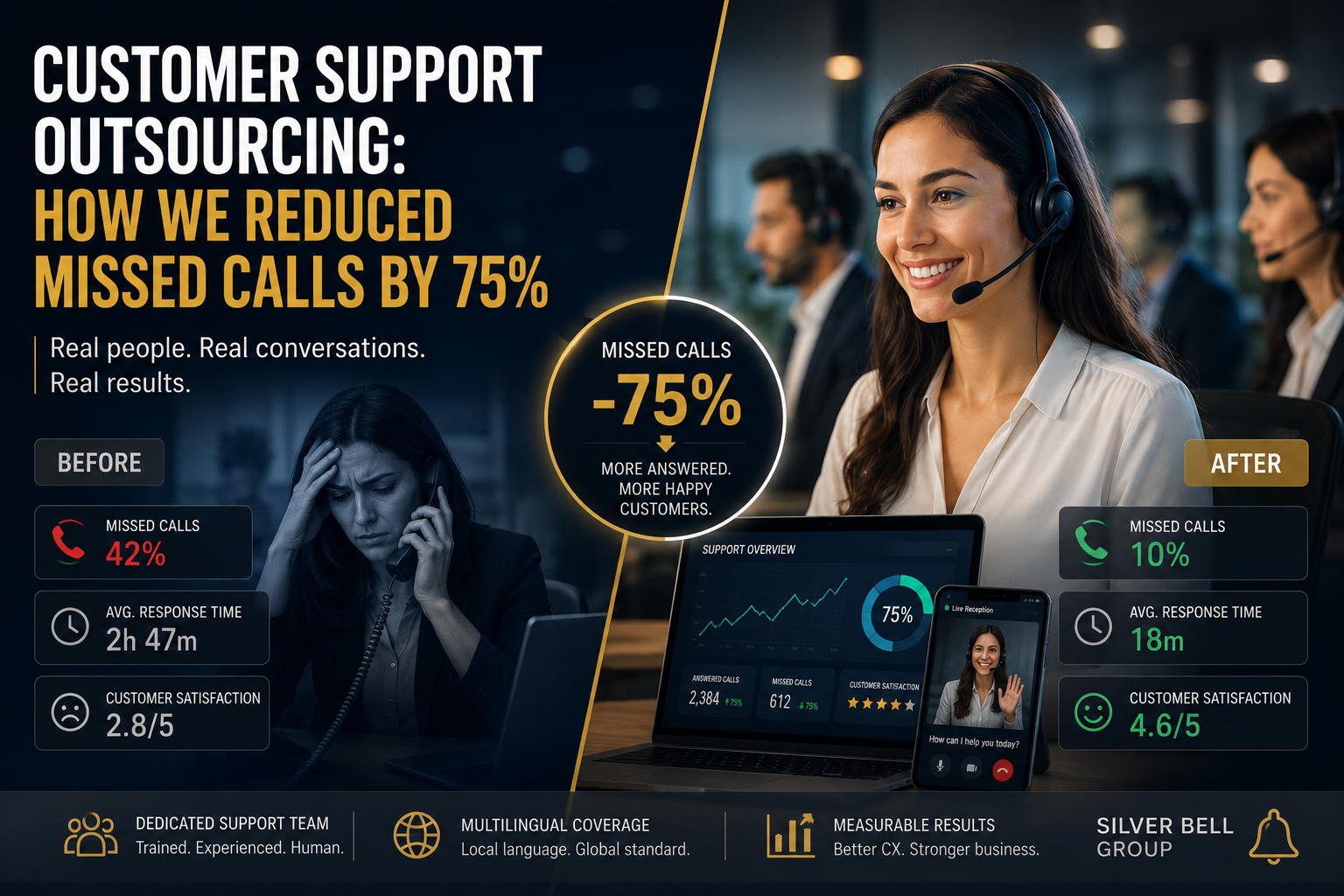
Within the first two weeks, answer rates stabilized during peak periods. By day 45, missed calls had dropped sharply. By the end of the first full quarter, the client had reduced missed calls by 75% compared with the baseline period.
Here is how the change looked in operating terms.
| Metric | Before outsourcing | After 45 days | After 90 days |
|---|---|---|---|
| Monthly inbound calls missed | 480 | 190 | 120 |
| Missed call rate | 20% | 8% | 5% |
| Average response time | 11 minutes | 5 minutes | 3 minutes |
| First-contact resolution | 68% | 76% | 82% |
| Customer satisfaction score | 82% | 88% | 91% |
| Internal time spent on call recovery | 100% baseline | 72% | 58% |
These numbers matter because they show more than coverage. They show control. The business was no longer reacting to demand. It had a repeatable service model that could absorb it.
Improving customer experience through better customer communication
Better availability helped, but availability alone did not create the result.
The stronger outcome came from better customer communication at the front line. Support specialists used consistent call handling steps, clearer escalation rules, and documented follow-up actions. Customers got faster answers. Internal teams received better notes. Callers were less likely to repeat themselves across touchpoints.
That consistency had a direct effect on customer experience outsourcing performance. Customers care about speed, yes, but they also care about confidence. A clear answer on the first call usually feels better than a rushed answer followed by two callbacks and a transfer.
This also reduced internal friction. Managers spent less time clarifying incomplete messages. Clinical and operational staff were interrupted less often. The support model gave employees room to focus on the work only they could do.
“Outsourcing worked here because the process got sharper, not just because more people were available.”
Why multilingual customer support creates better outcomes
For this client, multilingual customer support was not a branding feature. It was a service necessity.
A meaningful share of inbound inquiries came from callers who preferred to discuss scheduling, service details, or account questions in a language other than English. Before the outsourcing rollout, those calls could take longer to resolve, and the experience depended heavily on who happened to be available.
A multilingual support layer improved both clarity and speed. It reduced misunderstandings, shortened handoffs, and made customers more comfortable asking follow-up questions. In practical terms, that meant fewer abandoned calls, better information capture, and higher confidence in the next step.
For enterprise decision makers, this is a useful reminder. Language access is not separate from customer experience. It is customer experience.
How Live Reception complements customer support outsourcing
Phone support should not begin only after a customer decides to dial.
That is where Live Reception fits naturally into the operating model. Many businesses now need a bridge between website traffic and direct human interaction. Live Reception can turn Website Visitor → Live Conversation → Qualified Customer before a missed call ever becomes a problem.
For organizations dealing with high inquiry volumes, live reception services can screen intent, answer common questions, route qualified leads, and create a smoother handoff into inbound customer support. That reduces friction at the top of the funnel and protects staff from avoidable interruptions.
Combined with customer support services, the model becomes more powerful. One layer captures and guides incoming demand. The other manages ongoing customer communication with structure, speed, and consistency. For businesses trying to scale without sacrificing service quality, that combination can be a practical advantage.
Key lessons for customer support operations leaders
This case study offers a lesson that applies well beyond healthcare.
When companies see rising missed calls, they often assume the fix is simply more staffing. Sometimes that is part of the answer. Often, the deeper issue is that customer service operations have not kept pace with growth. Routing rules are informal. Coverage is uneven. Escalation paths vary by team. Reporting focuses on volume without tracking quality.
Leaders evaluating customer service outsourcing should look for these signals:
- Repeated voicemail spikes: especially during predictable peak windows
- Longer response time: even when overall staffing appears stable
- Cross-functional overload: specialists pulled away from core work to answer phones
- Inconsistent customer communication: different answers across shifts, sites, or channels
- Rising recovery work: too much time spent returning missed calls instead of resolving live inquiries
A well-designed outsourcing model creates value because it protects both the customer and the internal team. It gives customers a timely response. It gives employees a clearer operating structure. That is why the result often shows up in more than one metric at the same time.
What to measure in customer experience outsourcing besides call volume
Call volume tells you demand. It does not tell you service quality.
If a business wants to know whether support performance is improving, it should measure how customers move through the communication process and how efficiently teams resolve issues. In this case, leadership paid close attention to missed call rate, average response time, first-contact resolution, escalation quality, and the time internal teams spent recovering missed opportunities.
A stronger measurement set usually includes:
- Answer rate: how often live inquiries are handled in real time
- Response time: how quickly the business reacts when live handling is not possible
- First-contact resolution: how many issues are solved without follow-up or transfer
- Escalation accuracy: whether inquiries reach the right internal team the first time
- Customer satisfaction: whether the experience felt clear, timely, and helpful
Those metrics help leaders see the real issue. Not just how many people reached out, but how many were actually served well.