Hospitality operations rarely break all at once. They erode in small, expensive moments: a missed call from a guest ready to book, a late reply on Booking.com, an unanswered WhatsApp message about airport transfer, a website inquiry that sits untouched until the next shift.
Those moments look operational on the surface. In practice, they are commercial failures.
A recent implementation for a large hospitality and property management company made that visible very quickly. After Silver Bell Group deployed a hybrid omnichannel support structure with multilingual live reception and customer support teams integrated into the client’s own systems,
performance moved fast:
98.2% SLA compliance,
response times cut from hours to under 2 minutes,
a 34% increase in direct booking conversions,
a 4.8/5 guest satisfaction score,
and a 40% reduction in operational overhead.
Table of Contents
The Hidden Cost of Fragmented Hospitality Operations
Many hospitality brands still manage guest communication as a collection of separate tasks instead of one operating system. Reservations handles the phone. Front desk manages emails. OTA messages sit inside platform inboxes. Social media lives with marketing. Property managers monitor direct inquiries between site visits. None of this sounds dramatic until inquiry volume rises.
Then the real costs show up.
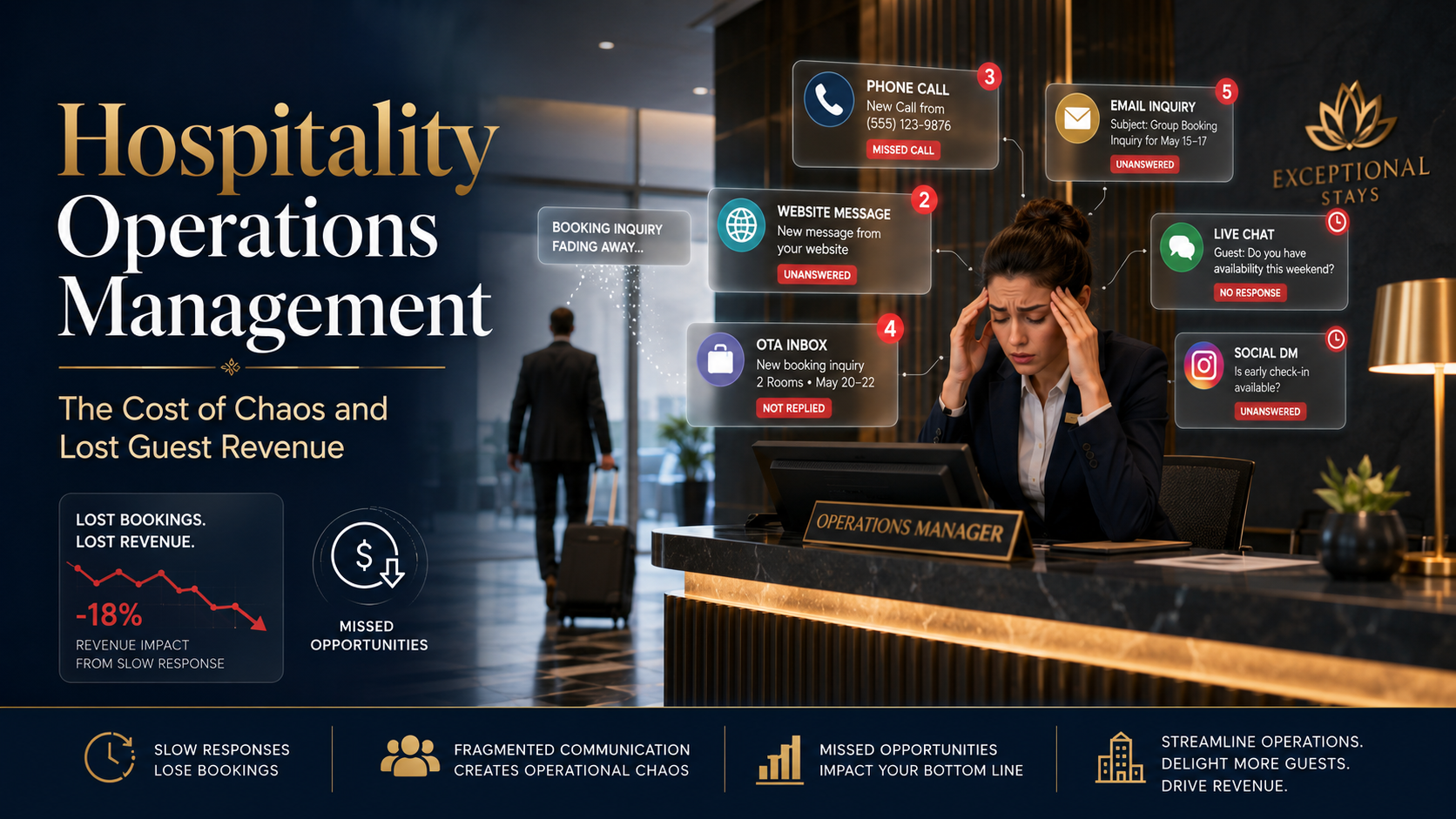
Fragmented communication creates a pattern that operations leaders know well: duplicated replies, missed follow-ups, inconsistent tone, weak escalation, and poor visibility into which conversations convert into revenue. The cost is not limited to team frustration. It appears in booking abandonment, lower direct revenue, poor review sentiment, and staff burnout during peak periods.
In large hospitality and property management environments, the problem becomes even sharper because guest journeys move across channels before a booking is confirmed. A traveler may see a listing on Airbnb, check the website for a better rate, call with a question about parking, then send a late message asking whether early check-in is possible. If those touchpoints are disconnected, the brand is asking the guest to do the coordination work.
That is where revenue starts leaking.
After years of expansion into OTAs, messaging apps, direct websites, and social channels, many teams are operating with more inbound demand than their internal structure can handle. The pattern usually includes:
- missed calls during peak hours
- delayed replies to pre-booking questions
- duplicated work across front desk and reservations
- unresolved issues moving between channels
- abandoned high-intent direct bookings
A premium guest experience cannot begin at check-in if the booking conversation already felt fragmented.
Why Hospitality Operations Management Became More Complex
Hospitality operations management used to be more linear. A guest called, emailed, or booked through a travel agent. Now one property can receive demand through phone, website forms, WhatsApp, Booking.com, Airbnb, Google Business messages, email, social media, and partner portals, all within the same hour.
This is not just channel growth. It is channel interdependence.
A guest may start with a public listing, ask a private question, request reassurance from a human, compare direct and OTA rates, then expect immediate confirmation and follow-up. That means operations teams are no longer managing a front desk workflow alone. They are managing a live revenue environment where service and sales are happening at the same time.
For property management companies, the pressure is even higher. Their model often includes multiple assets, different owners, rotating availability, multilingual demand, and location-specific guest questions. Strong property management customer service now depends on centralized visibility, channel discipline, and a support structure that can flex with seasonality.
This is why staffing alone no longer solves the issue. Many teams add headcount but keep the same fragmented workflows. The result is higher labor cost without real control.
The implementation led by Silver Bell Group started with that exact condition. The client had strong demand, valuable inventory, and capable internal teams, yet communication volume had outgrown the operating model. Inquiries were spread across systems, seasonal surges created queue congestion, and response quality shifted by shift, language, and platform. The problem was not effort. It was architecture.
The Operational Risks of Slow Guest Communication
Speed is one of the clearest indicators of whether a hospitality operation is protecting revenue or giving it away.
High-intent guests do not wait very long, especially before booking. If they need clarity on cancellation terms, family occupancy, pet policy, airport transfer, parking, or arrival time, a delay creates uncertainty. Uncertainty drives comparison. Comparison drives abandonment.
For direct bookings, the gap is even more painful. The guest is already in a brand-owned environment, asking for reassurance before purchasing. When that inquiry waits for hours, the brand is often training the guest to return to an OTA where response structures are faster and more visible.
Here is how the risk tends to show up operationally:
| Operational metric | Before support redesign | After hybrid omnichannel deployment | Business impact |
|---|---|---|---|
| First response time | Hours | Under 2 minutes | Fewer lost high-intent inquiries |
| SLA compliance | Inconsistent | 98.2% | Stronger service reliability |
| Direct booking conversions | Baseline | +34% | More revenue through owned channels |
| Guest satisfaction | Variable | 4.8/5 | Higher trust and better experience |
| Operational overhead | High manual load | -40% | More capacity without internal strain |
The commercial logic is straightforward. Faster replies reduce friction. Better coverage protects demand during evenings, weekends, promotions, and seasonal spikes. Centralized response handling reduces duplicate work. All of that improves conversion.
This is one of the clearest links between hospitality operations management and revenue performance.
Why Automated Support Fails in High-Stakes Hospitality Situations
Automation has value. It can route conversations, tag intent, trigger confirmations, send standard information, and support queue discipline. Those are useful gains.
Still, automation alone does not perform well in many hospitality situations where context, reassurance, and judgment matter.
A guest planning a five-night family stay does not want to argue with a bot about room configuration. A traveler arriving after midnight wants confidence, not a scripted loop. A direct booking lead comparing a premium suite with an OTA rate may need immediate human handling to secure the sale. In these moments, speed is necessary, but human confidence is what closes the gap.
Luxury and high-intent guests expect real interaction because the purchase is emotional as well as transactional. They are not just buying a room. They are buying certainty, convenience, recognition, and a smoother experience before arrival.
Pure chatbot models also struggle with multilingual nuance, exception handling, and service recovery. They can answer standard questions well enough, yet the expensive interactions are often the ones that fall outside the script. That is exactly where brands need their strongest support.
Technology should organize communication. Humans should manage relationships.
Why Modern Hospitality Operations Management Requires a Hybrid Human-Touch Approach
The strongest operational model today is hybrid. It combines automation for structure with trained human teams for conversion, service recovery, escalation, and guest confidence.
That was the core design principle in the Silver Bell Group deployment. Rather than replacing internal teams or flooding the operation with low-cost labor, the model inserted dedicated multilingual support professionals directly into the client’s communication flow. Live reception and customer support were integrated with the client’s systems, response rules, property information, and escalation paths.
The result was a more disciplined operating layer across every major touchpoint. Instead of forcing front desk staff, on-site managers, and reservations teams to absorb every incoming interaction, the support model centralized first response, triage, routing, and resolution standards.
That change is why overhead dropped by 40%. The internal team did not become less busy because demand disappeared. They became less overloaded because communication was handled with more structure.
In a high-performing hybrid model, each layer has a specific job:
- Automation handles: routing, tagging, acknowledgments, FAQ delivery, and SLA tracking
- Human teams handle: booking reassurance, multilingual conversation, exceptions, upselling, and issue resolution
- Operations leaders monitor: queue health, conversion leakage, quality scores, and staffing pressure
This is also where hospitality customer support outsourcing becomes a strategic operating decision rather than a narrow staffing tactic. When the support layer is integrated, multilingual, and measured against commercial outcomes, it functions as conversion infrastructure.
The Relationship Between Response Time and Booking Conversions
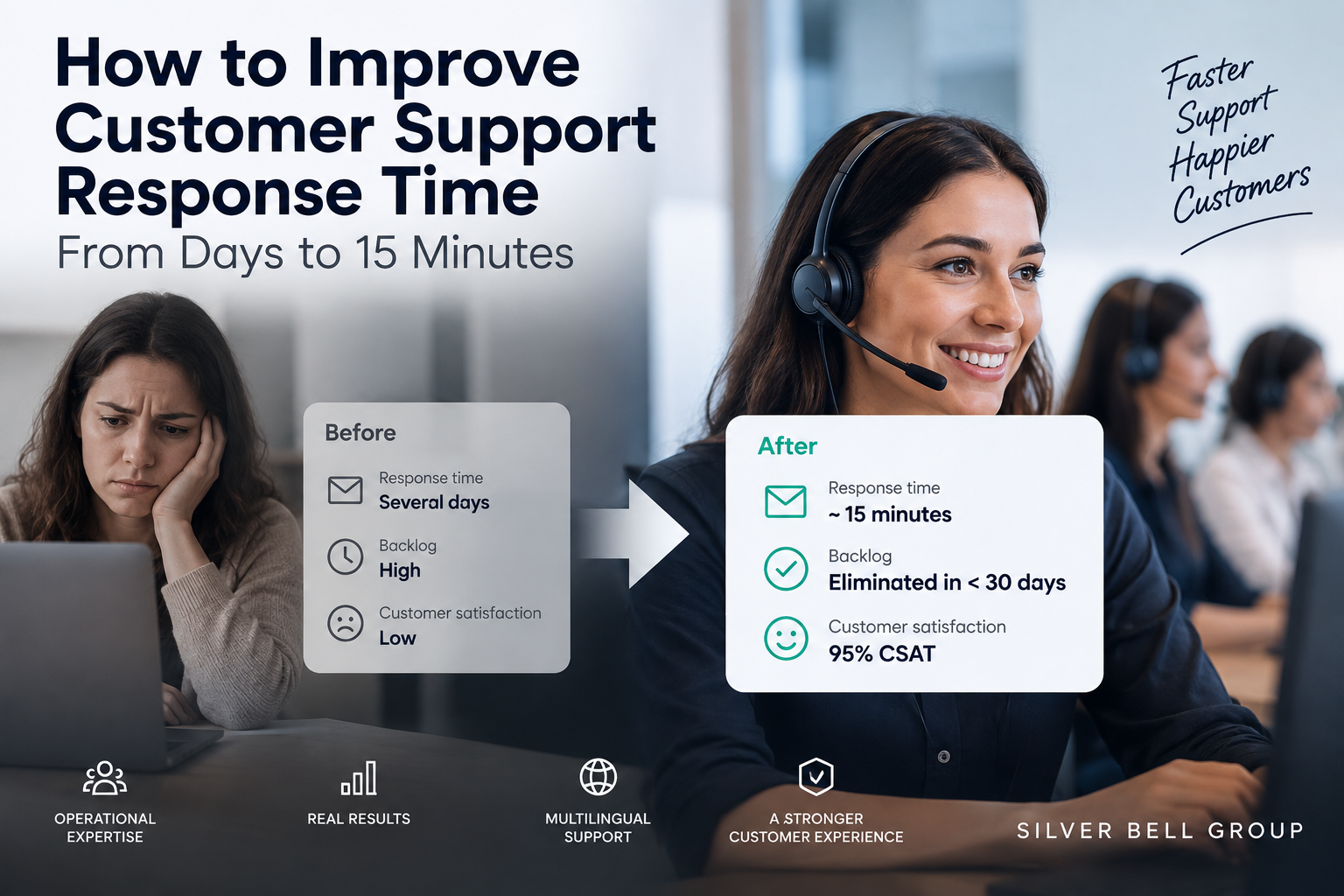
Every delay between inquiry and reply gives the guest time to doubt, compare, or leave, which is why reducing hotel booking abandonment often starts with response design, not rate strategy.
In the Silver Bell Group implementation, cutting response times from hours to under 2 minutes was closely tied to the 34% lift in direct booking conversions. That is not surprising. Quick human engagement signals competence, resolves uncertainty while intent is still active, and keeps the guest inside the brand’s booking path instead of sending them back into the market.
Building an Omnichannel Guest Support Infrastructure
Omnichannel guest support is often described as a channel issue. It is really an operations issue.
If phone calls, OTA inboxes, website forms, WhatsApp, email, and social messages are not managed through a unified service logic, the brand will keep generating service blind spots. A guest communication management system has to do more than collect messages. It must control ownership, response standards, escalation paths, and language coverage.
Silver Bell Group approached this with an infrastructure mindset. The support model was built around centralized intake, channel-specific workflows, multilingual response coverage, and direct system integration. That allowed the client to keep its brand standards and internal visibility while adding operational capacity exactly where revenue risk was highest.
A typical omnichannel support structure in hospitality should include:
- Centralized inbound capture across all guest-facing channels
- Priority routing based on booking intent, urgency, and service stage
- Unified guest history so agents can see context across interactions
- Language coverage matched to source markets
- Escalation protocols connected to property operations, reservations, maintenance, and management
- Reporting that links service performance to conversion and guest satisfaction
Without this structure, brands often mistake channel volume for staffing failure. The real issue is usually fragmented process design.
This matters for hotels, serviced apartments, short-term rental operators, and mixed property portfolios alike. It also matters for adjacent models where live reception for real estate and hospitality overlap, especially in premium residential leasing, branded residences, and mixed-use property groups where guest and resident expectations are close to hotel-level service standards.
For teams reviewing Silver Bell Group’s Travel & Hospitality expertise, the key point is not that every inquiry needs a large support team. The point is that every inquiry needs a controlled operating path.
How Silver Bell Group Reduced Operational Overload by 40%
The most valuable result in many support transformations is not the visible speed metric. It is the reduction in internal drag.
Before the redesign, the client’s internal teams were spending too much time switching systems, checking multiple inboxes, repeating answers, and chasing context across properties and channels. That type of workload is expensive because it interrupts the people who should be focused on on-site delivery, reservations strategy, owner communication, and issue escalation.
Silver Bell Group inserted a hybrid support layer that absorbed the front-end communication burden while keeping the client’s existing operational ownership intact. The support team handled first-line inquiries, triaged booking requests, managed multilingual conversations, and routed operational issues with better structure. This gave property and management teams cleaner queues and stronger visibility.
The outcome was a measurable 40% reduction in operational overhead, along with stronger service consistency.
That kind of shift usually comes from a few core changes rather than one dramatic intervention:
- Centralization: one view of guest demand instead of scattered inboxes
- Coverage: support capacity that matches evenings, weekends, campaigns, and seasonal surges
- Standardization: consistent response rules across properties, channels, and languages
- Escalation discipline: the right issue reaches the right internal owner faster
- Commercial focus: booking-related inquiries are treated as revenue events, not generic tickets
This is why outsourcing hospitality support can work at an executive level when it is treated as operational optimization. The support partner is not there to replace brand experience. It is there to protect it under pressure.
There is also a strong connection here to sales operations. Direct booking support, lead qualification, booking reassurance, and follow-up all sit close to revenue generation. For brands that want a tighter link between service and conversion, Sales Outsourcing Services can sit alongside guest support to create one stronger commercial motion.
The Role of Live Reception in Hospitality Revenue Protection
Live reception is often framed as a convenience feature. In reality, it is a revenue protection system.
When a guest calls or sends a direct message before booking, that contact is often the final checkpoint before purchase. If the response is slow, generic, or unavailable, the guest may book elsewhere, use an OTA instead of direct, or abandon the trip entirely. Live reception protects against that loss by ensuring immediate human contact at the point of intent.
This matters across hotels, serviced stays, vacation rentals, and property management portfolios. It also matters in mixed environments where a single operator manages reservations, arrivals, resident services, and ownership communication. In those cases, live reception becomes the operational front line for both service quality and booking capture.
Silver Bell Group’s Live Reception Services are built around that principle. The model is designed to support real guest communication, not just message taking. That includes booking questions, direct inquiry handling, multilingual reassurance, routing, escalation, and continuity across channels.
For executives looking at live reception for real estate as well as hospitality use cases, the crossover is clear. High-value properties, branded residences, short-stay portfolios, and leasing environments all depend on prompt, informed human response. The communication standard expected in premium hospitality is becoming the standard expected across property-facing businesses more broadly.
A guest rarely remembers that a queue was understaffed. They remember whether someone answered when they were ready to buy.
What Hospitality Brands Can Learn From High-Performance Support Systems
The most effective hospitality operations management models treat communication as part of the revenue engine, not a background service function. That shift changes staffing logic, reporting priorities, and partner selection.
Brands that perform well under volume usually do a few things differently. They centralize communication early, measure response performance by commercial impact, and avoid the false choice between automation and human service. They use both, with clear roles.
For operations directors, hospitality executives, and customer experience leaders, the lessons are practical:
- Centralize first: bring every guest-facing channel into one operating view
- Measure by outcome: track speed, conversion, satisfaction, abandonment, and escalation quality together
- Protect direct demand: treat website forms, phone calls, and messaging inquiries as revenue opportunities
- Build multilingual capacity: confidence rises when guests can ask important questions in their preferred language
- Plan for surge periods: promotions, seasonality, disruptions, and high occupancy all require overflow structure
There is a broader strategic point here as well. Premium hospitality requires premium support long before a guest reaches the property. The experience starts with the first question, the first call, the first late-night message, the first moment of uncertainty. If that moment is handled well, the brand earns trust. If it is mishandled, the brand often loses both revenue and reputation.
That is why guest support cannot remain fragmented. The market is moving too quickly, guest expectations are too high, and channel sprawl is too costly.
For enterprise hospitality brands and property management companies, the stronger path is clear: organize communication centrally, keep human interaction where trust matters most, and treat support as an operating asset that protects revenue every day.