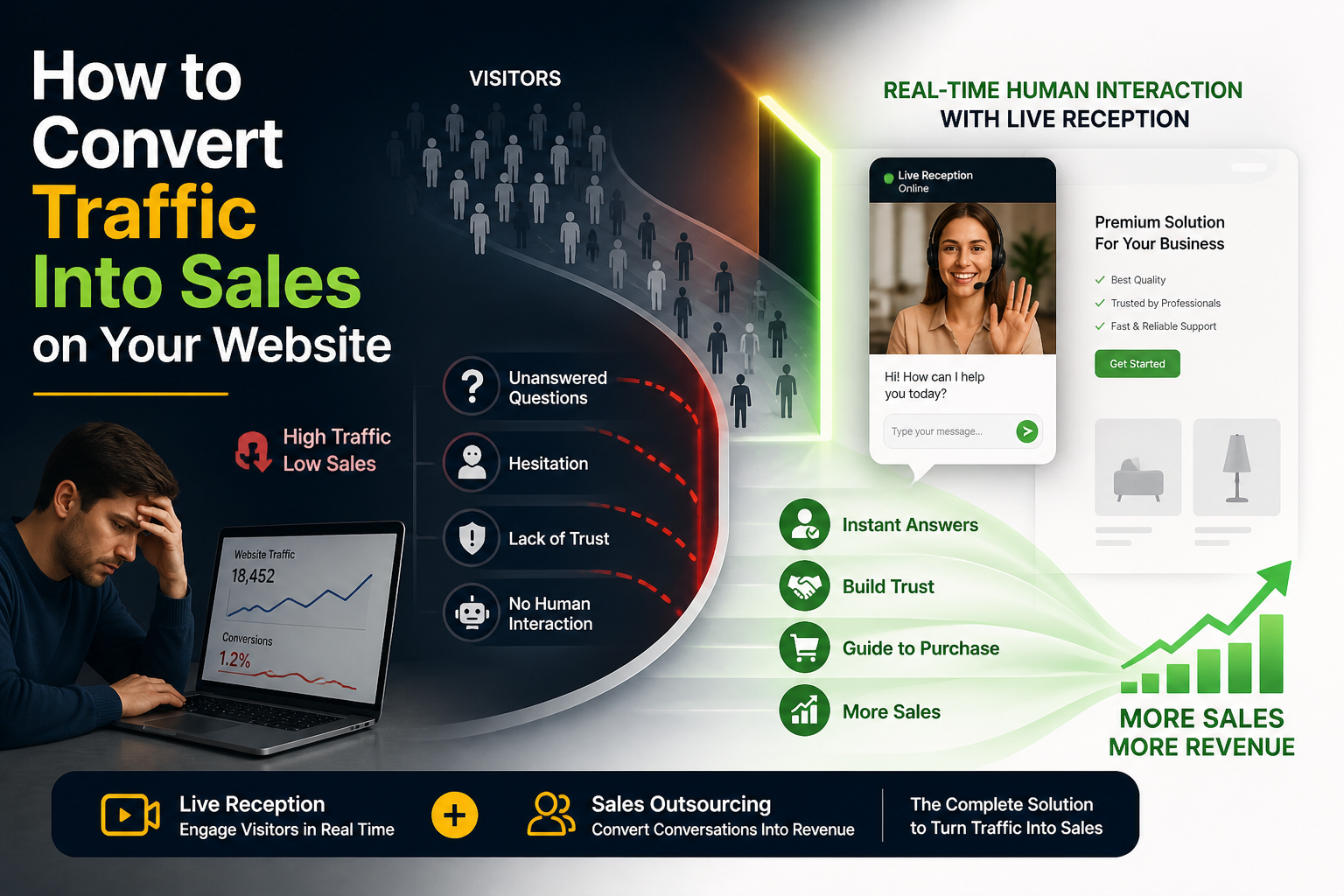
Traffic can look healthy in a dashboard and still leave revenue flat.
That gap frustrates business owners for a simple reason: interest is already present. People are landing on the site, reading pages, comparing options, and spending time with the offer. The real problem starts after the click, when a visitor reaches the point of decision and finds too much friction, too little guidance, or no one there to help.
Many websites lose buyers when they are closest to saying yes. A prospect may have one unanswered question about pricing, fit, timing, or risk. If that question sits unanswered for even a few minutes, the sale often disappears. The visitor does not always return, and more traffic will not fix that loss.
Table of Contents
Why website traffic does not automatically create sales
A website visit is not the same as buying intent, but many visitors arriving from search, ads, referrals, or direct traffic are already evaluating solutions. They are not casual browsers. They are weighing options and looking for enough confidence to move forward.
When sales stall despite steady traffic, the issue is often found in the decision stage. The product or service may be appealing, yet the website leaves key doubts unresolved. That is where momentum breaks.
Common conversion blockers usually look like this:
- unanswered product or service questions
- weak trust signals
- unclear next steps
- delayed responses
- no guidance during comparison
These issues matter most when the visitor has real intent. A person reading your service page twice, checking pricing, or hovering over a contact form is not at the top of the funnel. That person is close to action and needs reassurance, clarity, and speed.
High-intent website visitors leave when hesitation appears
A buying decision is rarely blocked by one dramatic failure. More often, it is lost through small moments of uncertainty.
A visitor may wonder whether your service fits their use case. Another may worry about hidden costs. Someone else may be ready to submit a form but pause because the next step feels vague. In each case, the visitor needs a simple answer, not a prettier page.
This is why traffic alone can be misleading. More visits may inflate activity, yet they do not improve the site’s ability to respond when buying hesitation appears. If the same friction remains, higher traffic simply sends more people into the same leak.
Here is what high-intent hesitation often looks like on a website:
| Visitor behavior | What it usually means | What is missing |
|---|---|---|
| Repeated visits to pricing or service pages | The visitor is comparing value | Clarity and reassurance |
| Long time on page with no action | Interest is present, confidence is not | Guidance |
| Form started but not submitted | The visitor is close, then unsure | A quick human response |
| Multiple FAQ or policy views | Risk concerns are slowing the sale | Trust-building answers |
| Clicks between similar options | The visitor cannot choose | Decision support |
That table points to a simple truth: many lost sales are not lost because people were uninterested. They were lost because no one stepped in at the right moment.
Why common conversion fixes still miss the sale
When conversion rates disappoint, many teams default to familiar solutions. They redesign pages, buy more traffic, add automated chat, or build longer email follow-up sequences. Those changes can help, though they often stop short of what the moment requires.
Better design can improve navigation and readability. It can reduce confusion and make the path cleaner. It does not answer nuanced sales questions in real time.
More traffic can increase opportunity volume. It does not improve efficiency. If the site converts poorly now, more traffic often means more wasted spend.
Chatbots work well for basic routing and simple requests. They struggle when the buying process is complex, high value, or dependent on trust. A scripted answer rarely gives a hesitant buyer enough confidence to commit.
Email follow-ups can recover a portion of lost leads. They usually arrive after the moment of strongest intent has already passed.
The pattern is clear:
- Design: helps visitors move around the site
- Traffic: creates more chances to win or lose
- Chatbots: handle routine questions well
- Email: attempts recovery after the drop-off
Sales happen when hesitation is removed at the exact moment it appears. That requires immediate interaction and a structured way to turn that interaction into revenue.
How to convert traffic into sales with real-time guidance
If your website already attracts relevant visitors, your next growth opportunity is not always more acquisition. It is often better decision support.
To convert traffic into sales, a business needs to treat the website as an active selling environment rather than a static information hub. That means someone must be available when the buyer is comparing, questioning, or hesitating.
Real-time guidance changes the experience in several ways. It reassures visitors that help is available, reduces uncertainty before abandonment, and keeps the conversation moving while intent is still strong. In practical terms, that can mean answering a product question, clarifying the next step, explaining differences between plans, or helping a buyer feel confident enough to submit an inquiry.
This is where live human interaction becomes far more powerful than passive page content alone.
Live Reception removes hesitation in the moment
A strong first layer for decision-stage conversion is Live Reception. It creates real-time human interaction on the website, giving visitors access to immediate support at the exact point where questions arise.
That changes the role of the website. Instead of asking visitors to figure everything out alone, the site becomes a place where concerns can be addressed while interest is still active. That is a major shift for businesses selling services, high-ticket offers, multi-step solutions, or anything that requires trust before commitment.
Live Reception helps in ways that static pages cannot:
- Immediate engagement: visitors are acknowledged before they drift away
- Real-time answers: objections can be resolved while intent is high
- Decision guidance: buyers can be directed toward the right option
- Drop-off prevention: hesitation is addressed before the session ends
Consider a visitor comparing two service packages. The page may explain the basics, yet the person still wants to know which option fits their situation. Without live help, that buyer may leave to “think about it” and end up choosing someone else. With real-time reception, the question is handled on the spot and momentum stays intact.
Or imagine someone hovering over a contact form without submitting it. A short exchange can clarify what happens after the form is sent, how fast the business responds, and whether the inquiry is a fit. That small intervention often makes the difference between a lost lead and a booked conversation.
Sales Outsourcing turns engaged leads into revenue
Real-time engagement is powerful, though it is only the first part of the system. Once a prospect is captured and qualified, someone still needs to move that opportunity through a professional sales process.
That is where Sales Outsourcing becomes essential. Live Reception captures and engages demand in real time. Sales Outsourcing converts that demand into revenue through follow-up, qualification, structured outreach, and closing discipline.
The relationship between the two services is straightforward:
- Live Reception identifies and engages high-intent visitors while they are on the site.
- Qualified interest is passed into a structured sales process.
- Sales teams continue the conversation with consistency and speed.
- Revenue grows without relying only on more traffic.
This matters because many businesses are not failing at lead generation. They are failing at lead handling. Good prospects arrive, show intent, ask questions, and then enter a weak follow-up process with slow response times, inconsistent qualification, or no clear next step.
A strong outsourced sales function fixes that gap. It gives businesses the discipline needed to turn interest into pipeline and pipeline into closed business.
Live Reception and Sales Outsourcing work better together
Used together, these services create a more complete conversion system. One handles the moment of hesitation. The other handles the sales path that follows.
That combination improves outcomes across the funnel:
- higher conversion rates
- faster response times
- more qualified leads
- stronger revenue from existing traffic
This matters for decision-makers watching ad costs rise while conversion efficiency stays flat. If each visitor becomes more valuable, growth becomes less dependent on buying more clicks. The business gets more return from traffic it already worked hard to earn.
There is also an operational benefit. Marketing, website engagement, and sales no longer operate as disconnected functions. Visitors are met quickly, qualified more effectively, and moved into a sales process built for consistency.
Practical website sales scenarios where real-time help wins
The strongest case for this approach comes from what buyers actually do online.
A visitor comparing services may understand your offer at a high level, yet still need clarity on scope, timing, or fit. A real person can answer that in seconds and keep the buyer moving.
A visitor hesitating before submitting a form may be unsure whether the business handles their type of need. A quick interaction removes that uncertainty and increases form completion.
A visitor unsure which option to choose may bounce between pages for several minutes. Guidance at that moment shortens the path to action.
A visitor ready to buy may simply want reassurance. That could be confirmation about onboarding, service quality, next steps, or response time. Without that reassurance, even strong intent can fade.
These situations are common, and they are highly valuable because they sit near the point of sale. They should not be left to static content alone.
The metrics that matter after the website visit
Traffic volume is useful, though it should not dominate the conversation once acquisition is working. The smarter question is what percentage of interested visitors are moving forward.
After businesses focus on decision-stage conversion, the most useful metrics tend to shift:
- form completion rate
- response time to high-intent inquiries
- qualified lead rate
- meeting or demo booking rate
- close rate from website-sourced leads
These metrics reveal whether the site is doing more than attracting attention. They show whether the business is turning attention into sales conversations and sales conversations into revenue.
A company with moderate traffic and strong conversion systems can outperform a company with heavy traffic and weak lead handling. That is encouraging news for teams that feel stuck. Growth does not always require a bigger audience first. It often starts with a better response to the audience already there.
The real growth opportunity sits at the moment of decision
Businesses rarely lose customers because there is no traffic. They lose them when buyers are ready to act and the website offers no clear, confident path forward.
That is why the decision stage deserves more attention than it usually gets. High-intent visitors do not need more marketing at that point. They need answers, reassurance, and direction while they are still engaged.
Live human interaction gives the website a way to respond in real time. Structured sales support gives the business a way to close what that interaction starts. Together, Live Reception and Sales Outsourcing create a practical answer to a very common problem: demand exists, but revenue stalls before the finish line.
Traffic matters. What matters even more is what happens next.