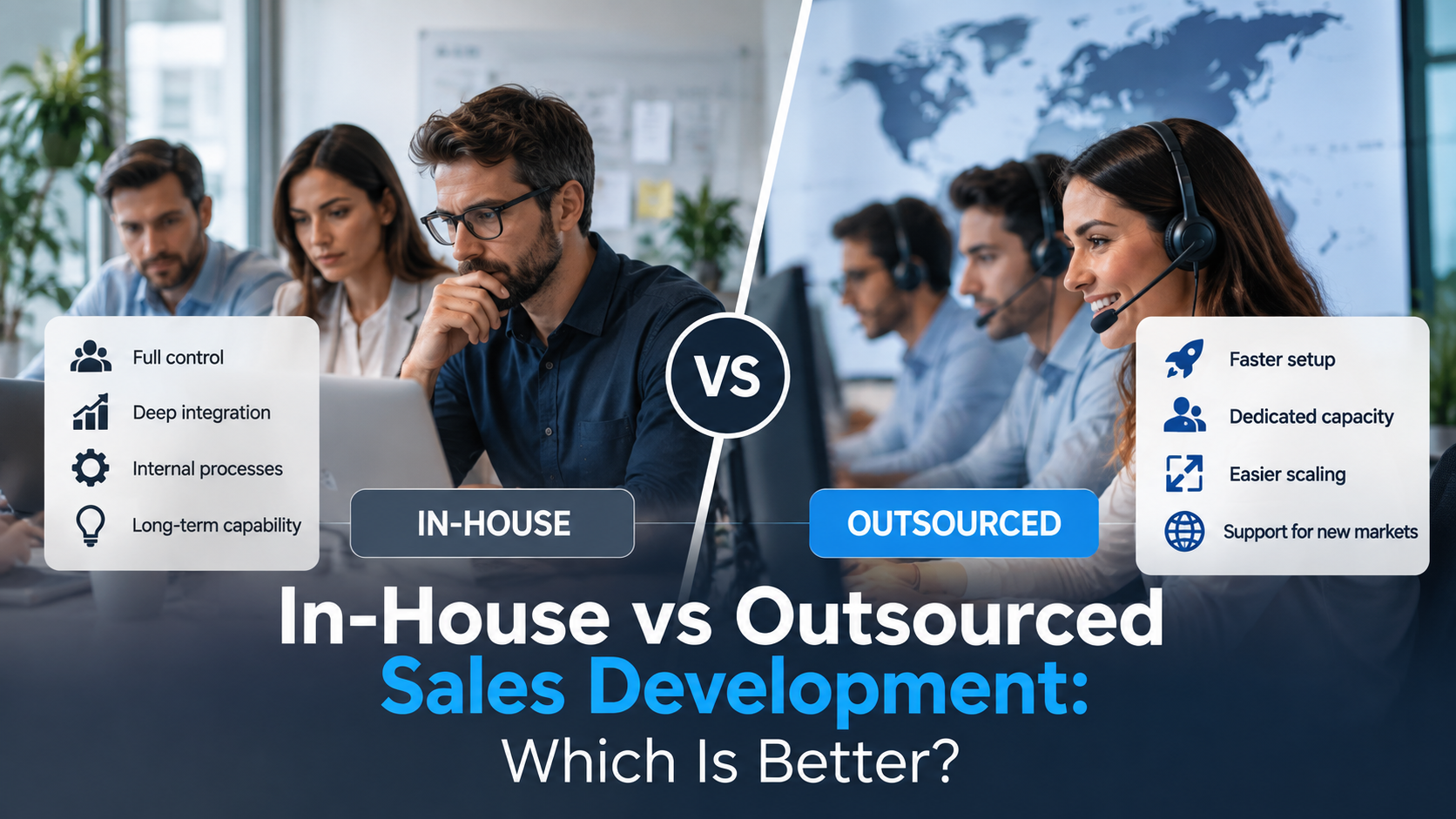
Choosing between an internal sales development function and an external one is rarely a simple cost comparison. For CEOs, CROs, founders, and revenue leaders, the real issue is whether the business needs more control, more speed, more internal capability, or more execution capacity right now.
The phrase in-house vs outsourced sales development often frames the decision as a binary choice. In practice, it is usually a design choice. Some companies need a tightly integrated in-house BDR team. Some benefit from sales development outsourcing because they need outbound capacity faster than they can build it. Others get the best result from a hybrid structure.
Direct answer: In-house sales development generally offers greater direct control and deeper integration with the internal sales organization, but requires recruitment, training, management, technology and time to build. Outsourced sales development can provide faster access to dedicated BDR capacity and operational infrastructure, while a hybrid model allows companies to retain strategic control internally and use external teams to expand execution capacity.
Table of Contents
What Is In-House Sales Development?
In-house sales development means the company builds and runs its own outbound prospecting function. That usually includes hiring BDRs or SDRs, onboarding them, training them on the product and market, managing daily activity, setting process standards, and measuring performance over time.
An internal sales development team is not just a few reps making calls and sending emails. It often depends on a full operating layer behind the scenes: prospect data, CRM hygiene, reporting, enablement, messaging, coaching, and management discipline. Without that structure, even strong hires can produce inconsistent results.
The relationship between the BDR team and Account Executives matters here. BDRs create and qualify opportunities. AEs take those opportunities forward, run discovery, manage the sales process, and close. If handoff rules are unclear, pipeline quality suffers no matter which model is used.
What Is Outsourced Sales Development?
Outsourced sales development means an external partner handles some or all of the outbound sales development work required to generate qualified conversations. Depending on the model, that can include dedicated BDR capacity, list building, outreach execution, qualification, meeting setting, reporting, and day-to-day management.
Not every outsourced BDR team offers the same scope. Some focus only on prospecting. Some provide a more complete outsourced business development or B2B sales outsourcing model. Some act as an extension of the internal team, while others run a more independent motion. That difference matters when comparing providers.
In-House vs Outsourced Sales Development: Key Differences
The core differences are less about theory and more about operating responsibility. Who recruits? Who manages? Who owns the systems? Who fixes performance issues when output drops?
| Factor | In-House | Outsourced |
|---|---|---|
| Initial setup | Requires internal build | Existing operational capability may accelerate setup |
| Recruitment | Internal responsibility | Typically handled by provider |
| Management | Internal | Provider or shared |
| Control | High | Depends on operating model |
| Scaling | Requires hiring | Capacity may be easier to expand |
| Market knowledge | Developed internally | Requires structured knowledge transfer |
| Technology | Built and managed internally | May be included in delivery model |
| Cost structure | Internal fixed plus variable costs | Contracted operating cost |
| Speed to capacity | Usually slower | Potentially faster |
| Cultural integration | Naturally stronger | Requires active alignment |
Advantages of an In-House BDR Team
The case for an internal team is strong when direct control matters. Leaders can adjust messaging quickly, coach reps closely, change priorities without contract friction, and keep sales development tightly connected to product, marketing, and customer feedback.
An in-house BDR team also tends to absorb nuance faster. Complex products, shifting buyer objections, and multi-stakeholder deals often benefit from reps who sit close to the rest of the revenue organization. That closeness can improve qualification quality and reduce the gap between prospecting and closing.
Internal ownership also builds long-term capability. A company that sees sales development as a core competency, not just a source of meetings, may prefer to keep that function inside the business and invest in it over several years.
The Hidden Operational Cost of Building Sales Development In-House
Many companies compare one BDR salary to one outsourcing fee and assume they are making a fair build vs outsource sales team decision. They are not.
Salary is only one line item. Internal sales development also requires hiring time, ramp time, management attention, enablement, tooling, data, quality control, and coverage for turnover. A new in-house BDR team may take months to stabilize even when leadership is experienced.
Total Internal BDR Cost = Compensation + Recruitment + Training + Management + Technology + Data + Enablement + Turnover + Ramp Time + Underutilized Capacity
That last item, underutilized capacity, is easy to miss. If outbound demand fluctuates, internal teams can be overbuilt or underused. A business may carry fixed cost before the motion is fully productive. This is one reason the in-house vs outsourced sales development question should start with operational reality, not just headcount math.
Advantages of Outsourced Sales Development
Outsourced sales development can make sense when the company already knows who it wants to sell to but lacks the time, bandwidth, or infrastructure to build outbound internally. The value is often speed. An external partner may provide trained BDR capacity, management, reporting, and process discipline faster than a company can recruit and ramp on its own.
This model can also reduce the burden on Account Executives. In many teams, AEs prospect because nobody else is available to do it consistently. That usually weakens both prospecting and closing. To outsource sales development in that situation can create cleaner role focus across the funnel.
It can also help with expansion. A company entering a new vertical, testing a new region, or trying to increase outreach volume without immediately adding permanent internal headcount may find BDR outsourcing more practical than building a larger team from scratch.
What Are the Risks of Outsourcing Sales Development?
Sales development outsourcing is not automatically effective. It can fail for very ordinary reasons: the provider does not grasp the product well enough, outreach becomes generic, the ICP is too broad, or internal sales leaders treat the outsourced team as a separate machine instead of part of the revenue motion.
Outsourcing execution cannot fix an unclear ICP, weak positioning or a product without market demand.
Several risks show up repeatedly when outsourced sales development underperforms:
- Product depth: External reps may miss nuance that internal teams take for granted
- ICP fit: Poor targeting can create activity without real opportunity creation
- Sales handoff: Weak coordination between BDRs and AEs can lower conversion rates
- Metric quality: Providers may optimize for volume if success criteria are not defined well
- Visibility: Limited reporting can make it hard to diagnose performance problems
When an In-House BDR Team Makes More Sense
There are clear cases where an internal model is the stronger choice. If the business already has strong sales leadership, mature systems, and the capacity to manage outbound well, keeping the sales development team in-house can produce better control and stronger long-term learning.
This is also true when product complexity is high, messaging changes often, or outbound volume is modest enough that a full outsourced structure is unnecessary.
Typical signals include:
- mature sales leadership
- highly complex product or buying process
- constant messaging changes
- desire to build internal BDR capability
- sufficient internal capacity already exists
When Outsourced Sales Development Makes More Sense
Outsourced sales development becomes more compelling when the strategy is sound but execution capacity is thin. A company may know its ICP, offer, and target markets, yet still struggle to create enough outbound activity. In that case, the problem is often not direction. It is throughput.
This tends to show up when AEs spend too much time prospecting, hiring BDRs slows growth, or outreach volume remains inconsistent quarter after quarter. It can also fit companies testing outbound in a new market before committing to a larger permanent structure.
A few practical signals stand out:
- AE workload: Account Executives are losing selling time to prospecting
- Hiring drag: recruiting internal BDRs is too slow for growth targets
- Capacity gap: outreach volume is below what pipeline goals require
- Expansion need: new verticals or regions require added prospecting coverage
- Execution inconsistency: internal prospecting effort rises and falls too sharply
Real-World Example: Expanding B2B Outreach Capacity
One operational example helps make this more concrete. In a program run by Silver Bell Group, three dedicated BDRs supported sector-focused outreach across Health, Manufacturing, and IT. That structure produced a 3x increase in outreach volume.
That result should not be treated as an industry benchmark or a guaranteed outcome. It does, however, show what can happen when dedicated capacity, clear sector focus, and structured execution are put in place. If you want more detail on that operating approach, see How to Scale B2B Sales Outreach Without Sacrificing Quality.
What Is a Hybrid Sales Development Model?
A hybrid model sits between fully internal and fully outsourced sales development. It allows the company to keep strategic ownership where it matters most while adding external execution capacity where internal bandwidth is limited.
In practice, that often means the internal team owns ICP definition, positioning, messaging standards, sales process design, and closing. The external team supports prospecting, outreach volume, qualification, meeting generation, or specific market coverage. Responsibilities vary by company, which is why hybrid models work best when ownership is explicit.
For many revenue leaders, this is the most useful answer to the build vs outsource sales team question. It avoids the false choice between total control and total delegation.
In-House vs Outsourced vs Hybrid Sales Development
When the decision is framed around business context rather than ideology, the model becomes easier to pick.
| Business Situation | Model to Consider |
|---|---|
| Strong internal SDR leadership and sufficient capacity | In-House |
| Need additional capacity quickly | Outsourced |
| Testing new market or vertical | Outsourced or Hybrid |
| Complex product requiring deep internal expertise | In-House or Hybrid |
| AEs spending excessive time prospecting | Outsourced or Hybrid |
| Building long-term internal SDR capability | In-House |
| Internal strategy is strong but execution capacity is limited | Hybrid or Outsourced |
7 Questions to Ask Before Outsourcing Sales Development
Before signing with any sales outsourcing provider, leadership should test whether the real bottleneck is capacity, strategy, or execution discipline. That self-check prevents expensive misalignment.
- Do we clearly know our ICP?
- Is our value proposition already validated?
- Is lack of outbound capacity actually the bottleneck?
- Which parts of the sales process must remain internal?
- How will leads move from BDR to Account Executive?
- What metrics will define success?
- How much visibility will we have into execution?
A company that cannot answer those questions may not be ready to outsource sales development yet. In many cases, the first issue to solve is positioning, qualification criteria, or sales process clarity.
How to Choose a Sales Development Outsourcing Partner
The strongest providers are not just sources of activity. They have a clear operating model, disciplined management, transparent reporting, and a credible process for training reps on the client’s market. Those basics matter more than broad claims about meetings booked.
Buyers should look closely at recruitment standards, QA processes, CRM discipline, communication with internal sales, and how success is measured. Ask whether the provider can show how its outsourced BDR team will integrate with your AEs, not just how many touches it will send.
This is also the point where commercial detail matters. Review the structure behind the service, expected ownership on both sides, and reporting scope. Pages like Sales Outsourcing Services, What Is BDR Outsourcing?, and How Much Does Sales Outsourcing Cost? are useful reference points during evaluation. Firms such as Silver Bell Group are most relevant when a company wants an experienced operator, not just extra sending capacity.
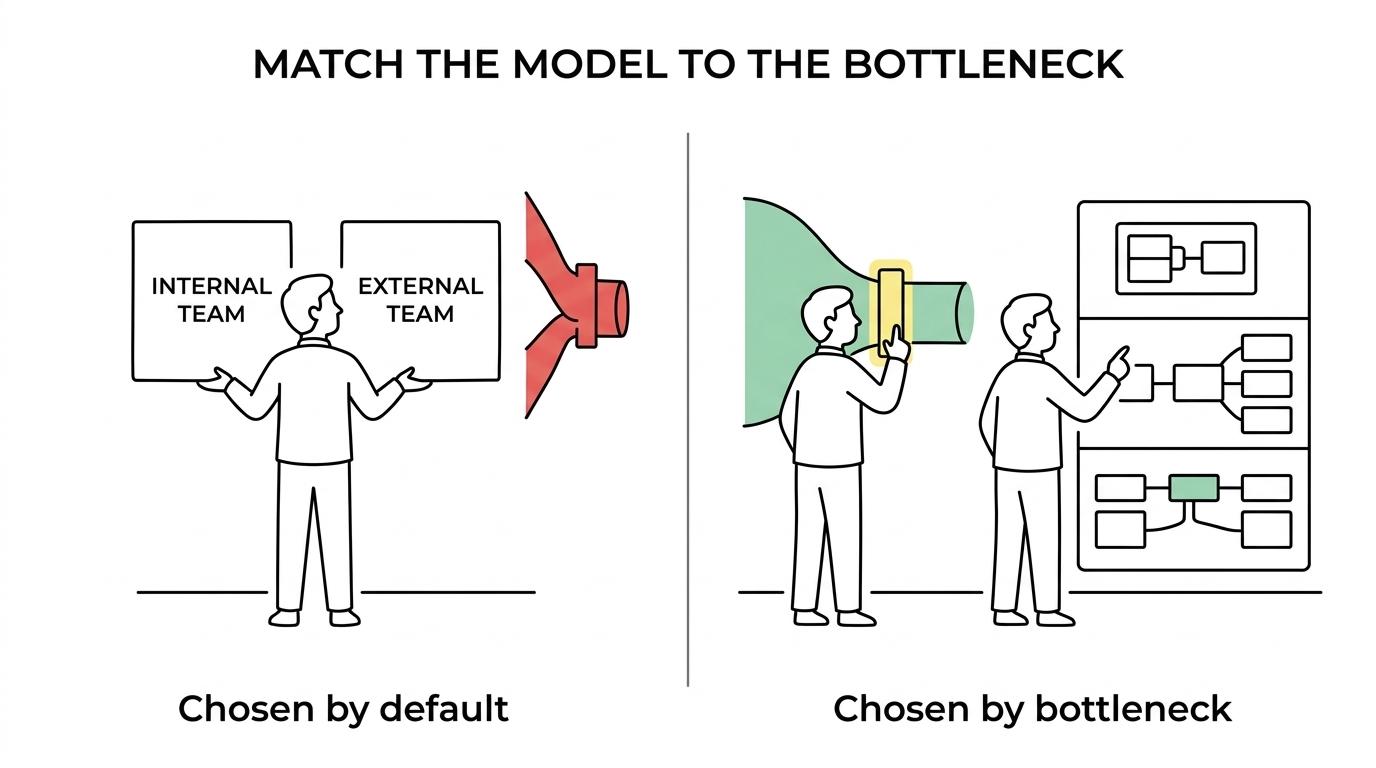
The Right Model Depends on the Bottleneck
The best answer to in-house vs outsourced sales development starts with one question: what is actually constraining growth?
If the problem is strategy, outsourcing probably will not solve it. If the problem is product-market fit, more BDRs probably will not solve it either. If the business has a sound offer, a defined market, and too little outbound execution capacity, outsourced sales development becomes a serious option. If the company needs both control and added throughput, a hybrid model may be the right fit.
The goal is not to outsource as much as possible, or to keep everything internal by default. The goal is to build a sales development model that creates the required capacity without sacrificing quality.