A budget question about sales development often starts in the wrong place.
Many leadership teams compare an outsourcing proposal to the salary of one BDR and stop there. That shortcut feels efficient, but it hides the real economics. Sales development is not only labor. It is management, onboarding, tooling, prospect data, quality control, reporting, coaching, and the time it takes to turn activity into qualified pipeline.
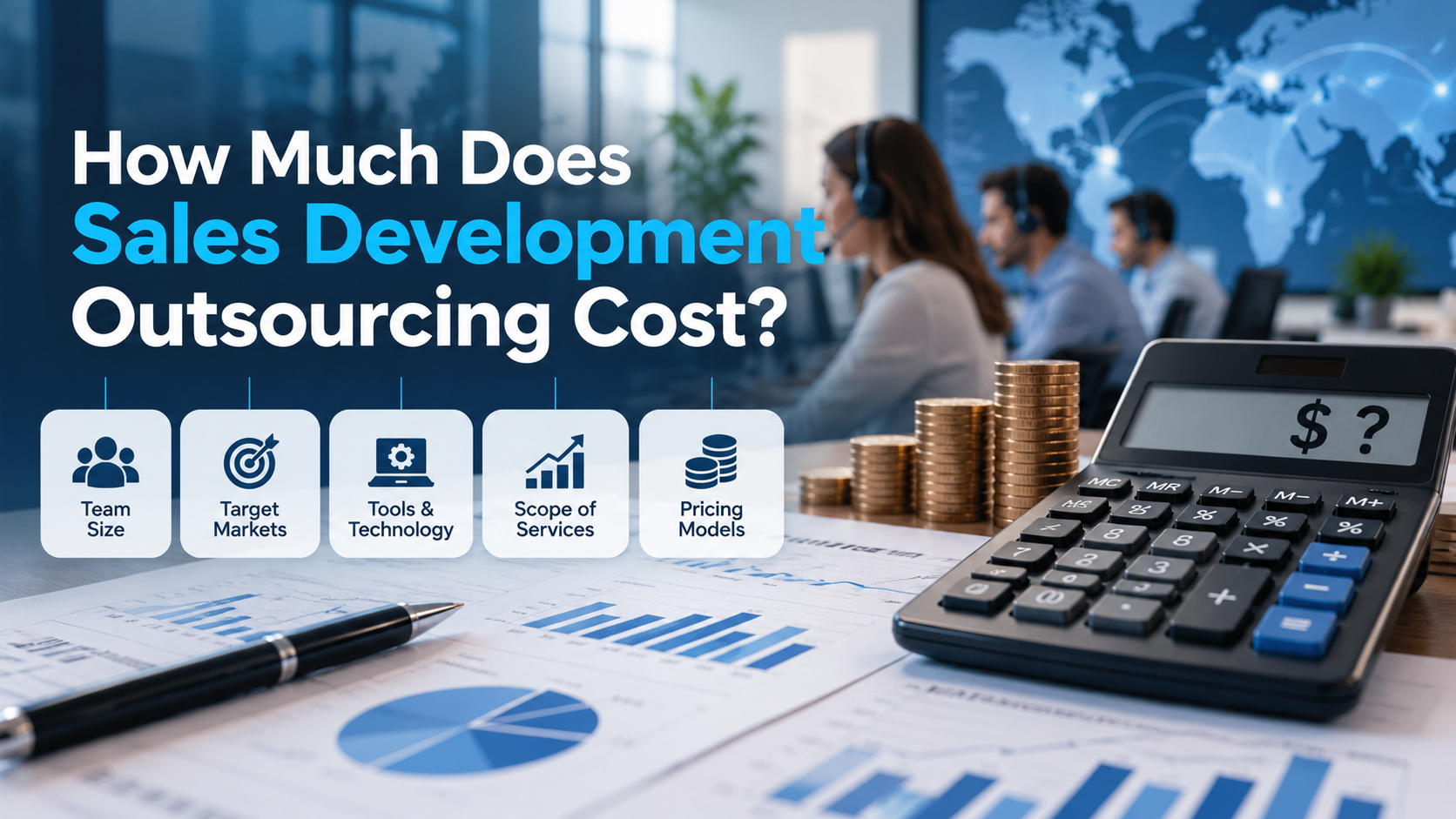
Sales development outsourcing costs depend on the delivery model, number of dedicated representatives, target markets, required experience, technology, management responsibilities and scope of services. Common pricing structures include monthly retainers, dedicated-team fees, performance-based models and hybrid arrangements. The most useful comparison is total operating cost relative to qualified sales opportunities generated, rather than the provider’s monthly fee alone.
Table of Contents
How much sales development outsourcing cost actually varies
There is no universal answer to sales development outsourcing cost because there is no universal scope. A company buying a limited outbound motion with one channel, one market, and a tight list of accounts is buying something very different from a company outsourcing a managed, multi-segment prospecting function.
That is why average pricing articles often create more confusion than clarity. They collapse very different service models into one number, even though the work behind those numbers can vary widely.
A useful starting point is this distinction: are you purchasing isolated prospecting tasks, or an outsourced sales development team that owns execution with management oversight? The first may look cheaper on paper. The second may include many of the operating layers that an internal team would need anyway.
What determines sales development outsourcing pricing
Pricing moves up or down based on scope, complexity, and operating responsibility. The more the provider is expected to own, the more the fee reflects infrastructure rather than rep time alone.
Several inputs shape BDR outsourcing pricing and outsourced SDR pricing:
- Team structure: one shared rep, one dedicated rep, or a managed team
- Market coverage: one geography versus multi-region outreach
- Language requirements: single-language outreach or multilingual execution
- Target complexity: broad SMB outreach versus narrow enterprise account targeting
- Channel mix: email-only programs versus email, phone, LinkedIn, and follow-up coordination
Other cost drivers sit behind the scenes but matter just as much. Prospect data sourcing, CRM administration, campaign setup, message testing, reporting cadence, and sales management all influence the total service cost. A proposal that excludes these items may look efficient until internal teams must absorb the missing work.
Industry focus matters as well. A provider supporting technical, regulated, or niche B2B segments may need stronger onboarding, tighter qualification logic, and more experienced talent. That changes the economics even if the number of outreach touches looks similar.
Common BDR outsourcing pricing models
Different providers package their services in different ways, which is why comparing proposals line by line matters more than comparing labels.
| Pricing model | How it works | Main consideration |
|---|---|---|
| Monthly retainer | Fixed recurring fee for an agreed scope of sales development work | Scope and service levels |
| Dedicated BDR team | Capacity-based monthly fee for named or dedicated resources | Utilization and management |
| Pay per appointment | Payment tied to meetings delivered under a defined standard | Appointment quality |
| Performance-based | Compensation linked to agreed results | Attribution and incentives |
| Hybrid | Fixed fee plus variable performance component | Balance of risk and predictability |
A monthly retainer can work well when the scope is stable and both sides agree on channels, reporting, and service boundaries. A dedicated-team model is often clearer for companies that want consistent capacity and tighter operational control.
Pay-per-appointment models can appear attractive, especially when leadership wants a clean outcome metric. Still, meeting volume is not the same as commercial value. If qualification standards are weak, a lower outsourced BDR cost can quickly turn into wasted calendar time for account executives.
Performance-based and hybrid structures can create stronger shared incentives, but only if attribution is clean. In long B2B sales cycles, the gap between first meeting and revenue can make compensation design more complex than it first appears.
What is included in the cost of an outsourced BDR team
When reviewing a proposal, the first question should not be “How many meetings?” It should be “What is included?”
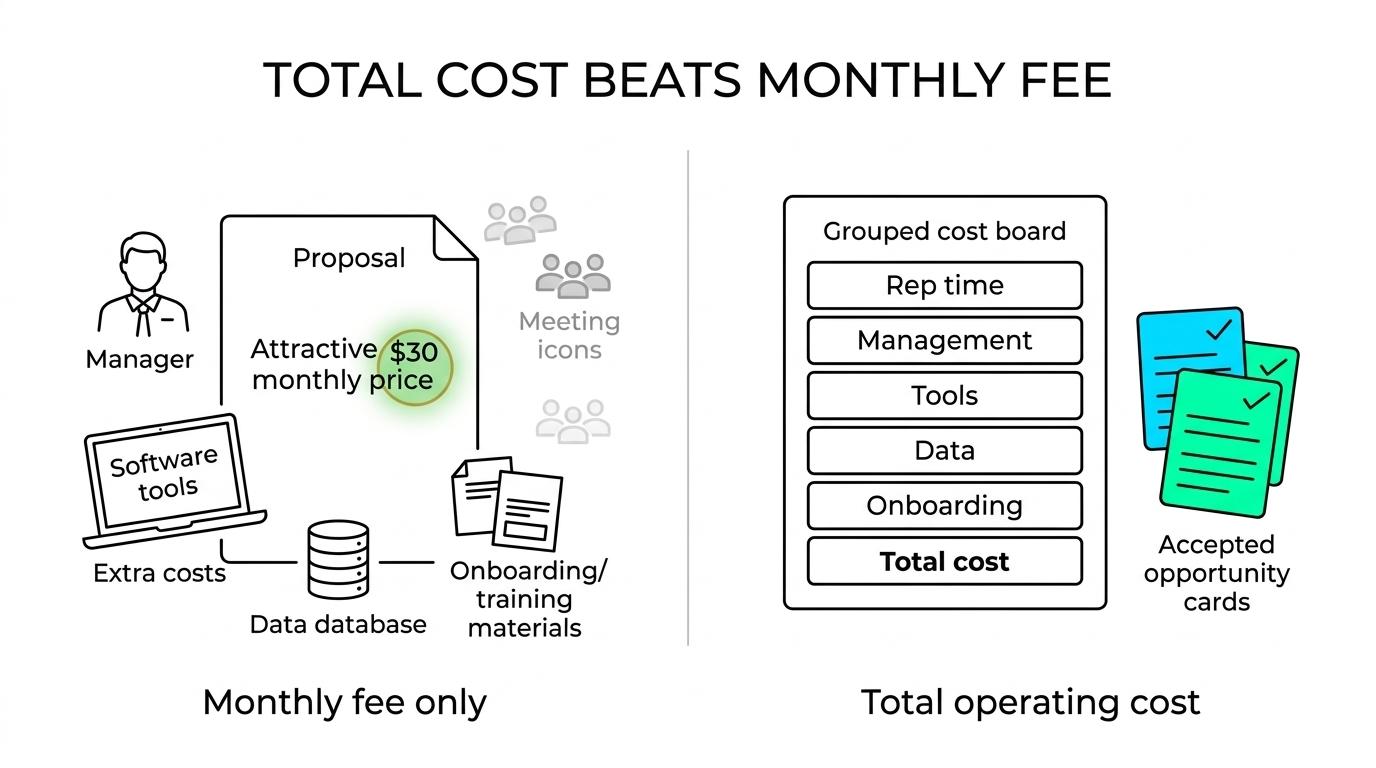
The work of a BDR is only one layer of a functioning sales development operation. The full package may include onboarding, account research, list building, messaging support, outreach execution, call blocks, CRM logging, reporting, quality checks, and sales management. Some sales development outsourcing services include all of this. Others include only parts.
That distinction is where many cost misunderstandings begin.
- Onboarding: ICP definition, messaging setup, workflow design
- Management: supervision, coaching, QA, performance reviews
- Technology: sequencing tools, CRM workflows, call systems, reporting stack
- Data: contact sourcing, enrichment, cleansing, compliance handling
- Operations: calendar coordination, handoff rules, meeting validation
A lower quoted fee may simply mean those responsibilities stay internal. That is not automatically bad. It only means the buyer still carries part of the delivery burden, and the true sales outsourcing cost sits across more than one budget line.
The hidden costs of building an internal sales development team
The strongest way to assess outsourcing is through total cost of ownership.
Internal BDR cost is not just compensation. It includes recruitment, employer overhead, onboarding, training, management time, technology licenses, prospect data, turnover, vacancy periods, and ramp-up time before a rep is fully productive. Once those costs are recognized, the comparison with an outsourcing fee becomes more realistic.
A simple framework looks like this:
Internal BDR Cost = Compensation + Recruitment + Training + Management + Technology + Prospect Data + Turnover + Ramp-Up Time
This is why the cost of hiring a BDR is rarely equal to salary plus commission. An internal hire needs a manager, systems access, coaching, process support, and a pipeline of accurate data. If turnover hits early, the company pays the startup cost twice.
Outsourced BDR cost vs in-house BDR cost
A side-by-side view is often more helpful than a single price discussion.
| Cost area | In-house BDR model | Outsourced BDR model |
|---|---|---|
| Talent acquisition | Internal recruitment effort and hiring risk | Usually included in provider delivery model |
| Ramp time | Internal onboarding and productivity lag | Depends on provider onboarding and readiness |
| Management | SDR manager or sales leader time | May be included in service fee |
| Tools and systems | Bought and maintained internally | May be bundled or partially bundled |
| Prospect data | Separate data vendors and list operations | May be bundled or billed separately |
| Turnover impact | Rehiring, retraining, lost capacity | Provider typically absorbs staffing continuity |
| Flexibility | Slower to scale up or down | Depends on contract structure |
| Visibility | Direct team control | Requires reporting discipline and governance |
The financial question is not whether one model is always cheaper. It is whether one model produces reliable qualified pipeline at a better total operating cost for your stage, market, and internal resources.
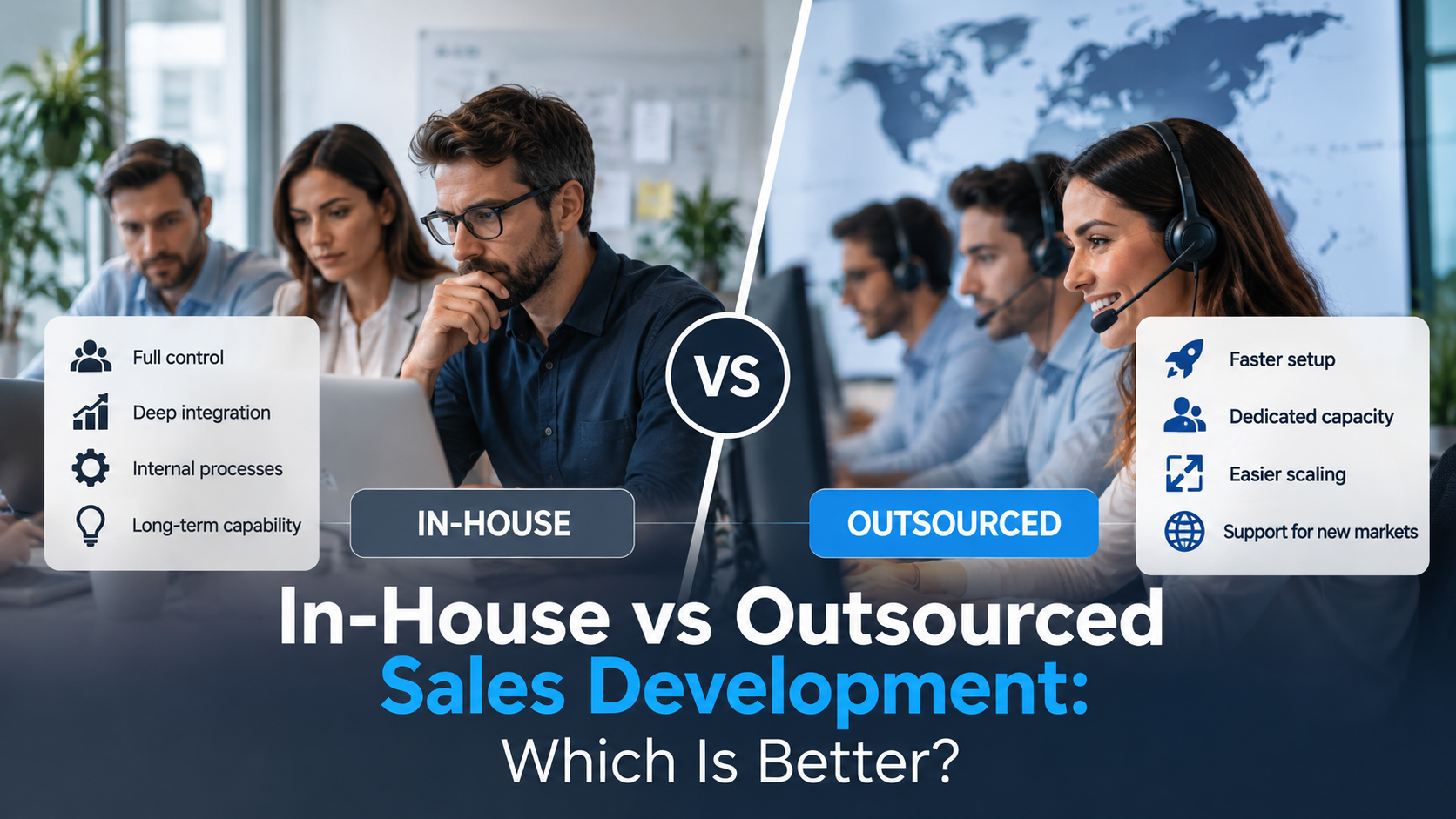
A broader strategic comparison belongs in In-House vs Outsourced Sales Development: Which Is Better?. The focus here is narrower: cost structure, operating burden, and measurable commercial output.
How to calculate the ROI of sales development outsourcing
ROI gets distorted when teams focus on top-of-funnel activity alone. Emails sent, calls made, and meetings booked can signal effort, but they do not tell you whether the program is creating pipeline that sales accepts and can move forward.
A stronger measurement stack moves through several layers: activity volume, qualified meetings, sales-accepted opportunities, pipeline created, and closed revenue. Each layer says something different about effectiveness.
To evaluate B2B sales outsourcing pricing in a disciplined way, track metrics like these:
- cost per qualified meeting
- cost per sales-accepted opportunity
- pipeline created per dollar invested
- conversion rate from meeting to accepted opportunity
- lag time from first touch to pipeline creation
Attribution needs care. In many companies, revenue lands quarters after the first sales development interaction. That means early ROI reviews should center on qualification quality and pipeline creation, not only closed revenue. A provider can be generating healthy economics long before deals close, or weak economics even while activity dashboards look busy.
Why lower BDR outsourcing costs can produce worse economics
A lower monthly fee can hide expensive inefficiency.
If targeting is loose, lists are weak, outreach quality is inconsistent, or meetings are accepted without serious qualification, the apparent savings disappear fast. Account executives lose time. Brand perception suffers. Pipeline reviews fill with opportunities that never had a real chance.
This is the difference between cost per activity and cost per meaningful commercial outcome. Cheap outreach that creates low-value meetings may cost more in the end than a stronger program with a higher monthly fee and a better acceptance rate.
The same logic applies to under-supported teams. If a provider underinvests in coaching, data quality, and reporting discipline, the client may spend additional internal time correcting execution. That hidden effort belongs in the financial picture too.
Real-world example of scaling BDR outreach capacity 3x
Operational capacity matters in pricing decisions because sales development output depends on people, process, and management working together.
A verified Silver Bell Group example shows this clearly: a program using 3 dedicated BDRs increased outreach capacity 3x across 3 industry segments, including Health, Manufacturing, and IT. That example demonstrates increased coverage and execution capacity. It does not, by itself, prove lower cost, stronger ROI, or added revenue.
That distinction matters. Capacity gains are valuable when a business needs more market coverage without building the same structure internally. If you want more detail on the operating side of this topic, see How to Scale B2B Sales Outreach Without Sacrificing Quality.
How to compare sales development outsourcing proposals
Proposal review works best when finance, sales leadership, and RevOps evaluate the same checklist. Monthly price alone is too narrow.
A disciplined comparison should clarify who owns execution, who owns management, and what level of quality control is built into the model.
- Scope: channels, target accounts, markets, and expected activity levels
- Resources: dedicated reps, shared reps, management coverage
- Reporting: dashboards, review cadence, CRM visibility, QA process
- Qualification: meeting standards, handoff rules, disqualification criteria
- Commercial terms: onboarding time, notice period, ramp expectations, termination conditions
It also helps to ask one direct question: what additional internal work will still be required after signing? That answer often reveals whether a proposal is a true outsourced function or simply extra prospecting labor.
When sales development outsourcing is worth the investment
Outsourcing often makes economic sense when a company needs speed, added capacity, or access to a working sales development structure without carrying the full burden of building one internally. It can also make sense when leadership wants to test a market, expand regionally, or add outbound coverage while keeping internal management focused elsewhere.
It is less effective when the core commercial foundation is still unstable. If ICP definition is weak, positioning is unclear, or sales qualification rules are inconsistent, an outsourced team may only scale the confusion. In that case, the better financial move may be to fix the model before paying for more outbound execution.
That is why the best buying decision is rarely about finding the lowest BDR team cost. It is about paying for a setup that can reliably create qualified opportunities without requiring hidden internal rescue work.
Choosing value over the lowest price in sales development outsourcing
The best sales development outsourcing cost framework looks past the fee and asks a sharper question: what level of qualified pipeline can this model create at a sustainable total operating cost?
That mindset changes procurement behavior. It shifts the conversation from “How cheap is this provider?” to “What are we truly buying, what still sits on our side, and what commercial outcomes can this structure support?” That is a far better basis for comparing outsourced sales development team models, outsourced SDR pricing, and internal hiring alternatives.
For companies assessing managed outbound support, Sales Outsourcing Services can be a practical next step to review what a full service model may include and how its operating scope compares with internal build costs.