
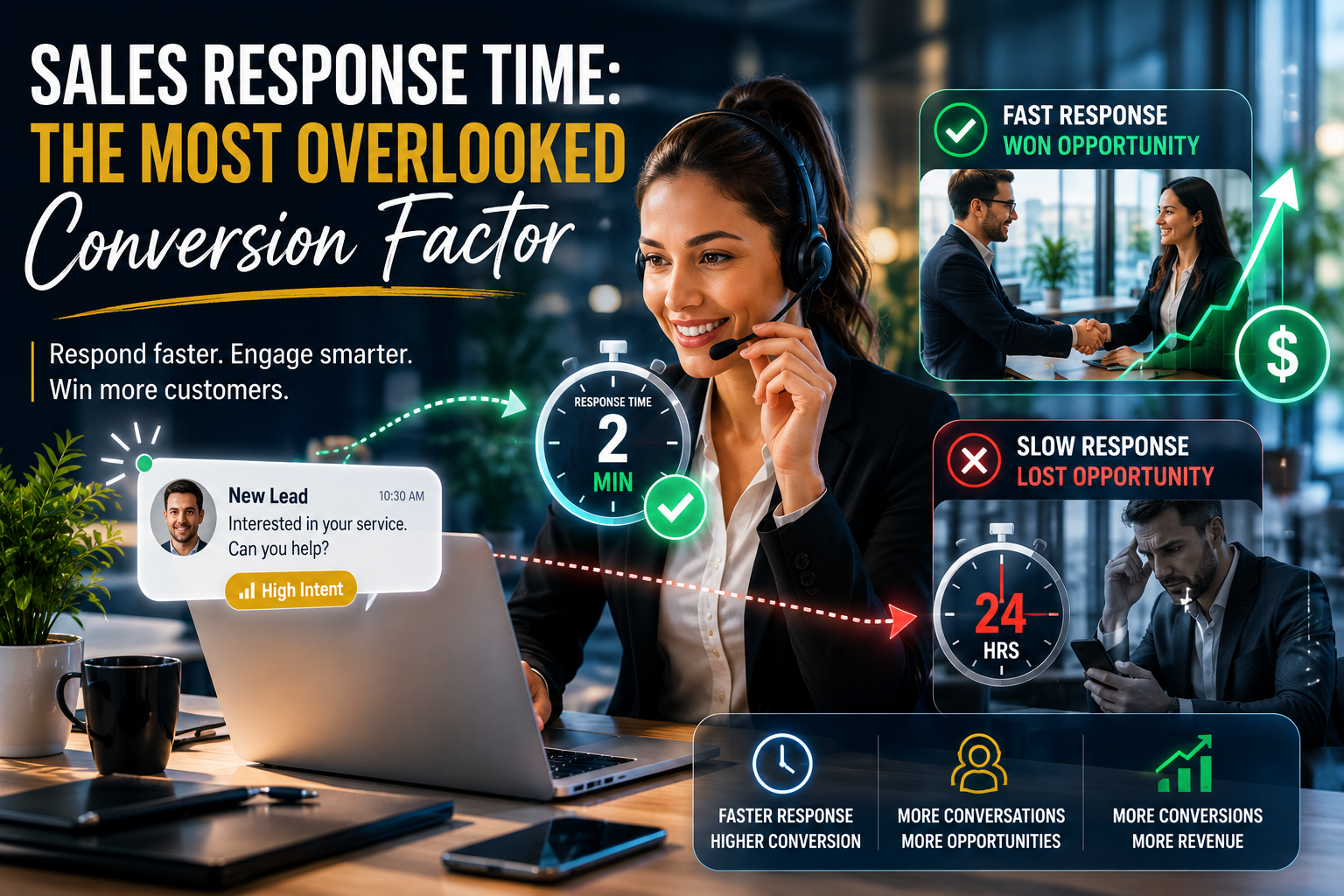
Most revenue teams can explain their cost per lead down to the cent. Fewer can tell you how long it takes for a new prospect to hear back after filling out a form, calling the office, or requesting a demo.
That gap matters more than many leaders realize.
A company can spend heavily on SEO, paid ads, outbound campaigns, referral programs, and content, then still lose high-intent buyers because no one answered fast enough. In many cases, the issue is not product-market fit, pricing, or traffic volume. It is sales response time.
Picture two competitors with similar offers and similar credibility. One replies in five minutes. The other replies the next day. The first company often wins before the second company even opens the lead notification.
Table of Contents
Why Sales Response Time Is the Most Overlooked Conversion Factor
Sales response time sits in a strange place inside many organizations. Marketing assumes sales will act quickly. Sales assumes the lead flow is manageable. Leadership assumes the CRM will surface any problems. Yet slow follow-up keeps hiding in plain sight.
That is why this factor is so often missed. It is not as visible as ad spend. It is not as easy to discuss as close rate. And it rarely gets the same attention as pipeline volume.
Research has pointed to this for years. A widely cited Harvard Business Review analysis found that companies responding within an hour were nearly seven times more likely to qualify a lead than those responding an hour later, and more than 60 times more likely than those waiting 24 hours or longer. Another well-known lead management study found that reaching out within five minutes can multiply qualification odds compared with waiting 30 minutes.
Those numbers tell a simple story. Buyer intent decays fast.
Marketing creates demand. Response time captures it.
The Hidden Cost of Slow Lead Response Time
Slow lead response time rarely appears on a profit and loss statement. No line item says, “revenue lost because we called back too late.” Yet the damage is real.
When a buyer raises a hand, they are at a peak moment of interest. They may be comparing solutions, solving an active problem, or trying to get budget approved. Delay changes the temperature of that opportunity. The same lead that looked highly qualified at 10:03 a.m. may be hard to reach by 2:30 p.m., and nearly gone by the next morning.
This silent revenue leak shows up in familiar places:
- missed inbound calls
- web forms waiting until the next business day
- demo requests routed to full calendars
- referrals sitting in email inboxes
- paid ad leads with no immediate sales follow up
A slow customer response time does more than lower contact rates. It also raises customer acquisition costs. If marketing spends more to generate demand while the sales team answers slowly, each extra dollar works harder just to replace lost opportunities.
That is why teams can see strong traffic, healthy lead volume, and disappointing revenue at the same time.
How Sales Response Time Impacts Sales Conversion Rate
Sales leaders often focus on later-stage metrics: meeting-to-opportunity rate, proposal win rate, average deal size, sales cycle length. Those matter. Still, a weak first-response process can drag all of them down before the pipeline even gets going.
The first contact shapes the whole path. Fast replies create more live conversations. More live conversations create more qualified meetings. More qualified meetings create more pipeline. And better pipeline gives the business a real chance to increase sales conversions without raising lead spend.
Here is a practical view of how response speed changes outcomes.
| Lead response window | Buyer state | Typical sales outcome | Likely effect on sales conversion rate |
|---|---|---|---|
| 0 to 5 minutes | Intent is active | Live conversation or quick booking | Highest |
| 5 to 30 minutes | Still engaged | Solid contact rate, some drop-off | Strong |
| 30 to 60 minutes | Buyer is comparing options | More callbacks, fewer live connections | Moderate |
| 1 to 24 hours | Intent is cooling | Lower response rates, more ghosting | Weak |
| 24+ hours | Buyer has often moved on | Voicemail, no reply, or competitor chosen | Lowest |
The point is not that every lead dies after a certain minute mark. Good teams can still win later. The point is that the odds move against you very quickly.
How fast should a business respond to a lead?
For high-intent inbound leads, five minutes is a strong benchmark. Fifteen minutes is still useful. Within an hour should be viewed as a floor, not an ideal.
If that sounds aggressive, think about buyer behavior. A person who just clicked a paid ad or requested a demo is already active. They are at their keyboard. They are on their phone. They are ready to talk now, not tomorrow.
B2B buyers are no exception. In fact, speed matters just as much in complex sales because the first vendor to respond often shapes the buying criteria, frames the problem, and earns the first layer of trust.
Why More Leads Do Not Automatically Create More Revenue
Many companies assume pipeline problems come from top-of-funnel weakness. Their answer is to buy more traffic, launch another campaign, hire another agency, or ask outbound to increase volume.
Sometimes that is right. Often it is not.
If the current system cannot respond quickly and consistently, more leads simply create a larger backlog. That means more stale follow-up, more missed calls, more overwhelmed reps, and more wasted spend. It can even make the team look less effective because conversion rates fall as volume rises.
A stronger customer acquisition strategy does not begin with more lead volume. It begins with tighter lead handling.
Three responsibilities need to work together:
- Marketing’s role: create qualified interest
- Sales’ role: respond while interest is still active
- Operations’ role: remove delays in routing, scheduling, and follow-up
When those three parts connect, growth becomes more efficient. When they do not, more lead generation can hide a response-time problem rather than solve it.
A common example is a company running Google Ads to a demo form. The campaign may be working. The landing page may be converting. The real loss happens after the form is submitted. If replies go out the next day, the business may conclude that ad quality is poor when the real issue is delayed contact.
How Customer Response Time Influences Buying Decisions
Speed is not only operational. It is psychological.
A fast response tells a buyer that the company is attentive, organized, and ready to help. A slow response sends the opposite signal, even when the product is excellent. Buyers use these small cues to judge future service quality, account support, and implementation reliability.
That matters even more in crowded markets where several vendors look similar at first glance.
Customer response time shapes buying decisions in a few direct ways:
- Speed signals competence: Buyers often assume a responsive company will also be responsive after the contract is signed.
- Silence creates doubt: A delay invites questions about reliability, staffing, and service standards.
- Attention fades quickly: The urgency that triggered the inquiry weakens with every passing minute.
- Choice expands fast: Prospects can contact three more vendors before your rep opens the alert.
Think about a founder researching a sales platform at 4:15 p.m. They submit two demo requests and place one call. One company answers live, qualifies the need, and books a call for the next morning. Another sends an automated “we’ll be in touch soon” email and follows up the next afternoon. Even if both products are strong, the first company has already shaped the decision.
The same pattern appears in home services, legal services, healthcare, B2B SaaS, agencies, and professional services. The category changes. Human behavior does not.
Why Sales Follow Up Often Happens Too Late
Late sales follow up is rarely caused by laziness. It is usually the result of process gaps.
Leads come in from different channels. Some go to a shared inbox. Some hit a CRM. Some trigger Slack alerts. Some go to voicemail. Some land in a rep’s calendar queue. Without clear ownership, response time slips.
Many companies also treat all leads the same. A whitepaper download, a pricing request, and an inbound sales call should not sit in the same line. Intent levels are different. The fastest action should go to the hottest signals.
Where most companies lose high-intent opportunities
The drop-off often happens in a few predictable places:
- after-hours inquiries with no live coverage
- inbound calls sent to voicemail
- forms assigned manually
- SDR teams overloaded during campaign spikes
- no response-time service level agreement
- no second or third follow-up when the first attempt fails
This is why revenue leaders should audit speed with the same seriousness they apply to ad efficiency or funnel conversion. Look at time-to-first-contact by source. Look at missed call volume. Look at response rates by hour of day. Look at what happens on weekends. The answers are often uncomfortable, and very profitable.
How Live Reception Services Improve Sales Response Time
When companies rely only on forms, voicemail, and delayed callbacks, they create friction at the exact moment when a prospect is ready to engage. That is where live reception services can change the outcome.
A live answer gives the business a way to capture intent while it is still fresh. Instead of asking a prospect to wait, the company can greet them, qualify them, route them, and in many cases book the next step immediately. That is a very different experience from “leave a message and someone will get back to you.”
For businesses that depend on inbound calls from website traffic, paid media, referrals, or direct outreach, live reception services can reduce lead response time without requiring a full internal team to cover every hour of the day.
The gains usually show up in several areas:
- Faster first contact: prospects speak with a person right away
- Higher engagement: fewer callers abandon the attempt
- Better qualification: teams can filter urgency, fit, and intent earlier
- More booked conversations: strong leads move to the calendar faster
This is especially valuable for companies where a phone call signals strong intent. If someone is willing to call, waiting until later is risky. A live answer protects that opportunity and turns response speed into a competitive edge.
Why Sales Outsourcing Helps Businesses Respond Faster
As lead volume grows, many internal teams hit a limit. Reps juggle demos, proposals, renewals, prospecting, admin work, and inbound follow-up. Response time suffers first.
That is one reason sales outsourcing services can be so effective. They give companies more capacity without waiting for a long hiring cycle, and they help create consistent coverage across channels and time periods. When inbound demand rises, speed does not have to collapse.
Used well, sales outsourcing services help businesses respond faster by solving three common problems: bandwidth, consistency, and process discipline.
A strong outsourced structure can support:
- rapid lead qualification
- immediate outreach after form submissions
- overflow handling during campaigns
- structured sales follow up sequences
- clear response-time reporting
This matters for CEOs and sales directors who are trying to scale without letting customer response time slip. Marketing success creates operational pressure. Outsourced sales support can absorb that pressure and protect conversion opportunities that would otherwise be lost in the queue.
What High Performing Sales Organizations Do Differently
The best-performing revenue teams do not treat fast follow-up as a nice extra. They treat it as part of the offer.
They know that a buyer’s first experience with the company starts before the discovery call, before the proposal, and before pricing is discussed. It starts the moment the buyer asks for contact.
These organizations usually share a handful of habits. They route leads instantly. They rank response priority by intent, not by convenience. They monitor time-to-first-contact at the channel level. And they do not let after-hours inquiries vanish into voicemail.
They also design for reality. Reps get busy. Calendars fill up. Campaigns spike. Calls overlap. Instead of hoping speed will happen, they build systems that make speed normal.
A practical operating model often includes:
- A clear service level agreement for first response
- Live phone coverage or instant call handling
- Automated routing based on source and intent
- Structured follow-up across call, email, and SMS
- Reporting that shows response time by team, channel, and hour
One more trait stands out. High-performing teams audit response speed before they buy more traffic.
That choice can change the economics of growth. If a company improves lead response time from next-day follow-up to near-immediate engagement, the same marketing budget can produce more conversations, more qualified pipeline, and a better sales conversion rate.
Before increasing ad spend, adding outbound seats, or investing in another lead generation program, it makes sense to ask a simpler question: how quickly are current opportunities getting a real human response?
Many businesses do not have a lead problem.
They have a response-time problem, and fixing it is often one of the fastest ways to create more revenue from demand they are already paying for.