Chatbot vs human conversion: which one actually converts better?
Chatbots earned their place on modern websites for obvious reasons, including their impact on customer service. They are scalable, always available, cost-efficient, quick to implement, and enhanced further by artificial intelligence. For ecommerce brands and service businesses trying to capture more demand without adding large teams of agents, that combination looks like a smart conversion move.
And in some parts of the funnel, it is.
The problem starts when businesses assume that the same tool that helps a visitor browse will also help that visitor buy.
After years of chatbot adoption, a clearer pattern has emerged: bots are often useful at the top of the funnel, but weak at the bottom. They can help someone find a page, answer a simple policy question, or route an inquiry. Yet when a buyer is close to making a decision, the limits of automation become painfully obvious.
- Scalable coverage
- 24/7 availability
- Lower operating cost
- Fast deployment
Those benefits are real. They just do not solve the right problem in high-intent moments.
Table of Contents
Why chatbots work for top-of-funnel website visitors
Early-stage visitors are usually gathering basic information. They may want to know your hours, shipping time, pricing range, service areas, or which product category fits a broad need. At this stage, they are still researching. They are not emotionally committed, and they are not yet weighing the risk of a final decision.
That makes chatbots useful. A bot can answer repeat questions, route leads, suggest relevant pages, and keep the site active outside business hours. When the stakes are low, users are more forgiving of rigid flows and generic answers.
At that stage, speed matters more than nuance.
For many websites, this is where chatbots create legitimate value. They reduce friction for casual visitors and help teams handle volume. If the goal is to assist exploration, automation can do the job well enough.
Bottom-of-funnel conversion problems caused by chatbots
Late-stage buyers behave differently. They are no longer asking broad questions. They want specifics tied to their situation. They may ask whether a product fits an unusual use case, whether a service includes a certain deliverable, or whether your offer compares favorably with another option they are considering.
This is where scripts start to break.
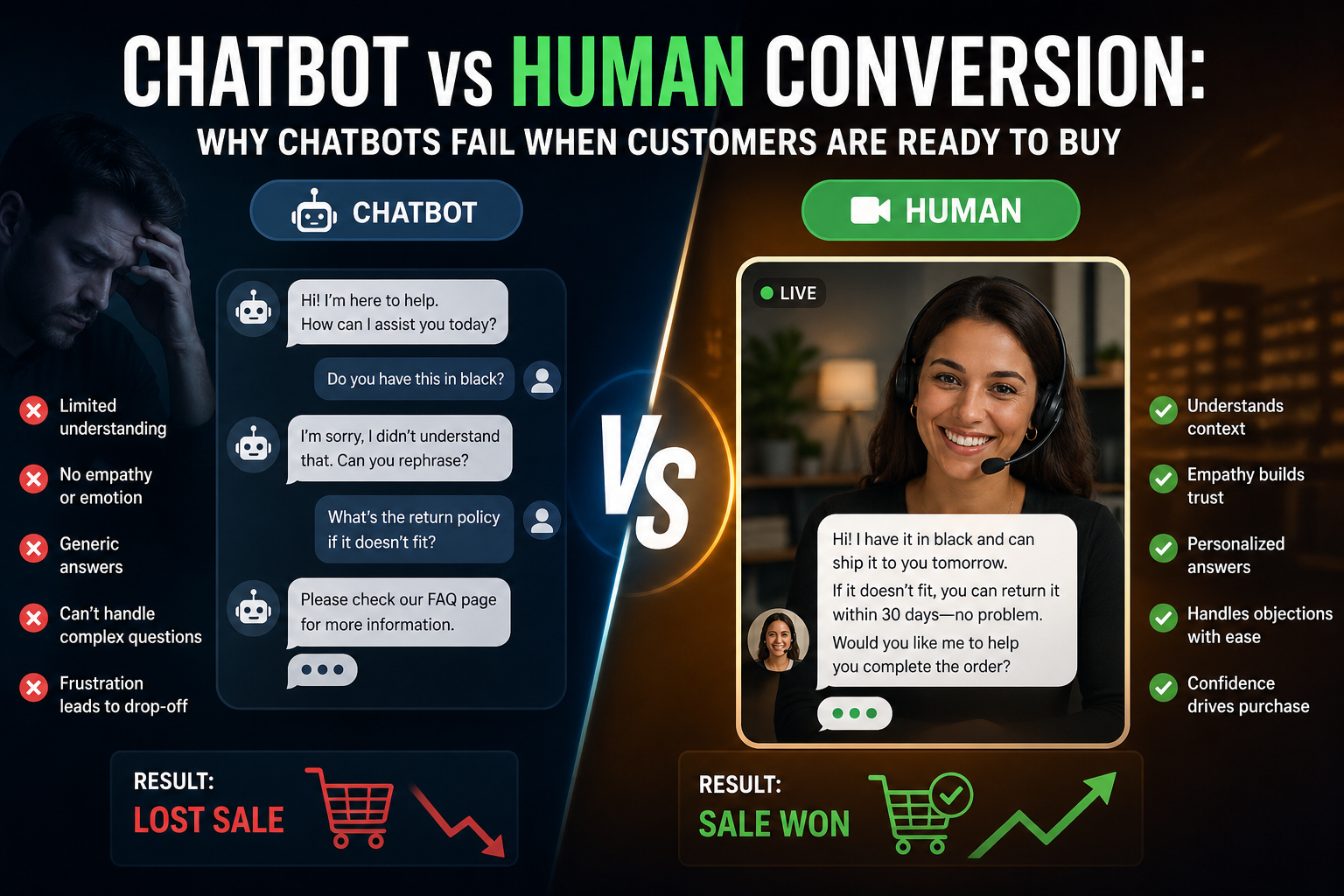
A chatbot can only respond within the logic it has been given. Even advanced systems struggle when a buyer’s question involves context, tradeoffs, exceptions, or subtle hesitation. The response may be technically related to the topic, yet still fail to answer what the buyer is really asking.
That gap matters because the final step in a purchase is rarely just informational. It is emotional. Buyers are trying to reduce risk. They want to feel confident that they are making the right call, with the right company, at the right time. A chatbot may provide data, but data alone does not resolve doubt.
After a few scripted replies, trust can drop fast. A buyer who senses they are trapped in a flow starts to feel distance instead of support. If they cannot get clarity quickly, they hesitate. If hesitation grows, conversion falls.
- Complex questions: High-intent buyers often ask layered questions that do not fit predefined flows
- Emotional signals: Hesitation is usually about risk, not just missing information
- Scripted responses: Repetitive answers make the interaction feel generic and unaccountable
- Resolution speed: Every unanswered objection adds friction at the exact moment the user should be moving forward
A delayed answer during casual browsing is easy to overlook. A delayed answer at checkout or before a quote request can cost the sale.
Why reassurance matters more than information at the point of purchase
When someone is ready to buy, they are not simply collecting facts. They are looking for reassurance.
That distinction changes everything.
A person who asks, “Will this work for my team?” may already understand the features. A shopper who asks, “What if the size is wrong?” may already know your return policy. A prospect who asks, “How quickly can you start?” is often testing reliability as much as logistics. The literal question matters, but the deeper issue is confidence.
Human interaction meets that need in a way automation cannot. A skilled person can hear uncertainty in the phrasing, adjust tone in real time, clarify the concern behind the question, and answer with judgment rather than a script. That kind of exchange reduces perceived risk, which is often the final barrier to conversion, highlighting the importance of skilled customer service agents.
Human support brings the qualities buyers want most in those moments:
- Trust
- Empathy
- Adaptability
- Real-time objection handling
- Confidence to move forward
That is why many businesses see decent engagement from bots but stronger conversion from people.
Chatbot vs human performance in high-intent conversion scenarios
The comparison becomes much clearer when you look at what happens in real buying situations involving artificial intelligence.
| High-intent task | Chatbot response | Human response |
|---|---|---|
| Answering complex questions | Pulls from predefined logic or knowledge base | Interprets context and answers the actual concern |
| Handling objections | Offers generic reassurance or loops to help articles | Addresses hesitation directly and adjusts message in real time |
| Building trust | Feels transactional and scripted | Feels accountable, attentive, and personal |
| Closing decisions | Struggles when buyer needs confidence | Creates momentum and helps the buyer commit |
| Managing edge cases | Often fails or escalates slowly | Makes judgment calls and gives immediate clarity |
| Saving abandoning users | May trigger automated prompts | Can actively rescue the sale through conversation |
A chatbot can surface information. A human can turn information into confidence.
That difference is especially important for higher-ticket ecommerce purchases, service inquiries, consultations, subscriptions, and any offer where buyers compare options before committing.
High-intent website scenarios where human interaction wins
Take the user hesitating at checkout. They are one step away from purchase, but something feels uncertain: shipping timing, return risk, compatibility, warranty coverage, or a final pricing question. A chatbot that serves canned replies may keep the page active, but it often fails to remove the hesitation. A real person or skilled agents in customer service can answer the exact concern and keep the momentum alive.
Now consider the user comparing options on a service website. They may be deciding between two packages, two timelines, or two levels of support. This is not a search problem. It is a judgment problem. They want help making the right choice. A human can ask one or two smart questions and guide them to the right fit. A bot tends to flatten the nuance.
Another common case is product or service fit. A visitor may say, “I’m not sure this is right for my setup,” or “My case is a little different.” That sentence is an invitation to convert, if someone responds well. A chatbot often treats it as a keyword match. A person hears it as an opening to clarify, reassure, and close.
Then there is the silent loss most teams never see: the buyer who was about to submit, buy, or book, but left because they could not get a clear answer fast enough. Many websites read that as normal drop-off. In reality, it is often preventable abandonment.
Using Live Reception as a human conversion layer
This is where Live Reception changes the model. Instead of treating conversations as support tickets, it treats them as live sales moments. The goal is not only to answer questions, but to help high-intent visitors take the next step while intent is still strong.
For ecommerce websites, that can mean rescuing a checkout decision, clarifying product fit, or answering policy concerns before the cart is abandoned. For service businesses, it can mean handling quote-stage objections, explaining service details, qualifying urgency, and moving prospects toward a booked call or signed agreement.
The value is timing. Buyers do not need human help at every stage. They need it at the moments where uncertainty meets intent. Live Reception puts real people there when that moment happens.
That makes it more than support. It becomes a live sales layer on the website.
This approach also fits a broader growth system. Different parts of the customer path need different tools and responsibilities. A practical model looks like this:
- Lead Generation: brings qualified visitors to the website
- Live Reception: meets high-intent users when they need real answers
- Sales as a Service: supports deeper sales conversations and structured closing
- Customer Support: extends trust after the purchase and protects retention
When those functions work together, automation still has a place. It just stops pretending to be the closer.
What businesses should change if conversion matters more than automation
The first change is strategic. Stop asking whether chatbots increase engagement and start asking where they increase conversion. Those are not the same thing. A bot can create more interactions while quietly depressing close rates in the moments that matter most.
The second change is operational. Identify the pages and events where visitor intent is strongest. That may be checkout, pricing pages, quote forms, product comparison pages, booking flows, or service detail pages. These are the places where human availability has the greatest commercial value.
The third change is philosophical. Efficiency is useful, but buying is emotional. Businesses that treat late-stage conversations as a cost to reduce often miss the reality of what those conversations do. They do not just answer questions. They create trust at the exact moment trust determines revenue.
Automation helps scale. Human connection converts.
When customers are ready to buy, the experience needs to match that moment. If the buyer needs reassurance, judgment, and real-time clarity, a script is not enough. A real person is still the strongest tool on the page.