Plenty of ecommerce teams have a traffic problem.
Plenty more think they do.
A store can attract a steady stream of visitors, generate healthy session counts, and still leave significant revenue on the table every day. The issue is not always awareness. In many cases, the real gap appears later, right when a shopper is close to buying and needs one more answer, one more reassurance, or one more sign that this purchase is the right call.
That shift in perspective matters. If people are already arriving, browsing, adding items to cart, and reaching checkout, then revenue growth does not begin with another campaign or a larger ad budget. It begins with what happens at the point of decision.
Table of Contents
Why ecommerce revenue stalls even when traffic looks healthy
Traffic is easy to celebrate because it is visible. Sessions rise, click-through rates improve, and paid campaigns bring in new visitors. Those metrics feel like momentum.
Revenue tells a stricter story.
If sales stay flat while traffic grows, the site is not extracting enough value from existing demand. That usually means high-intent shoppers are slipping away during the final steps. They are not casual browsers. They are people who have already shown interest, evaluated options, and moved close to purchase.
This is where many ecommerce businesses get stuck. They keep investing in acquisition while the real problem sits inside the store experience itself. More traffic enters the funnel, but the same doubts, delays, and objections remain unresolved. The result is a bigger top of funnel with the same leak near the bottom.
A smarter path starts with one question: where is revenue being lost right before a customer is ready to buy?
Where ecommerce revenue is lost at the moment of decision
Most lost revenue does not disappear because a shopper suddenly stops wanting the product. It disappears because uncertainty wins the final few minutes.
A buyer may like the item, trust the brand enough to keep browsing, and even reach checkout, yet still hesitate over fit, quality, shipping speed, return policies, or whether a competitor offers a safer option. Those moments feel small, but they directly affect conversion rate.
In many stores, revenue leaks show up in patterns like these:
- Checkout hesitation
- Shipping or delivery questions
- Uncertainty about sizing or compatibility
- Last-minute comparison shopping
- Lack of trust before payment
- Cart abandonment after reviewing total cost
Each of these moments involves a shopper who is close to purchasing. That is what makes them so valuable. A visitor at this stage does not need broad brand education. They need a fast, credible answer.
That distinction changes how revenue growth should be approached. When the prospect is already warm, the goal is not persuasion at scale. The goal is removing friction with precision.
Why common ecommerce conversion tactics often fall short
Most ecommerce teams are not ignoring conversion. They are usually trying a mix of standard fixes. The problem is that many of those fixes help at the margins while leaving core buyer doubt untouched.
Site design updates can improve clarity. Better product pages can reduce confusion. A stronger checkout flow can remove unnecessary clicks. All of that helps. But good UX does not answer a question that is personal, situational, or time-sensitive. A polished interface still cannot tell a customer whether a jacket runs small, whether a replacement part fits an older model, or whether a gift will arrive before Friday.
Discounts can drive action, but they come at a cost. If every revenue bump depends on a coupon, margins erode and customers learn to wait. Sales rise in the short term while profitability weakens.
Email recovery campaigns have their place too, especially for abandoned carts. The issue is timing. By the time the email lands, the customer has already left, already cooled off, or already bought somewhere else.
Chatbots create another common gap. They can handle simple requests and basic routing. Yet when a shopper is frustrated, unsure, comparing options, or looking for reassurance, scripted automation often feels thin. Complex questions and emotional hesitation are exactly where bots tend to fall short.
The pattern is clear:
- UX improvements: Better flow, but no direct human reassurance when doubt appears
- Discounts: More conversions, but weaker margins and lower pricing power
- Email recovery: Useful follow-up, but too late for many high-intent visitors
- Chatbots: Fast for simple prompts, limited when nuance or trust is needed
None of these tools are useless. They just are not enough on their own when a customer needs help right now.
Revenue growth comes from converting existing demand more efficiently
Once a store has reliable traffic, the next growth phase is usually less about reach and more about efficiency.
That means turning more current visitors into buyers, turning more buyers into higher-value orders, and reducing the number of people who abandon purchase because no one addressed their concern in time.
This is a strong position to be in. Existing traffic already represents marketing spend, brand visibility, and intent. Improving the yield from that traffic often produces faster gains than chasing net-new visits. It can also be more profitable, since the store is extracting more value from acquisition dollars that have already been spent.
A useful way to think about it is simple: traffic creates opportunity, but conversion captures revenue.
Here is how that shift looks in practice:
| Focus area | Traffic-first mindset | Revenue-first mindset |
|---|---|---|
| Growth priority | More visitors | More buyers from current visitors |
| Main problem | Not enough sessions | Too much hesitation before purchase |
| Typical response | Increase ad spend | Remove friction at decision points |
| Margin impact | Can rise with acquisition costs | Often improves through better conversion |
| Buyer support | Mostly self-serve | Real-time help when intent is highest |
A store with strong traffic and weak conversion is not starting from zero. It is sitting on demand that can be monetized better.
How Live Reception helps increase ecommerce revenue in real time
This is where Live Reception becomes a powerful revenue tool.
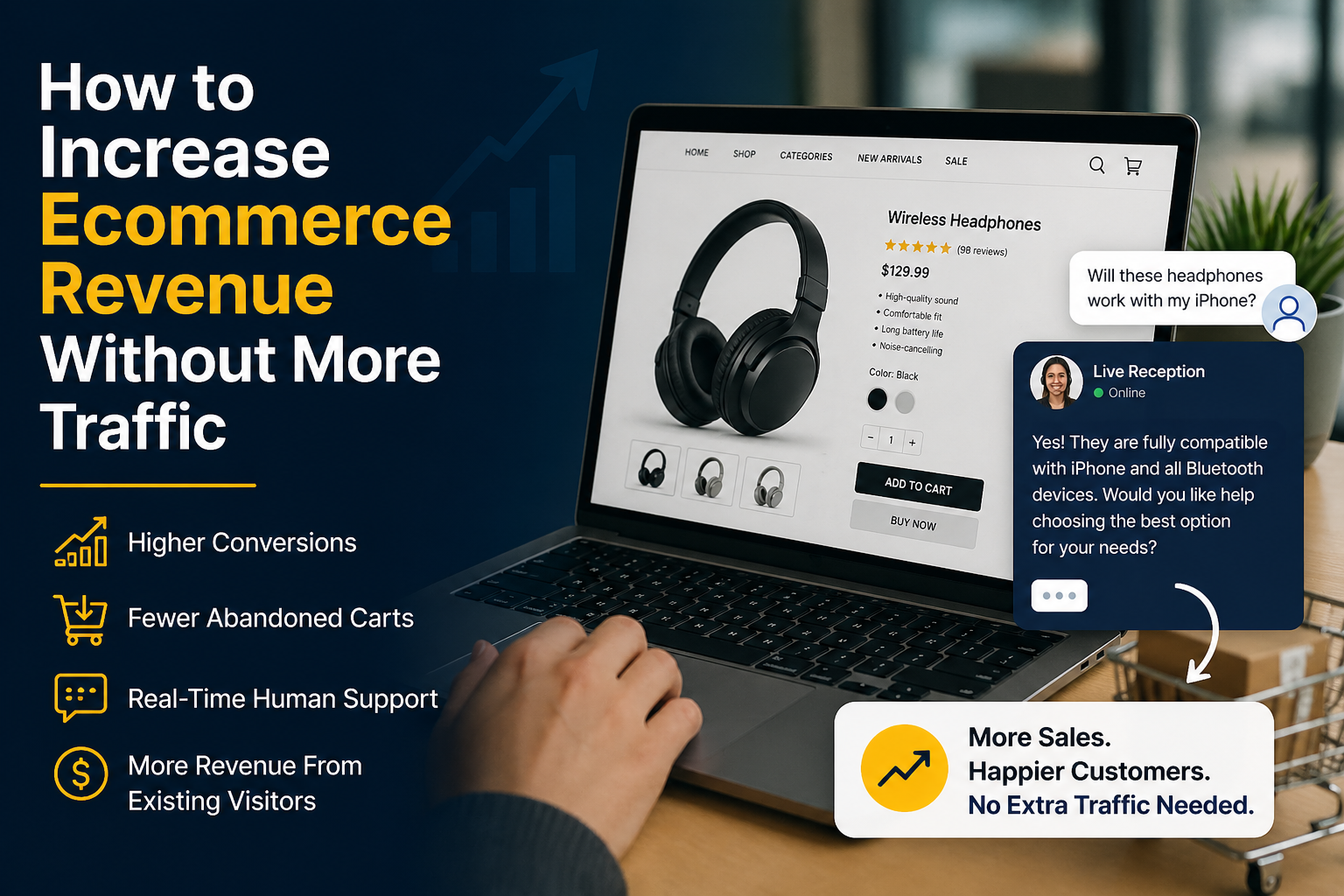
Live Reception adds a real-time human interaction layer to ecommerce. Instead of leaving shoppers alone with unanswered questions, it gives them access to immediate help from a real person during the exact moments when hesitation can kill a sale.
That matters because buying decisions are often emotional as much as rational. Shoppers want speed, but they also want confidence. A real conversation can do what static content, delayed email, and generic automation often cannot: reduce doubt in the moment it appears.
For ecommerce brands, Live Reception can support revenue in direct ways:
- Instant answers: Resolve questions about fit, specs, shipping, returns, or availability before the customer leaves
- Decision support: Help shoppers compare products and choose the right option
- Checkout reassurance: Address final concerns that lead to cart abandonment
- Trust building: Create a stronger sense that the brand is responsive and credible
- Sales guidance: Encourage higher-value purchases when a customer is open to related options
This is not customer support after the fact. It is revenue support during the purchase decision.
That timing is what makes the difference.
Live Reception use cases that directly affect ecommerce conversions
Real-time human support becomes most valuable when a customer is already engaged but not yet committed. Several common ecommerce scenarios make that especially clear.
Product fit and product specification questions
A shopper has found the product they want, but something small is blocking action. Maybe they are between sizes. Maybe they need to confirm dimensions. Maybe they want to know whether an item works with what they already own.
Without immediate help, many shoppers pause the purchase and leave to search elsewhere. Some never come back.
With Live Reception, that uncertainty can be addressed on the spot. A real person can answer the question, reduce risk, and move the buyer forward while purchase intent is still active.
Comparison shopping during product evaluation
Comparison behavior is normal, especially in categories with many lookalike options. Buyers want to know why one model costs more than another, whether an upgrade is worth it, or what tradeoffs come with a cheaper choice.
Static comparison charts help, but they do not always match the customer’s exact situation.
A human interaction at this stage can frame the decision more clearly. It can also keep the shopper engaged with your store rather than letting the comparison process drift toward a competitor.
Checkout hesitation and cart abandonment
Checkout is where intent meets anxiety.
Unexpected totals, delivery uncertainty, return concerns, payment hesitation, and last-minute trust issues often appear right before completion. This is one of the highest-value moments in the entire ecommerce funnel because the shopper is only one step away from revenue.
A live human presence can reduce abandonment in ways that automated systems often cannot. The customer gets reassurance while still on the site, not hours later through a recovery email.
That changes the economics of conversion.
Reassurance before first purchase
New customers often need more confidence than returning buyers. They may be asking themselves whether the product quality is as good as it looks, whether support will be available if something goes wrong, or whether returns will be painful.
Trust is often the final barrier.
Live Reception gives brands a chance to answer that trust question in a human way. That can be especially valuable for higher-ticket items, considered purchases, or categories where product quality is hard to judge from photos alone.
How Live Reception improves conversion rate, cart abandonment, and average order value
The revenue effect of real-time human interaction is not limited to one metric. It can influence multiple parts of ecommerce performance at once.
First, it can lift conversion rates by helping high-intent visitors move from interest to purchase. When questions are resolved quickly, fewer shoppers stall out.
Second, it can reduce cart abandonment by addressing objections before the customer exits. This is often more efficient than trying to recover the same customer later through email or retargeting.
Third, it can increase average order value. When a customer is already in conversation, there is room to guide them toward the better-fit product, the premium option, or a relevant add-on. This works best when the guidance is useful, not pushy. A person who understands the buyer’s concern can recommend a stronger choice with more credibility than a generic upsell prompt.
The customer experience improves as well. That matters not only for conversion, but also for brand perception. A store that feels responsive at the point of purchase is easier to trust.
A few practical revenue outcomes often follow:
- Higher conversion from existing traffic
- Fewer abandoned carts
- Better close rates on high-intent visitors
- Larger orders when guidance supports stronger product selection
- More confidence among first-time buyers
This is why the impact of Live Reception can reach beyond a single transaction. Better purchase experiences can also influence repeat buying and word of mouth over time.
Why human support works when chatbots and static pages do not
Automation has real value. It can answer store hours, point to policies, and handle simple routing. But ecommerce buying decisions are rarely made in perfect conditions.
A shopper may be comparing products while commuting, buying a gift under time pressure, or worrying about whether a costly item will actually meet expectations. Those moments involve nuance, urgency, and trust. They do not always fit cleanly into scripted decision trees.
That is where human interaction stands apart.
A person can read context, clarify vague concerns, and adapt language to what the shopper actually means. They can reassure without sounding robotic. They can answer the question behind the question.
That capability is especially useful in situations like these:
- Emotional hesitation: “I just want to make sure I’m not getting this wrong”
- Complex product selection: “Which option fits my setup and budget?”
- Trust concerns: “What happens if I need to return this?”
- Time sensitivity: “Can this arrive before the weekend?”
Those are revenue moments, not just support moments.
How Live Reception fits with Lead Generation, Sales as a Service, and Customer Support
Live Reception works especially well as part of a broader revenue system.
When a brand needs more volume at the top of funnel, Lead Generation can help bring in additional qualified traffic. That makes sense when acquisition is the actual bottleneck. Yet once those visitors arrive, Live Reception helps turn that traffic into revenue more effectively.
For businesses with higher-value products, custom orders, or more involved buying cycles, Sales as a Service can extend the same logic. Some shoppers need more than a quick answer. They need active sales support that helps move them toward a larger purchase or a more consultative close.
Customer Support adds another layer after the sale. Post-purchase service affects repeat buying, retention, and customer sentiment. Strong support after purchase makes pre-purchase promises more believable, which can lift trust earlier in the funnel as well.
These services are strongest when they work together:
- Lead Generation: Attracts qualified visitors when traffic expansion makes sense
- Live Reception: Converts existing demand at the moment of decision
- Sales as a Service: Closes more complex or high-value opportunities
- Customer Support: Protects loyalty and improves the post-purchase experience
The common thread is simple. Revenue growth does not come from one isolated tactic. It comes from supporting the buyer at the right stage with the right kind of interaction.
What ecommerce teams should measure when shifting from traffic growth to revenue efficiency
When the goal changes from “get more visitors” to “monetize existing visitors better,” measurement should change too.
Traffic still matters, of course. But it should no longer dominate the conversation. The more useful metrics are the ones that show whether high-intent shoppers are being converted effectively.
Teams often benefit from tracking conversion rate by device, cart abandonment rate, checkout completion rate, average order value, and assisted conversion patterns tied to live interactions. Looking at these metrics together gives a much clearer picture of where revenue is gained or lost.
Response speed matters as well. If a shopper needs help now, a slow answer is close to no answer. In ecommerce, minutes can be expensive.
This is where a more disciplined revenue lens can be powerful. Instead of asking whether traffic rose this month, a team can ask whether existing demand was handled better. That is a sharper question, and it usually leads to sharper decisions.
The stores that grow most efficiently are often not the ones with the biggest audience. They are the ones that make the best use of buyer intent when it appears.
More visitors can help. No question.
But when traffic is already steady, the bigger opportunity is often hiding in plain sight: the customer who is ready to buy, hesitates for one moment, and leaves because nobody was there to help.
That is why the point of decision matters so much. It is where uncertainty becomes abandonment or revenue. And it is exactly where real-time human interaction can change the outcome.