Luxury has always depended on distance, discernment, and personal attention. The boutique, salon, showroom, and private appointment all signal that the brand is not merely selling a product. It is staging an experience that confirms taste, status, confidence, and belonging.
Online, that logic often gets reversed. Premium brands invest heavily in photography, design systems, and performance media, then place a generic chatbot, a rigid help center, and a queue-based support model between the customer and the purchase. The visual layer says luxury. The service layer says commodity.
That gap is expensive.
When digital luxury retail borrows its customer experience model from mass-market e-commerce, brand equity starts to erode long before conversion rates fall. High-value buyers notice the difference immediately. They notice when every answer sounds templated, when no one takes ownership, and when the relationship ends the moment payment clears. For a premium buyer, convenience matters, but it does not replace care. In many cases, automation is not a sign of sophistication. It is a downgrade.
Table of Contents
The psychology behind the high-net-worth customer journey online
A high-ticket purchase is rarely a pure utility transaction. Even when the item has obvious functional value, the decision carries identity weight. A fine watch, couture garment, collector automobile, luxury stay, or premium B2B service becomes part of how the buyer sees themselves and how others read them. That is why the luxury brand customer experience cannot be reduced to checkout speed and ticket deflection.
High-net-worth customers and premium buyers are seeking validation as much as efficiency. They want reassurance that they are choosing correctly, that the item is authentic, that the fit or finish will meet expectation, and that the brand recognizes the significance of the purchase. A standardized response strips away much of the emotional reward. The customer is not simply asking, “Can I get this by Friday?” They may also be asking, “Am I being looked after at the standard your brand promises?”
Risk feels different at premium price points. A poorly handled $60 cart abandonment is an inconvenience. A poorly handled $6,000 or $60,000 transaction can feel careless, even insulting. Anxiety rises across every touchpoint: authenticity, payment security, tailoring, timing, packaging, white-glove delivery, returns, repairs, privacy, and aftercare. The higher the price, the more customers want a trusted human presence who can reduce uncertainty in real time.
That expectation changes the service model. Premium buyers do not want to hunt for answers through a self-service maze unless they choose to. They want immediate access to someone capable, tasteful, and accountable. The language matters. The pace matters. The confidence of the response matters.
The signals are consistent across categories:
- Emotional reassurance
- Personal recognition
- Discretion and privacy
- Contextual recommendations
- Proactive ownership after purchase
A luxury buyer will often accept a slower transaction if the interaction feels intelligent and personal. They will rarely forgive an interaction that feels cheap, automated, or indifferent.
Where automation weakens luxury brand customer experience online
Standard automation fails in luxury because luxury requests are rarely standard. A scripted bot can answer store hours, return windows, or payment options. It cannot hold a meaningful conversation about drape, silhouette, provenance, finish, collector value, lifestyle fit, or whether a gift will land with the right emotional effect. The moment the customer asks a nuanced question, the illusion breaks.
This is where many brands make a costly mistake. They assume that a polished interface can compensate for thin service. It cannot. A premium customer is often highly skilled at detecting synthetic empathy. They hear it in the scripted phrasing, the repetitive reassurance, and the inability to interpret tone. They also recognize when no one on the brand side has enough authority to make a judgment, take responsibility, or offer a recommendation with conviction.
Conversational commerce for luxury only works when the conversation is actually valuable. If the exchange feels like a keyword parser dressed in polite language, the brand moves closer to commodity status. That harms conversion in the moment, and it weakens premium brand loyalty over time.
The weak points show up in predictable places:
- Rigid chatbot logic: subjective questions get flattened into irrelevant prewritten answers
- Synthetic empathy: polite language without taste, memory, or real judgment
- Sterile post-purchase updates: shipping notifications replace proactive care
- Fragmented ownership: the customer repeats context across channels and agents
Post-purchase is often where digital luxury falls furthest behind physical retail. In-store, a client advisor may follow up personally, confirm delivery, suggest styling, and remain available for adjustments. Online, the same buyer receives a series of automated emails and a tracking link. The transaction is technically complete, but the relationship is absent. For premium customers, that absence is loud.
A luxury brand can spend millions crafting exclusivity, then lose trust with one interaction that feels indistinguishable from fast fashion.
The digital concierge framework for digital luxury retail
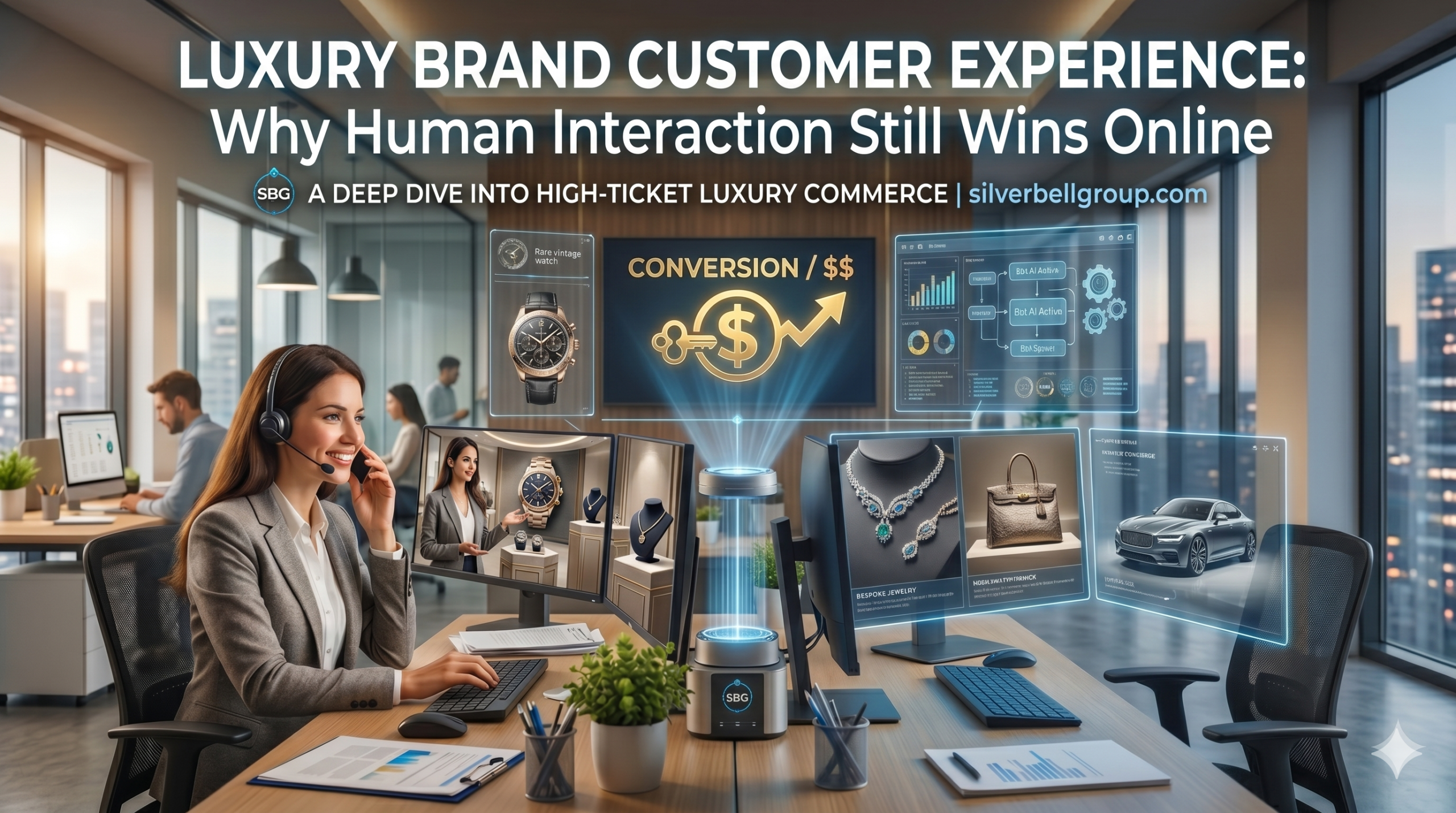
If automation is not the answer, the alternative is not inefficient manual service. The strongest model is a digital concierge service built on technology that identifies intent, routes context, and equips a human expert to act with speed and precision. Technology becomes the stage, not the actor.
This framework turns digital traffic into relationship opportunities rather than support tickets. It also creates a structure that operations leaders can scale without diluting the brand.
High-intent behavioral triggers for human outreach
Not every visitor needs human attention. The art lies in identifying the moments when a person should step in before hesitation turns into abandonment. Premium shoppers leave very clear signals when they want help but may not want to ask for it directly.
Time spent on high-value product pages is one signal. Repeated visits to sizing or material information is another. Multiple returns to customization options, shipping timelines, or care instructions often indicate purchase intent mixed with uncertainty. Returning clients reviewing similar categories may be open to guided recommendations. A cart containing a high-ticket item with long inactivity often calls for outreach, not another discount email.
The trigger system should combine behavioral data with value thresholds and client history. A first-time visitor hovering around a premium collection page is different from a repeat customer known to purchase seasonally. Both may merit contact, but the tone and channel should differ.
Practical triggers often include the following:
- Extended consideration: five or more minutes on a premium product or customization page
- Repeated reassurance checks: multiple views of sizing, materials, provenance, or delivery details
- High-value hesitation: a cart above a defined threshold with inactivity during checkout
- Known client return behavior: previous buyer revisits favored categories or wish-listed items
When these signals appear, the outreach should feel discreet and timely. “Would you like assistance from a brand advisor?” is stronger than a pop-up that aggressively pushes a chatbot. In luxury, interruption should feel like invitation.
Instant human escalation without a bot gatekeeper
The transition from browsing to conversation must be friction-light and respectful. A bot gatekeeper that forces the customer through irrelevant prompts damages momentum. The buyer should be able to move directly into live chat, voice, video, or curated messaging with a trained ambassador.
Channel choice matters. Some customers want text because it is discreet and efficient. Others want a voice conversation that builds trust faster. In high-consideration categories, video can replicate some of the physical retail experience by showing product details, demonstrating fit, or giving a more personal introduction to the brand. The point is not to offer every channel at once. It is to offer the right one at the right moment.
Response quality matters even more than speed. In mass e-commerce, instant response is often the core promise. In luxury, rapid response with poor judgment still fails. The brand ambassador must be able to interpret nuance, guide choices, and speak in a way that reflects the brand’s identity without sounding rehearsed.
This handoff model changes service economics. A general support queue treats all inquiries as roughly equal. A concierge model prioritizes likely revenue, relationship value, and emotional intensity. That protects margin while improving customer lifetime value.
CRM context and relationship memory for premium brand loyalty
A digital concierge service only feels premium when memory is present. Customers should not need to restate preferences, past purchases, prior concerns, or delivery requirements every time they reappear. Relationship continuity is one of the strongest signals of care.
That requires CRM integration that gives the ambassador a live view of relevant context: purchase history, sizes, favored categories, location, language preference, service history, event dates, communication channel preference, and notes from previous interactions. Context should guide judgment, not create robotic personalization. The human remains the interpreter.
When done well, the experience feels almost invisible. The buyer receives advice that fits their known style. Delivery guidance reflects their region and urgency. Follow-up feels thoughtful rather than promotional. This is how premium brand loyalty is built online, not through points alone, but through remembered taste and reliable stewardship.
The framework can be mapped operationally:
| Phase | Customer signal | Human action | Supporting data | Primary business impact |
|---|---|---|---|---|
| Behavioral detection | Long dwell time, repeated detail checks, cart hesitation | Offer advisor contact at the right moment | Session behavior, product value, traffic source | Higher conversion on high-intent traffic |
| Human connection | Customer accepts outreach or requests help | Move into chat, voice, or video with a trained ambassador | Channel preference, language, device, urgency | Lower abandonment, stronger trust |
| Relationship continuity | Conversation continues through purchase and aftercare | Advisor follows through on delivery, fit, care, and next-step guidance | CRM history, purchase data, service notes | Stronger CLV, lower return risk, better premium brand loyalty |
This model also improves internal coordination. Marketing sees clearer signals of true purchase intent. Sales gets richer context. Operations can prioritize service by value and complexity rather than inbox order.
Operating white-glove customer service across time zones
The most common objection to a human-centric luxury model is scale. A brand may be able to offer boutique-level service in one market during business hours, yet struggle to support a global customer base across evenings, weekends, launches, and peak seasons. That challenge is real, but it is operational, not philosophical.
White-glove customer service requires a different talent profile than ordinary support. Agents cannot simply read scripts and escalate exceptions. They need product fluency, writing quality, verbal precision, emotional control, cultural awareness, and brand storytelling ability. In premium categories, they also need confidence. Customers can sense uncertainty quickly, and uncertainty reduces trust.
Training has to reflect that reality. Product knowledge alone is not enough. Brand ambassadors need to know how to advise without pressure, how to protect exclusivity while staying warm, how to handle affluent clients who expect discretion, and how to recover service failures without resorting to canned language. They are not call center agents in luxury clothing. They are digital hosts.
The operating model usually needs four capabilities working together:
- Brand voice discipline: every interaction sounds consistent, intelligent, and calm
- Service ownership: one person or a small pod follows through across the interaction
- Global coverage: customers in key markets receive quality support outside local retail hours
- Escalation authority: advisors can solve problems without excessive internal transfers
This is why outsourcing can be a strong strategic move for premium brands, provided the partner is set up for white-glove work rather than mass-volume efficiency. A specialized partner can provide multilingual coverage, scheduling flexibility, trained talent pools, QA structures, and performance reporting while keeping the brand’s service ethos intact. That matters for CMOs and operations leaders who need proof that the digital experience can scale without flattening into generic support.
A good outsourcing structure does not distance the brand from the customer. It extends the brand through disciplined execution. The wrong partner creates script dependency and churn. The right partner creates continuity, poise, and availability.
Customer Support Outsourcing and Live Reception for luxury growth
For brands trying to close the gap between digital traffic and true experiential retail, a strong outsourcing layer can become the operating engine behind human-first service. That is where Customer Support Outsourcing becomes relevant. Rather than staffing only for basic support, the model can be designed around brand ambassadors who handle high-intent conversations, purchase reassurance, post-purchase care, and relationship continuity.
A complementary layer is Live Reception Services. This is especially useful when a brand wants every inbound call, lead, or service request to feel personally received instead of routed into a generic queue. For luxury hospitality, premium automotive, fashion, and high-value services, live reception can function as the front door to the digital boutique. It protects tone, captures intent, and directs customers toward the right human contact quickly.
The value is not just labor flexibility. It is execution quality. When a partner is trained around premium etiquette, product nuance, and service ownership, the outsourced team acts less like external support and more like an extension of the brand’s private client experience. That can be the difference between a website that transacts and a website that hosts.
Metrics that justify human-centric digital luxury retail
Luxury leaders often need a commercial case, not just a philosophical one. The good news is that human interaction can be measured in ways that matter to both marketing and operations. The strongest programs usually improve more than conversion rate alone.
High-intent human support tends to lift average order value because buyers receive confident guidance at the moment they are weighing trade-offs. It can also reduce return rates in categories where fit, materials, customization, or suitability drive uncertainty. In many premium categories, one avoided return or canceled order can offset the cost of meaningful service coverage.
Customer lifetime value often tells the clearest story. A buyer who feels remembered is more likely to return, accept curated recommendations, engage across categories, and stay brand-loyal without constant promotional pressure. That makes human service one of the few CX investments that supports both margin protection and revenue growth.
The most useful scorecard usually includes a mix of commercial and relational metrics:
- Conversion rate on assisted sessions
- Average order value for advisor-supported purchases
- Repeat purchase rate among concierge-served clients
- Return rate for assisted versus unassisted orders
- Time to human response on high-intent contacts
- CSAT and qualitative feedback on advisor interactions
- Customer lifetime value by service tier
Brands should also look at softer but telling indicators: fewer escalations, more direct outreach from returning clients, stronger referral behavior, and higher acceptance of premium services like private appointments, advanced access, or curated recommendations. Those signals point to emotional resonance, not just transactional efficiency.
A luxury brand does not win online by becoming frictionless in the same way a mass retailer does. It wins by being memorable, trustworthy, and unmistakably attentive. That requires systems, data, staffing, and discipline, but the principle is simple. Premium customers do not just buy items. They buy the assurance that someone capable is there, before the sale, during the decision, and after delivery.
That is why human interaction still wins online. It protects brand equity at the exact moments when digital commerce tends to flatten it. It turns conversational commerce for luxury into a real advisory channel rather than a scripted widget. It gives the high-net-worth customer journey the care it deserves. And it turns technology into what it should be for a premium brand: the stage, not the actor.