In a world where businesses constantly evolve, staying competitive often necessitates a flexible and efficient workforce. Staff Augmentation, a strategic approach to staffing, plays a pivotal role in achieving this.
In this comprehensive guide for 2023, we will dive deep into the intricacies of Staff Augmentation services, exploring its various models, benefits, challenges, and much more. By the end of this article, you’ll be well-equipped with the knowledge to make informed decisions regarding your staffing needs
Table of Contents
- What is considered Staff Augmentation?
- What Models of Staff Augmentation Exist?
- Who Needs Staff Augmentation?
- How to Choose a Staff Augmentation Model?
- Staff Augmentation vs Managed Services
- Staff Augmentation vs Consulting
- Staff Augmentation vs Outsourcing
- What are the Benefits of Staff Augmentation?
- What are Challenges of Staff Augmentation?
- Pros and Cons of Staff Augmentation (Table)
- Why Should Your Business Use Staff Augmentation?
- How to Augment Your Staff Correctly in 2023?
- How Much Does Staff Augmentation Cost? (Explain SBG policy)
- How to Measure the Success of Staff Augmentation Personnel?
- Conclusion
- Frequently Asked Questions (FAQ)
What is considered Staff Augmentation?
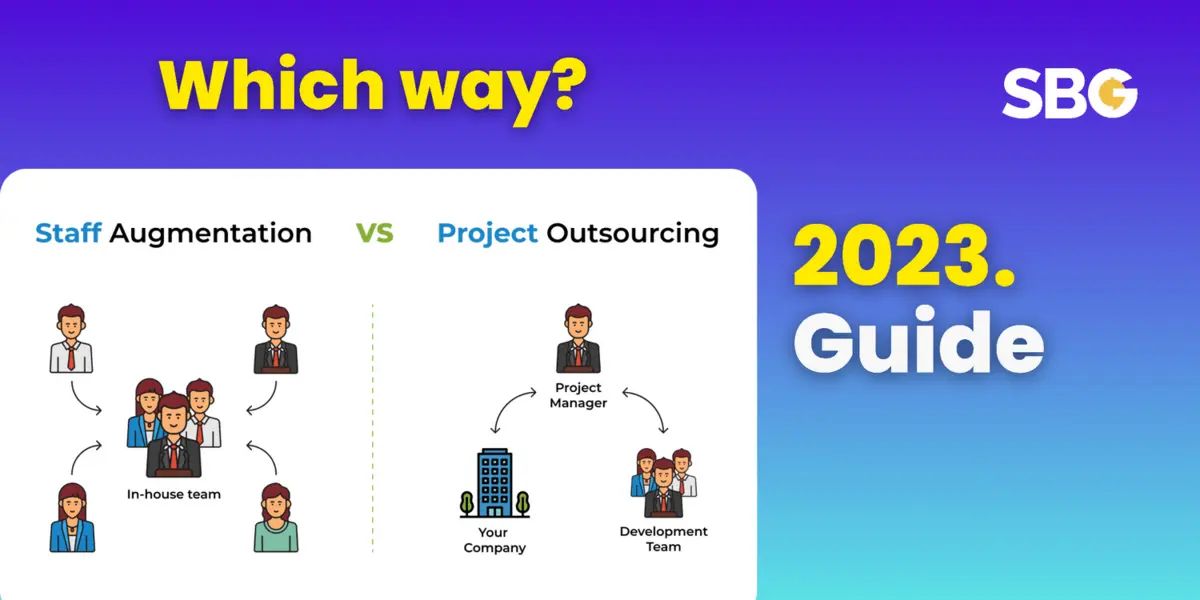
Staff Augmentation is a strategic staffing approach where businesses bring in external talent to bring their services and complement their existing in-house workforce. This can involve hiring individual professionals or entire teams with specific skills and expertise to fulfill for a certain amount of time or long-term projects, without the complexities of traditional recruitment.
In 2023, Staff Augmentation is one of the most popular ways to hire high level experts or teams, without having to worry about the hiring process that should be done for the long term commitments. Companies are turning to this way of outsourcing to find new employees, mostly in the IT sector, looking for developers with experience, without the costs of having them on retainer if they are not needed on the project.
The IT sector is not the only one that is exploiting this way of outsourcing, digital marketing is another sphere of work where companies opt for staff augmentation solutions, as well as many other areas. Based on the latest research from 2019, done by Delloit, more and more companies hire new employees for projects through augmentation, in all spheres, from sales to facility employees.
What Models of Staff Augmentation Exist?
Staff Augmentation encompasses various models, including:
- Onshore Staff Augmentation: Hiring local talent with similar cultural backgrounds and language fluency.
- Nearshore Staff Augmentation: Extending your workforce to neighboring or nearby countries.
- Offshore Staff Augmentation: Engaging talent from distant regions, often with cost-efficiency in mind.
Each model has its own set of advantages and considerations, making it essential to choose the right one for your company needs. While the most popular one currently for digital services is offshore, since the labor costs are smaller and still on the elite level, you should still consider whether it is the right fit for the company or you need to choose a different model for maximum efficiency.
If the organization is local, for the offshore employees, the gaps in culture could be detrimental, lowering the level of services and an onshore team of experts might be needed to provide the best and most authentic experience for customers.

Who Needs Staff Augmentation?
Staff Augmentation is ideal for businesses facing fluctuating workloads, specialized skill requirements, or constrained hiring budgets. It’s one of the most valuable solutions for startups, small and medium-sized enterprises, and large corporations seeking scalability and flexibility from outside help.
There are a few types of staff augmentation, which you should consider for the maximum development of members of the staff and company as a whole:
- Commodity – this includes types of employees that are reliable, will show up on time to do their job, but don’t need a specific set of skills to be working on the project. It includes basic jobs such as factories, retail and all kinds of manual labor. It is a fast and effective solution to members of staff leaving on short notice.
- Skill-based – This type of augmentation is best when the company has demand for jobs that require a certain amount of skill, but still aren’t highly specialized jobs. Digital marketing is one of these since for an entry level position, it is optimal to hire people who are new to copywriting, MS office and other skills needed and can learn through working in the company.
- Translating, editing, data processing are other examples where types of people that are brought for their services through augmentation provide a great solution for the project without the huge costs of experts.
- High level of expertise – acquired through education of the highest level or training and experience, this allows only for a certain number of people to be the option. Projects such as software development, legal cases, app development and brand design for multinational companies are just a few examples of what is considered a high level of expertise augmentation.
How to Choose a Staff Augmentation Model?
Selecting the appropriate Staff Augmentation model hinges on factors like your business goals, budget, and the nature of your services. Careful consideration of onshore, nearshore, and offshore options will help you align the model with your needs effectively.
As we have mentioned before, while everyone goes the offshore route, for obvious reasons, let’s take a look at when the other 2 types could be the best solution.
- Onshore staff augmentation is perfect for a business run locally that is expanding and the need for experts in their respective fields requires contacting new talent and possible members of staff. Another reason to go onshore is the pure factor of ease, talking in your native language about a project every time you are in contact with the new staff makes a business feel smoother.
Another angle to look from when implementing this way of outsourcing these services is if you run a company remote, for example in Japan. The best option is to hire locally to your business, which is employees in Japan, that are familiar with culture, way of operating and communicating.
- Nearshore staff augmentation is for businesses that do the work regionally, or are looking to expand regionally. Outsourcing staff through an augmentation model is a great solution to get specialized help while not having to go through the process of hiring.
If you have a project in the neighboring country every so often, choosing services from that country could be a game changer for the quality of the project.
Staff Augmentation vs Managed Services
Staff Augmentation differs from Managed Services as it involves hiring talent to work under your direct supervision. Managed Services, on the other hand, delegate the management of a particular function or process to an external provider. Aside from this blog, you can find more about Staff Augmentation vs Managed Services in the full in-depth article.
Though it takes a bit more time, than to just provide function to outside providers, augmentation could be a better option long term for companies that are in the development or even already established names in the sphere. This is mostly because you need the best possible talent for certain projects, which outsourcing companies specialize in finding. The best agencies will find a workforce that will ace all the projects without sacrificing either quality or quantity, with minimal training.
Staff Augmentation vs Consulting
While Staff Augmentation focuses on adding temporary resources to your team, Consulting offers advisory and expertise-driven services. Choosing between Staff Augmentation vs Consulting depends on whether you need extra hands-on support or specialized guidance for your projects.
An established company that works without problems in all sectors, will usually get more value from a team of experts to bring different angles, thoughts and flexibility to a project, rather than needing guidance.
Staff Augmentation vs Outsourcing
Staff Augmentation and Outsourcing both involve external talent, but the key distinction lies in control. With Staff Augmentation, you maintain control over the external professionals, while outsourcing hands over complete control to a third-party provider.
While Staff augmentation could be considered outsourcing it is more than a traditional way of finding external expertise. This allows companies to still have the main voice in projects, leaving to their management supervision over augmented staff, rather than having an autonomous team. This is the duality of outsourcing, but we hope that this has helped you understand the differences.
If you are still unsure of the differences between these two and maybe some examples of companies that use it, we are offering a lot more resources on our website, such as this blog that goes in-depth on Staff Augmentation vs Outsourcing.
What are the Benefits of Staff Augmentation?
- Flexibility: Easily scale your workforce to meet project demands. Certain projects need a particular set of skills, could be tight with time or have another problem. This is all easily fixable if you hire the right team of specialized employees.
- Cost-Efficiency: Avoid long-term commitments and expenses associated with full-time hires. It is a myth that external sources are not as cost effective as an in-house team, especially in the short and mid term.
- Access to Talent: Quickly hire specialized skills to meet project requirements. Development of an in-house team would need at least a few months, so hiring the right partners for the project is much more efficient.
- Shorter Onboarding: Temporary support is often experienced and requires minimal training, if any.
- Risk Mitigation: Handle sudden employee turnover or resource shortages seamlessly. Often agencies that provide these services offer some kind of insurance, so the risk is minimal.
What are Challenges of Staff Augmentation?
- Integration Challenges: Merging temporary support talent with the existing team can be a complex strategy. It takes time for these two to start really understanding each other, so make sure that you hire a team that will get along with the in-house team, if you have one.
- Communication Hurdles: Different time zones and language barriers may arise in offshore scenarios. With the development of apps for communication and organizing work, there is no need to worry about this point too much, but it should be noted if you think about hiring external people.
- Cultural Differences: Managing diverse teams requires a nuanced approach. On the other hand, this allows a more diverse company, which could be a great thing for the work.
- Data Security Concerns: Sharing sensitive information with external professionals necessitates robust security measures. The team that you onboard should be informed about all protocols and data security measures. This is by far the biggest concern when getting augmentation services.
- Legal and Compliance Issues: Navigating employment regulations and contracts is crucial. This should not be a problem for any serious firm, but it should be noted when getting a new team.
Pros and Cons of Staff Augmentation
| Pros | Cons |
| Scalability and flexibility | Integration challenges |
| Cost-effectiveness | Communication hurdles |
| Access to specialized skills | Cultural differences |
| Reduced onboarding time | Data security concerns |
| Risk mitigation in workforce | Legal and compliance issues |
Why Should Your Business Use Staff Augmentation?
In 2023, harness the power of Staff Augmentation to meet your staffing needs effectively. Discover how this strategic approach can optimize your workforce and drive success.
For example, your team is developing a software product, an app for example, which provides customer support by itself. For this project, along with the in-house team, you can bring a team of experts that has done app and software development in this area successfully, of course, to bring new angles and expertise. It would save a lot of time, make the product better and scale your business to the next level.
This is just one example, but think about how many more instances of augmentation being the best possible option are there. From software and app development to translation and manual labor, the hired experts will never have negative value.
How to Augment Your Staff Correctly in 2023?
To succeed in Staff Augmentation, you must align your business goals, project needs, and budget with the right model. Learn the steps to augment your staff correctly in 2023.
Overlooking any of these on a project could be detrimental for the budget and time needed to finish it, as well as the development of the team.
How Much Does Staff Augmentation Cost?
The cost of Staff Augmentation depends on various factors. To ensure transparency and cost-effectiveness, many businesses adopt a Service-Based Global (SBG) policy, where prices are predefined based on the service levels provided.
How to Measure the Success of Staff Augmentation Personnel?
Assessing the success of augmented staff involves tracking key performance indicators, project outcomes, and overall team integration. Learn how to measure and optimize the impact of these resources effectively.
Every project should have specific KPIs that will tell how good the team is on the project, is the provided value worth it, as well as their development.

Conclusion
In a dynamic business landscape, Staff Augmentation offers a competitive edge. By understanding the nuances of this specific staffing strategy, you can adapt your project goals and get help to ever-changing needs and drive your business toward success.
Having a clear goal on every project as well as the way in which the development of your business should go, are two of the most important factors when choosing this method of going outside of the in-house teams.