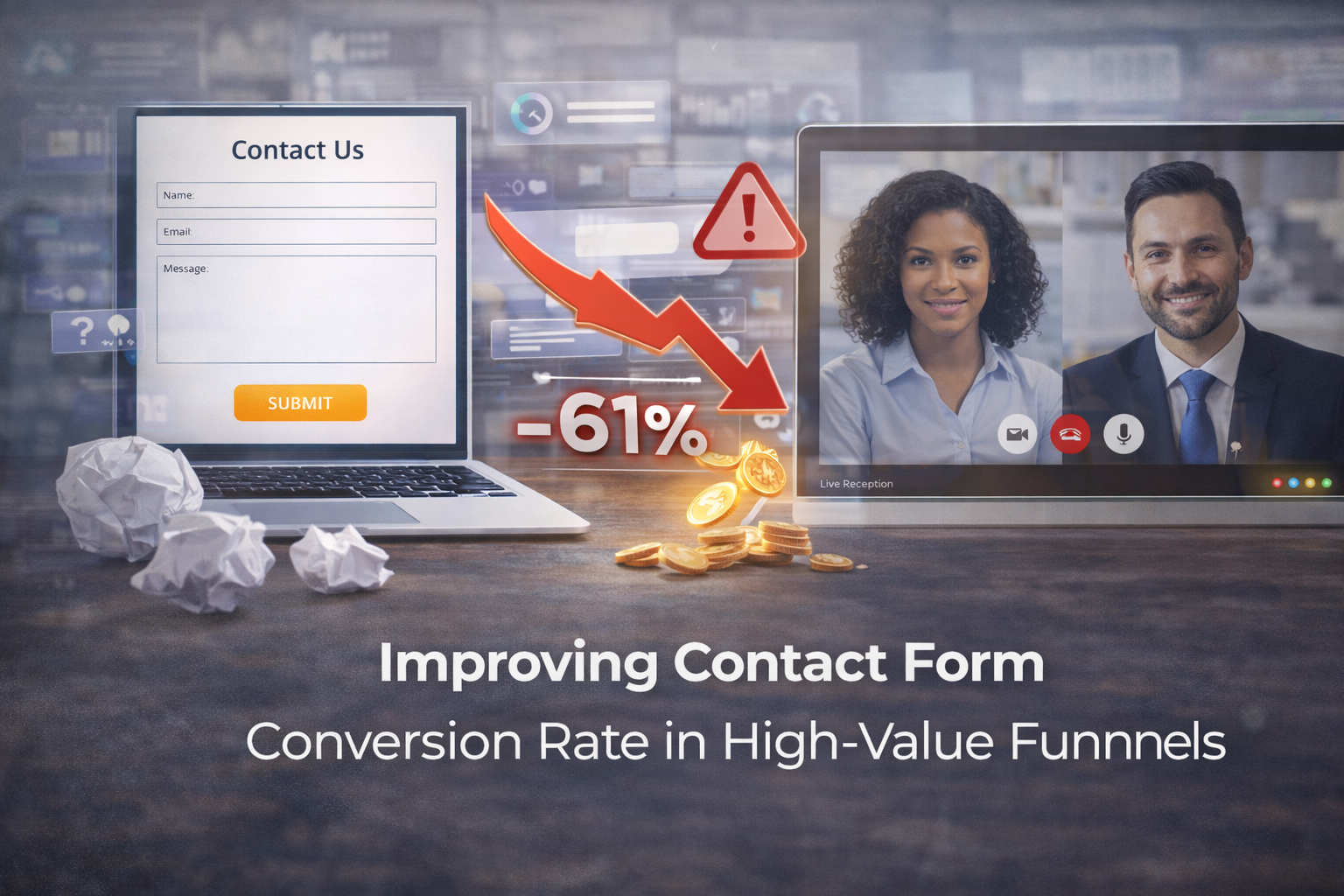
A contact form can look like the simplest step in a funnel, yet it often carries the heaviest psychological load. In high-value funnels, the visitor is not just asking a question. They are weighing risk, credibility, internal approval, timing, and the cost of being “sold to” before they even press Submit.
That is why contact form conversion rate tends to dip precisely when lead value is highest. The stakes go up, the questions get more nuanced, and a static form can start to feel like a one-way door.
Table of Contents
Why high-value funnels behave differently
Low-friction purchases tolerate ambiguity. A buyer can click around, guess, and still feel fine. High-value decisions do not work that way. When contracts, security reviews, multi-year commitments, or business-critical outcomes are involved, visitors want evidence that a real, competent team is on the other side.
A typical “Contact us” flow is often designed as an intake mechanism. High-intent visitors experience it as an audition. They do not want to spend five minutes crafting a message into a void, only to receive a slow, generic reply that resets the conversation.
This is also why the best-performing high-value funnels rarely rely on a single conversion moment. They provide multiple paths to a conversation, each matched to a different level of urgency and confidence.
What contact form conversion rate actually measures
Contact form conversion rate is usually reported as:
- Form submissions ÷ form views
- or form submissions ÷ page sessions
Those numbers matter, yet they can hide the real story in high-value funnels. A “good” conversion rate that yields low-quality conversations can be worse than a lower rate that produces fewer but highly qualified meetings.
A more useful view pairs conversion with downstream signals, including meeting set rate, show rate, sales-accepted lead rate, and time to first human response. When those are tracked together, you can tell whether the form is functioning as a bridge or as a barrier.
Why people abandon contact forms when the deal size is larger
Abandonment rarely comes from laziness. It often comes from a rational choice: “This feels risky, unclear, or time-consuming.”
The most common causes cluster into a few predictable categories:
- Uncertainty: They do not know what happens after they submit, how fast you respond, or whether they will be pushed into a sales process.
- Trust gaps: The page does not provide enough reassurance that you are credible, safe to engage, and appropriate for their use case.
- Time cost: The form asks for too much too soon, especially when visitors still have unresolved questions.
- Communication mismatch: A form forces asynchronous text when the visitor wants a live back-and-forth to clarify specifics.
When these issues stack, even motivated visitors postpone. Postpone often turns into never.
Reduce uncertainty with “next step” clarity
Many contact pages focus on the company. High-value prospects are focused on themselves: their timeline, their risk, and their internal constraints.
A small set of cues can remove outsized friction:
- State the typical response window in plain language.
- Explain who replies (role, not a name if you prefer), and what the first interaction looks like.
- Offer an alternate route for urgent requests.
After visitors understand the process, they can decide with confidence. That decision, not the form itself, is often the real conversion event.
Trust is reinforced through specifics that feel operational, not promotional. Security badges can help in the right context, yet clarity and competence usually carry more weight: what you need from them, what you will provide back, and how quickly it will happen.
Shorter forms win, but only when the questions are smart
Teams often respond to poor conversion by cutting fields. That helps, but it is not the whole solution. High-value funnels need to balance two competing goals:
- Make it easy to start the conversation.
- Collect enough context to respond well.
The best pattern is not “ask everything” or “ask nothing.” It is sequencing: ask the minimum required to route and respond, then gather deeper detail after the visitor has received value.
The table below shows common field strategies and when they tend to work.
| Approach | What it looks like | When it helps | Common failure mode |
|---|---|---|---|
| Ultra-minimal | Name, email, message | Early-stage interest, high traffic, broad audience | Sales follow-up becomes generic, response feels low-effort |
| Routing-focused | Email, company, role, topic dropdown | Multiple products or buyer types, need fast assignment | Dropdowns feel restrictive if categories are unclear |
| Qualification-heavy | Budget, timeline, team size, stack, message | Limited sales capacity, narrow ICP, high inbound volume | High abandonment when visitors are still evaluating fit |
| Progressive | Short form first, richer questions after reply or scheduling | High-value funnels with complex questions | Requires tight handoff and fast response to maintain momentum |
A progressive flow is often the most reliable in high-consideration scenarios. It respects the visitor’s time and still supports serious, context-aware replies.
Microcopy that feels human, not legal
Microcopy can raise conversion because it addresses the quiet objections that sit in the visitor’s mind while they hover over the form.
A few examples of what tends to work:
- “We reply within one business day” (only if you can consistently do it).
- “If you are evaluating options, a couple of details help us route you to the right specialist.”
- “Prefer not to share a phone number yet? No problem.”
The goal is not to persuade. It is to remove friction created by ambiguity.
If a field is optional, label it as optional. If you ask for a phone number, explain why. If the message box is required, hint at what to include so visitors do not feel stuck staring at an empty rectangle.
Response time is part of the conversion rate
A visitor who submits a form and hears nothing for two days learns an uncomfortable lesson: “This relationship will be slow.” In high-value funnels, speed signals competence.
Even when a same-hour human response is unrealistic, you can still improve perceived responsiveness:
- Send an immediate confirmation that sets expectations.
- Offer a self-serve next step (calendar scheduling, a short FAQ, relevant documentation).
- Provide a “reply-to” email address that is monitored, not a no-reply.
Teams often obsess over the form UI while ignoring the invisible half of conversion: what happens after submission. Improving post-submit experience can lift pipeline results even if the raw submit rate stays flat.
Real-time human interaction: when a form is the wrong tool
Forms are great for structured intake. They are weaker at handling nuance. High-value prospects often have edge cases, internal politics, compliance questions, or integration concerns that do not fit neatly into a textarea.
Real-time interaction reduces drop-off because it replaces guessing with dialogue. It also creates a sense of reciprocity: “I am investing attention, and they are too.”
The most effective options are not one-size-fits-all. Consider offering a small menu of conversation modes:
- Live chat: Quick clarification and routing, best when staffed by people who can answer real questions.
- Callback: A low-effort way for visitors to get a human without staying on the page.
- Live video help: A high-trust channel for complex evaluation, demos, technical validation, or sensitive questions.
Live video support is especially powerful when hesitation is driven by complexity. A short face-to-face exchange can resolve misunderstandings that would otherwise take several email rounds, or never happen at all.
This does not mean every visitor should be pushed into a call. The point is optionality: offer a faster lane for those who are ready and a quieter lane for those who are not.
Use video to lower perceived risk, not to “pitch”
When teams add video to a funnel, the temptation is to treat it as a bigger demo. High-performing high-value funnels treat it as assisted decision-making.
A few practical ways video helps reduce form abandonment:
- It confirms there is a real team behind the website.
- It allows complex questions to be answered with precision.
- It prevents prospects from oversharing sensitive details in a form field.
If you choose to offer live video, position it as support. Make the invitation feel like service, not escalation. Visitors should feel in control of the pace and the level of commitment.
Qualification without making people feel screened
High-value funnels often require qualification. Sales time is limited, and not every inquiry is a fit. The friction appears when qualification feels like interrogation.
A better approach is to qualify by helping. Ask questions that clearly improve the visitor’s outcome, and explain why you are asking. Good qualification feels like competence, not gatekeeping.
A compact set of fields often performs well:
- Contact basics (so you can respond)
- A single routing selector (so they get the right person)
- One context field that improves the first reply (timeline, goal, or primary question)
If you need deeper qualification, consider moving it to a second step after a reply, or after the visitor chooses a meeting time. By then, the prospect has received value and is more willing to share detail.
Make the form feel safe
“Safety” in this context is emotional and operational. The visitor wants to know they will not be trapped in spammy follow-ups, that their information will be treated responsibly, and that they can control the pace.
Small design choices support that:
- Provide a brief privacy note near the submit button, written in plain English.
- Avoid aggressive required fields that are not essential for response.
- Keep error messages specific and helpful.
Even the submit button label can matter. “Send message” can feel vague. “Request a reply” or “Talk to an expert” can work if it matches what will actually happen next. The key is accuracy.
What to test first (without turning your site into a lab)
Testing improves results when it is tied to a clear hypothesis about why people abandon. Start with changes that reduce uncertainty and shorten time to value.
A focused testing sequence might look like this:
- Post-submit expectations: Add response-time promise, describe the next step, include a fast alternative for urgent needs.
- Field reduction with routing: Remove anything not required to respond well, keep a single routing dropdown with clear labels.
- Real-time option placement: Offer chat, callback, or video beside the form, framed as optional support.
- Confirmation experience: Replace a generic thank-you page with a useful next step, plus an easy way to add context.
Track more than submissions. Watch meeting rates, response time, and the percentage of conversations that reach a meaningful sales step.
When a higher conversion rate is not the goal
A contact form can become too effective at attracting the wrong conversations. High-value funnels benefit from a slightly more intentional experience when it protects the sales team’s time and improves the prospect’s experience.
The aim is qualified momentum: fewer dead ends, faster clarity, and a first interaction that makes the visitor think, “These people are organized, responsive, and worth talking to.”
When you combine a simpler form, clear expectations, and optional real-time human help, you are not just increasing a metric. You are making it easier for serious buyers to take the step they already want to take.