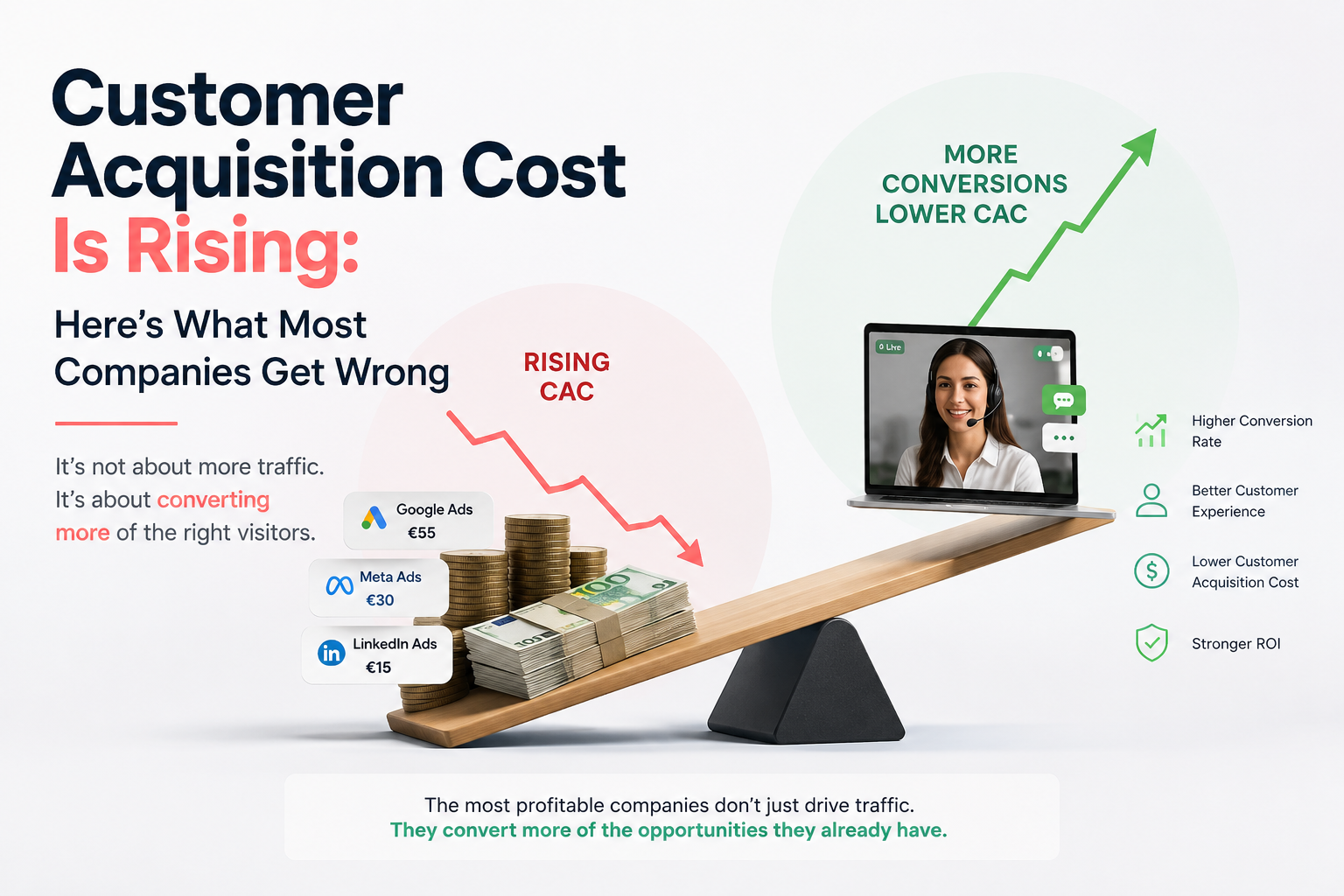
When customer acquisition cost starts climbing, most leadership teams look outward first. They review Google Ads, question Meta performance, ask whether SEO has stalled, and wonder if competitors are simply paying more. Those are fair questions. They are just rarely the first ones that matter most.
A lot of companies do not have a traffic problem. They have a conversion efficiency problem.
That distinction changes everything. If a business spends €100,000 to generate attention and only a small share of visitors become qualified opportunities, management often asks, “How do we get more leads?” A better question is, “How do we convert more of the leads we already paid for?”
Customer acquisition cost is not only a marketing metric. It is also a sales metric, a service metric, and an operational metric. Rising CAC often reflects what happens after a prospect clicks, calls, or fills out a form.
Table of Contents
Why customer acquisition cost keeps rising
Some of the increase is real and external. Paid media is more competitive, audience targeting is less precise than it used to be, and many categories are crowded with similar offers. That pushes up the cost of generating attention.
At the same time, internal inefficiency makes the increase feel worse than it should. If response times are slow, if website visitors leave with unanswered questions, or if sales follow-up is inconsistent, every marketing dollar has to work harder to produce the same number of customers.
Several forces tend to raise CAC at the same time:
- higher media bids
- channel saturation
- weaker audience targeting
- longer buying committees
- slower sales cycles
The mistake is assuming the answer must be another channel, a bigger budget, or a new agency. Sometimes the real issue is simple: the business is losing too many ready-to-buy prospects after they arrive.
What most companies get wrong about customer acquisition cost
The most common error is treating CAC as a pure top-of-funnel metric.
The standard formula is straightforward:
That formula matters because it shows where leadership teams often look in the wrong place. If the denominator is weak, meaning too few customers are acquired, CAC rises even if spend stays flat. In other words, marketing did not suddenly become bad. The company may just be converting demand poorly.
Take a simple example. A firm spends €100,000 on paid search, content, outbound support, and sales labor.
- If it acquires 20 customers, CAC is €5,000
- If it acquires 40 customers from the same spend, CAC drops to €2,500
Nothing changed about the budget. Conversion changed.
This is why lead volume can be a misleading comfort metric. Many companies celebrate lower cost per lead while missing the fact that leads are not turning into meetings, proposals, or closed deals. A cheap lead that never converts is expensive. A more expensive lead that closes quickly can be efficient.
A second mistake is separating marketing from operations. Marketing creates demand. Sales captures demand. Customer experience protects demand. If any part of that chain breaks, CAC goes up.
How website conversion rate impacts customer acquisition cost
Website conversion rate is one of the fastest ways to reduce customer acquisition cost because it improves the output of spend already committed.
If 100 people visit a site and one becomes a customer, the acquisition economics look very different than if three become customers. The traffic source may be identical. The ad creative may be identical. The difference is what happened on the site, during follow-up, and in the handoff to sales.
That is why the most useful way to view website conversion rate is not just page conversion. It is stage conversion. A strong company measures how visitors become leads, how leads become conversations, and how conversations become customers.
Here is a simple comparison.
| Metric | Low-conversion organization | High-conversion organization |
|---|---|---|
| Monthly acquisition spend | €100,000 | €100,000 |
| Website visitors | 10,000 | 10,000 |
| Visitor-to-lead rate | 2.0% | 3.5% |
| Leads generated | 200 | 350 |
| Lead-to-meeting rate | 25% | 40% |
| Meetings booked | 50 | 140 |
| Meeting-to-customer rate | 20% | 25% |
| New customers acquired | 10 | 35 |
| Customer acquisition cost | €10,000 | €2,857 |
This is the point many teams miss. Marketing did not get cheaper in the second column. Conversion got better.
A high website conversion rate also compounds across the rest of the funnel. Better qualification, faster routing, clearer calls to action, live contact options, and stronger follow-up can turn the same traffic into much more revenue. That is why sales conversion optimization often produces better ROI than another round of budget expansion.
Why customer acquisition strategy should focus on conversion efficiency
A strong customer acquisition strategy does not begin with “How do we buy more clicks?” It begins with “Where are we losing the demand we already created?”
That requires a broader view of acquisition. Most executive dashboards still overemphasize impressions, click-through rates, and cost per lead. Those metrics matter, but they do not show where revenue is being lost. The more useful questions are operational.
- How quickly are inbound leads contacted?
- How many calls go unanswered?
- How many form fills never book a meeting?
- How many pricing-page visitors leave without speaking to anyone?
- How often do sales reps follow up after the first touch?
A company can have a sharp lead generation strategy and still suffer from rising CAC if these answers are weak.
The most efficient firms treat acquisition as a full-system issue. They review landing page clarity, response speed, intake quality, qualification, handoff, follow-up cadence, and close rates as one connected engine. That approach often lowers CAC without asking the market to provide more traffic.
The hidden cost of losing high-intent visitors
Not all visitors have the same value. A casual blog reader is not the same as someone on a pricing page, a demo page, or a service page with an urgent need. When high-intent visitors leave without action, CAC rises sharply because those are the easiest opportunities to convert.
This is where many growth programs quietly break down. A prospect arrives from a paid search ad, reads the offer, has one question, and sees only a form. Another prospect calls during lunch and gets voicemail. A third visits after business hours, wants confirmation before committing, and leaves because no one is available.
These moments look small on a dashboard. Financially, they are expensive.
The most common high-intent leakage points look like this:
- Pricing-page visitors: close to a buying decision but blocked by unanswered questions
- Inbound callers: ready to talk, yet routed to voicemail or long delays
- Form submissions: captured in the CRM but contacted too late
- Repeat visitors: signaling serious interest but seeing no direct path to a conversation
- After-hours prospects: willing to buy now, gone by the next morning
A lot of rising CAC is simply the cost of wasted intent.
This is also why human interaction matters. Buyers do not always need more content. Sometimes they need reassurance, clarity, and a real answer in real time. Trust rises when a prospect can speak with someone immediately. Confidence rises when the next step feels easy.
How live reception services help reduce customer acquisition cost
Many leaders still think of reception as administrative support. In acquisition terms, that view is too narrow.
Live reception can be a conversion tool.
When a prospect reaches out, the first response sets the tone for the sale. If that contact is warm, fast, and useful, the business is more likely to convert the inquiry. If the response is delayed, generic, or absent, paid traffic loses value almost instantly.
A live reception service can help reduce customer acquisition cost by protecting demand that marketing already generated. Instead of letting calls go unanswered or leaving visitors with only passive options, live reception adds real human engagement at the moment intent is highest.
That support can improve performance in several ways:
- immediate response to inbound interest
- better qualification before handoff
- more booked appointments
- fewer abandoned opportunities
- stronger website conversion rate
Consider a home services business paying heavily for local search. A prospect clicks an ad, visits the site, and wants to confirm availability before booking. If the only option is a form response hours later, the lead may go to a competitor. If a live receptionist answers, confirms details, and schedules the next step, the same ad spend produces a much better return.
The same logic applies to professional services, healthcare, legal, financial services, and B2B companies with valuable inbound traffic. Live response is not just a service upgrade. It is a CAC reduction move.
Why sales outsourcing services improve marketing ROI
Marketing can generate demand well and still underperform if sales execution is inconsistent. That is why rising CAC often points to a capacity issue, not only a channel issue.
A common pattern looks like this: campaigns generate leads, the team celebrates pipeline activity, and then response time slips because internal sales bandwidth is thin. Some leads are followed up immediately. Others wait a day or two. Some get one outreach attempt. Others receive a full sequence. Conversion becomes uneven, and CAC rises because the same spend produces fewer wins.
Structured sales outsourcing services can improve marketing ROI by adding consistency where many firms struggle most: speed, process, and follow-through.
When sales execution becomes more disciplined, several economics improve at once:
- Response speed: more inbound leads contacted while intent is still high
- Coverage: fewer opportunities missed during busy periods or staff gaps
- Qualification: stronger separation between low-fit and high-fit prospects
- Cadence: better follow-up across calls, email, and scheduled next steps
- Reporting: clearer visibility into where conversion is won or lost
A B2B software company is a good example. It may have strong paid search performance and healthy demo requests, yet weak meeting attendance and low close rates. The issue may not be lead generation strategy at all. It may be poor handoff, weak pre-call confirmation, or inconsistent sales follow-up. A more structured sales function can lift conversion without increasing ad spend.
This is where sales and marketing stop competing for blame and start working as one revenue system. Marketing fills the top of the funnel. Sales turns that interest into revenue. Better execution in both lowers CAC.
Executive questions about customer acquisition cost and ROI
Leaders usually ask practical questions, not academic ones. The right answers help focus investment where returns are clearest.
What is a healthy customer acquisition cost?
A healthy CAC depends on margin, sales cycle, retention, and customer lifetime value. A business with strong retention and high expansion revenue can support a higher CAC than one with low repeat purchase behavior. What matters is not the standalone CAC number. What matters is whether CAC produces acceptable payback and durable profit.
A common benchmark is to compare CAC to customer lifetime value. If customer lifetime value is high, a larger acquisition investment can make sense. Still, high LTV should not be used to excuse poor conversion. Strong firms work both sides of the equation: they protect lifetime value and reduce customer acquisition cost.
Should a company cut ad spend when CAC rises?
Not automatically.
If demand quality is still solid, cutting spend too early can shrink pipeline while leaving the real issue unresolved. The better first move is to inspect conversion stages. Look at landing pages, intake paths, contact speed, meeting rates, no-show rates, and close rates. If the problem is operational, spend cuts may hide the issue instead of fixing it.
How fast should sales respond to inbound leads?
Faster than most teams think.
The first few minutes after inquiry are often the highest-value window. Response speed affects contact rate, trust, and meeting conversion. Waiting hours, or worse, until the next day, can turn an expensive lead into a lost one. This is one reason live reception services and dedicated sales coverage matter so much in high-intent channels.
Is cost per lead still a useful metric?
Yes, but only when paired with downstream conversion data.
A lower cost per lead can look impressive while producing weak revenue. A higher cost per lead can be profitable if sales-qualified rates and close rates are strong. Executives should review lead quality, sales acceptance, pipeline value, closed revenue, and CAC together.
Where should leaders look first when ROAS falls?
Start where buyer friction is most likely.
Check message match between ads and landing pages. Review form length, CTA clarity, and mobile usability. Audit whether calls are answered live. Measure time to first response. Review the percentage of inquiries that become meetings. Then inspect whether sales is running a consistent process. In many cases, ROAS drops because the business is leaking intent after the click.
Building a more efficient customer acquisition strategy
A more efficient customer acquisition strategy is usually built by improving conversion, not by chasing endless traffic expansion.
The good news is that this work is measurable. It does not depend on vague brand hope or waiting months for channel shifts to settle. It depends on fixing friction points that can be observed in calls, forms, funnels, and sales activity.
A practical operating plan often includes five steps:
- Audit every conversion stage from first click to closed deal.
- Measure response speed for calls, forms, chats, and booked meetings.
- Identify where high-intent visitors abandon the process.
- Add human interaction where trust or urgency affects conversion.
- Tighten follow-up discipline through internal process or external sales support.
This kind of review often changes budget conversations at the executive level. Instead of asking for more spend to overcome weak performance, teams can show how better conversion turns the same spend into more customers.
A professional services firm that answers inbound requests live, shortens its intake path, and follows up within minutes may reduce CAC without touching channel budgets. A SaaS company that improves demo scheduling and pre-call qualification may lift revenue from existing traffic. A multi-location service business that captures after-hours inquiries can turn lost demand into booked appointments. These are not marginal gains. They change the economics of growth.
The companies that outperform in periods of rising acquisition costs are usually not the ones spending the most. They are the ones converting intent more efficiently, protecting every qualified opportunity, and treating customer acquisition as a shared responsibility across marketing, sales, and operations.