Many businesses assume online buyers make decisions based on features, pricing, or a polished website. Those things matter, but they are rarely the full reason someone says yes.
A buyer usually moves forward when they feel safe enough to do it.
That shift changes how weak conversion rates should be viewed. If traffic is healthy but forms are abandoned, carts are left behind, and visitors keep comparing competitors, the issue may not be visibility or even offer quality. It may be hesitation at the exact moment a person is closest to converting.
Table of Contents
Why customer trust shapes online buying decisions
By the time someone reaches a product page, pricing page, or inquiry form, they are often interested already. They are not casually browsing anymore. They are testing risk.
They may be asking themselves whether the company is reliable, whether someone will help if there is a problem, or whether they are about to make an expensive mistake. These questions are emotional, practical, and immediate.
Common hesitation points often look like this:
- Company certainty: the business does not feel fully real, responsive, or established
- Answer speed: key questions are left hanging too long
- Decision risk: the buyer worries about choosing the wrong product or service
- Support confidence: post-purchase help feels unclear
- Personal fit: the message sounds generic and does not reflect the buyer’s situation
This is why strong traffic numbers can sit next to disappointing conversions. Interest exists. Confidence does not.
Why hesitation appears right before conversion
Online buying behavior is often misunderstood because hesitation can look like disinterest. In reality, it often signals the opposite. People pause when they are close enough to imagine the consequences of buying.
Someone who abandons a cart may be very interested. Someone who opens a contact form and leaves may be highly qualified. A visitor who spends ten minutes comparing booking options is already engaged. The friction shows up because the decision now feels real.
That moment deserves more attention than many businesses give it. Marketing attracts attention. Trust turns attention into action.
Why traditional conversion tactics only go so far
Testimonials, chatbot widgets, discount banners, and follow-up email flows all have a place. They can support a buying decision, but they do not always remove live uncertainty.
A testimonial can reassure, yet it is passive. A chatbot can answer basic questions, yet it often feels scripted. A discount can create urgency, yet urgency without trust can actually increase pressure. Automated emails may recover some leads, though they often arrive after the buyer has already cooled off or chosen someone else.
The gap becomes clear when you look at what each tactic actually solves.
| Tactic | What it does well | Where it falls short |
|---|---|---|
| Testimonials | Provides social proof | Cannot answer the visitor’s specific concern in real time |
| Chatbots | Handles simple, repeat questions | Often feels robotic when nuance or reassurance is needed |
| Discounts | Pushes action with urgency | Reduces hesitation about price, not about trust |
| Automated emails | Brings visitors back later | Misses the high-intent moment happening now |
| Live human response | Answers, reassures, and guides | Requires the right process and coverage |
The lesson is simple. Buyers do not always need more persuasion. They often need less uncertainty.
How real-time human interaction builds customer trust
Trust is built through interaction, which significantly enhances the customer experience.
When a visitor gets a fast, thoughtful response from a real person, it exemplifies exceptional customer service, and several things happen at once. The business feels more present. The buyer feels seen. Questions stop circulating in their head and start getting resolved.
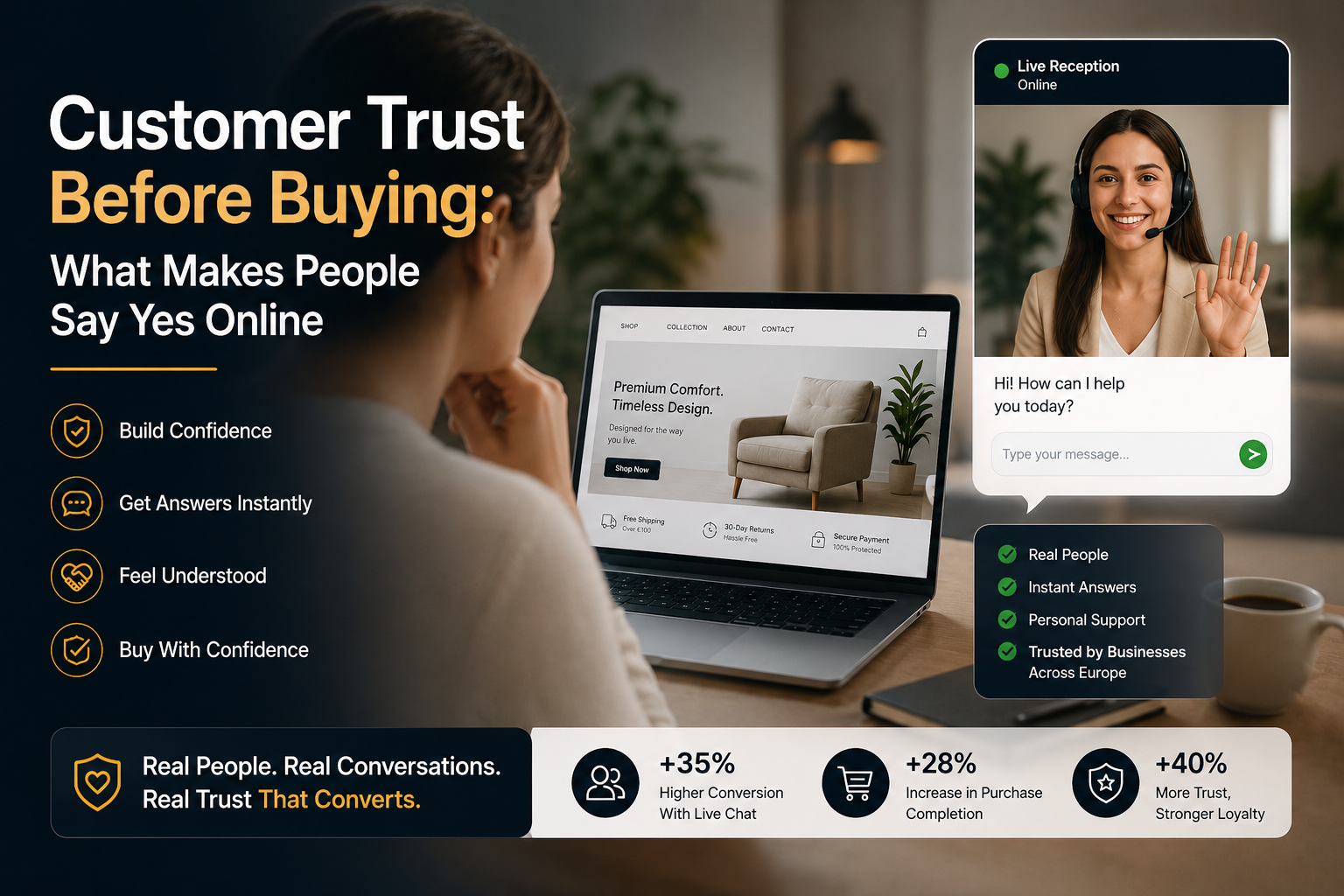
That is why a service like Live Reception can be so effective for conversion. It adds a human layer where hesitation usually grows. Instead of asking visitors to wait, guess, or leave, it gives them a chance to ask, clarify, and move forward with confidence.
Real-time trust-building often creates these outcomes:
- Faster answers
- Lower uncertainty
- A more personal experience
- Stronger credibility
- Clearer next steps
This is not just about friendliness. It enhances the customer experience and improves customer service by changing the buying environment itself. A website can inform. A live interaction can reassure.
How immediate responses reduce uncertainty for online buyers
Speed matters because uncertainty expands quickly. A buyer who cannot get an answer right away often creates their own answer, and that answer is usually cautious.
They might assume shipping will be slow, support will be hard to reach, or the service may not fit their needs. Once those assumptions take hold, conversion drops.
Immediate responses stop that spiral early. They also signal competence. When a company replies quickly and clearly, it communicates reliability without needing to say it outright.
The buyer feels supported instead of sold to, and that difference matters.
Ecommerce customer trust when product quality feels uncertain
An ecommerce shopper may love the design, like the price, and still hesitate because they cannot judge quality through a screen. Photos help. Reviews help. Yet a lingering question like “Will this actually look and feel as expected?” can stop the order.
A live conversation changes the tone. A real person can explain materials, sizing, shipping expectations, return policies, or common concerns from other buyers. That response feels grounded and specific. It lowers the risk of disappointment.
In many cases, the sale was never blocked by the product itself. It was blocked by the customer’s fear of regret.
Hotel booking trust when guests compare options
Hospitality buyers compare constantly. They review room types, cancellation terms, local access, amenities, and hidden costs. Even a small uncertainty can push them back to a booking platform or another property.
A guest may be ready to book but want one last point confirmed. Is early check-in possible? Is parking available? Which room works best for a family? If those answers are not available fast, the guest keeps shopping.
A responsive human interaction can turn a comparison shopper into a direct booking. It makes the hotel feel attentive before the stay even begins, which is exactly the kind of reassurance many guests are looking for.
Service inquiry trust before someone submits a form
Service businesses often focus heavily on getting people to the inquiry page. Yet that page is where many good leads disappear.
The reason is not always poor form design. A potential client may be wondering what happens next, whether their request is too small, whether the company works with businesses like theirs, or whether anyone will actually respond soon.
A real person can answer those concerns in seconds. They can explain the process, set expectations, and make the first contact feel human instead of transactional. That often gives hesitant prospects enough confidence to submit the form or book the call.
Why Customer Trust Before Buying Matters More Than Price or Features
Trust creates the foundation where decisions become comfortable.
In an online context, nurturing this trust demands more than just presenting compelling features or competitive pricing. The transformation from interest to purchase thrives on a seamless and dynamic connection, where customer concerns are acknowledged and addressed without delay. Prompt and personal interactions alleviate doubt, reinforcing confidence and paving the way for a decision that feels right.
Real-time engagement shifts the focus from transaction to connection, enhancing the customer experience through improved customer service.
Businesses that prioritize immediate and empathetic dialogue cultivate an environment where trust flourishes. This authenticity not only comforts but also distinguishes them in a crowded digital marketplace, redefining the dynamics of consumer trust before buying.
In an era where choices abound, the reassurance of human touchpoints can be the ultimate differentiator. When every customer touchpoint holds the potential to inspire confidence, businesses gain the opportunity to turn browsers into loyal advocates.
International customer trust when distance increases risk
International buyers carry extra questions. They may worry about language, time zones, payment security, shipping reliability, or what happens if something goes wrong after purchase.
Distance increases perceived risk. The product or service may still be attractive, but uncertainty grows because the business feels farther away in every sense.
Human interaction narrows that distance. It assures the customer that support exists, communication will be possible, and the business is prepared to serve them well. That reassurance can be the difference between a lost visitor and a confident buyer.
Why customer trust must continue beyond the website
Trust does not stop mattering after the visitor takes the first step. It continues through follow-up, qualification, proposal discussions, and every sales conversation that comes after initial interest.
This is where many companies lose momentum. They create enough confidence to get a lead, then allow delays, inconsistent messaging, or weak follow-up to reopen doubt.
A strong sales process reinforces trust through every stage:
- Speed: follow up while interest is still active
- Consistency: keep the tone clear, helpful, and reliable from first contact onward
- Clarity: answer questions before they turn into objections
That is why trust-building at the website level should connect naturally to the broader sales effort. Sales Outsourcing can support that by giving businesses a structured, responsive way to handle leads after the first interaction. The same confidence that encourages a visitor to ask a question should carry through to the point of purchase.
How businesses can reduce hesitation when traffic is strong but conversions are weak
If visitors arrive but do not act, the first question should not always be “How do we make the page more persuasive?” A better question is “Where are people feeling unsafe, unconvinced, or unsupported?”
That shift leads to smarter fixes. It moves attention away from surface-level conversion tweaks and toward the buyer’s decision experience.
Practical areas to review include:
- Response time to pre-sale questions
- Visibility of real human support
- Clarity around what happens next
- Reassurance around returns, onboarding, or service delivery
- Language that reflects customer concerns rather than company claims
In many cases, businesses already have enough demand. What they need is a better way to meet buyers in the last few feet before the decision.
This is encouraging, because trust can be built. It is not mysterious. It comes from responsiveness, clarity, human presence, and consistent follow-through.
Customers rarely buy the moment they first visit a website. They buy when hesitation disappears. Trust is what removes that hesitation.