Every growth team is hearing the same message right now: automate more, reduce labor, let AI handle the front line. On paper, the logic looks airtight. Chatbots answer common questions in seconds, route tickets without delay, and keep support costs from climbing with volume.
But conversion tells a more honest story.
Automation is excellent at efficiency. It is often weak at persuasion. When buyers are close to purchase and carrying real hesitation, a scripted bot can become a revenue leak. The issue is not that automation is bad. The issue is that many businesses place automation in the exact moments where trust, nuance, and reassurance matter most.
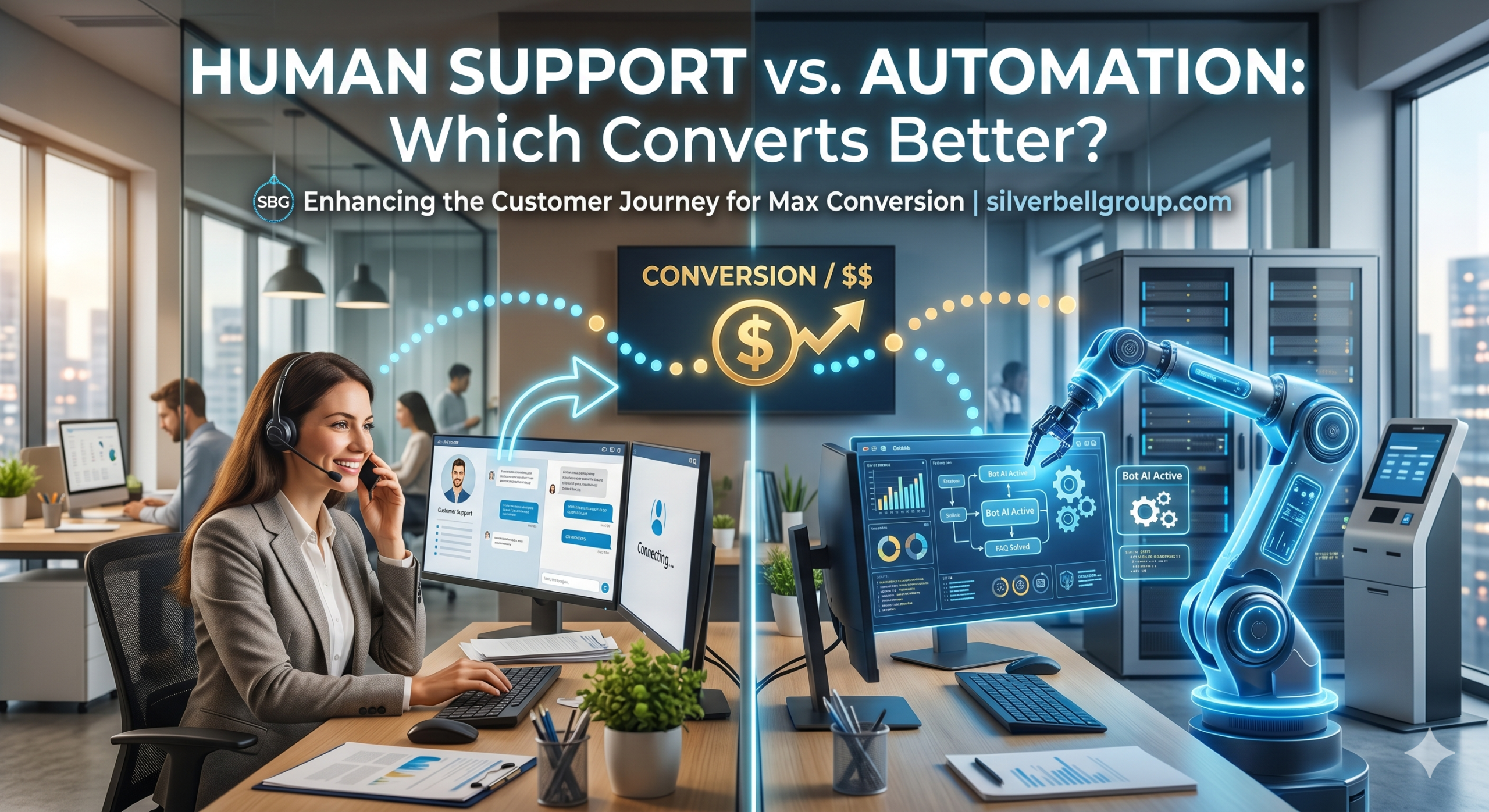
That is the real tension inside human support vs automation conversion. The strongest customer journey is rarely fully automated or fully manual. It is structured so automation handles repetition, while human support appears at the high-intent friction points where a deal can stall, shrink, or disappear.
Table of Contents
The automated customer journey and where conversion leaks happen
A purely automated journey feels efficient to the company, but not always to the buyer. That gap matters. A person who is casually browsing will tolerate a self-serve flow. A person who is about to spend money, commit to a contract, or place a larger order evaluates risk in a different way.
At that stage, the buyer is no longer asking, “Can this company answer me?” They are asking, “Can this company handle my specific situation?” That is where AI vs human customer service stops being a cost debate and becomes a conversion debate.
Three structural leaks show up again and again in over-automated funnels:
- dead-end loops
- generic knowledge-base redirects
- repeated qualification prompts
- delayed access to a real person
- unresolved pricing or policy questions
Each leak adds conversation friction. One extra prompt may seem minor. Two or three in a row can push a ready-to-buy customer into hesitation, then cart abandonment, then bounce.
The dead-end loop is especially damaging. A buyer asks a transactional question about implementation timing, returns, custom terms, shipping windows, account transfer, or compatibility. The bot responds with a broad article, not an answer. The buyer asks again. The system rephrases the same response. Confidence drops quickly because the company now appears organized around containment, not clarity.
Lack of empathy is another hidden conversion killer. A high-ticket buyer may not state their anxiety directly. They might ask a narrow question about guarantees, onboarding support, or cancellation policy when what they really mean is, “I want reassurance before I commit.” Automation can detect keywords. It still struggles to read emotional hesitation in a commercially useful way.
Artificial friction makes this worse. Many brands force buyers through multiple automated filters before allowing human contact. That design saves agent time, yet it can cost revenue. If someone is already comparing options, every extra gate tells them the business is harder to buy from than a competitor.
Why high-intent micro-moments need human support
A high-intent micro-moment is the short window when a buyer shifts from browsing to evaluating a purchase seriously. You can see it in behavior: repeated visits to pricing pages, time spent on guarantees, questions about terms, hesitation at checkout, or requests that mix support and sales concerns.
This is where human support changes the economics of the funnel.
A trained person can pick up on nuance that a standard chatbot misses. They can answer the stated question and the unstated concern underneath it. That matters in conversational commerce, where a chat or call is not just a support channel but a buying environment.
Human interaction is also a trust signal.
When the internet is full of automated responses and synthetic content, access to a real person signals accountability. It says the company is present, reachable, and willing to stand behind the sale. For B2B buyers, that can shorten evaluation time. For e-commerce brands, it can reduce cart abandonment at the exact moment a purchase feels risky.
The strongest human support teams do more than reassure. They expand revenue by shaping the decision in real time.
- Nuance handling: Clarify edge-case questions, custom requests, and policy concerns without forcing buyers into generic flows.
- Trust building: Respond with confidence, context, and emotional awareness when hesitation is present.
- Dynamic upselling: Recommend a better-fit package, add-on, or service level based on the buyer’s actual concern.
- Objection recovery: Catch doubts around price, timing, setup, or guarantees before the buyer exits.
- Deal protection: Prevent high-intent leads from dropping due to avoidable confusion.
That is why human support is not just a service cost. In the right moment, it is a revenue function.
Human support vs automation conversion in a practical comparison
The difference becomes clearer when you map each option to buyer intent.
| Journey Stage | Best Fit | What It Handles Well | Conversion Risk |
|---|---|---|---|
| Early browsing | Automation | FAQs, order status, routing, basic policies | Low risk when questions are simple |
| Mid-funnel evaluation | Hybrid | Product guidance, qualification, contextual responses | Moderate risk if bots over-filter |
| Bottom-funnel decision | Human support | Pricing clarity, objections, trust, urgency, custom terms | High risk if human access is delayed |
| Post-purchase routine support | Automation first, human backup | Tracking, password resets, standard requests | Low risk if escalation is easy |
| Retention and expansion | Human-led | Renewals, dissatisfaction, upgrades, account growth | High revenue impact if mishandled |
This is where customer journey optimization becomes more disciplined. Instead of asking, “What can we automate?” ask, “Where does automation protect margin, and where does human contact protect conversion?”
Those are different questions, and they produce very different operating models.
A hybrid customer journey optimization framework that converts better
A high-converting business uses automation to absorb volume and human support to capture intent. That split sounds obvious, yet many teams still deploy bots in the most sensitive commercial moments because the support org and revenue org are measured separately.
The healthier model is simpler. Automation should remove low-value repetition. Humans should step in when revenue is explicitly on the line.
In practice, that usually looks like this:
- top-of-funnel FAQs and routing handled automatically
- order tracking and account actions handled automatically
- pricing, contract, shipping exception, guarantee, and pre-purchase hesitation routed to a person fast
- repeat visitors with high buying signals prioritized for live support
- abandoned-cart or stalled-lead follow-up handled by human outreach when value justifies it
For e-commerce, think about a shopper with a full cart who asks whether two products work together, whether expedited shipping is guaranteed, or whether a return would apply to a bundle. A bot can answer the general rule. A person can close the sale by addressing the exact scenario and reducing perceived risk.
For B2B, the pattern is even more pronounced. A prospect reviewing pricing may ask about onboarding time, internal approvals, SLA terms, or integration limits. Those questions are rarely “support only.” They are buying questions. Treating them as ticket deflection tasks can slow the sales cycle and lower close rates.
A useful test is this: if a question can change purchase intent, it should not sit in a dead-end automation path.
Reducing conversation friction across support and sales
Conversation friction is not just about poor wording in chat. It is any obstacle that makes a buyer work harder to get clarity. That includes long routing trees, scripted repetition, delayed escalation, missing context between channels, and support teams that are trained to resolve tickets but not advance decisions.
A hybrid model lowers friction by making escalation intelligent, not accidental. Buyers should not need to prove they deserve human attention. The system should recognize purchase signals and route accordingly.
That means teams need shared triggers between operations, support, and revenue. Good triggers often include:
- repeated pricing-page visits
- checkout abandonment after a support interaction
- questions containing policy plus urgency
- return visits from paid traffic or outbound campaigns
- high cart value or enterprise-level inquiry patterns
When these triggers are active, automation should become a bridge, not a barrier.
Customer support outsourcing as a conversion tool, not just a cost tool
Many companies know they need more human touchpoints but hesitate because in-house staffing is expensive, time-consuming, and hard to scale across nights, weekends, and seasonal peaks. That is where customer support outsourcing becomes strategically useful.
The old view of outsourcing was simple cost reduction. The stronger view is capacity plus conversion. An outsourced team can extend human availability into the exact windows where buyers need reassurance, without requiring a full internal buildout. That matters for global traffic, after-hours buying behavior, and campaigns that spike demand suddenly.
A good outsourced support structure helps in three ways:
- Coverage: Human response is available when in-house teams are offline.
- Flexibility: Staffing can expand around launches, holidays, and promotional periods.
- Commercial focus: Agents can be trained to reduce friction, protect trust, and support revenue goals.
This is especially valuable when support and sales touch the same conversation. Brands often underestimate how many “support” contacts are actually conversion opportunities in disguise.
Why live reception can raise conversion at the moment of choice
Some of the highest-value interactions happen when a buyer wants immediate confirmation from a person. Not a ticket reply in six hours. Not another bot path. A real-time conversation.
That is why live reception can act as a direct conversion engine. When someone is comparing vendors, trying to verify legitimacy, or making a final decision, immediate human contact reduces uncertainty fast. It also prevents the silent drop-off that occurs when people cannot get reassurance at the moment they need it.
This matters in B2B where responsiveness often shapes perceived reliability. It matters in e-commerce too, especially for premium products, custom orders, and first-time buyers.
Speed helps. Human presence closes the gap.
The companies getting better results are not trying to make humans act like machines. They are using machines to handle the repetitive work so humans can step into the moments that decide revenue. Automation protects the bottom line. Human interaction grows the top line. When both are placed with precision, the customer journey becomes easier to run and easier to buy from.
Human Support vs Automation Conversion: Final verdict?
Automation enhances efficiency considerably. However, when it comes to leveraging a sophisticated blend of human support and automation, businesses can truly optimize their customer journey for better conversion rates. By strategically deploying human touchpoints precisely at moments of buyer hesitation, companies can significantly elevate their conversion success.
Customer interactions are not just about resolving inquiries; they are pivotal opportunities to cement trust, provide reassurance, and reinforce a brand’s commitment to quality and service. Skilled human agents can decode subtle buyer hesitations and objections that algorithms simply overlook, offering personalized consultation that can decisively influence purchase decisions.
This is where the real competitive advantage lies.
An ideal sales journey employs automation to manage routine inquiries and processes, while human agents take center stage at critical decision points. Whether it’s sealing a deal mid-evaluation or managing complex sales queries, strategic human engagement ensures that leads remain on course and ultimately convert.
Forward-thinking companies that have embraced a hybrid model witness a marked improvement in their bottom line, with automation handling repetitive tasks and humans bringing the finesse necessary to close impactful deals. Achieving harmony between automated efficiency and human empathy is how forward-thinking businesses can thrive in today’s multifaceted commercial landscape.