
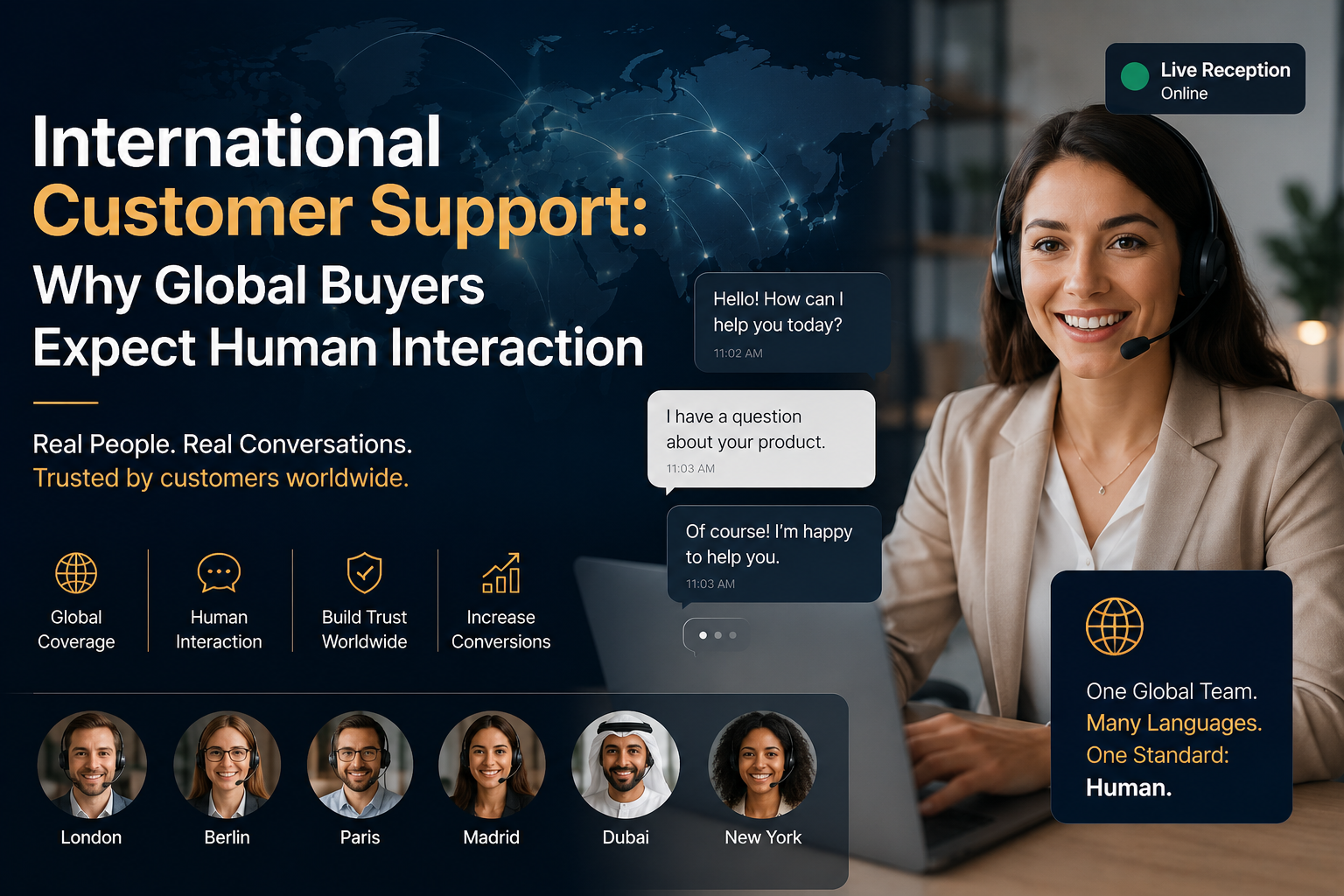
International commerce has changed the psychology of buying.
A customer in Copenhagen can compare a software platform from Berlin, a hotel brand from Dubai, and an ecommerce store in New York within minutes. A buyer in Toronto can message three vendors before breakfast and expect useful replies before lunch. When distance stopped being a barrier, patience dropped with it.
That shift matters for every company serving more than one market. International buyers no longer judge businesses only by product, price, or design. They judge the entire interaction. If support feels slow, generic, overly scripted, or culturally tone-deaf, confidence slips fast. Many sales are lost long before a formal objection appears.
Table of Contents
How international customer expectations changed in global markets
Global access raised the standard for everyone. Customers now assume that if a company can sell internationally, it should also be ready to communicate internationally. That means more than translated landing pages or a help center with multiple language options.
Today’s buyers expect a support experience that feels immediate and personal. They want replies that sound natural, not machine-built. They want reassurance before purchase, not only after something goes wrong. They want a sense that the business understands how people in their country prefer to communicate.
That expectation shows up in a few clear ways:
- fast responses
- support in the customer’s language
- human communication
- cultural awareness
- confidence during the buying process
For international businesses, this changes the role of support. It is no longer a back-office function. It directly shapes conversion, retention, and brand perception across borders.
Why human interaction matters in international customer support
Many companies still treat international support as an operational checkbox. Translate a few templates, add chat, route tickets, and call it done. The problem is that global buyers are often making decisions in moments of uncertainty. They are purchasing from another country, another legal environment, another service culture. In that context, human interaction is not a luxury. It is reassurance.
A robotic answer may be technically correct and still fail completely. If the tone is too cold, too aggressive, too vague, or badly timed, the customer may read it as risk. That is especially true in ecommerce, SaaS, hospitality, and service businesses where trust shapes the sale long before the invoice.
The gap often looks small from inside the company and huge from the customer’s side.
- Translation alone: solves words, not meaning
- Basic support coverage: handles requests, not hesitation
- Automation by itself: speeds response, not trust
- Human interaction: gives context, confidence, and clarity
This is where many international businesses lose buyers. The support function exists, but it feels disconnected from the customer’s culture. A reply arrives late. A sales message feels too pushy. A live chat agent answers the question but misses the emotional need behind it. The customer leaves with unresolved doubt, and doubt is expensive.
Cultural fluency creates trust in international sales and support
Speaking the language is not enough.
What creates trust is cultural fluency: the ability to read expectations, timing, tone, directness, and decision behavior across markets. A customer can tell very quickly whether communication feels native to their market or imported from somewhere else.
Consider a few familiar patterns. Scandinavian customers often dislike aggressive sales communication. If the tone is overly persuasive or too persistent, the brand can appear disrespectful rather than enthusiastic. German customers frequently expect precision, structure, and clarity. Loose promises or casual explanations can weaken confidence. American customers usually expect quick, proactive communication. If a company waits too long to follow up or sounds hesitant, it may appear disorganized.
Luxury travelers bring another layer. They are not only purchasing a room, a reservation, or a service slot. They are assessing whether the brand can anticipate needs and handle details smoothly. They expect concierge-level interaction, with responsiveness and polish built into every touchpoint.
International ecommerce buyers also reveal this pattern clearly. If delivery terms are unclear, if return policies feel difficult to interpret, or if support appears unavailable, hesitation rises sharply. In many cases, the product is not the issue. The communication around the purchase is.
International customer behavior across markets
The differences are practical, not theoretical. They affect conversion, response rates, complaint volume, and customer lifetime value.
| Market or segment | Common expectation | What weakens trust | Better support approach |
|---|---|---|---|
| Scandinavia | Respectful, low-pressure communication | Aggressive follow-up or hard selling | Calm tone, clear value, measured outreach |
| Germany | Precision and structure | Vague answers or inconsistent details | Detailed replies, clear process, factual language |
| United States | Speed and initiative | Delayed responses or passive communication | Fast follow-up, proactive updates, direct next steps |
| Luxury travel | High-touch service | Generic scripts or transactional tone | Concierge-style interaction, polished communication |
| International ecommerce | Clarity before purchase | Unclear availability, returns, or delivery terms | Real-time answers, visible support, confident guidance |
Take Denmark as a very practical example. When handling sales for Danish clients, timing matters. Calling customers after 6PM can create frustration because respecting personal time is deeply embedded in Danish culture. A team that knows this will time outreach differently, shape messaging differently, and protect brand perception while improving conversion. That is not a minor detail. It is a commercial advantage.
Why robotic support loses international buyers
When support feels robotic, customers sense distance immediately. The issue is not only automation itself. Automated systems can be useful and efficient. The issue is what happens when there is no human layer available at the moment the customer needs confidence.
International buyers are often evaluating signals very quickly:
- Is this company present and responsive?
- Will someone help if something changes?
- Does this brand really serve my market, or is it just available there?
- Can I trust the people behind the website?
If the answers feel uncertain, the sale can stall even when demand is strong.
This is why delayed or disconnected support has a direct cost. A prospect hesitates on checkout. A SaaS buyer postpones a demo request. A hotel guest abandons a reservation. A service inquiry goes cold. In each case, the business may think price or competition caused the loss, when the real issue was confidence.
Why live reception improves international conversion
Live communication changes the buying moment.
When a real person answers questions instantly, hesitation has less room to grow. Concerns can be addressed while intent is still high. Tone can be adjusted to the customer. Cultural cues can be read in real time. That is especially valuable for businesses serving several countries where one communication style will never fit every buyer.
This is where Live Reception becomes commercially powerful. It gives international companies a human front line that feels present, attentive, and credible. Rather than forcing every buyer into delayed email loops or impersonal ticket flows, it creates trust while the decision is still active.
That support can influence performance in several ways:
- Instant answers: reduce uncertainty before purchase
- Human presence: makes the brand feel available and accountable
- Decision support: helps buyers compare options and move forward
- Real-time trust: lowers friction across unfamiliar markets
- Conversion impact: protects revenue that might otherwise disappear quietly
For ecommerce brands, this can mean fewer abandoned carts tied to delivery or returns concerns. For SaaS companies, it can mean stronger qualification and smoother demo conversion. For hospitality businesses, it can mean a better pre-booking experience that matches premium positioning. For service providers, it can mean faster commitment from buyers who need reassurance before engaging internationally.
How Silver Bell Group supports international communication with cultural fluency
Silver Bell Group is positioned differently from providers that focus only on language coverage or low-cost handling. As a European outsourcing partner, the company combines multilingual communication, cultural fluency, real human interaction, live response capability, and international sales and support experience.
That combination matters because international growth rarely fails from lack of reach. It fails when communication does not match buyer expectations in each market. A support team may answer accurately and still miss the sale if the tone, timing, or sales behavior feels wrong for the country.
Silver Bell Group’s model fits companies that need more than basic coverage:
- international ecommerce brands serving customers across markets
- SaaS companies selling into multiple countries
- hospitality businesses where service tone affects booking confidence
- service providers that rely on trust before purchase
- international businesses that need customer support and sales coordination
The value is not generic outsourcing. It is communication that feels local while supporting global scale. That includes Customer Support Services for day-to-day interactions and issue resolution, as well as Sales Outsourcing Services when the commercial side of communication needs the same cultural precision.
A multilingual team can answer in the customer’s language. A culturally fluent team can answer in the customer’s context. That is the difference buyers feel.
International customer support as a competitive advantage
When businesses get this right, support stops being reactive and starts shaping growth. It strengthens first impressions. It increases trust during evaluation. It supports premium positioning. It also protects the brand from the subtle damage caused by communication that feels foreign, rushed, or detached.
Competitive advantage in international markets often comes from small moments handled well. A fast reply in the right tone. A sales call placed at the right hour. A support answer that respects how a market interprets directness, urgency, or politeness. A live receptionist who reduces uncertainty before the customer leaves the page.
These moments rarely show up in strategy slides, yet they decide whether global buyers feel safe enough to move forward.
For companies operating across countries and cultures, the standard is clear now. Products may travel globally with ease. Trust does not. Trust still depends on people, timing, language, and behavior.
Global buyers do not expect perfect sales scripts. They expect to feel understood.