
Real estate websites are excellent at generating property inquiries, yet many teams quietly accept that a big share of those leads will never become a showing, let alone a closing. The cost is not only ad spend. It is agent time, response fatigue, and missed moments with serious buyers who are ready to act.
Real estate lead qualification is the practical fix, but the channel matters. When qualification happens through slow, fragmented follow up, it often fails at the exact point where buyer intent is still forming and confidence is easiest to build.
Table of Contents
The Hidden Problem of Real Estate Lead Waste
A typical property search session creates lots of “signal” that looks like intent: repeated listing views, a saved home, a quick form fill, a tap on “schedule a tour.” That activity can be genuine, or it can be casual browsing that never reaches a decision.
This is where lead waste starts. Many inquiries are made by people who are curious about a neighborhood, testing affordability, or simply collecting screenshots for later. None of that is wrong, but it is very different from a buyer who is pre approved and wants to tour this weekend.
Low response quality adds to the problem. When the first reply is generic, delayed, or routed through multiple handoffs, the prospect often disengages. Slow follow up is not just inconvenient, it creates doubt: “If they cannot respond now, will they handle the transaction well?”
Unqualified property inquiries and slow follow up form an expensive loop. Agents spend time trying to resurrect cold leads, while high intent buyers quietly move on to someone who answers clearly and quickly.
Why Traditional Lead Qualification Fails in Real Estate
Most real estate lead qualification still relies on a familiar chain: a contact form, an email response, then a phone call hours later when schedules finally line up. Each step introduces delay and friction.
The first issue is engagement. A lead who filled out a form while viewing a listing is often in a short attention window. If the next touch happens much later, that window closes. The property might still be interesting, but the urgency is gone.
The second issue is context loss. A form rarely captures the nuance behind the click. Is the buyer relocating and needs speed? Are they early stage and comparing school districts? Are they an investor with strict yield targets? When qualification starts without this context, the conversation becomes an interrogation instead of guidance.
The third issue is the chasing problem. Agents end up calling, texting, and emailing people who were never ready. That effort feels productive because it is activity, yet it can quietly reduce real estate lead generation quality by starving serious prospects of attention.
A simple way to see the gap is to compare how a buyer experiences the process.
| Stage | Traditional follow up | Live video qualification |
|---|---|---|
| First contact | Form submitted, waiting begins | Conversation offered immediately |
| Buyer mindset | Curious, uncertain, easily distracted | Present, already engaged with the listing |
| Information captured | Minimal, often incomplete | Rich, conversational, clarifies intent |
| Agent time | Spent chasing and repeating basics | Focused on high intent conversations |
| Outcome | More lead volume, weaker real estate lead quality | Fewer dead ends, better property inquiry conversion |
What Is Live Video Qualification
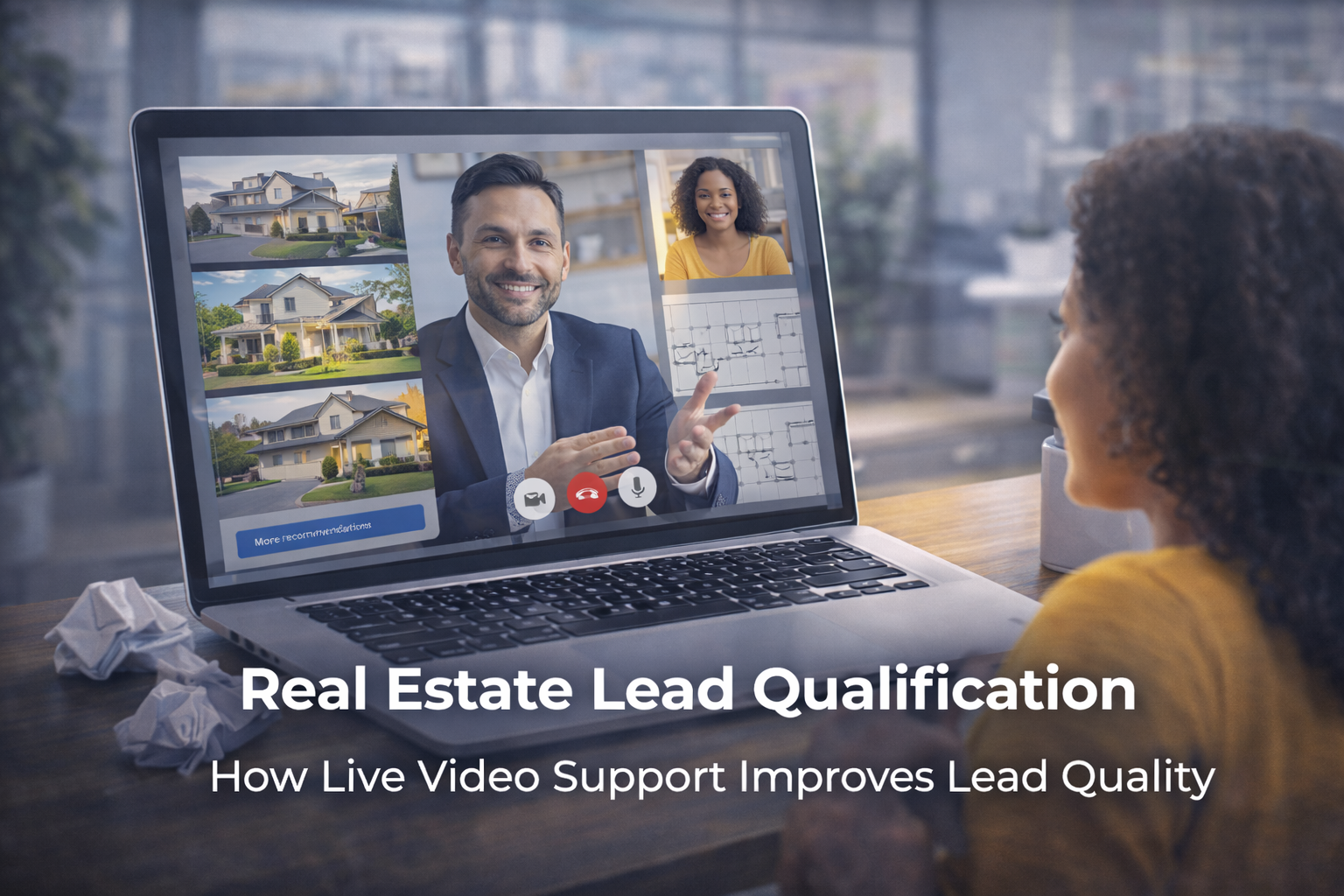
Live video qualification brings a real person into the moment a visitor is actively evaluating a property. Instead of forcing a prospect into a slow sequence, the website offers an immediate video conversation that can start with one click.
It is not about turning the site into a constant meeting. It is about giving serious prospects a faster path and letting casual browsers self select out.
In practice, a visitor viewing a listing is offered live help. An agent or a trained support team member greets them on video, confirms what they are looking at, and asks a small set of questions that quickly clarify fit.
These questions stay focused on decision drivers, not a long intake form:
- Budget range: What monthly payment or purchase price feels comfortable?
- Timeline: Are you looking to buy in the next 30 days, 90 days, or later?
- Property type: Condo, single family, multi family, new build?
- Location preferences: Must have neighborhoods, commute needs, school priorities?
- Financing status: Pre approved, cash, or still exploring options?
This approach is also a strong method for qualifying property buyers online because it allows clarification in real time. A buyer can ask about HOA rules, rental restrictions, lot size, flood zones, or offer strategy without waiting for a call back.
Case Study: Reducing Lead Waste with Live Video Conversations
Consider a mid sized real estate website that attracts steady traffic from search and paid campaigns. The site generates a healthy number of inquiries, yet agents report a familiar pattern: many leads never respond, and many that do are months away from a decision.
A live video option is added to listing pages and key conversion points. When a visitor spends time on a property, scrolls through photos, and reaches the “schedule a tour” area, a small prompt offers a live video conversation with a real person.
One afternoon, a visitor is viewing a home and clicks the video prompt. The support team answers in under a minute, confirms the property, and begins qualifying.
The conversation stays simple:
- timeline for purchase
- budget comfort zone
- financing status
- whether they need to sell a current home
- what would make them book a showing today
Within five minutes, the team can place the lead into one of three tracks:
- High intent: ready for a showing, financing is clear, decision horizon is near.
- Medium intent: interested, needs education or lender connection, timeline is forming.
- Low intent: browsing, not ready, wants alerts or market info.
The key is what happens next. High intent buyers are routed directly to an agent for immediate scheduling. Medium intent leads receive a clear next step, often a lender introduction or a shortlist of similar homes. Low intent visitors are not chased with repeated calls. They are invited into a lighter nurture path that fits their pace.
That is how lead waste drops: not by doing more follow up, but by matching effort to intent while the buyer is still engaged.
Results: Better Real Estate Lead Quality
When live video qualification is used consistently, teams often see a noticeable shift in the shape of the pipeline. Lead volume may stay similar, yet the percentage of leads that are truly workable rises.
Real estate lead quality improves because key disqualifiers appear early. If someone’s budget does not match the neighborhood, it becomes a helpful, respectful redirect rather than a week of missed calls. If the timeline is “maybe next year,” the team can provide value without treating it like a hot lead.
Property inquiry conversion tends to improve because the next step is immediate. Instead of “We will call you,” the conversation ends with a booked showing, a lender referral, or a curated set of options. Confidence increases when the buyer feels guided, not processed.
Real estate website conversion can also rise because video reduces form friction. Many buyers hesitate to share their phone number with a stranger, yet they will talk to a real person who is present and helpful. Video can capture the lead while still respecting the buyer’s control.
A few outcomes that commonly follow:
- faster scheduling
- fewer no show appointments
- higher agent productivity per lead
- cleaner handoffs between marketing, support, and agents
Real estate lead qualification becomes less of a back office task and more of a front door experience.
Why Human Conversations Matter in High Value Purchases
Buying property is rarely just a transaction. Even confident buyers can feel tension around timing, negotiation, inspections, or the fear of missing out.
A human conversation helps because it carries nuance. Tone, pacing, and quick clarification do not translate well through autoresponders. Video adds even more: it signals credibility, reduces uncertainty, and creates a sense that there is a capable professional on the other side.
Trust builds quickly when the buyer can ask one real question and get one real answer. A short video call can prevent long email threads. It can also surface important constraints that forms never capture, like accessibility needs, school enrollment timing, or concerns about resale value.
This is where real estate lead generation quality can improve without raising spend. The same traffic becomes more valuable when the site can respond like a high performing storefront, not a mailbox.
How Real Estate Websites Can Improve Lead Qualification
Better qualification starts with fewer obstacles and faster clarity. The website should make it easy for a serious buyer to talk to a real person, while still supporting self serve browsing for everyone else.
The goal is simple: qualify earlier in the funnel, while intent is visible and the buyer is still present.
A practical plan often includes changes in three areas:
- Shorter forms
- Real time conversation options
- Clear routing for high intent prospects
After you have a baseline, you can refine with measurement. Watch where prospects drop off, how long first response takes, and which pages produce the highest intent conversations. Teams that want to tighten this loop often pair live qualification with focused conversion work, similar to the approaches discussed in Conversion Drop Off and Contact Form Conversion Rate Improvement.
Live video also benefits from smart traffic strategy. When you attract visitors who are closer to a decision, the impact of real time qualification rises. A useful framing can be found in High Intent Website Traffic.
To implement live conversations, many organizations choose a dedicated front line that can answer quickly, gather key details, and route warm prospects to agents. That model is often described as Live Reception, and it pairs naturally with pipeline building efforts like a Lead Generation program.
One caution is worth making: human support is not interchangeable with automated chat. Automation can help with routing and after hours triage, yet high value decisions often need real conversation to move forward with confidence. If you are weighing the options, Human Customer Support vs Chatbots lays out the tradeoffs clearly.
Live video qualification is not a shiny add on. It is a disciplined way to treat serious prospects like serious prospects, and to stop spending premium agent time on leads that were never ready.