Most conversion advice is built for the top and middle of the funnel. It talks about traffic volume, page speed, button color, ad targeting, form design, and optimizing high-intent keywords. Those things matter, but they are not the main issue when a buyer is already close to saying yes.
High intent conversion, which is often driven by commercial intent, lives in a different part of the buying process. At this stage, the user is informed, motivated, and actively weighing action. Yet many still stop just before the finish line. For B2B companies and high-value industries, that pause is expensive. It slows revenue, weakens lead flow, and creates the false impression that the problem is technical when it is often psychological.
Table of Contents
high intent conversion and user behavior at the decision stage
A high intent user is not casually browsing high-intent keywords. This person has already moved past general awareness and basic research. They have compared options, reviewed proof, checked pricing, and looked for practical details that only matter when a decision feels real.
That is what makes high intent user behavior different from early-stage traffic. Early visitors are open-ended. They may be gathering ideas, scanning categories, or trying to define their problem. High intent users are narrowing the field. Their attention is focused, their questions are sharper, and their behavior signals immediate conversion potential.
Common signs of high intent user behavior include:
- Pricing or quote page visits
- Return sessions within a short time frame
- Repeated comparison activity
- Time spent on case studies, policies, or implementation details
- Questions about timing, fit, or next steps
This is why decision stage conversion deserves its own strategy. A visitor at this point does not need another general explainer. They need confidence. They need clarity. They need a final reason to act now instead of later.
When businesses treat these users like early-stage readers, they miss the moment. The site may still attract attention, but it fails to convert interest into action. In high intent leads conversion, the distance between intent and commitment is often just a few unanswered questions.
why high intent conversion fails at the last step
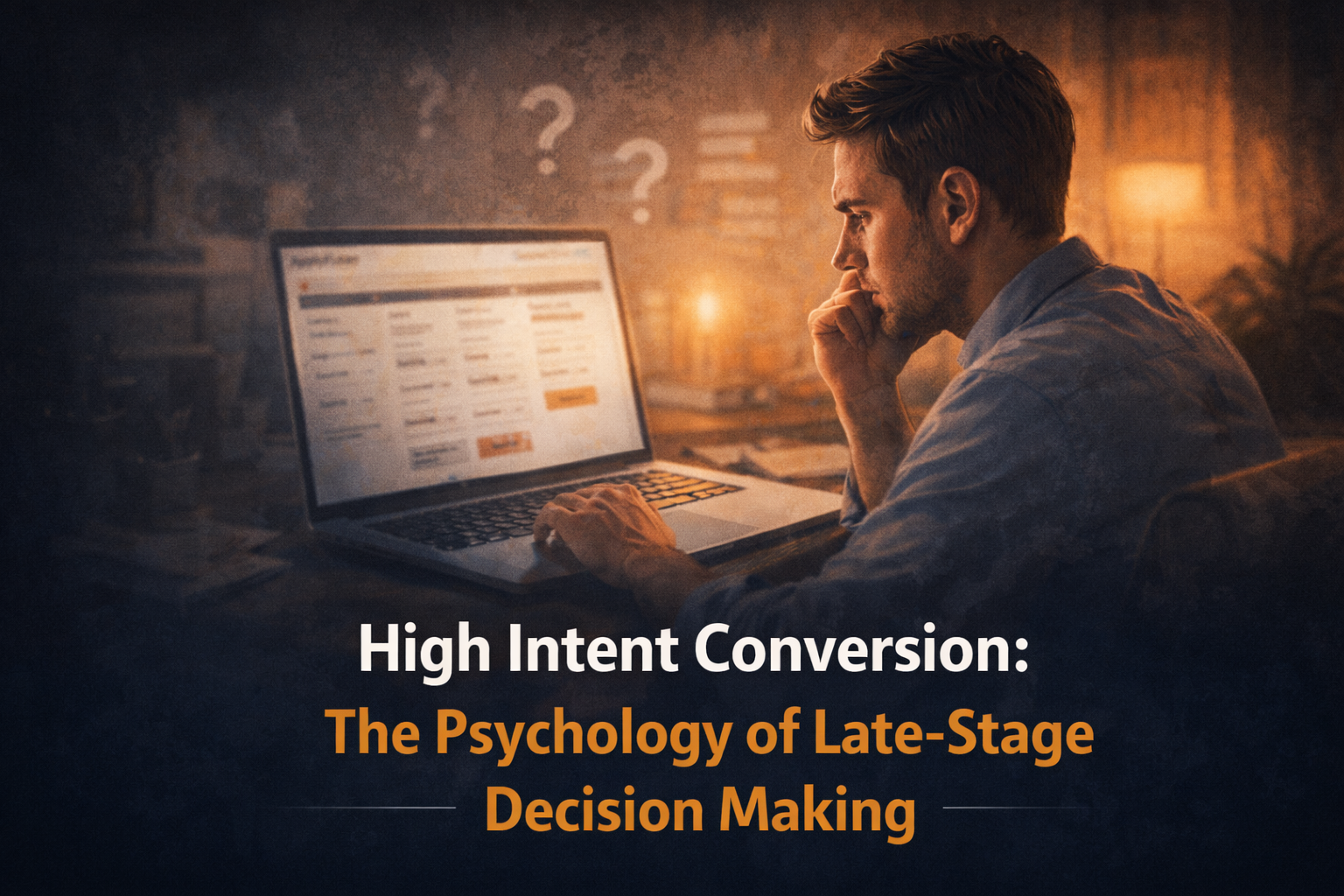
Late stage conversion often fails for a simple reason: strong intent does not erase hesitation. A buyer can want the product, see the value, and still delay. This is common in B2B purchasing, where the final decision can affect budget, workflow, reputation, and team outcomes.
That final pause is rarely about confusion at a broad level. It is about unresolved specifics. Will this work in our setting? What if onboarding is harder than expected? Can we trust the vendor after the contract is signed? Is there someone who can answer this one concern right now?
In many cases, the site creates a missed decision moment. The user reaches the point of action and gets routed into a form, an automated workflow, or a static page that cannot respond to real-time doubt. Intent is present, but the environment does not support it.
This is why users drop off at the final stage, even when the traffic quality looks strong. The conversion path assumes readiness while the user still needs reassurance. That gap is where revenue leaks.
psychology behind high intent conversion
Conversion psychology becomes most visible near the point of commitment. Earlier in the funnel, a visitor can stay detached. At the final stage, the decision feels personal. There is more to lose, and the mind shifts from interest to self-protection.
Fear of making the wrong decision is often the first barrier. In B2B, that fear can be professional. A buyer may worry about choosing a platform that underperforms, a provider that overpromises, or a solution that creates internal friction. In consumer settings, the same pattern appears around money, time, inconvenience, or regret.
Validation is the second barrier. High intent users want proof, but not only in the form of logos and testimonials. They want situational proof. They want to know that people like them made this choice and felt secure doing it. They also want confirmation that their own reasoning is sound.
Risk perception also rises at this stage. The reward may be attractive, but the cost of a bad outcome becomes more vivid. Add cognitive overload, and the user freezes. Too many options, too many claims, and too many steps can weaken action even when purchase intent is strong.
| Psychological barrier | What the user may be thinking | Effect on conversion optimization high intent | What helps |
|---|---|---|---|
| Fear of the wrong choice | “What if this is a costly mistake?” | Delays action despite clear interest | Fast, credible human answers |
| Need for validation | “Am I making a smart call?” | Creates a search for reassurance | Social proof plus live confirmation |
| Risk perception | “What happens if this goes badly?” | Pushes the buyer toward caution | Clear policies, expectations, and support |
| Cognitive overload | “There is too much to process right now.” | Causes hesitation and drop-off | Guided conversation and decision support |
The key point is simple. At the decision stage, the user is not asking, “Do I care about this?” They are asking, “Can I feel safe acting on this now?”
late stage conversion psychology in high value industries
Late stage conversion psychology is especially visible in industries where the decision carries weight. Hospitality, healthcare, real estate, ecommerce, banking, automotive, and enterprise B2B sales all share one trait: the stakes feel high to the buyer.
A hotel guest may be one click from booking but still wonder whether the room, location, or service will match expectations. A patient may be ready to contact a provider but hesitate because the situation feels sensitive. A real estate lead may want to schedule a viewing yet pause over financing, timing, or neighborhood fit. An ecommerce buyer with a large cart may stop because shipping, returns, or product fit still feel uncertain.
The pattern changes by category, but the psychology is familiar:
- Hospitality: Experience risk matters as much as price.
- Healthcare: Trust and reassurance shape action.
- Real estate: Financial exposure raises hesitation.
- Ecommerce: Small unanswered details can stop a high-value purchase.
High-ticket decisions blend emotional and rational factors, making the strategic incorporation of high-intent keywords essential for attracting potential buyers. Buyers may compare rates, features, or square footage, but they also imagine the result of being wrong. That is why a high value conversion strategy cannot rely only on information architecture. It must account for emotion, timing, and confidence.
This is also why industry examples matter. Teams looking for real-world conversion improvement often find that the winning change was not another page element. It was a better response to decision-stage psychology.
why traditional conversion methods fail high intent users
Traditional website tools are useful, but they were not built for the full complexity of late-stage hesitation. They collect signals. They do not resolve doubt very well.
Forms are a clear example. A contact form may capture a lead, but it inserts time between question and answer. That delay is costly when the user is deciding right now. A person who is close to converting may not want to “submit and wait.” They want to interact, test trust, and feel progress in the moment.
Chatbots help with speed, but speed without depth only solves part of the problem. Many chatbots can surface links, collect contact details, or answer routine questions. High intent users often need nuanced responses because they are often guided by high-intent keywords, which indicate their strong purchase motivations. They may ask layered questions about fit, exceptions, process, or risk. A scripted flow can feel thin at exactly the moment a human response matters most.
Static pages have the same limitation. They can explain, but they cannot adapt. They cannot sense hesitation. They cannot ask a clarifying question. They cannot react when the real blocker is not visible on the screen.
The gap is easiest to see here:
- Forms: create delay between intent and response
- Chatbots: lack the depth to handle layered concerns
- Static UX: cannot adapt to the buyer’s live decision context
That is why many teams looking into why forms fail high intent users or why human interaction converts better find the same pattern. The issue is not a lack of traffic or even a lack of interest. It is a lack of responsive, credible interaction at the point of decision.
real time human interaction in high intent conversion
Real time customer interaction changes the psychology of the moment. It reduces the distance between concern and clarity. A user with a high level of intent no longer has to hold uncertainty alone. They can ask, clarify, confirm, and move forward with greater confidence.
That shift matters because trust is built through exchange, not only presentation. A live conversation allows a buyer to test responsiveness, competence, and tone. It gives the business a chance to answer the exact concern behind the hesitation, not just the concern anticipated on the page.
This is the missing layer in many conversion systems. A strong site can attract qualified visitors. Strong content can educate them. Real-time human interaction can convert them when the last barrier is emotional or situational rather than informational.
It also creates emotional reassurance without sacrificing professionalism. In high-value sales, buyers want to feel that someone is present, informed, and able to help. That feeling can turn a tense decision into a confident one.
how live conversations improve high intent conversion
Live conversations improve conversion because they reduce hesitation at the exact moment it appears. They turn passive browsing into active decision support. When a skilled human answers a question immediately, risk perception drops and momentum returns.
This can improve conversion rate in several ways. It can lower abandonment on high-intent pages, effectively utilize high-intent keywords to draw in the right audience, increase qualified lead capture, shorten time to action, and raise the share of visitors who move from inquiry to booked meeting, checkout, or consultation. In B2B settings, it can also improve lead qualification by identifying urgency, fit, and purchase readiness in the same interaction.
There is another benefit. Conversation surfaces objections that analytics alone cannot reveal. Heatmaps can show where users stop. Funnels can show where they exit. A live exchange can show why. That insight is powerful for conversion optimization high intent because it feeds product messaging, sales scripts, content strategy, and operational changes.
Teams that are already thinking about why users drop off at the final stage or late-stage hesitation in ecommerce usually find that live support is not an extra layer. It is the layer that allows the funnel to finish its job.
building a high intent conversion system
A strong system starts earlier than the conversion event. SEO and paid acquisition bring in high-intent keywords to capture and channel interest effectively. Content builds context, answers common objections, and filters for fit. That work matters because it prepares the user to take the final step with less friction.
But content alone is rarely enough for decision stage conversion. The highest-value moments often happen when a visitor wants a human answer before committing. That is where a modern conversion system becomes more effective: traffic brings the opportunity, content builds confidence, and live interaction closes the gap between interest and action.
This central view also connects closely with related topics across the funnel. A useful reading path might include high intent users, why users drop off at the final stage, late-stage hesitation in ecommerce, why human interaction converts better, why forms fail high intent users, real-world conversion improvement, and real-time human interaction.
For companies in B2B and other high-value categories, the opportunity is clear. Stop treating late-stage conversion loss as a simple UX problem. Start looking at the buyer’s state of mind. When a user is already close, the biggest win may come from meeting hesitation with a real conversation. If that gap exists in your funnel today, a demo or consultation can show where live interaction can turn intent into revenue.