
Scaling outreach sounds simple until activity rises faster than quality can keep up. Many teams can push out more emails or add more calls for a few weeks. Very few can scale B2B sales outreach in a way that keeps targeting sharp, follow-up steady, and sales teams focused on the right work.
Short answer: To scale B2B sales outreach without sacrificing quality, companies need dedicated sales-development capacity, clear segmentation, repeatable process, and technology that supports execution rather than replacing it. In one Silver Bell Group-supported operation for 1Kosmos, a three-person dedicated BDR structure using sector-focused outreach across Health, Manufacturing, and IT increased outreach volume 3×.
This is a specific operational example, not a universal performance benchmark.
That distinction matters. Sustainable scale is an operating model, not a burst of extra activity.
Table of Contents
What It Actually Means to Scale B2B Sales Outreach
A lot of B2B sales outreach programs stall because teams confuse growth in activity with growth in capability. Sending more messages is easy. Building a repeatable sales outreach process that keeps producing relevant conversations over time is harder.
Real scale means the system can handle more volume while preserving the elements that make outreach valuable in the first place. That includes targeting the right accounts, tailoring messaging to the buyer context, maintaining follow-up discipline, and giving leadership visibility into what is happening across the funnel.
When a sales outreach strategy is built for scale, it protects a few non-negotiables:
- relevance
- consistency
- follow-up discipline
- target account coverage
- performance visibility
Without those, volume often rises while results become less dependable.
Why B2B Sales Outreach Becomes Difficult to Scale
Most teams do not fail because they lack effort. They hit operational constraints that become more obvious as outreach expands.
A common issue is simple capacity. A small outbound sales team may know its market well, yet still lack enough BDR hours to cover the total addressable market. Another constraint is inconsistency. Prospecting quality can vary from rep to rep, and follow-up often suffers first when calendars get crowded.
Poor segmentation also creates drag. A message that works for one industry can miss the mark in another. When teams try to use the same sales development team structure, same scripts, and same assumptions across every vertical, outreach begins to flatten.
Sales reps themselves can become the bottleneck. If Account Executives spend too much time on top-of-funnel work, they have less time for discovery, deal progression, and closing. That creates an expensive mismatch between senior talent and daily activity.
Some of the most common scaling constraints look like this:
- Limited capacity: not enough dedicated BDR bandwidth to cover the market
- Fragmented process: outreach, qualification, and handoff happen without clear ownership
- Weak segmentation: industries and buyer groups receive generic messaging
- Inconsistent follow-up: prospects get one touch or two, then disappear from the sequence
- Rep overload: closers spend too much time prospecting
- Expansion friction: new markets are added before the outreach model is ready
Not every company faces all of these at once. Still, they show up often enough that they shape how smart teams think about scale.
More Outreach Is Not the Same as Better Sales Development
Activity metrics can be comforting. More calls, more emails, and more touches create a sense of momentum. Yet raw volume can hide deterioration in quality.
If a team adds 100 more calls but lowers targeting precision, those calls may create more noise than opportunity. If email output doubles but follow-up becomes erratic, the sales development team may look busy while pipeline quality weakens.
A better way to think about B2B outbound sales is through a simple operating principle:
Volume × Relevance × Consistency
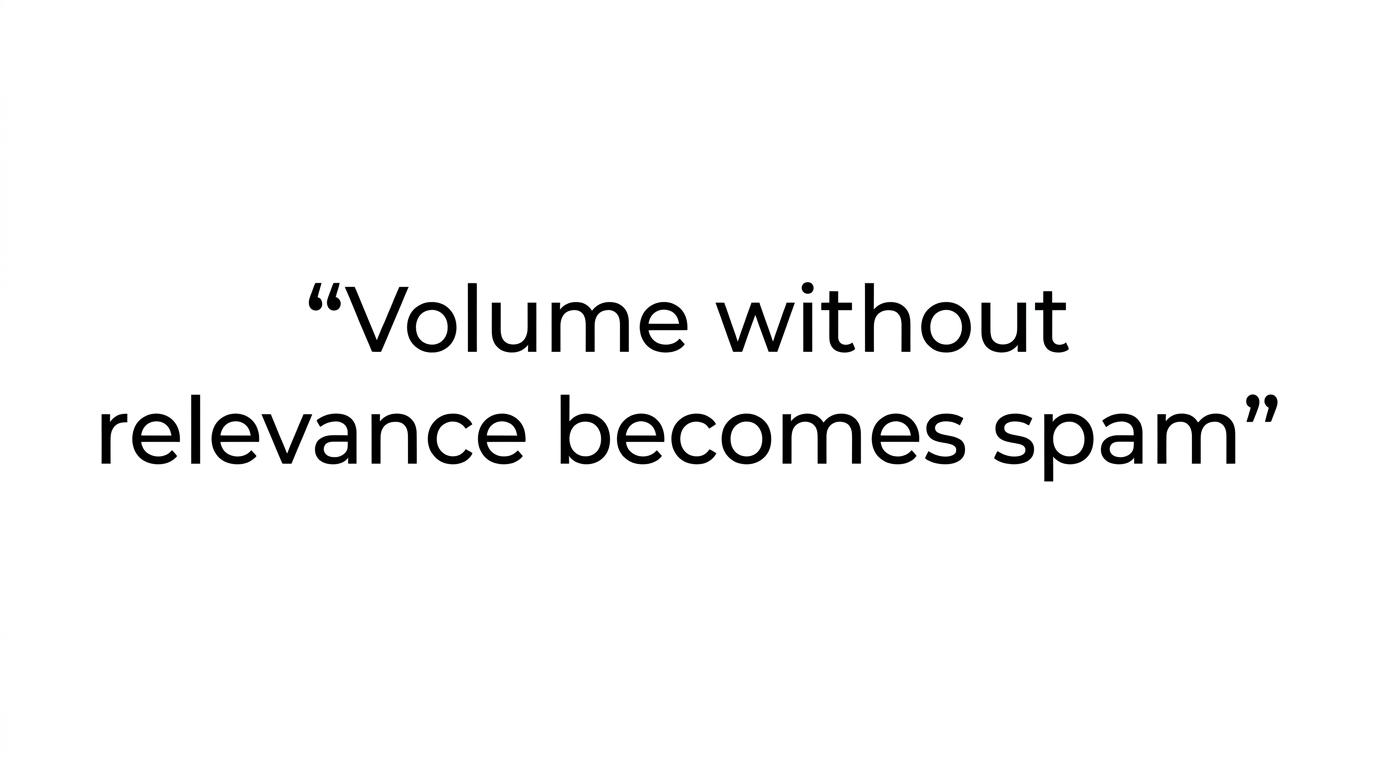
If any one of those drops too far, scale becomes fragile. Volume without relevance becomes spam. Relevance without consistency stays too small to matter. Consistency without volume can keep a team disciplined, but still underpowered.
That is why strong B2B lead generation systems treat activity as one dimension, not the whole story.
The Role of Specialization in Scaling Outbound Sales
As organizations grow, specialization becomes less of a luxury and more of a productivity requirement. The same person can prospect, qualify, run the sales conversation, and close deals in an early-stage setup. Past a certain point, that model creates friction.
Prospecting requires research discipline, list management, segmentation, and persistence. Qualification requires a different kind of judgment. Sales conversations and closing demand yet another skill set. When senior sellers own every stage, the process often slows down and costs rise.
A specialized structure usually separates work in this order: prospecting, qualification, sales conversation, then closing. That does not make one role more important than another. It simply recognizes that scaling outbound sales works better when each stage has clear ownership.
This is where the BDR model becomes useful. A dedicated business development function creates focused capacity at the top of the funnel, allowing Account Executives to spend more time where their experience has the greatest commercial value.
How Industry Segmentation Can Improve B2B Outreach
Industry segmentation is one of the most practical ways to raise outreach quality while increasing volume. Buyers in different sectors do not respond to the same context, concerns, or language.
A manufacturing prospect may care about operational continuity, production environments, and deployment realities. A health-sector buyer may weigh regulatory context, trust, and risk very differently. IT buyers often bring another set of technical questions and internal decision dynamics.
That is why segmentation is not just about list organization. It shapes the entire sales outreach strategy:
- Messaging: the problem framing changes by industry
- Objections: concerns differ by buying environment
- Use cases: proof points must match operational context
- Cadence: urgency and response patterns vary across sectors
For companies trying to scale outbound sales into multiple verticals, this matters a lot. Generic outreach can create acceptable volume, but segment-focused outreach is more likely to preserve relevance as activity rises.
Real-World Example: Increasing Outreach Volume 3×
One useful example comes from a Silver Bell Group-supported operation for 1Kosmos. The structure included 3 dedicated BDRs and a sector-focused model across Health, Manufacturing, and IT. Within that setup, outreach volume increased 3×.
The value of this example is not that it promises the same outcome everywhere. It does not. Different markets, products, data quality, and team maturity levels lead to different results.
What it does show is operationally important: when dedicated sales-development capacity is paired with clearer segmentation, outbound capability can expand materially beyond what an unstructured approach usually supports.
That point deserves emphasis. The lesson is not “just add more activity.” The lesson is that a well-designed BDR structure can create more room for scale without forcing quality to collapse first.
Where Technology Fits Into Sales Outreach
Technology matters, but it is not the strategy. Too many teams expect software to solve process problems that are actually rooted in role clarity, segmentation, or management discipline.
The best use of technology is to support a sales outreach process that already makes sense. CRM systems can organize account history and handoffs. Dialing technology can improve rep efficiency. Prospect data can sharpen targeting. Workflow automation can reduce administrative drag. Reporting and activity tracking can expose gaps in coverage and follow-up.
What technology cannot do on its own is create relevance. It cannot fix weak market segmentation, poor messaging, or the absence of dedicated capacity. Those are operating-model issues first.
For teams evaluating tools, a useful question is simple: does the stack make a good process faster and more visible, or is it being asked to compensate for a bad process?
When You Should Build More BDR Capacity
There is a point where outreach stops scaling through individual effort alone. At that moment, the right move is not always to hire immediately, and it is not always to outsource. The first step is diagnosing whether capacity is truly the constraint.
Several signals tend to show up before teams make that decision:
- Account Executives prospect too much: closing work gets squeezed by top-of-funnel tasks
- Coverage is too low: the target account universe is much larger than active outreach capacity
- Follow-up is inconsistent: reps start strong, then lose momentum across sequences
- New industries are opening: expansion creates messaging and research demands the current team cannot absorb
- Personalization is slipping: more volume means weaker relevance
- Visibility is weak: management cannot clearly see activity levels, segment coverage, or gaps
When multiple signals appear together, the issue usually is not motivation. It is operating capacity.
This is also where related topics become useful for buyers doing commercial research. Teams often move from this question into deeper comparisons around What Is BDR Outsourcing?, In-House vs Outsourced Sales Development, and How Much Does Sales Outsourcing Cost?
Internal BDR Team vs Outsourced BDR Team
Both models can work. The right choice depends on timing, internal resources, hiring speed, management bandwidth, and how mature the sales motion already is.
An internal team often makes sense when a company has stable leadership for sales development, clear onboarding processes, and the patience to build infrastructure over time. An outsourced BDR team can make sense when speed, flexibility, or access to operating expertise matters more than building every layer from scratch.
Here is a balanced view:
| Consideration | Internal BDR team | Outsourced BDR team |
|---|---|---|
| Control | Higher day-to-day control | Shared control with external partner |
| Ramp speed | Often slower to hire and onboard | Often faster to launch capacity |
| Process maturity needed | Strong internal systems help a lot | External structure can help fill gaps |
| Management load | Higher internal oversight | Some management burden shifts outward |
| Flexibility | Hiring changes take time | Capacity can be easier to adjust |
| Best fit | Stable long-term buildout | Faster scale or specialized execution |
This is not a winner-take-all decision. Many companies use a hybrid path, especially when they want to test segments, add short-term capacity, or enter new markets without fully rebuilding the outbound sales team first.
When Sales Development Outsourcing Can Accelerate Scale
Sales development outsourcing becomes relevant when the bottleneck is not product-market fit or basic sales strategy. It becomes relevant when the company already sees a market opportunity, but struggles to build and operate the sales-development engine fast enough internally.
That distinction makes a major difference. If the core offer is unclear, outsourcing will not rescue the model. If the issue is capacity, specialization, management bandwidth, or speed to market, BDR outsourcing or broader sales outsourcing can become a practical option.
In that situation, an external partner may help with pieces like:
- dedicated prospecting capacity
- repeatable outbound process
- segment-based execution
- reporting discipline
- faster launch of an outreach program
For teams evaluating this route, the next logical step is often a detailed review of a Sales Outsourcing Services page, followed by side-by-side analysis of outsourced versus in-house sales development.
How to Scale B2B Sales Outreach Without Losing Quality
A reliable path to scale usually looks less dramatic than people expect. It is built through structure, not heroics.
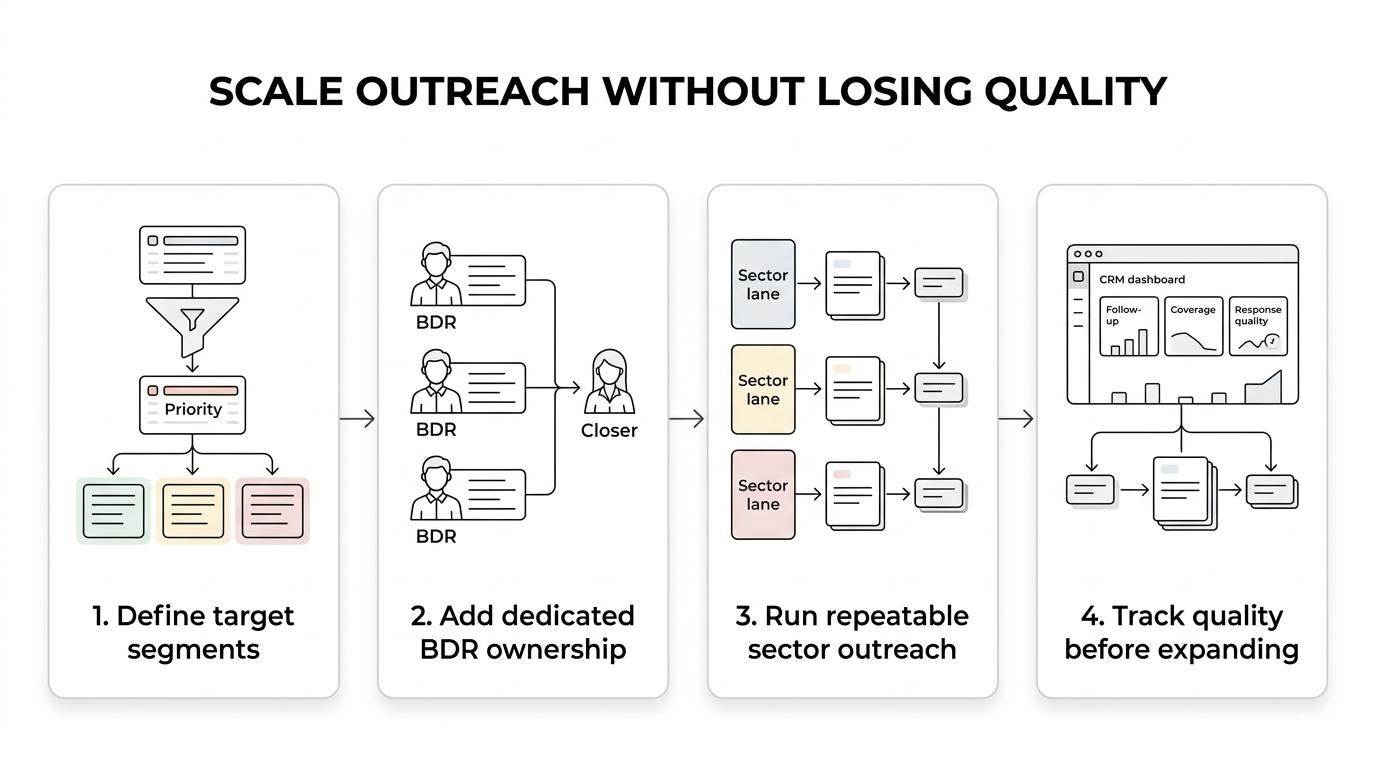
A strong framework for scaling B2B sales outreach includes these steps:
- Define your ICP and target segments.
- Separate prospecting from closing where it makes sense.
- Create dedicated BDR capacity.
- Segment outreach by market or industry.
- Use technology to improve execution efficiency.
- Measure quality alongside activity volume.
- Expand capacity only when the process is repeatable.
Each step reinforces the others. Clear ICPs make segmentation useful. Dedicated BDRs make consistency more realistic. Technology makes repeatable process easier to manage. Measurement keeps volume from overwhelming quality.
That is the real pattern behind sustainable growth in B2B sales outreach. Not more motion for its own sake, but a better operating model for producing it.