More leads can look like progress. In many B2B teams, they actually create noise.
When qualification is loose, Marketing celebrates volume, BDRs book meetings, and Account Executives quietly lose time on prospects that were never likely to become real opportunities. Pipeline value rises on paper while forecast confidence falls in practice.
Table of Contents
B2B lead qualification for stronger pipeline quality
B2B lead qualification is the process of evaluating whether a prospective customer fits a company’s ideal customer profile, has a relevant business need, and demonstrates sufficient buying potential to justify further sales engagement. An effective qualification process combines firmographic fit, buying intent, business requirements, and readiness to engage, helping sales teams focus on opportunities with meaningful commercial potential.
A practical way to think about it is simple: interest is not the same as commercial potential. A lead can attend a webinar, reply to an email, or request content and still be a poor fit, poorly timed, or far from any serious buying motion.
Here are the key points that matter most:
- Lead volume and lead quality are different measures.
- ICP fit is necessary, but it does not prove buying intent.
- Qualification criteria should be shared across Marketing, BDRs, and Sales.
- Lead scoring helps with prioritization, but human judgment still matters.
- Sales acceptance and downstream conversion are the best reality checks.
- Qualification standards should be reviewed against actual pipeline outcomes.
What B2B lead qualification means in practice
The B2B lead qualification process sits between lead generation and opportunity creation. Its purpose is not to decide whether a company could ever buy. Its purpose is to decide whether this account, at this moment, deserves deeper sales attention.
That distinction becomes more important as lead volume grows. A team can generate more inbound responses or outbound conversations and still fail to create more qualified pipeline. Without a clear filter, sales capacity gets consumed by weak meetings, vague interest, and stalled follow-up.
Why B2B lead qualification matters more than lead volume
Poor sales lead qualification creates expensive confusion. Account Executives spend time on low-value conversations. BDRs optimize for booked meetings rather than accepted meetings. Marketing sees campaign engagement but struggles to connect it to revenue.
The damage usually shows up in familiar ways:
- Inflated pipeline: Forecasts include deals that were never truly viable
- Sales friction: AEs reject meetings because context is missing or weak
- Unclear priorities: Teams chase the loudest leads instead of the best ones
- Weak visibility: Reported demand looks stronger than actual purchase intent
This is also why scaling outreach needs discipline. More activity can help fill the top of the funnel, but it should not weaken standards. That balance matters in How to Scale B2B Sales Outreach Without Sacrificing Quality.
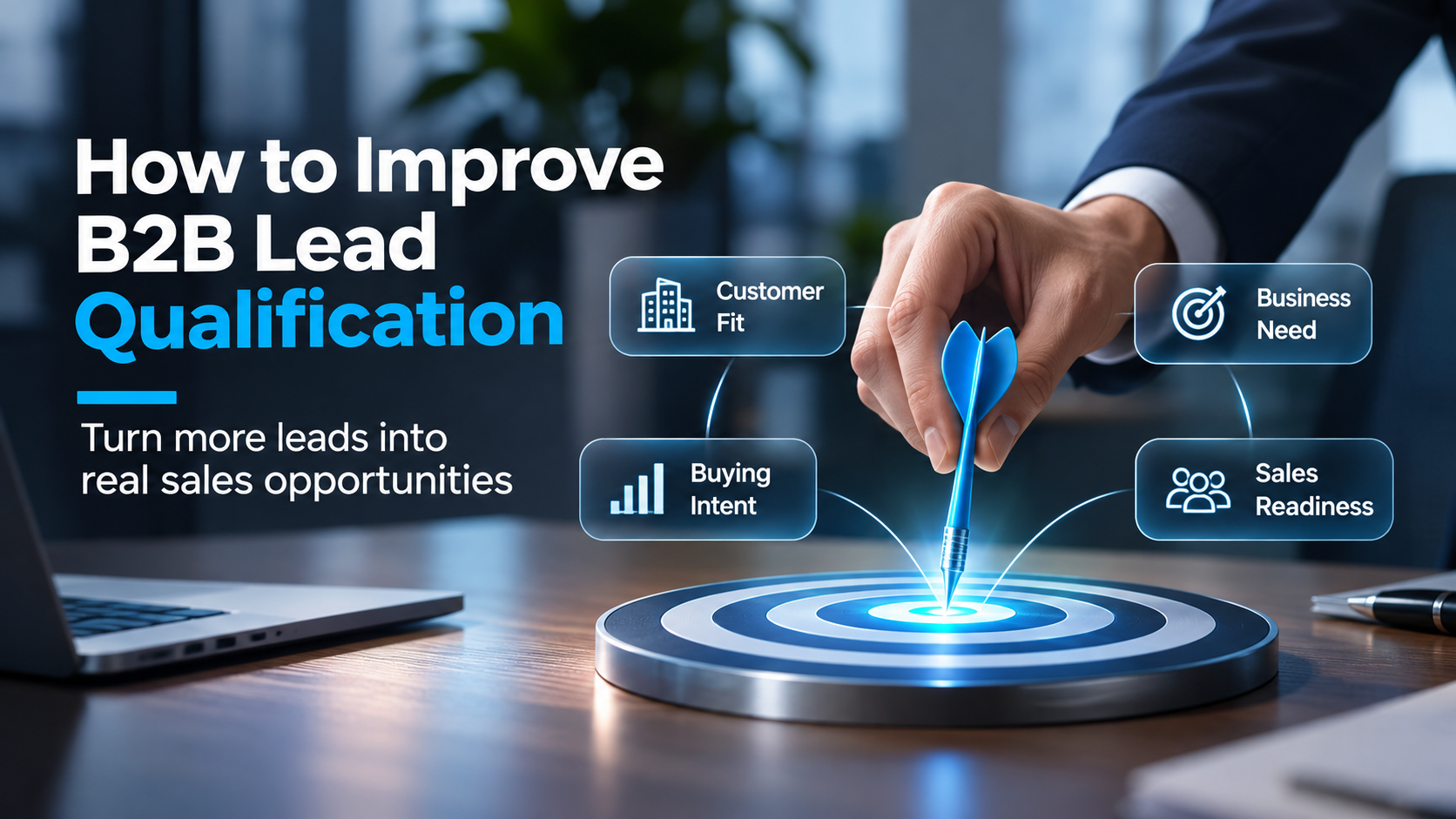
The four dimensions of B2B lead qualification
A useful lead qualification framework does not need to be complicated. One practical model is to assess four dimensions together.
| Dimension | Main question | What to evaluate |
|---|---|---|
| Customer Fit | Is this the right type of company? | Industry, size, geography, business model |
| Business Need | Is there a relevant problem? | Operational issues, goals, urgency |
| Buying Intent | Is the prospect actively considering change? | Evaluation activity, engagement, internal discussion |
| Sales Readiness | Is there a realistic next step? | Stakeholders, timing, process, next meeting |
This is a recommended operating framework, not a proprietary scoring model. Its strength is that it separates different kinds of signal that often get blended together.
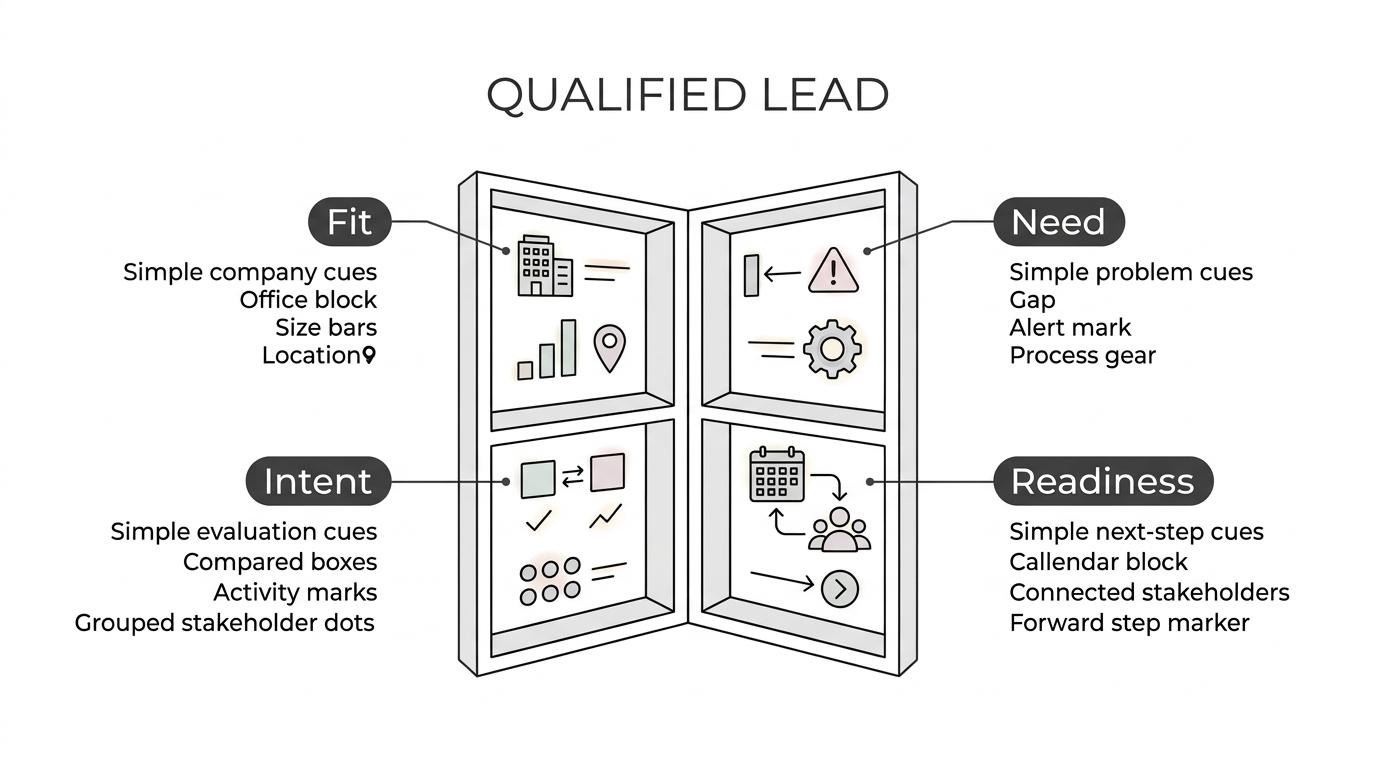
A company may fit the ICP but have no pressing need. Another may have a clear need but no active project, no stakeholder alignment, and no timing. A third may show strong intent but still require more discovery before an AE should engage. Strong qualification asks all four questions, not just one.
How to define lead qualification criteria
Clear lead qualification criteria reduce subjectivity. They also make it easier to train BDR teams, review call quality, and improve handoffs.
Start with mandatory criteria, then add priority criteria. Mandatory criteria answer whether the lead belongs in the pipeline at all. Priority criteria help decide who should be worked first.
A simple way to separate them is this:
- Mandatory criteria: ICP fit, relevant business problem, valid contact, plausible use case
- Priority criteria: urgency, stakeholder access, active evaluation, account potential
Disqualification matters too. If the account is too small, outside target geography, using the product in an unsupported way, or clearly only researching, that should be documented early. Good qualification protects sales time as much as it creates opportunities.
MQL vs SQL in B2B lead qualification
MQL vs SQL debates often waste energy because the labels vary by company. What matters is whether both stages are defined clearly and used consistently.
| Stage | Purpose | Typical signals | Owner | Next action |
|---|---|---|---|---|
| MQL | Identify leads worth initial sales review | Form fills, content engagement, event activity, fit signals | Marketing | Route for BDR follow-up |
| SQL | Confirm meaningful sales potential | Valid need, fit, buying context, agreed next step | Sales development or Sales | Handoff to AE |
An MQL shows enough signal to justify attention. A sales qualified lead shows enough substance to justify active sales engagement. Shared definitions matter more than generic terminology.
Which sales lead qualification framework should you use?
Established frameworks are useful, but none is universal.
BANT works well in direct, transactional environments where budget and timing are visible early. CHAMP is often better when the business challenge needs to be clarified before budget is discussed. MEDDIC fits complex enterprise sales where multiple stakeholders and formal evaluation criteria shape the deal.
The right choice depends on deal size, cycle length, and how much discovery a BDR can realistically complete. Many teams use a lightweight version early, then deepen qualification later.
- BANT: Best for simpler sales cycles with clearer buying authority
- CHAMP: Strong when pain and prioritization are more revealing than budget
- MEDDIC: Better for high-value deals with longer evaluation processes
The strongest operating model is usually a tailored one. Use your own qualification criteria, then borrow structure from the framework that matches your sales motion.
What questions should BDRs ask to qualify B2B leads?
Good BDR lead qualification should sound like a business conversation, not an interrogation script. The goal is to learn enough to decide whether the opportunity deserves progression.
Useful lead qualification questions often cover current challenges, existing tools or workarounds, business impact, who is involved, why timing matters, and what happens next. Questions like “What is prompting you to look at this now?” or “How are you handling this today?” often reveal more than rigid checklist prompts.
A few strong examples include:
- What business issue is getting the most attention internally?
- How is the team managing this today?
- What happens if nothing changes in the next six to twelve months?
- Who else is likely to weigh in on a decision?
- What would a sensible next step look like from your side?
That approach gives BDRs a repeatable structure without forcing unnatural conversations.
How to identify buying intent in B2B sales
Interest is easy to overread. A download, email open, or website visit may show curiosity, not intent.
Buying intent is stronger when the signal has context. A prospect mentions an initiative already under review. Multiple stakeholders join a call. The team describes a current process gap with real business impact. There is a visible evaluation path, even if budget is not fully approved yet.
No single signal guarantees conversion. Intent becomes credible when several signals connect: fit, pain, activity, and a realistic path to action.
Lead scoring vs human qualification
Lead scoring can support the B2B lead qualification process, especially when volume is high. Firmographic scores help surface good-fit accounts. Behavioral scores help identify active engagement. CRM fields help standardize routing.
Still, lead scoring has limits. A lead can accumulate points for activities that mean little commercially. Poor data quality can also distort scores and create false confidence.
Use scoring to prioritize, not to replace judgment. Human review is still needed to assess nuance, urgency, and actual sales readiness.
How to improve the BDR to Sales handoff
The handoff is where many qualification systems break down. A meeting is booked, but the AE receives little beyond a calendar invite and a contact record.
A stronger handoff should include the basics and the commercial context:
- Company and contact details: Who the prospect is and why the account fits
- Business problem: What issue has been identified and how it affects operations
- Buying signals: What suggests active consideration rather than passive interest
- Stakeholder context: Who is involved now and who may join later
- Next action: What the prospect agreed to discuss or evaluate
- Open questions: What still needs to be validated by the AE
This is also where acceptance metrics matter. Teams that want a cleaner handoff should track rejection reasons and compare them against qualification notes. The article BDR Performance Metrics: What Should You Actually Measure? is especially useful here.
How to measure lead qualification effectiveness
Qualification quality should be judged by downstream outcomes, not by top-of-funnel activity alone.
| Metric | What it tells us |
|---|---|
| Lead to SQL conversion | How many leads meet the agreed threshold |
| Meeting acceptance rate | Whether Sales trusts BDR qualification |
| Meeting show rate | Whether the prospect’s interest was real enough to attend |
| SQL to opportunity conversion | Whether qualification predicts true pipeline value |
| Sales rejection reasons | Where standards or discovery are failing |
| Pipeline generated | Commercial contribution from qualified leads |
Definitions must stay stable across teams and reporting periods. Otherwise, trend analysis becomes unreliable.
Common B2B lead qualification mistakes
Most qualification problems are operational, not theoretical. Teams usually know they need better standards. The issue is that the standards are vague, unevenly applied, or disconnected from outcomes.
Common mistakes include treating every engaged lead as qualified, relying only on lead scoring, skipping discovery notes, and optimizing purely for meeting count. The correction is usually straightforward: tighten ICP criteria, document discovery consistently, and measure whether Sales accepts and converts what comes through.
When outsourced B2B lead qualification makes sense
Some companies have a solid market position and clear qualification standards but lack the bandwidth to run consistent outbound and follow-up activity. In those cases, external support can help.
Outsourcing works best when the target market, messaging, and qualification criteria are already defined. It does not fix weak positioning or an undefined ICP. Companies comparing models should review In-House vs Outsourced Sales Development: Which Is Better? and the economics in How Much Does Sales Development Outsourcing Cost?.
Providers with hands-on operating experience can add value here. Teams like Silver Bell Group have run dedicated BDR structures, including segmented outreach across Health, Manufacturing, and IT, and increased outreach capacity substantially. That kind of experience speaks to execution discipline and scale, not automatically to qualification quality. Qualification still depends on criteria, coaching, and handoff rigor. Companies assessing support options can review Sales Outsourcing Services.
Building a repeatable B2B lead qualification process
A repeatable process is usually more valuable than a perfect script. The goal is to create a shared operating system across Marketing, BDRs, Sales, and RevOps.
The sequence is straightforward: define the ICP, set qualification criteria, identify buying signals, run discovery, document findings, agree the handoff, measure conversion quality, and refine based on real pipeline outcomes.
That last step matters most. Qualification should be reviewed against what happens later in the B2B sales pipeline. If accepted meetings rarely become opportunities, the criteria need work. If good opportunities are rejected too early, the bar may be misapplied.
FAQ about B2B lead qualification
What is B2B lead qualification? It is the process of assessing whether a lead fits the ICP, has a relevant need, shows buying potential, and merits deeper sales engagement.
How do you qualify a B2B sales lead? Review fit, uncover the business problem, look for real buying signals, and confirm a realistic next step.
What are the most important lead qualification criteria? ICP fit, business need, intent, stakeholder context, and sales readiness are usually the most useful.
What is the difference between MQL and SQL? An MQL has enough signal for sales review. An SQL has enough validated substance for active sales engagement.
Which lead qualification framework is best for B2B sales? There is no universal best choice. BANT, CHAMP, and MEDDIC each fit different deal types and sales cycles.
What questions should a BDR ask during qualification? Questions should cover current challenges, existing process, business impact, stakeholders, timing, evaluation plans, and next steps.
How do you measure lead qualification effectiveness? Use lead-to-SQL conversion, sales acceptance, show rate, SQL-to-opportunity conversion, rejection reasons, and pipeline created.