Revenue rarely breaks down because one department is weak. More often, it stalls because several capable teams are moving in different directions.
A business can generate strong campaign performance, hire good salespeople, and maintain a responsive support desk, yet still see uneven pipeline conversion, missed handoffs, slow follow-up, and disappointing retention. From the outside, each function appears productive. Inside the customer lifecycle, the experience feels fragmented.
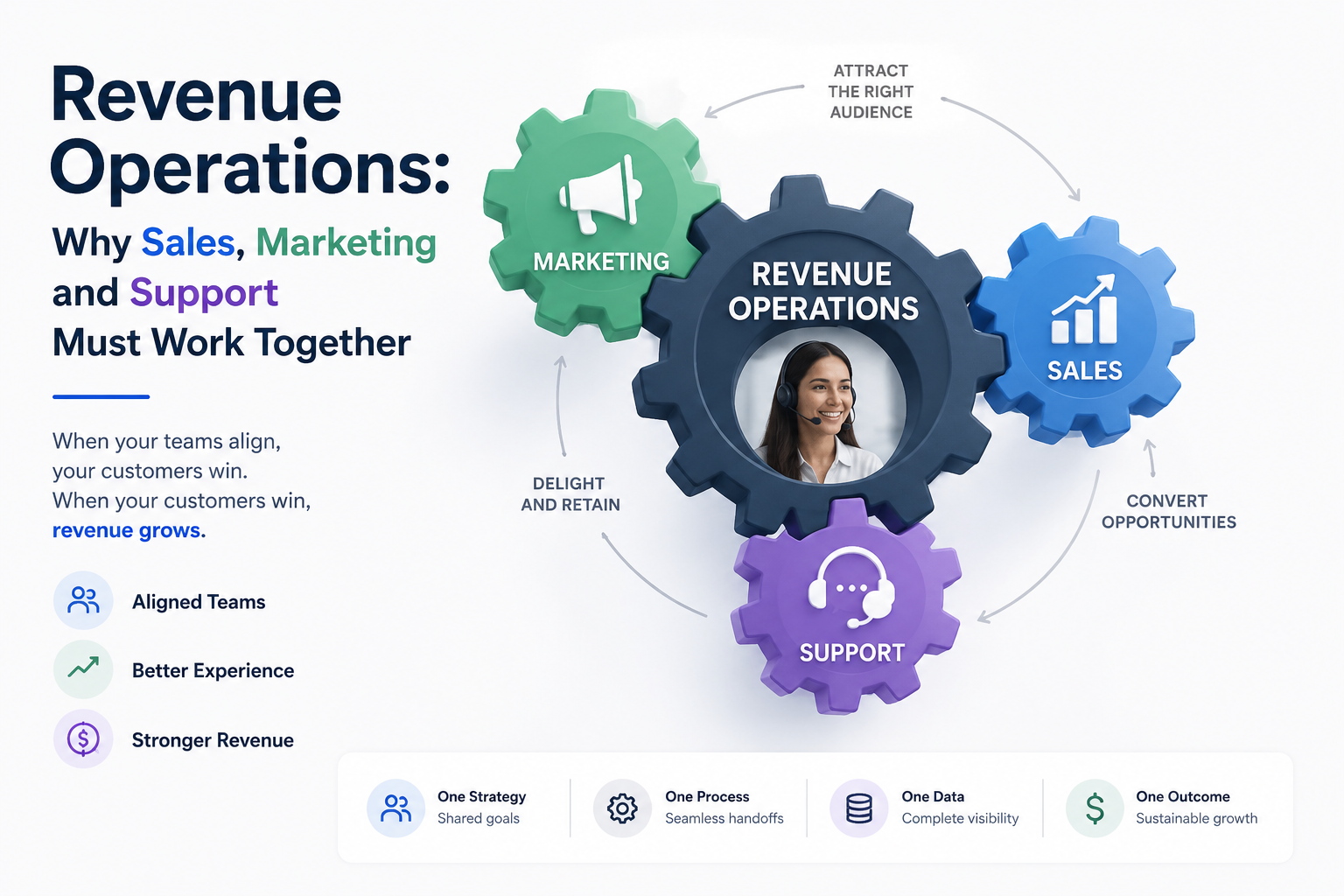
That gap is where revenue operations, often shortened to RevOps, becomes a strategic advantage. It treats revenue as a shared system rather than a departmental scoreboard. Marketing shapes demand. Sales converts interest into opportunity. Support protects trust, renewals, and expansion. When these functions operate as one coordinated motion, growth becomes more predictable.
Table of Contents
Why revenue operations is essential for business growth
Revenue operations is the operating model that connects people, process, data, and technology across marketing, sales, and customer support. Its purpose is straightforward: remove friction between teams so the business can move prospects and customers through the lifecycle with consistency.
Many companies still assume revenue is created mainly at the sales stage. That view no longer matches how buying decisions happen. Prospects read ads, visit websites, submit forms, call the front desk, talk with sales, compare alternatives, review onboarding quality, and judge responsiveness long before they decide whether to stay and expand. Revenue forms across the full experience, not in one isolated conversation.
That is why revenue operations matters to CEOs, CROs, COOs, and operating leaders. It creates one commercial system with shared definitions, shared metrics, and shared accountability. Instead of asking whether marketing hit lead volume or whether support closed tickets on time, leadership can ask a better question: are we producing profitable, repeatable growth?
A practical way to picture the lifecycle looks like this:
Visitor -> Inquiry -> Qualified conversation -> Sales opportunity -> Customer onboarding -> Ongoing support -> Renewal -> Expansion -> Referral
What sales, marketing, and support silos do to revenue performance
Silos create invisible revenue loss. The loss is invisible because it does not always show up as a dramatic failure. It shows up as delay, inconsistency, duplicated work, poor context, and missed timing.
A common example looks like this. Marketing runs a successful campaign and drives a large increase in form fills. Sales sees the lead volume spike but does not trust the lead quality because qualification criteria were never agreed upon. Follow-up slows. Some leads never receive a call. Others are contacted with messaging that does not match the campaign promise. Conversion drops, and both teams blame the other.
Another example appears after the sale. Sales closes a deal based on urgency and specific customer goals. Support receives only partial notes in the CRM, so onboarding starts with missing context. The customer must repeat information, wait for clarification, and adjust expectations. Nothing in that sequence looks catastrophic on its own, yet trust declines at the exact moment the business should be reinforcing confidence.
These patterns tend to show up in familiar ways:
- Marketing: generates leads that sales does not contact quickly
- Sales: lacks campaign context and speaks with incomplete customer insight
- Support: gets brought in after the promise is made, not before it is shaped
- duplicated records
- inconsistent handoff notes
- unclear ownership of follow-up
When leadership teams see only departmental reports, those issues stay hidden longer than they should. Revenue operations surfaces them by connecting the full commercial process.
How revenue operations improves the customer lifecycle
RevOps improves performance by treating every handoff as a managed part of the lifecycle rather than an administrative afterthought. That means teams agree on what qualifies a lead, what information must move with an opportunity, how quickly each stage requires action, and which signals indicate risk or buying intent.
This is where a revenue operations strategy becomes practical rather than theoretical. It sets shared service levels between departments. It defines lifecycle stages in plain language. It creates one source of truth for contact data, attribution, pipeline status, account history, and support activity. Technology supports all of that, but the operating discipline matters more than the software itself.
A strong revenue operations strategy usually includes a few core elements:
- Shared definitions: one meaning for MQL, SQL, opportunity, customer, renewal risk
- Response standards: clear timing expectations for inbound leads and internal handoffs
- Data governance: consistent fields, ownership rules, and reporting logic
- regular cross-functional reviews
- unified pipeline and retention reporting
Without that structure, teams can work hard while still creating friction for buyers.
Why customer experience management is a revenue growth strategy
Customer experience management is often treated as a brand topic or a service topic. It is both, but it is also a revenue growth strategy.
Marketing creates expectations. Sales validates those expectations in conversation. Support proves whether the promise was real. If those stages feel disconnected, buyers become cautious. If those stages feel coherent, buyers move with more confidence and stay longer after the deal closes.
That is why customer experience should not sit outside revenue discussions. A prospect who receives a fast, informed response is more likely to convert. A new customer who experiences a smooth onboarding process is more likely to adopt the service fully. An existing customer who gets consistent support is more likely to renew and expand. Experience influences acquisition, retention, and account growth.
This is especially relevant for companies with strong top-of-funnel activity and uneven revenue results. The problem is not always lead volume. It is often the quality of coordination after the lead arrives.
The hidden cost of department misalignment
Misalignment creates costs that rarely appear in a single budget line.
Sales teams spend time re-qualifying leads because campaign intent was unclear. Marketing spends money driving traffic that never gets proper follow-up. Support teams solve preventable issues caused by poor pre-sale communication. Leaders make decisions using reports that do not share the same definitions. Revenue slows, yet no one issue looks large enough to explain the slowdown on its own.
Consider a mid-market services company running aggressive digital campaigns. Marketing reported record lead generation. Sales reported weak conversion. Support reported rising frustration from new accounts. Once leadership mapped the lifecycle, the cause became clear. The campaign offered immediate expert access, but inbound prospects waited two business days for a callback. When they did connect, sales had limited visibility into campaign source and customer need. After close, support inherited accounts without call notes or expectation summaries. The business did not have a demand problem. It had a coordination problem.
A second example comes from a company with a capable sales team and healthy win rates, yet weak retention. The issue was not product quality. Support was excluded from revenue planning, so common onboarding questions and service risks never made it back to marketing or sales. New customers entered the account with assumptions that could have been corrected earlier. Renewals suffered because the wrong customers were being won in the first place.
The comparison below shows the difference between a traditional model and a revenue operations model.
| Area | Traditional department model | Revenue operations model |
|---|---|---|
| Ownership of revenue | Mostly sales | Shared across marketing, sales, and support |
| Lead qualification | Separate criteria by team | Agreed criteria and lifecycle stages |
| Customer data | Split across tools and spreadsheets | Unified reporting and governed data |
| Handoffs | Informal, inconsistent | Defined process with timing and context |
| Messaging | Department-specific | Coordinated across the lifecycle |
| Support role | Post-sale only | Active input into retention and growth |
| Forecasting | Pipeline-heavy | Pipeline, retention, expansion, and conversion trends |
| Customer experience management | Reactive | Built into the revenue growth strategy |
How live reception services connect marketing, sales, and customer support
For many businesses, the first human interaction happens before a sales call ever takes place. It happens when a prospect phones in response to an ad, a website visit, or a referral. That moment matters more than many teams realize.
Live reception services can serve as the connective layer between demand generation, qualification, and service responsiveness. A trained receptionist does more than answer a phone. They capture campaign response in real time, route inquiries correctly, identify urgency, and make sure prospects do not fall into a delayed callback queue.
When integrated well, live reception services improve commercial performance in several ways:
- Speed to contact: inbound interest becomes a real conversation while intent is still high
- Lead quality: reception teams can gather key details before transfer
- Sales efficiency: qualified opportunities reach the right seller faster
- stronger brand consistency
- cleaner information for downstream reporting
There is also a customer support strategy benefit here. Existing customers call with service questions, billing concerns, or urgent account needs. A live reception function can recognize the difference between a new revenue opportunity and a support issue, then route both appropriately. That protects experience quality while giving leadership better visibility into customer intent.
In companies where voicemail, generic inboxes, or slow call routing still sit at the front of the funnel, this is often one of the fastest operational fixes available.
Why sales outsourcing services strengthen revenue operations
Sales outsourcing is often framed as a staffing shortcut. Used well, it is better understood as an operational extension of RevOps.
An outsourced sales team can add disciplined follow-up, structured qualification, and consistent outreach capacity at moments when internal teams are stretched. That matters when strong marketing activity is producing more inbound demand than the current sales team can contact promptly.
The strategic value appears when outsourced sellers work inside the same rules, systems, and reporting standards as the rest of the commercial engine. In that setup, sales outsourcing services do not create another silo. They strengthen execution inside a shared revenue operations framework.
That can help in situations like these:
- Inbound overflow: leads receive prompt contact instead of aging in the queue
- Territory gaps: coverage remains stable during hiring or expansion periods
- Process discipline: outreach and qualification follow a defined playbook
- faster testing of new market segments
- more reliable top-of-funnel conversion data
For leaders focused on predictable growth, the real question is not whether sales should be internal or outsourced. The real question is whether every seller, regardless of employment model, operates with the same messaging, data standards, handoff rules, and customer context.
Revenue operations is more than a CRM project
Some companies say they are building RevOps when what they really mean is that they are implementing a CRM, buying automation software, or cleaning up dashboards.
Those are useful moves. They are not the strategy.
Revenue operations succeeds when people agree on process, when process is reflected in systems, and when leadership reinforces shared accountability. A polished dashboard cannot fix weak handoffs. A new platform cannot solve conflicting lead definitions. Software should support the operating model, not substitute for it.
This distinction matters because many failed transformation efforts start with tooling before operating design. Teams are asked to enter better data into a system that still reflects old departmental habits. The interface changes. The friction stays.
Revenue operations vs sales operations
Sales operations remains valuable, but it has a narrower scope. It usually focuses on territory planning, pipeline hygiene, forecasting, compensation support, and seller productivity.
Revenue operations includes sales operations and extends beyond it. It connects demand generation, sales execution, onboarding, support, retention, and expansion through one operating lens. The goal is not only to help sales close more. The goal is to improve revenue performance across the full customer lifecycle.
That difference is easy to summarize in one sentence: sales operations optimizes the sales team, while RevOps optimizes the revenue system.
For executive teams, this distinction changes governance. If growth is inconsistent because marketing is sending the wrong leads, support is excluded from feedback loops, or data definitions vary by department, sales operations alone will not solve the issue.
Building a revenue operations strategy that scales
A scalable revenue operations strategy starts with a leadership decision: revenue is a shared responsibility, and shared responsibility requires shared design.
The first step is mapping the lifecycle from first touch to renewal and expansion. Not a marketing funnel in isolation, not a sales pipeline in isolation, and not a support workflow in isolation. One connected system. Leadership should identify where prospects wait too long, where data goes missing, where ownership becomes unclear, and where messaging changes without reason.
Next comes operational design. Teams need common stage definitions, clear handoff rules, response-time commitments, and standard information requirements. If a qualified inbound lead must be contacted within fifteen minutes, that standard should be visible and measured. If support needs certain pre-sale notes to onboard properly, those notes should be mandatory, not optional.
Technology should then be configured to support that design. CRM fields, routing rules, attribution logic, call notes, support records, and reporting views should reflect the actual commercial process. When the system mirrors reality, data becomes reliable enough to guide decisions.
Leadership should also review a small set of cross-functional metrics instead of a long list of isolated departmental numbers. The most useful measures often include lead response time, lead-to-opportunity rate, sales cycle velocity, onboarding time, customer retention, expansion rate, and source-to-revenue attribution.
A scaling model usually depends on a few operating habits:
- weekly marketing, sales, and support review of lifecycle friction
- monthly audit of lead handling and handoff quality
- Shared dashboards: one commercial view for pipeline, retention, and service signals
- Feedback loops: support insights flow back into marketing and sales messaging
- Ownership clarity: each stage has a primary owner and a service expectation
When those habits are maintained, sales and marketing alignment becomes measurable instead of aspirational, and customer support strategy becomes part of growth planning rather than a separate service function.
What leadership teams should fix first
The fastest gains rarely come from a complete reorganization. They usually come from fixing the moments where revenue is currently leaking.
Start with first-response speed for inbound demand. Then examine qualification criteria. Then review what information moves from marketing to sales and from sales to support. In many companies, those three areas account for a large share of missed revenue, poor customer experience management, and avoidable operational waste.
A business does not need more activity when activity is already strong. It needs better coordination. Revenue operations provides that coordination by turning disconnected departments into one accountable growth system.
When that shift happens, marketing stops generating leads into a void, sales stops working without context, support stops inheriting broken expectations, and leadership gains a clearer path to durable revenue growth.