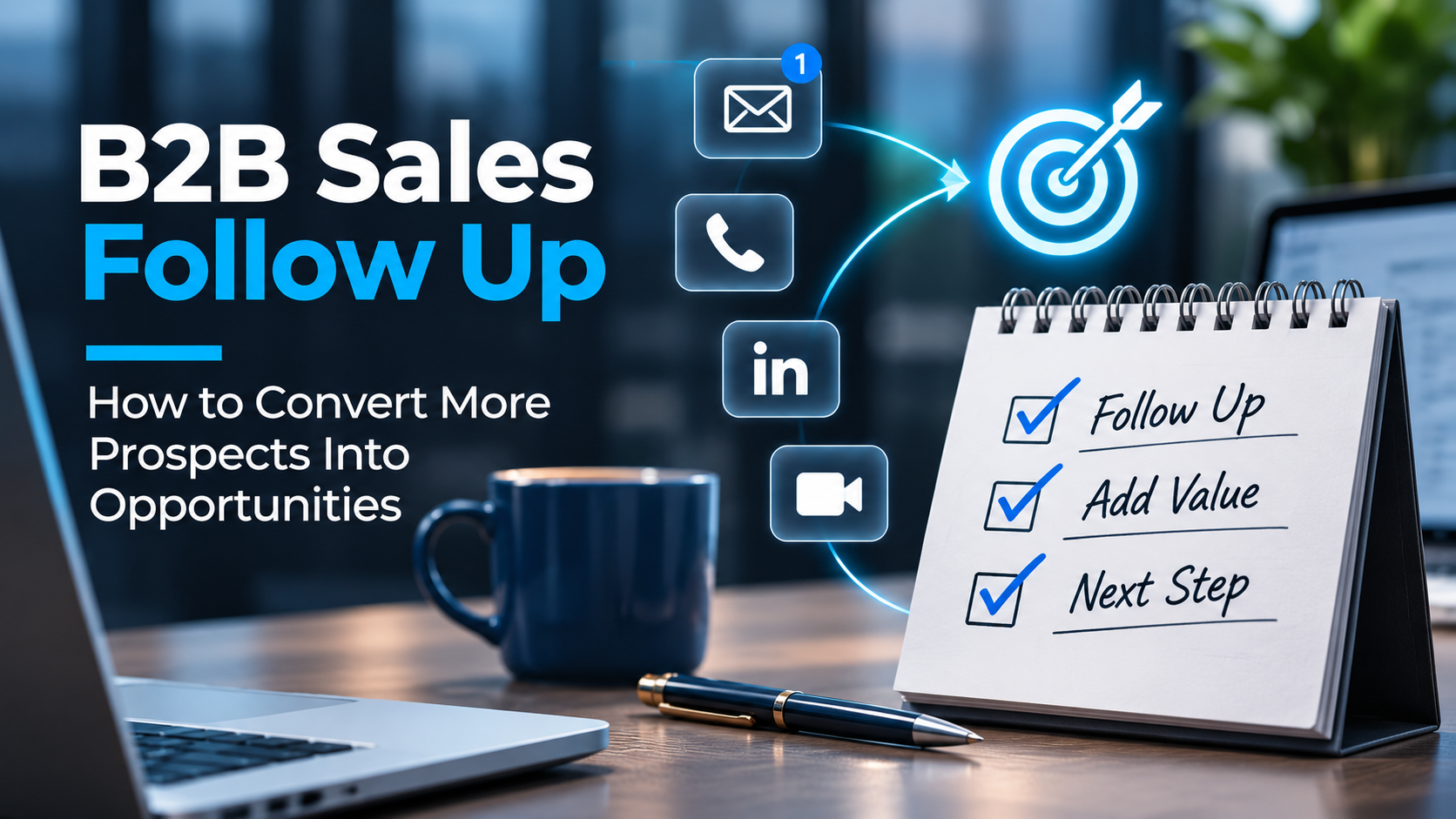
Strong B2B sales follow up sits between interest and opportunity. A prospect answers an email, requests information, joins a discovery call, or reviews a proposal. What happens next often decides whether momentum builds or fades.
B2B sales follow up is the process of maintaining relevant communication with prospective customers after an initial interaction. An effective follow up strategy combines timely outreach, personalized messaging, multiple communication channels, and clearly defined next steps. The objective is to help qualified prospects progress through their buying process without creating unnecessary pressure or repetitive communication.
For sales directors and revenue operations leaders, this is less about persistence alone and more about execution discipline. Good follow up keeps context intact, respects buyer timing, and gives every rep a clear action to take.
Table of Contents
What B2B sales follow up means
B2B sales follow up starts after a meaningful touchpoint. That touchpoint might be an inbound inquiry, a cold outreach response, a discovery meeting, a demo, or a proposal review. The purpose is not simply to “stay in touch.” It is to help the buyer move to the next useful step.
This is different from initial prospecting, which creates the first conversation, and different from long-term nurturing, which keeps a light relationship with contacts who are not active opportunities. A sales follow up process is closer to deal progression. It responds to live context, known needs, and specific commercial questions.
B2B follow up is harder than consumer follow up because there are more people involved, longer evaluation cycles, and more internal approvals. A message that works after a first meeting with one stakeholder may not work after a technical review with four.
Why B2B sales teams lose opportunities during follow up
Most missed opportunities are not caused by a lack of effort. They come from weak operating habits. A rep responds late. A meeting ends without a defined next action. Notes sit in inboxes instead of the CRM. An account changes hands, and no one realizes a prospect is waiting.
These are process failures before they are performance failures. When teams want better conversion, they should inspect ownership, timing, documentation, and messaging quality before asking for more activity.
Common follow up breakdowns include:
- Delayed responses
- Unclear ownership
- Generic messaging
- Missing CRM notes
- Channel inconsistency
- No agreed next step
- Excessive outreach
If qualification is loose at the top of the funnel, follow up gets noisy fast. A related guide on improving B2B lead qualification can help teams decide which prospects deserve active sales attention.
The five stages of an effective B2B sales follow up process
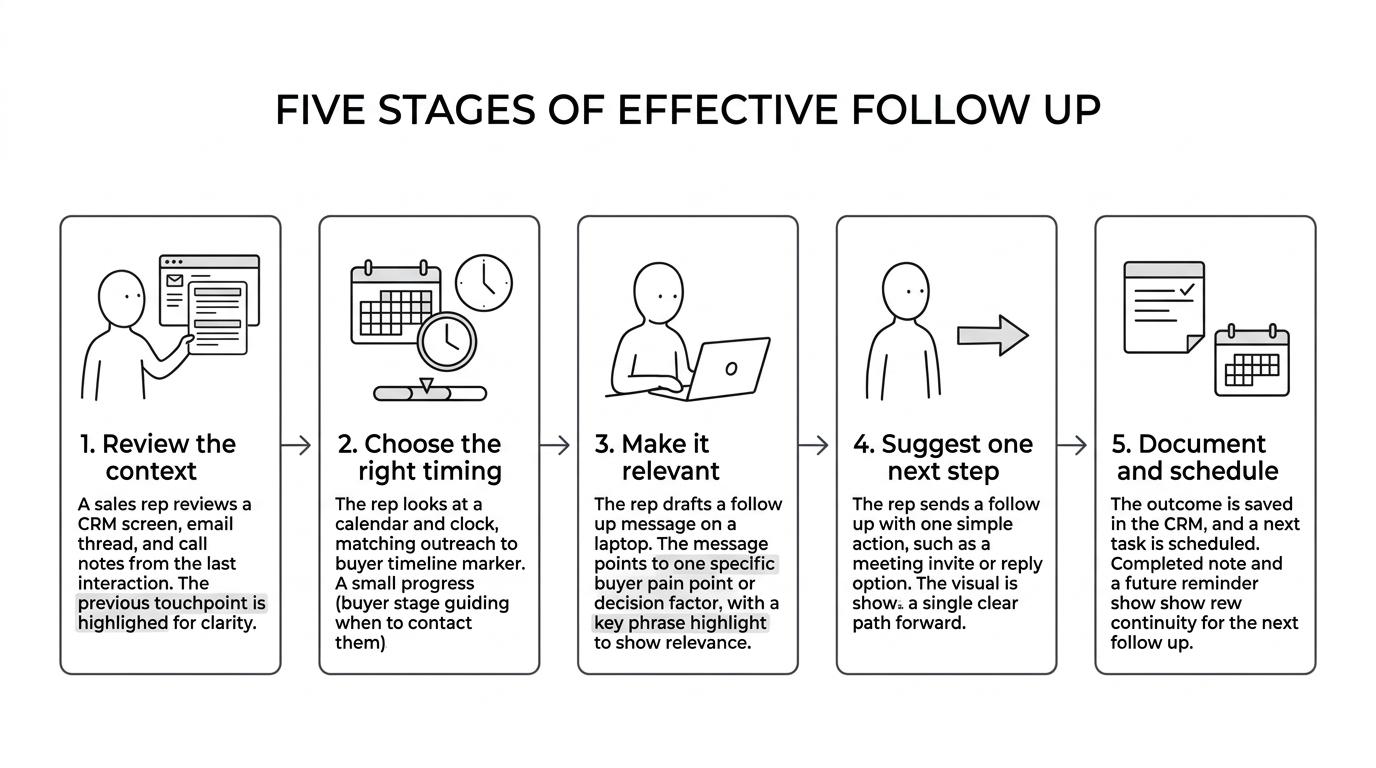
A practical B2B sales follow up strategy can be organized into five stages. This is a useful operating framework, not a proprietary formula.
| Stage | Objective | Recommended action |
|---|---|---|
| Context | Understand the previous interaction | Review CRM notes, emails, call summaries, and stakeholder history |
| Timing | Choose an appropriate moment | Base outreach on urgency, buying stage, and commitments already made |
| Relevance | Give the buyer a reason to respond | Reference a specific pain point, decision factor, or new insight |
| Next Step | Make progression easy | Suggest one clear action, not three competing options |
| Documentation | Maintain continuity | Record the outcome and schedule the next task in the CRM |
These stages work together. If the context is weak, the message feels generic. If the timing is off, even a good message gets ignored. If the next step is vague, the conversation stalls. If documentation is poor, the team starts over every time.
When to follow up with B2B sales prospects
There is no universal sales follow up cadence that fits every prospect. Timing should reflect what the buyer said, what they did, and where they are in the buying process. A prospect who requested pricing deserves a different pace than a prospect who opened a cold email once and never replied.
The strongest rule is simple: follow up in a way that matches the last real signal. If a buyer said they would review a proposal this week, the follow up should reflect that commitment. If there was no engagement at all, the next message should add new relevance rather than repeat the same ask.
A useful way to think about timing is by scenario:
- After an initial inquiry: Respond quickly, acknowledge the stated need, and confirm the next action.
- After an unanswered cold email: Wait a reasonable interval, then add a new angle, proof point, or business reason to reconnect.
- After a discovery call: Follow the timeline agreed during the conversation and recap any commitments.
- After a product demo: Tie the message to evaluation criteria, open questions, and stakeholder involvement.
- After a proposal: Match the prospect’s review process and decision milestones.
- After inactivity: Reassess fit before restarting outreach, especially if priorities may have shifted.
That last point matters. Not every quiet account is a delayed opportunity. Some are simply no longer active, and a disciplined team should be comfortable pausing or disqualifying.
How many times B2B sales teams should follow up
There is no credible universal number. The right frequency depends on prior engagement, buying intent, deal size, industry norms, and whether a next step was agreed during the last conversation.
Persistence is useful when it is anchored in relevance. Repetition without a reason damages trust. A sales prospect follow up should keep moving the conversation forward, not create friction.
Good stop or pause conditions include:
- explicit refusal
- opt-out request
- clear disqualification
- repeated silence after multiple relevant attempts
- internal signal that timing has moved far beyond the original buying window
How to write B2B sales follow up emails that get responses
A strong B2B follow up email usually follows a simple structure: context, relevance, value, next action. Context shows you remember the last interaction. Relevance connects the message to a real business issue. Value gives the buyer a reason to spend attention. The next action makes replying easy.
Avoid empty check-ins. “Just following up” asks the prospect to do all the work. A better email gives them a reason to respond now.
Example 1: follow up after an unanswered introductory email
Subject: Question on identity workflow priorities
Hi [Name],
I reached out last week because teams in [industry] often run into delays when identity access requests move across multiple systems.If reducing review time is on your agenda this quarter, I can share how similar teams are structuring the process and where bottlenecks usually appear.
Open to a short call next week?
Best,
[Rep]
Example 2: follow up after a discovery meeting
Subject: Next step from our discussion
Hi [Name],
Thanks again for the conversation today. You mentioned three priorities: improving handoff visibility, reducing time lost between meetings, and giving managers cleaner activity data.I’m attaching a brief summary of the workflow we discussed and two options for the next step: a review with your RevOps lead or a deeper product walkthrough for the sales managers.
Which path makes more sense for your team?
Best,
[Rep]
Example 3: follow up after sending a proposal
Subject: Proposal review and decision process
Hi [Name],
I wanted to reconnect based on the proposal sent on [date]. From our last call, it sounded like the main review points were rollout scope, reporting needs, and internal approval timing.If it helps, I can join a short call with the wider buying group to answer those questions directly.
Would [two options] work for a review?
Best,
[Rep]
Which sales follow up channel works best
Channel choice should reflect buyer preference, deal stage, and the nature of the message. Some updates need a written record. Some need a live conversation.
| Channel | Strength | Appropriate use |
|---|---|---|
| Clear documentation and fuller context | Meeting recaps, proposals, resources, next-step confirmation | |
| Phone | Direct conversation and fast clarification | Active opportunities, callback commitments, urgent open questions |
| Professional context and light-touch visibility | Relevant engagement when email is crowded or a relationship is still forming | |
| Video meeting | Collaborative discussion | Multi-stakeholder reviews, technical evaluation, decision alignment |
A good sales follow up strategy uses channels together rather than treating them as substitutes. The phone call works better when the email already framed the issue.
How to build a B2B sales follow up cadence
A sales follow up cadence is a planned sequence of touches tied to buyer signals. It is not a fixed calendar of generic reminders. The sequence should change based on whether the prospect is engaged, neutral, or inactive.
Below is an illustrative cadence for an engaged prospect after a discovery call. It is an example, not a benchmark.
| Step | Purpose | Sample action |
|---|---|---|
| Touch 1 | Confirm context | Send recap with agreed priorities and next step |
| Touch 2 | Add value | Share a relevant resource tied to the buyer’s stated issue |
| Touch 3 | Advance the deal | Call or email to schedule the agreed follow-up meeting |
| Touch 4 | Reconfirm decision path | Clarify stakeholders, timing, and evaluation criteria |
| Touch 5 | Pause or requalify | If momentum fades, ask directly whether the initiative is still active |
Stop conditions should be explicit in the process: opt-outs, negative responses, clear non-fit, or a decision to defer beyond the team’s active pipeline window. For teams managing larger volumes, this discipline matters even more. The same principle appears in this guide on scaling B2B sales outreach without sacrificing quality.
How CRM systems improve B2B sales follow up consistency
CRM discipline is what turns good intentions into repeatable execution. The system should show who owns the account, what happened last, what objections surfaced, which channel the buyer prefers, and what task is due next.
This is where sales follow up automation helps. Reminders, task creation, email logging, and stage-based triggers reduce manual gaps. Still, automation should support judgment, not replace it. A scheduled message with no context is still a poor follow up.
How to measure B2B sales follow up performance
Activity volume alone can mislead. A team can send more emails and create less pipeline. Strong measurement focuses on whether follow up is completed, whether buyers engage, and whether opportunities move forward.
| Metric | What it measures |
|---|---|
| Follow up completion rate | Whether scheduled actions are actually completed |
| Response rate | Prospect engagement with outreach |
| Positive response rate | Relevant expressions of interest |
| Meeting conversion rate | Follow up conversations progressing to meetings |
| Opportunity progression | Movement through agreed sales stages |
| Time to first response | Speed of response to inbound interest |
| Disqualification rate | Prospects identified as poor fit |
These metrics are strongest when reviewed alongside qualification quality and commercial outcomes. A fuller measurement framework is covered in this article on BDR performance metrics.
Common B2B sales follow up mistakes
Teams usually know the obvious mistakes, yet they still appear in daily execution. The same message gets sent three times. A rep ignores what happened in the last meeting. Objections are discussed live but never documented. A handoff from BDR to AE breaks continuity and forces the buyer to repeat themselves.
The fix is rarely “try harder.” It is better process design. Require one clear purpose for every follow up. Record objections in a consistent field. Define ownership at each stage. Stop outreach after an explicit refusal. These habits protect buyer trust and improve sales pipeline management.
When outsourced sales development improves follow up execution
An external BDR team can help when demand exists but internal capacity is thin. That is especially true when follow up is inconsistent because reps are balancing too many accounts, too many channels, and too many manual tasks. Outsourcing can add structure, dedicated coverage, reporting discipline, and clearer handoff rules.
Silver Bell Group’s work operating dedicated BDR teams shows why that structure matters. In one documented 1Kosmos engagement, three dedicated BDRs supported segmented outreach across Healthcare, Manufacturing, and IT, resulting in a threefold increase in outreach volume. That example speaks to organized coverage and execution capacity, not a blanket promise about conversion results.
For companies weighing options, it helps to compare in-house vs outsourced sales development and review available Sales Outsourcing Services. Outsourcing can improve follow up execution, but it does not fix weak positioning, a poor offer, or vague qualification standards.
Building a repeatable B2B sales follow up system
A repeatable system is built in sequence: define follow up scenarios, assign ownership, set communication standards, match timing to context, document every interaction, measure outcomes, and adjust based on what moves opportunities forward.
That approach keeps B2B sales follow up where it belongs: inside a managed revenue process rather than inside individual memory and personal persistence.
FAQ about B2B sales follow up
What is B2B sales follow up?
It is the process of continuing relevant communication with a prospect after an initial interaction so the buyer can move toward a decision.
How soon should you follow up with a B2B prospect?
Follow up based on the prospect’s situation, urgency, and any timeline discussed. Inbound interest usually deserves a faster response than cold outreach.
How many follow up emails should you send?
There is no fixed number. The right amount depends on engagement, buying intent, deal complexity, and whether the messages keep adding relevance.
What should you say in a sales follow up email?
Reference the last interaction, connect to a business issue, add useful value, and suggest one clear next step.
What is a B2B sales follow up cadence?
It is a planned sequence of outreach touches based on buyer signals and deal stage, not a string of arbitrary reminders.
Which channel is best for following up with prospects?
Email is often best for documentation, phone for fast clarification, LinkedIn for light professional engagement, and video for multi-stakeholder discussion.
How do you measure sales follow up effectiveness?
Look at completion rate, response rate, positive responses, meeting conversion, opportunity progression, time to first response, and disqualification quality.
When should you stop following up with a prospect?
Stop when the prospect opts out, declines clearly, is disqualified, or shows repeated non-engagement after several relevant attempts.