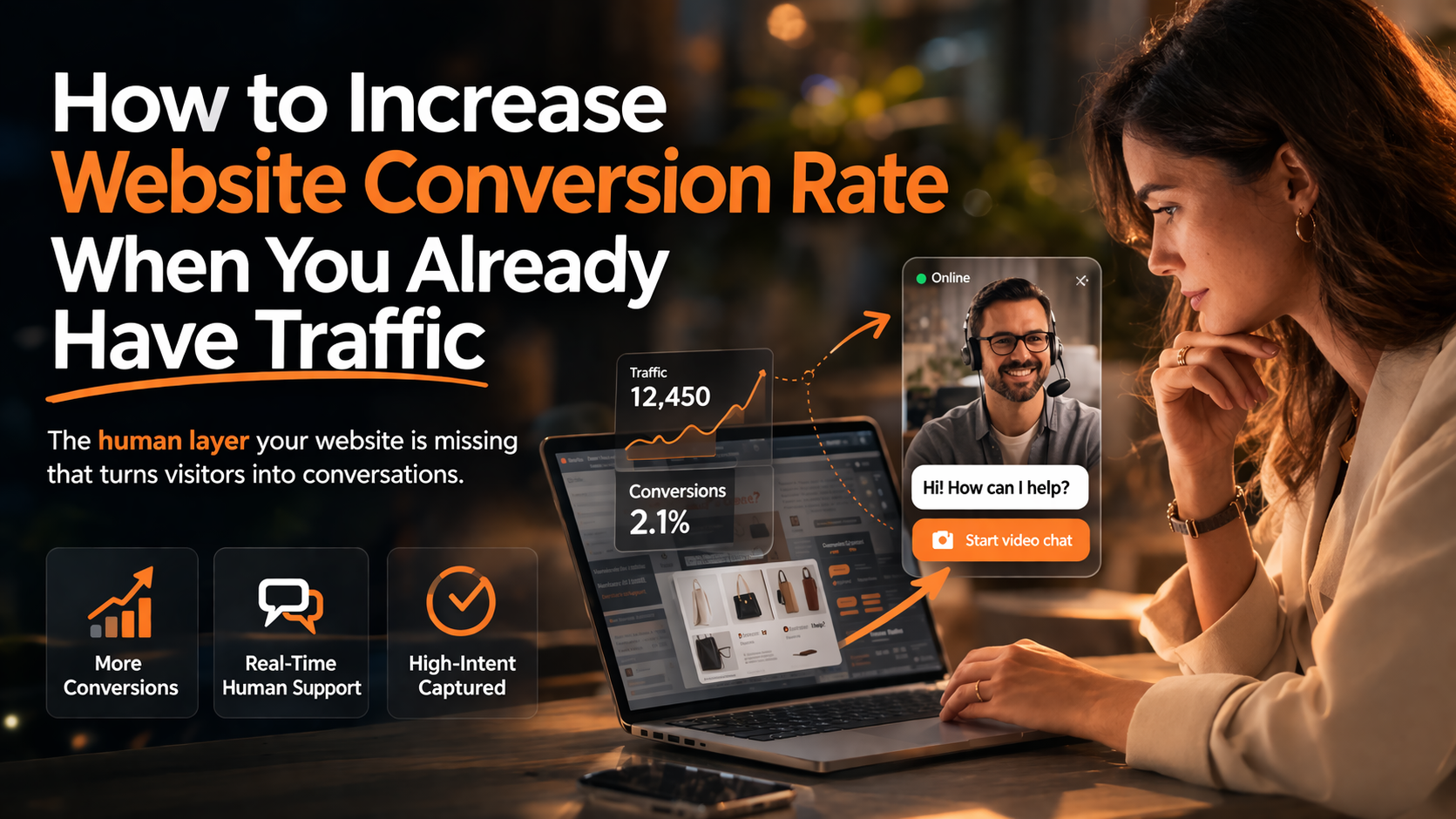
If you want to increase website conversion rate, the first instinct is usually to question traffic quality. Maybe the ads are attracting the wrong clicks. Maybe SEO traffic is too broad. Maybe social visitors are curious but not ready to buy.
That explanation is convenient, but it is often incomplete.
Many companies already have enough traffic to generate stronger results. The real gap appears after the click, when a visitor is actively weighing risk, value, timing, and trust. That is the moment when conversion happens or disappears.
Table of Contents
Increase Website Conversion Rate by Fixing the Decision Phase
A low conversion rate in ecommerce is often treated as a traffic problem. In practice, low conversion rates are usually a conversion experience problem.
This is why teams can spend heavily on paid acquisition, publish content consistently, rank for valuable keywords, and still feel disappointed by results. Traffic keeps coming in, dashboards look active, but revenue or qualified leads stay flat. The missing piece is not always volume. It is what the site does, or fails to do, when a real buyer arrives with questions.
Most websites are built as one-way experiences. They present pages, forms, pricing, and calls to action. Visitors are expected to read, process, decide, and commit on their own. That works for a small percentage of people. It leaves a large number of high-intent users without the support they need at the exact point of decision.
Why traffic alone does not increase website conversion rate
Traffic acquisition and conversion optimization are often treated as separate tracks. One team brings people in. Another team tries to improve the page. That division makes sense operationally, but not from the visitor’s perspective.
A person who clicks an ad or lands from search does not care how your org chart is structured. They care about one thing: can they get enough confidence, clarity, and momentum to take the next step right now?
When that does not happen, more traffic simply means more missed opportunities, often reflected in a higher bounce rate. Every extra click becomes more expensive because the site cannot convert existing intent efficiently.
After a certain point, buying more visits without fixing the conversion layer starts to create a familiar pattern:
- Higher media spend
- Flat lead volume
- Abandoned forms
- Product page exits
- More “we have traffic, but…”
That pattern is not random. It usually points to friction in the decision phase, not to a shortage of visitors.
Why page optimization alone has limits
Most businesses do the sensible things first. They improve copy. They redesign landing pages. They simplify navigation. They test headlines, button colors, form length, and social proof. Those efforts matter, and they can produce gains.
Still, they often produce incremental gains because they optimize a static experience.
A static page, even a strong one, cannot respond when a visitor thinks, “Do you ship to my region?”, “Can this integrate with our current system?”, “Is there someone I can talk to before I submit this?”, or “What plan actually fits my case?” The page can anticipate some objections, but it cannot fully handle the uncertainty that appears in real time.
This is where many conversion programs stall, often leading to a website not converting as desired. The site is polished, but conversion rates remain low. The offer is visible. The traffic is steady. Yet users hesitate, and hesitation online is expensive because it rarely announces itself. People do not say “I was close, but I needed one answer.” They simply leave.
Real-time human interaction is the missing conversion layer
The strongest conversion experiences do not just present information. They support decisions.
That is why real-time human interaction matters so much. A visitor with intent often needs one of three things before converting:
- clarification
- reassurance
- guidance
Without immediate access to any of those, the path from interest to action breaks down.
This is where Live Reception becomes valuable. It adds a human layer at the exact moment when a visitor is evaluating whether to buy, inquire, book, or submit. Rather than forcing users into a silent, self-serve decision, it opens a conversation while intent is still active.
That is not just another widget or another support channel. It is a practical next step in conversion optimization. Instead of asking how to squeeze another small lift from page design alone, it asks a better question: how can conversion rates improve if ready-to-convert visitors could talk to someone the moment they needed help?
How Live Reception helps increase website conversion rate
Live Reception closes the gap between intent and action, significantly improving conversion rates.
A visitor lands on your site with a purpose. They are not looking for a design award. They are trying to resolve uncertainty fast enough to move forward. Live Reception supports that process in real time, which changes the economics of traffic you already paid for.
A strong real-time reception layer can help in several ways:
- Immediate clarification: answer questions before they become exits
- Buying confidence: reduce risk for visitors who are close to acting
- Lead qualification: identify serious prospects early
- Sales momentum: move people toward the right next step
- Support before purchase: remove friction that blocks conversion
The key idea is simple. Many high-intent visitors are not unqualified. They are undecided. A real conversation can move them from hesitation to action far more effectively than another form field or headline variation.
Ecommerce conversion rate problems often start with unanswered questions
An ecommerce store can have healthy traffic and weak sales at the same time, often indicating a low conversion rate ecommerce issue. That usually confuses teams because the top of the funnel appears strong. Ads are generating clicks. Product pages are getting views. Cart activity exists. Yet revenue underperforms.
In many cases, shoppers are not rejecting the product. They are pausing on details the site does not answer well enough. Shipping timelines, return policies, sizing, compatibility, stock certainty, or payment options can all become final barriers.
A product page can include FAQs, badges, and reviews. Those help. But when a buyer wants confirmation now, real-time conversation is far more persuasive than static reassurance.
| Scenario | Visitor intent | What blocks conversion | What real-time interaction changes |
|---|---|---|---|
| Ecommerce product page | Ready to buy | Shipping, sizing, returns, compatibility | Removes doubt before cart abandonment |
| B2B service page | Evaluating vendors | Fit, pricing, timeline, process | Turns passive traffic into qualified leads |
| High-ticket offer | Interested but cautious | Risk, trust, complexity, commitment | Builds confidence before form drop-off |
For ecommerce brands, this often means recovering revenue from traffic that was already expensive to acquire. If your paid campaigns are producing product interest but not enough completed orders, the issue may be less about ad targeting and more about the site’s ability to support decision-making in the moment.
B2B websites lose qualified leads during the evaluation stage
B2B conversion problems are rarely as simple as “people are not interested.” Many visitors are interested, but they are still sorting through fit, timing, scope, and internal approval.
That creates a fragile stage between traffic and lead submission, often leading to an increased bounce rate. Someone may read the site, visit pricing, check case studies, and still leave without filling out a form because one practical question remains unanswered. If there is no human interaction available, that lead can disappear to a competitor that feels easier to engage.
This is why a real-time response layer is powerful for B2B sites. It acts as the first sales touchpoint, not in a pushy way, but in a helpful one. It helps visitors clarify fit, understand process, and take a lower-friction next step.
Seen this way, conversion optimization connects naturally with broader revenue services:
- Lead Generation: more traffic has greater value when the site converts existing demand more efficiently, improving conversion rates
- Sales as a Service: live conversations can function as an early qualification and handoff point
- Customer Support: pre-purchase help can influence pipeline quality before a contract ever exists
If those areas are part of a wider growth system, it makes sense to connect them thoughtfully through Lead Generation, Sales as a Service, and Customer Support. Live Reception sits in the middle because it captures intent at the moment it appears.
High-ticket services need trust before the form fill
High-ticket services face a different version of the same issue. Traffic may come from search, referrals, paid campaigns, or thought leadership content. Visitors are interested, but the stakes are higher, so hesitation increases.
When the commitment feels significant, users want reassurance before they submit a form or request a consultation. They may be thinking about cost, outcomes, fit, confidentiality, timing, or whether they will be speaking to the right person. A generic contact form does very little to calm those concerns.
This is one reason high-ticket websites often mistake low form volume for low demand or identify a website not converting as a low conversion rate ecommerce issue, impacting overall conversion rates. The demand may be present. The site just does not create enough confidence at the point of evaluation.
Real-time interaction changes that dynamic. It gives the visitor a sense that there are people behind the site, ready to respond, clarify, and guide. That alone can shift a brand from feeling distant to feeling credible and accessible.
What to review before you spend more on traffic acquisition
If traffic is consistent but conversion is lagging, the smartest next move is not always another campaign. It may be a deeper review of what happens after the click.
Start by looking at where intent is visible but action is weak. That usually reveals more than broad channel metrics.
Ask a few direct questions:
- Are visitors reaching product, pricing, or service pages but failing to convert?
- Are forms being started but not completed?
- Are there signs of evaluation behavior without follow-through?
- Do prospects need answers that the site cannot provide in real time?
- Is the business treating support and sales as separate from conversion when they should be connected?
Those questions shift the focus from “How do we get more visitors?” to “How do we convert the people already showing intent?”
That shift matters because it protects budget. It also creates a stronger foundation for every acquisition channel you already use.
Conversion rate optimization works best when humans support the decision
There is still a place for testing layouts, refining copy, improving speed, and polishing UX. Those basics matter. A weak page cannot be rescued by conversation alone.
But when a site already has solid traffic and reasonable fundamentals, the next step is often more human, not more cosmetic.
The strongest websites do not just persuade. They respond.
They give visitors a path to ask, confirm, and move forward while motivation is still present. That is why businesses that want to increase website conversion rate should look beyond the landing page itself and pay closer attention to the decision phase.
When people are ready, even a short real-time exchange can be the difference between a bounce rate concern and a buyer, a visit and a qualified lead, a costly click and measurable growth.
Bridging the Gap: Live Reception as Your Conversion Layer
Increasing your website conversion rate hinges on understanding that what truly matters is the experience after a visitor clicks, not just the volume of traffic. High-intent users often need immediate clarification and reassurance; without it, they abandon promising buying journeys prematurely. Implementing a real-time interaction strategy, like Live Reception, addresses these gaps, transforming fleeting online interests into actionable opportunities.
This approach integrates seamlessly with broader initiatives in Lead Generation, Sales as a Service, and Customer Support, enhancing the value of each visitor. By transitioning from static optimization to dynamic engagement, businesses can safeguard their budgets and fully leverage existing traffic for sustained, measurable growth.