Many companies think they need more leads when the real issue sits much earlier in the revenue process.
They already have attention. They already have inquiries. They already have people filling out forms, calling in, chatting, or requesting pricing. What they do not always have is a reliable way to identify which of those people are worth immediate sales attention and which need a different path.
That is where lead qualification changes the picture.
Imagine two companies that each receive 100 inbound inquiries this month. Company A treats every lead the same way and contacts them in no particular order over several days. Company B responds within minutes, asks a short set of qualifying questions, identifies buying intent, and routes the strongest opportunities to the right sales representative. Both companies generated the same volume. Only one turned interest into a predictable sales engine.
Table of Contents
What lead qualification means for revenue
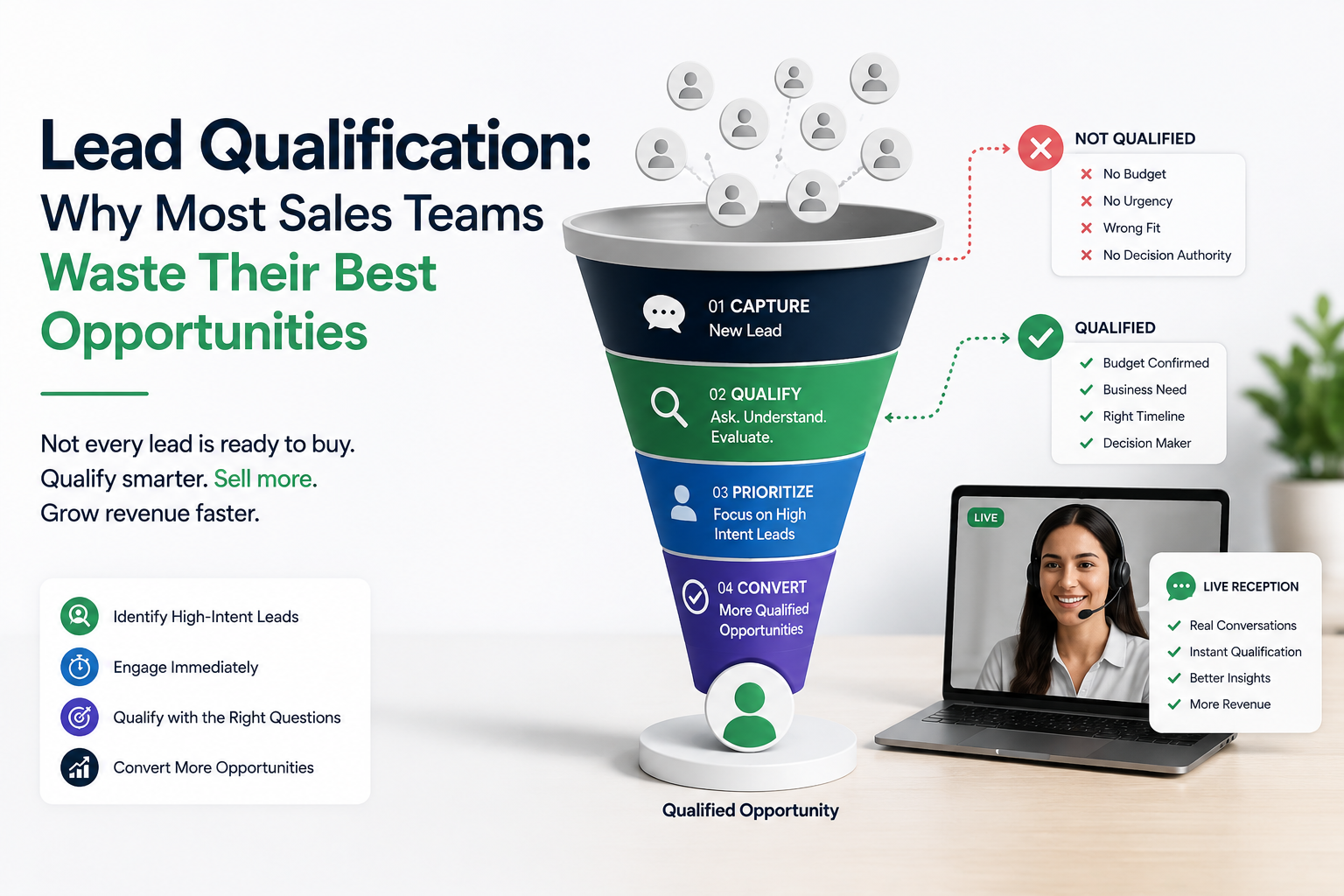
Lead qualification is the process of assessing whether an inquiry is likely to become a real sales opportunity. In practical terms, it answers a few simple questions: Is there a business need? Is there intent to buy? Is there a realistic timeline? Is the person involved in the decision? Can the opportunity fit the company’s ideal customer profile?
That sounds basic, yet many teams still treat inbound demand as one large undifferentiated pile. That approach creates a hidden tax on the sales organization. Reps spend time sorting, chasing, and clarifying instead of selling. Managers see activity but not progress. Marketing sees leads come in but cannot explain why conversion stays flat.
Sales lead qualification matters because every lead is not equal. Some inquiries are casual. Some are early research. Some are highly motivated buyers. A strong lead management process does not dismiss any inquiry. It gives every inquiry a fast, consistent check so the right next step happens quickly.
Most inbound pipelines include a mix like this:
- Information seekers
- Comparison shoppers
- Decision makers
- Ready-to-buy prospects
When teams identify that intent early, everything downstream improves. Response quality gets better. Pipeline stages become more meaningful. Forecasting becomes less wishful. Revenue leaders stop asking for more lead volume before fixing the conversion logic they already control.
Why sales teams struggle with sales lead qualification
The problem is rarely effort.
Sales teams usually work hard. They follow up, send emails, make calls, and log activity. The issue is that many organizations built their process around lead capture, not lead qualification. They invested in marketing campaigns, forms, paid search, content, or outbound tools, then assumed a sales rep would sort out the rest.
This creates three common breakdowns.
First, there is no shared definition of a qualified lead. Marketing may count any form submission. Sales may only care about meetings with active projects and real budgets. If those definitions differ, friction follows. Teams argue about lead quality when the real gap is process design.
Second, response speed tends to be inconsistent. A lead that comes in at 10:07 a.m. may not get touched until the next day because the assigned rep is in meetings, handling current accounts, or working a stale prospect list. By then, the best opportunity may already be speaking with a competitor.
Third, qualification questions often happen too late. The rep spends two or three exchanges trying to book a meeting before learning the contact has no budget, no authority, or no active need. That wastes time for both sides.
A few patterns show up again and again:
- No routing rules: every rep sees everything, so priorities blur
- No intake script: each first conversation depends on the rep’s style
- No response standard: speed varies by person, day, and workload
- No lead scoring logic: high intent leads are buried next to low-fit inquiries
These problems are especially common in companies with steady inbound traffic. When a business receives only a handful of inquiries each week, manual handling can limp along. When volume increases, weak qualification becomes expensive very quickly.
How poor lead qualification slows revenue growth
Poor qualification does more than waste a few calls. It slows the entire revenue system.
The first cost is time. Sales representatives are expensive resources. Their highest value work is progressing serious opportunities, running strong discovery, shaping proposals, and closing deals. If they spend large chunks of the week filtering low-fit inquiries, the business loses capacity without always noticing it.
The second cost is conversion rate. A rep who is overloaded with unqualified conversations has less time to respond promptly and thoughtfully to the strongest opportunities. That means high intent leads often receive the same delayed, generic treatment as everyone else. The pipeline appears full while close rates drop.
The third cost is visibility. When a team has weak qualification, its funnel data becomes noisy. Stage progression means less because weak leads entered the pipeline too early. Forecast confidence falls because the pipeline includes opportunities that were never real.
This is why many growth plans stall after a successful lead generation strategy. The top of the funnel expands, but revenue does not rise at the same pace. Leadership may decide to increase marketing spend, hire more reps, or add more campaigns. Yet the real gain may come from qualifying existing inbound demand far better.
A SaaS company offers a good example. Imagine 200 demo requests in a month. Without qualification, reps book meetings with startups that are only curious, students researching tools, small teams with no buying authority, and mid-market buyers with urgent needs. All appear in the same queue. The result is predictable: calendars fill, pipeline quality falls, and strong prospects wait too long.
A hospitality group faces a similar pattern. A hotel or venue may receive inquiries for event space, group bookings, vendor questions, and speculative pricing checks. If all of those contacts are handled in the same way, sales capacity disappears into low-yield conversations while serious event planners wait.
In healthcare, the stakes can be even higher. A provider group may field requests from prospective partners, referral sources, patients, and procurement teams. Fast, structured qualification helps route each inquiry correctly without burdening clinical or business development staff.
B2B services firms see the same issue in a different form. An accounting, legal, consulting, or managed services team may get a healthy number of “contact us” leads. Some are ideal clients with active buying timelines. Others are price shopping, job seeking, or asking for information that should never enter the sales pipeline at all.
High intent leads vs low intent leads
High intent leads show signals that they are close to a business decision. Low intent leads may still matter, but they should not receive the same level of sales attention at the same moment.
That distinction is one of the most valuable moves in lead management. It protects sales time and improves buyer experience. A high intent lead wants speed, clarity, and direct access. A low intent lead may need nurturing, education, or a light-touch follow-up plan.
Here is a practical comparison.
| Characteristic | Qualified lead | Unqualified lead |
|---|---|---|
| Business need | Clear problem or initiative | Vague curiosity or general research |
| Timing | Active project or short buying window | No defined timeline |
| Authority | Decision maker or strong influencer | No role in purchase decision |
| Budget | Budget exists or is being approved | No spending plan |
| Fit | Matches target industry, size, or service need | Outside ideal profile |
| Urgency | Wants next steps now | Only gathering options |
| Engagement | Responds quickly and asks specific questions | Slow replies and broad questions |
| Sales path | Ready for rep conversation | Better suited for nurture or support |
A qualified lead does not need to be perfect. Budget may still be forming. A final decision maker may not yet be on the call. What matters is whether there is enough evidence to justify direct sales time now.
A low intent lead is not a bad lead. It is simply a lead that needs a different path.
That difference becomes obvious in real situations. A SaaS buyer asking about implementation timing, security review, and contract steps likely has high intent. A hospitality inquiry asking for rates for “maybe next year” has lower intent today. A healthcare operations contact requesting a meeting to address a live staffing or service issue may be high intent. A B2B services prospect asking only for a rough ballpark with no context may still be early stage.
A simple lead qualification framework for consistent sales decisions
The best lead qualification process is not complicated. It is consistent.
Many teams use some variation of four core checkpoints: budget, need, timeline, and decision authority. Those questions can be asked on a phone call, a web form, a chat, or a first meeting. The goal is not interrogation. The goal is clarity.
A useful qualification framework includes:
- Budget: Is there realistic capacity to buy, even if approval is still in motion?
- Need: Is there a real business problem, priority, or gap to solve?
- Timeline: Is there a near-term decision window or active project?
- Decision authority: Is this contact able to decide or strongly influence the decision?
These questions help teams make better routing choices. A lead with urgent need and decision authority may go straight to an account executive. A lead with strong fit but no timeline may go into a structured nurture sequence. A lead with no fit may be handled politely and closed out early.
This framework also improves sales conversations. Reps walk into calls with context instead of guesswork. They know whether to focus on problem diagnosis, pricing range, implementation risk, stakeholder mapping, or next-step urgency. That makes the buyer experience better, not just the rep experience.
Qualification should happen early, but not all at once. The first interaction should confirm fit and intent. The next conversation can deepen the details. What matters most is that the business has a shared standard for what moves a lead forward.
Building a better lead qualification process
A better process starts with a simple question: what must be true before a lead deserves one-to-one sales time?
The answer should be written down, agreed across sales and marketing, and used every day. Once that standard exists, the rest becomes operational.
Start with response speed. If inbound inquiries wait too long, even a great script will not save the opportunity. A strong target is measured in minutes, not days. Fast contact improves both conversion and qualification accuracy because buyer intent is freshest in the first interaction.
Next, define intake questions for each channel. A website form, inbound call, chatbot, and email inquiry should all capture the minimum details required to assess fit. Not every field has to be visible to the prospect, but the business should know exactly what it needs to route the lead correctly.
Then build routing logic. High intent leads should not land in a generic queue. They should move to the right person by territory, service line, deal size, or industry. That is where sales pipeline management starts to feel organized instead of reactive.
A good process also includes clear outcomes for each inquiry:
- Sales call now
- Nurture track
- Support or service routing
- Disqualify and close
Without those paths, teams default to endless follow-up on leads that were never likely to convert.
How live reception improves lead qualification in real time
Many businesses lose momentum before a rep even sees the lead.
Calls go to voicemail. Web inquiries sit in a queue. Chat messages get a delayed reply. Prospects who are ready to buy do not feel seen quickly enough, so they move on. A live reception function can solve that front-end gap by creating an immediate first layer of qualification.
With trained agents handling inbound conversations in real time, businesses can greet prospects promptly, ask a short set of qualification questions, collect context, and route the opportunity to the correct sales team. That means serious buyers are identified early instead of waiting for a callback that may come too late.
A live reception layer is especially useful when inbound demand is steady but uneven across the day. It keeps response quality stable even when the internal team is tied up with meetings or current accounts. It also creates consistency. Every caller gets the same essential qualification check, which improves data quality and routing accuracy.
Companies looking to tighten this first step often use live reception services as a real-time intake and qualification point. That model works well in hospitality, healthcare, B2B services, and any business where speed to first conversation strongly affects conversion.
In practical terms, a trained live reception team can help identify:
- Urgency: Does the prospect need action today, this week, or later?
- Use case: What problem or service requirement brought them in?
- Buyer role: Are they the decision maker, recommender, or researcher?
- Next step: Should they be routed to sales, service, scheduling, or nurture?
That first exchange often determines whether an inquiry becomes a sales opportunity or disappears.
Why sales outsourcing services help teams qualify leads faster
Some organizations know their qualification process is weak but do not want to hire, train, and manage a full internal team to fix it. That is where sales outsourcing services can be a practical growth move.
An outsourced sales function can bring dedicated resources, repeatable qualification frameworks, call coverage, and disciplined follow-up without the ramp time of building a team from scratch. This is valuable for companies with healthy inbound volume that still struggle to convert inquiries into qualified opportunities.
The biggest gain is focus. A dedicated outsourced team can own the early stages of qualification, apply a consistent script, capture the right data, and pass only qualified leads to closers or account executives. That reduces wasted sales effort and keeps experienced reps working the opportunities that deserve their attention.
It also helps with speed. Internal teams often juggle closing, renewals, proposals, and service escalations. An outsourced qualification team can maintain quick response times and tighter follow-up standards across every inbound channel.
Businesses evaluating this route often look at sales outsourcing services to add structure without slowing growth. In sectors where inbound demand is strong but internal bandwidth is limited, this can improve both lead qualification and overall sales pipeline management.
Measuring the success of your lead qualification strategy
Lead qualification should produce measurable gains. If it does not, the process is either too loose or too rigid.
Start with response metrics. How quickly does the business contact new inbound leads? What percentage receive contact within the target window? If speed is poor, qualification quality usually suffers too.
Then look at conversion quality. Are more leads reaching the sales accepted stage? Are meetings more likely to progress? Is close rate improving on the opportunities that pass qualification? Those are stronger indicators than raw lead volume.
A few metrics matter most:
- Speed to first response: how long a new inquiry waits before human contact
- Qualification rate: what share of inquiries meet the agreed standard
- Sales accepted lead rate: how many qualified leads are actively pursued by sales
- Pipeline conversion: how often qualified leads become real opportunities and wins
It also helps to review disqualification reasons. If many leads fail because of poor fit, marketing targeting may need adjustment. If many fail because of low authority, forms and scripts may need to capture stakeholder details earlier. If many fail because of timing, nurture programs may need more discipline.
The goal is not to qualify fewer leads. The goal is to qualify more accurately.
When done well, lead qualification creates a healthier pipeline with fewer distractions, stronger conversations, better forecasting, and more revenue efficiency. That is why it often delivers a better return than simply increasing ad spend or filling the top of the funnel faster.
Where to audit your lead management process next
If a company is generating consistent inbound inquiries but struggling to convert them into qualified sales opportunities, the smartest next move is usually not more demand generation.
It is a hard look at how inquiries are handled in the first hour.
Audit response times. Audit intake questions. Audit routing rules. Audit who handles the first conversation. Audit what evidence is required before a lead enters the active sales pipeline. Those fixes tend to produce gains faster than most campaign changes because they act on demand the business already paid to generate.
Revenue growth begins when teams stop treating every inquiry as equal and start treating every inquiry with a fast, structured qualification process. That shift turns lead generation into lead management, and lead management into a more predictable pipeline.